
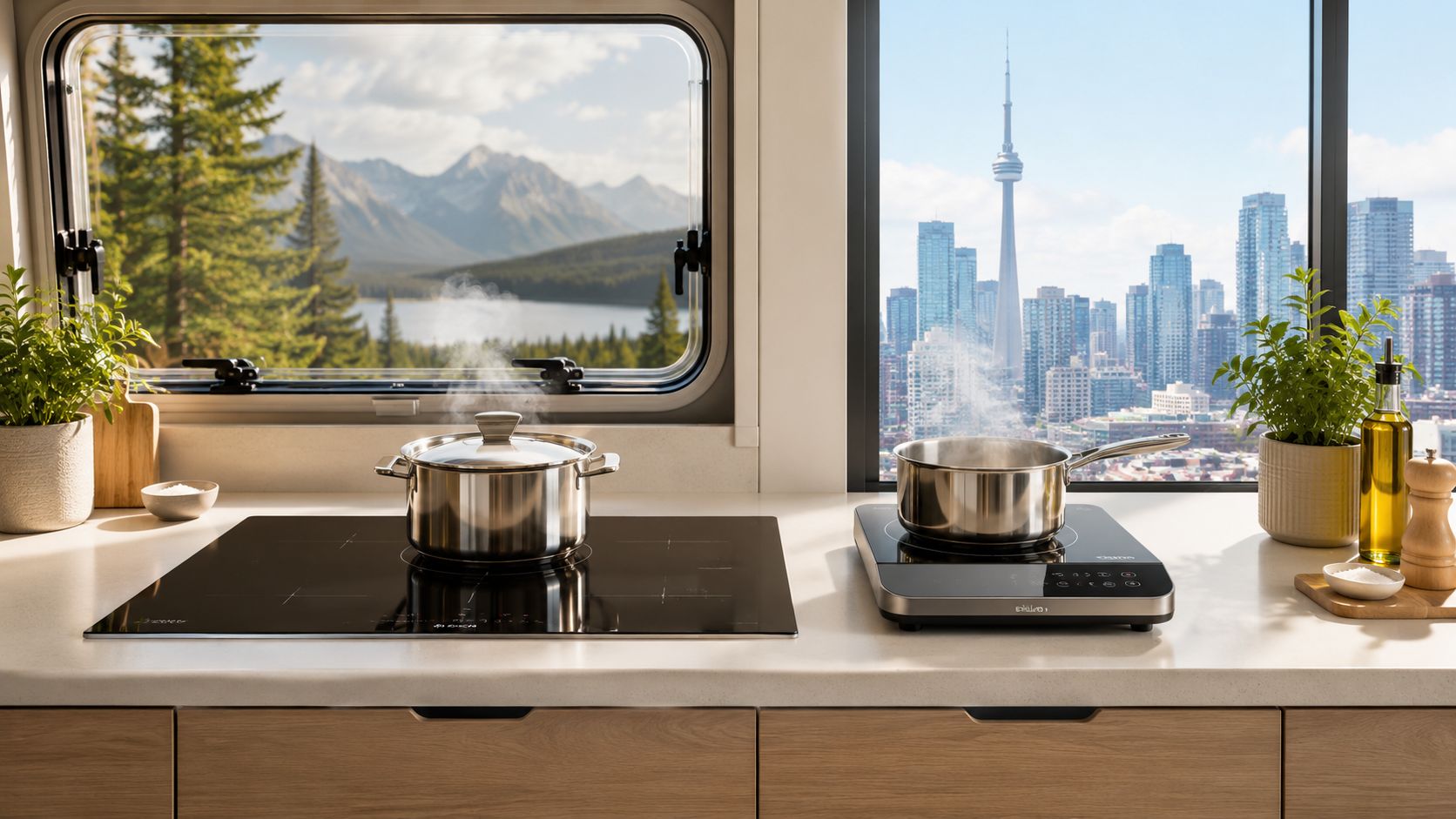
You're probably staring at two tabs right now. One is a sleek built-in induction cooktop that looks like a proper kitchen upgrade. The other is a portable burner that costs far less, plugs into the wall, and promises to solve dinner in a condo, a rental, or a campsite.
That's the fork in the road for Canadian buyers. Not “is induction good?” It is. The better question is whether you need a permanent appliance or a flexible tool you can lift with one hand and stash after pasta night. Most induction cookers reviews blur those two categories together, and that's how people end up buying the wrong thing.
My advice is blunt. Start with fit, wiring, rebate eligibility, and cookware. Performance matters, but those four issues are what stop most purchases cold.
Table of Contents
- Built-In or Portable, Which Decision Comes First
- What Induction Actually Does Differently in Canada
- Built-In Cookers Worth a Look in Canada
- Portable Cookers That Earn a Spot on the Counter
- Rebates, Fit, and Cookware Before You Click Buy
- Head-to-Head, Which Format Wins Which Scenario
- Verdicts for Small Kitchens and Campers
Built-In or Portable, Which Decision Comes First
Start with the constraint that will stop the purchase.
For a built-in, that is usually cutout width and rebate eligibility. For a portable, it is cookware compatibility and whether the unit can hold a low simmer without annoying power cycling. Those are the first two friction points Canadian shoppers hit, and plenty of induction cookers reviews bury them under generic talk about speed and cleanup.
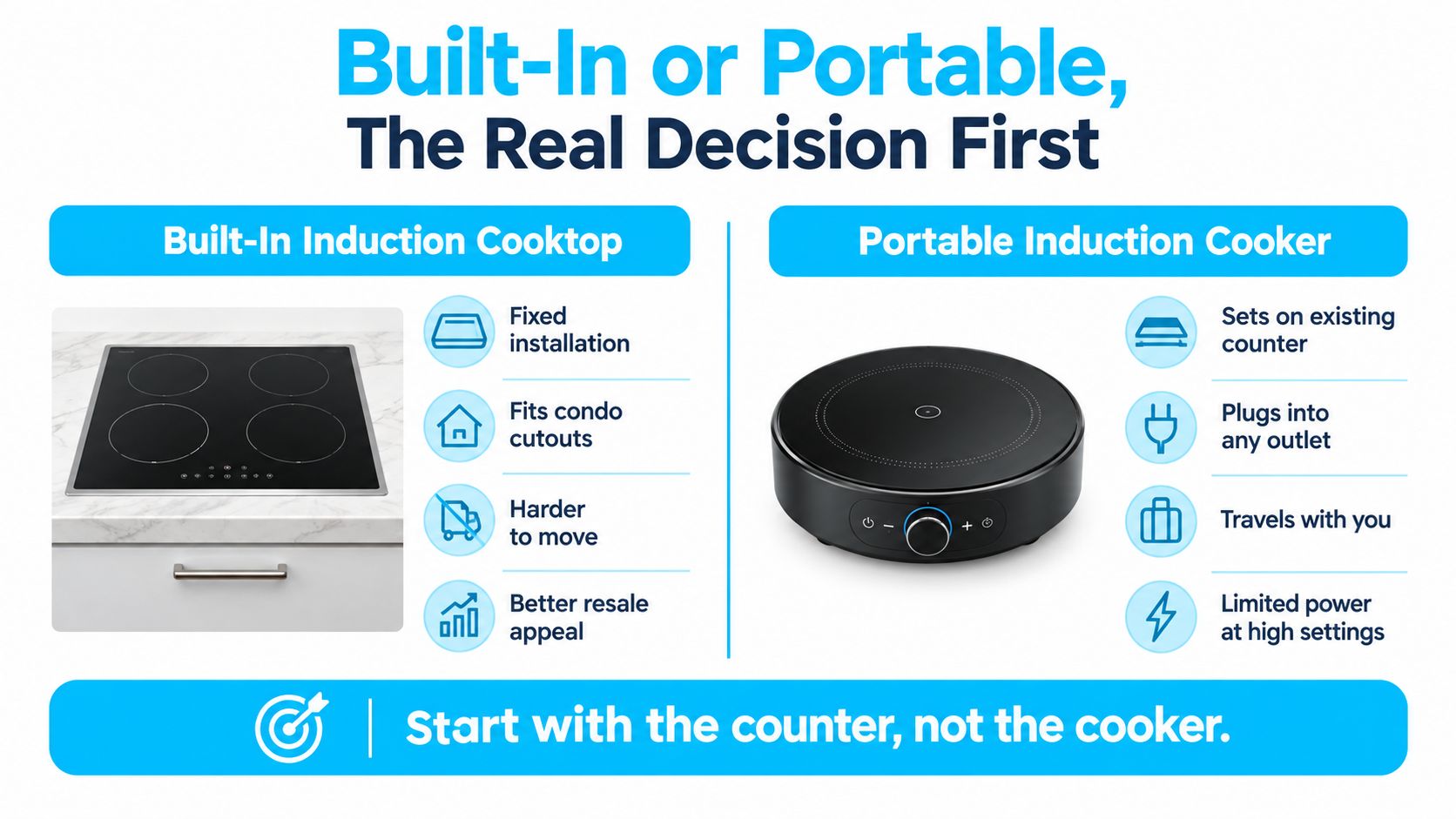
| Format | Typical setup | Main strengths | Main compromises | Best fit |
|---|---|---|---|---|
| Built-in induction cooktop | Replaces an existing cooktop in a cabinet cutout | Better multi-pan cooking, cleaner look, less countertop clutter | Higher total cost, fit and wiring can complicate the job, fixed in place | Owners replacing a main cooktop or planning a kitchen update |
| Portable induction cooker | Sits on the counter and plugs into a standard outlet | Lower buy-in, easy to store, useful in rentals, cottages, and campsites | One pan at a time for many models, less consistent low-heat control, takes counter space while in use | Renters, condo owners, campers, and anyone adding a burner without a renovation |
What built-in actually asks from you
A built-in is the right pick if this will be your main cooking surface and your kitchen can accept it without drama. The key question is not style. It is fit.
Measure the cutout before you shop, then check the model's required width and clearance. A few millimetres can turn a simple swap into countertop work, and that is where the cheap-looking deal disappears. Canadian buyers should also check rebate rules before buying, not after delivery, because some programs care about model eligibility and proof of install.
You do get something worthwhile for the hassle. Better pan spacing. More than one serious cooking zone. A kitchen that feels finished, not improvised.
Why portable still wins plenty of kitchens
Portable induction units make more sense than many people admit.
I have hauled one between a condo, a balcony table, and a campsite. That experience changes how you judge them. You stop caring about glossy marketing and start caring about two things fast. Will your pans work, and can the burner simmer rice, sauce, or chili without cycling so hard that dinner catches?
A portable is the practical choice if you rent, if your current range is mediocre but usable, or if your kitchen only needs one extra strong burner. It also lets you test whether you even like cooking on induction before you commit to a built-in.
Practical rule: Measure first for built-ins. Test cookware and low-heat control first for portables.
What I judge before anything else
I care about these points before peak wattage or preset modes:
- Install width: Built-ins live or die on cutout fit and clearance.
- Rebate eligibility: Check the program and the exact model before you buy.
- Cookware reality: A portable is a bad purchase if your favourite pans do not trigger it properly.
- Simmer precision: Low heat separates decent portables from irritating ones.
- Space trade-off: Built-ins save working room. Portables borrow it, then can be stored away.
Pick the format that clears those hurdles cleanly. Everything else is secondary.
What Induction Actually Does Differently in Canada
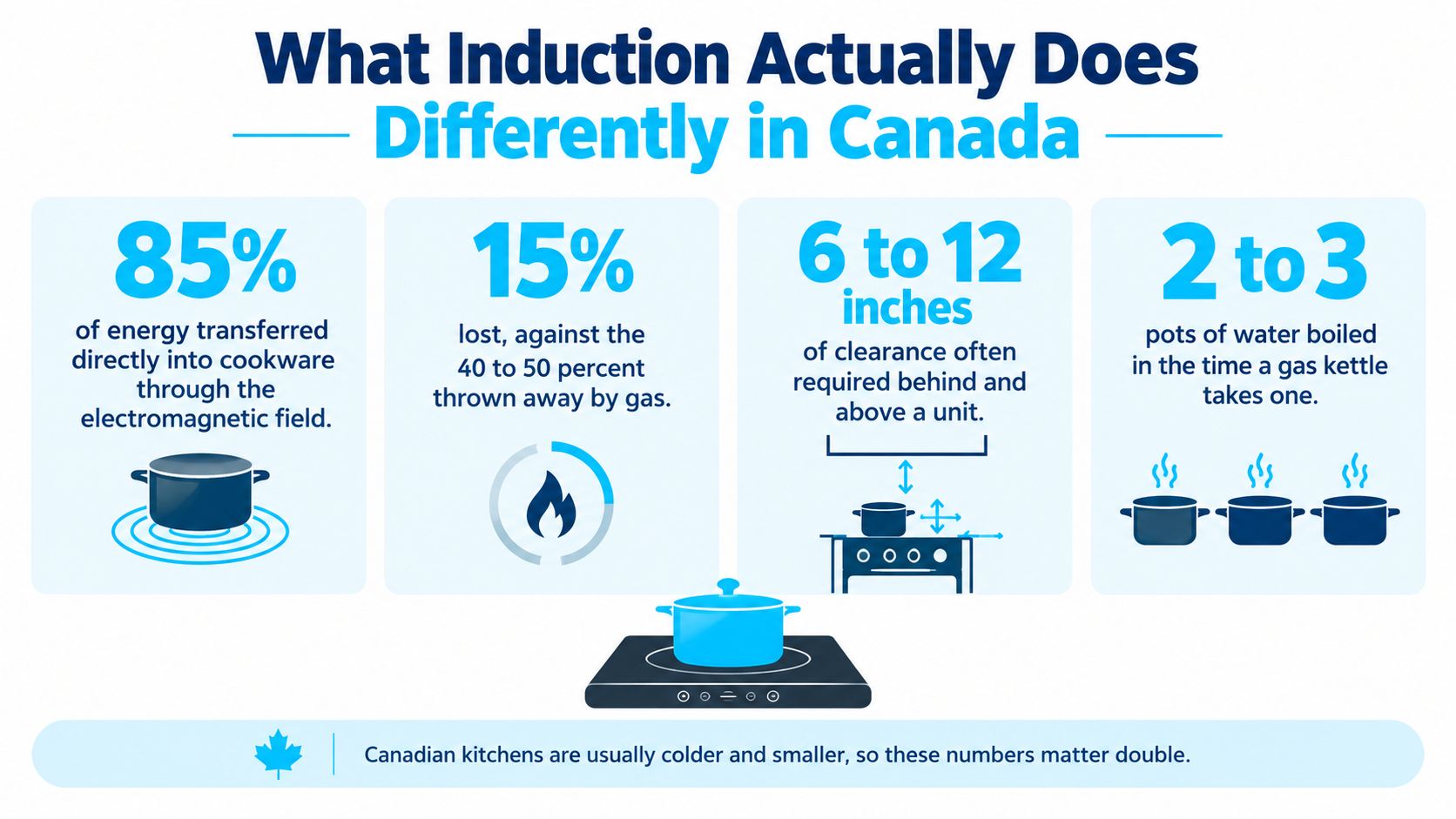
Induction works differently from the first second you turn it on. It heats the cookware directly rather than the surface beneath, which Natural Resources Canada highlights as a reason it's among the most efficient cooking technologies for households that care about speed, control, and cleanup, and NRCan also notes that ENERGY STAR certified electric cooking products are up to 10% more efficient than standard models and that electric smooth-element cooktops including induction are being discussed under a 207 kWh/year maximum Integrated Annual Energy Consumption threshold in Canada (Natural Resources Canada cooking appliance guidance).
Why it feels faster and cleaner
In plain kitchen terms, induction feels sharp. The pan responds quickly when you raise or lower heat. The surface around the pot stays easier to manage than a hot electric element. Cleanup is less of a chore because spills don't bake onto the same kind of scorching surface you get with older resistance tops.
That matters more in Canada than a lot of reviews admit. In a smaller condo kitchen, extra ambient heat is annoying in summer and pointless in tight cooking spaces year-round. Induction keeps more of the action in the pan instead of dumping it into the room.
The efficiency case is already clear
Canada-focused guidance is consistent here. Hydro-Québec says an induction cooking plate uses 15% to 20% less electricity than a resistance plate, and UBC research cited in Canadian coverage found induction can operate around 85% efficiency compared with about 25% to 35% for standard gas ranges. CBC also summarized induction as roughly 85% efficient versus about 32% for gas in the same Canada-focused review context (Reviewed Canada overview of induction cooking in Canada).
That's why induction usually scores well on the things buyers notice. Speed. Control. Less waste heat. Easier cleanup.
Induction isn't magic. It just puts more of the energy where you want it, which is the base of the pan.
The trade-off most people discover late
Not every pot works. Induction needs magnetic cookware. Stainless steel can work. Cast iron usually works. Aluminum and glass won't work unless they're built with a compatible base.
Use the magnet test before you buy the cooker, not after. If a magnet sticks firmly to the base, that pan is in the conversation. If it doesn't, move on.
Built-In Cookers Worth a Look in Canada
You feel the built-in decision the first week you cook on one. Two full-size pans fit without crowding. The surface wipes clean fast. You stop shuffling a portable unit on and off the counter.
For Canadian buyers, built-in induction starts with two boring checks that matter more than showroom features. Rebate eligibility. Install width. Get those wrong and the pretty control panel does not help.
A market outlook from Research and Markets on Canada induction cooktops points to continued growth through the next several years. The useful takeaway is simple. You now have real choice in Canada across 24-inch, 30-inch, and 36-inch models, instead of a tiny premium-only shelf.
Built-In Induction Cooktops Available in Canada
| Brand & Series | CAD Price Tier | Width | Zones | Best For |
|---|---|---|---|---|
| Frigidaire induction cooktops | Entry | 24-inch or 30-inch class | 4 | Buyers replacing an older electric top without chasing premium features |
| Samsung induction cooktops | Entry | 30-inch class | 4 | Shoppers who want modern controls and broad retailer availability |
| Bosch induction cooktops | Entry to mid | 24-inch or 30-inch class | 4 | Households that want a safer long-term brand bet |
| GE Profile | Mid | 30-inch class | 4 | Cooks who care about stronger feature depth without going luxury |
| KitchenAid | Mid | 30-inch or 36-inch class | 4 or more | Families that want a more polished daily-driver cooktop |
| Bosch Benchmark | Premium | 30-inch or 36-inch class | Flexible multi-zone layouts | Buyers who want premium flexibility and are already renovating |
| Miele | Premium | 30-inch or 36-inch class | Flexible multi-zone layouts | Buyers willing to pay for refinement and high-end finish quality |
Entry tier is fine if the cutout already lines up
Frigidaire, Samsung, and the lower Bosch lines make sense for straightforward replacements. If you have a standard opening, ordinary cooking habits, and no interest in bridge zones or fancy presets, this tier does the job.
I would still check pan spacing before buying. Some lower-priced 30-inch tops technically give you four zones, but a large skillet and a stockpot can crowd each other fast. On paper that looks normal. In a real condo kitchen, it gets annoying.
Mid-tier is where built-in induction starts paying you back
GE Profile, KitchenAid, and stronger Bosch models are the safer recommendation for daily cooks. You usually get better zone layout, better control response, and fewer irritating compromises with larger cookware.
That matters more than flashy feature lists. A cooktop that fits your 12-inch frying pan properly and lets you hold a steady lower setting is worth more than one extra specialty mode you will never use.
My take: A mid-tier 30-inch built-in is the smart buy for a lot of Canadian homes. It is the point where induction feels settled and capable, not like a spec-sheet upgrade.
Premium only makes sense if the kitchen around it matches
Bosch Benchmark and Miele are good products. They are not automatic value.
Buy in this tier if you are already renovating, moving to a 36-inch layout, or you know you will use the flexible multi-zone setup. If you are swapping out a tired electric cooktop in an otherwise ordinary kitchen, premium money is easy to waste here.
What to verify before you buy
Check these before you compare boost modes or touch sliders:
- Actual cutout size: A 30-inch cooktop is not a universal fit. Measure the existing opening and compare the manufacturer cutout spec, not just the stated width.
- Rebate rules in your province or utility area: Some programs care about product category, Energy Star status, installer paperwork, or proof that you replaced electric or gas with induction. Confirm eligibility before checkout.
- Electrical setup: Built-ins need the right circuit and amperage. If an electrician has to upgrade the line, your bargain price disappears quickly.
- Control usability: Flat touch controls look sharp. Some are fussy with wet hands or quick adjustments.
- Service coverage where you live: Parts and service access matter more in Halifax, Regina, or Kelowna than they do in a big GTA showroom.
The one trade-off buyers surface late is fit, not cooking performance. Width class, cutout dimensions, and clearance rules decide whether the install is easy or a headache.
My recommendation is direct. If you own the place and cook often, buy a mid-tier 30-inch built-in from a brand with solid service coverage in Canada. Drop to entry tier only if the existing opening matches cleanly and the price gap is meaningful. Step up to premium for a remodel, not for bragging rights.
Portable Cookers That Earn a Spot on the Counter
Portable induction cookers deserve their own standard. Don't judge them by built-in rules. Judge them by whether they hold a low simmer, heat evenly enough to avoid a nasty centre hot spot, and fit your actual living setup.
That's where most cheap units get exposed.
Portable Induction Cookers Available in Canada Compared
| Model | Wattage | CAD Price Range | Burners | Simmer Verdict |
|---|---|---|---|---|
| Salton portable induction cookers | Standard portable class | Entry | Single | Fine for boiling and frying, less convincing for delicate sauces |
| Master Chef portable induction cookers | Standard portable class | Entry | Single | Good budget utility, watch for lower-end control pulsing |
| T-fal portable induction cookers | Standard portable class | Mid | Single | Better everyday kitchen use than bargain-bin units |
| Duxtop portable induction cookers | Standard portable class | Mid | Single | Strong all-rounder reputation for condo kitchens |
| Cuisinart portable induction cookers | Standard portable class | Mid to upper-mid | Single | Better fit for regular indoor use than rough travel duty |
| Dual-burner portables from major marketplace brands | Higher portable class | Upper-mid | Dual | Better for families, but only if the low-end control is stable |
Single burners are the honest buy for most people
A single-burner portable is still the right first purchase for renters, students, and cottage users. It takes up less room, stores more easily, and asks less from your counter. For overflow cooking, hot pot, or a backup burner during holidays, it's hard to beat.
The issue is control quality. Some units advertise settings that sound precise, but in daily use they cycle aggressively on low power. That's fine for boiling potatoes. It's lousy for beurre blanc.
Consumer guidance also notes that induction works only with magnetic cookware such as stainless steel or cast iron, while aluminum and glass will not work. In the same review context, a Canada-reviewed portable cooktop user report complained that power was controlled only by heat levels, not exact temperature, and that the unit had noticeable hot spots (Consumer Reports induction cooktop guidance).
That complaint is dead on. It's one of the first things I look for in portable-focused induction cookers reviews.
Dual burners look better than they cook
Dual-burner portables are tempting. Two pots at once sounds like the answer. Sometimes it is. But these units are wider, harder to store, and often feel like compromise appliances rather than elegant solutions.
If your kitchen is small, a bulky dual unit can become permanent clutter. If you really need two active burners every day, that's usually a sign you should be looking at a built-in instead.
My portable ranking by use case
Here's the blunt version.
- Best for true simmer work: A mid-range single-burner from a brand with a reputation for steadier low-end control. I'd look at Duxtop or Cuisinart first.
- Best for travel: A lighter single-burner unit with a simple glass top and straightforward controls. Salton-type units make more sense here than heavier premium-looking portables.
- Best for small kitchens: A compact single burner you won't resent leaving out for a week. T-fal and Duxtop-style units fit this role better than oversized duals.
The wrong portable doesn't fail at boiling water. It fails when you try to simmer soup, melt chocolate, or hold a sauce without babysitting it.
If you only need occasional extra capacity, buy a single burner. If you need precision daily, spend above the absolute bottom tier. Cheap portable induction works. Cheap portable induction with good simmer control is harder to find.
Rebates, Fit, and Cookware Before You Click Buy
Buyers save themselves grief. Not at the product page. Not in the checkout cart. Before that.
Rebate eligibility can change the shortlist fast
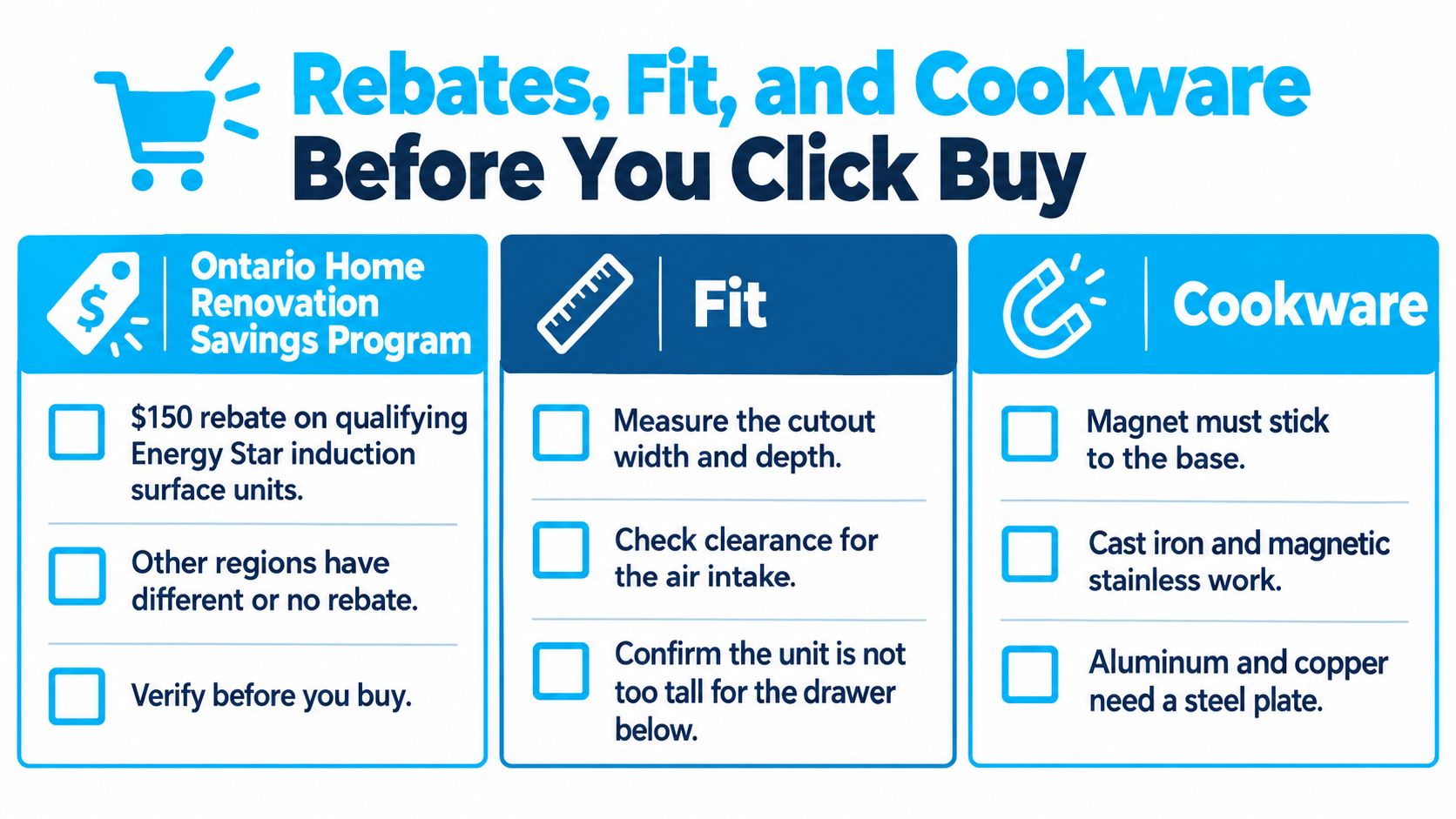
Ontario's Home Renovation Savings program offers up to $150 for an induction cooktop or range, but the appliance has to meet eligibility rules, and some incentive materials specify a minimum 30-inch surface width for qualifying induction cooktops (Ontario rebate update and eligibility notes).
That one detail knocks out a lot of assumptions. A compact built-in that looks perfect on paper may not qualify. A model with the wrong certification trail may not qualify either.
If you're shopping beyond Ontario, don't assume the same rebate exists. Some regions have different programs. Some have none. Verify first.
Fit matters more than brand loyalty
The next friction point is physical fit. Built-ins live or die by measurements. Your current opening, surrounding counter space, drawer clearance below, and electrical setup all matter more than a glossy product photo.
Use this quick check:
- Measure the cutout: Width and depth both matter.
- Confirm the surface size: If you're shopping with rebates in mind, the width requirement matters.
- Check installation conditions: Clearance and electrical readiness can make or break the job.
For broader kitchen planning around appliance shopping, Celmin's guide to best kitchen appliances for Canadian homes is a practical companion if you're comparing a cooktop purchase against other kitchen upgrades.
Cookware is the quiet budget trap
A lot of first-time induction buyers think the appliance is the whole purchase. It isn't. Your pans are part of the decision.
Cast iron and magnetic stainless steel are usually the safest bets. All-aluminum and copper won't work unless they're built for induction compatibility. If you're unsure, use a fridge magnet. If it sticks well to the base, that piece is worth trying.
Don't lose a rebate because you skipped one PDF, and don't buy induction with a pan set that won't heat.
Pre-checkout list
Run through this before you hit buy:
- Rebate check: Confirm that the exact appliance class and model fit current program rules.
- Width check: Measure the opening, not the old brochure.
- Power check: Make sure your kitchen can support the appliance you chose.
- Magnet check: Test the cookware you already own.
- Paperwork check: Save model details and purchase records for any incentive claim.
Head-to-Head, Which Format Wins Which Scenario
There isn't one universal winner. There's a right answer for the kitchen in front of you.
Built-In Versus Portable Induction, Scenario Scorecard
| Criteria | Built-In | Portable | Winner by Scenario |
|---|---|---|---|
| CAD price band | Higher commitment | Lower entry cost | Portable for budget-first buyers |
| Footprint | Frees up counter once installed | Uses live counter space | Built-in for tight everyday kitchens |
| Simmer control precision | Usually better and more stable | Varies a lot by model | Built-in for frequent cooking |
| Cookware compatibility | Same induction rules apply | Same induction rules apply | Tie |
| Setup effort | Requires planning and installation | Plug in and cook | Portable for renters and casual users |
| Multi-pan workflow | Strong | Limited, especially with single burners | Built-in for families |
| Mobility | Fixed in place | Easy to move | Portable for campers, cottages, rentals |
When built-in wins
If you cook most nights, use multiple pots, and want a cleaner counter, built-in wins. It feels better to use because it is better aligned with how a real kitchen works. You're not shifting a burner around, managing its cord, or giving up prep space.
It also makes more sense for homeowners replacing an old main cooktop. If your kitchen already supports the install and the model fits your rebate path, the decision gets easier.
When portable wins
Portable wins when flexibility beats polish. That's the case for renters, small apartments, occasional overflow cooking, cottages, and camping setups. You can bring it out only when you need it.
It's also the smart move if you're not ready to commit to a renovation-level purchase. A good portable lets you live with induction before you start thinking about a permanent change.
For readers weighing compact appliance choices more broadly, Celmin's take on which smart kitchen appliances are worth it is useful because it frames the same question every condo buyer asks. What deserves permanent space?
My honest scorecard
A Toronto condo owner who wants to avoid renovation headaches may be happier with a quality portable and a tidy storage plan. An Ottawa family replacing an old cooktop in a freehold home should lean built-in and not overthink it.
Buy the format that matches your kitchen's limits. Specs don't cook dinner. Layout does.
Verdicts for Small Kitchens and Campers
For small kitchens, my pick is a 30-inch built-in induction cooktop that clears the Ontario rebate check and drops into an existing opening without cabinet surgery. Yes, it costs more. I'd still take that trade if the kitchen is your main cooking space. Cleaner counters, better daily flow, and no portable unit hogging prep room.
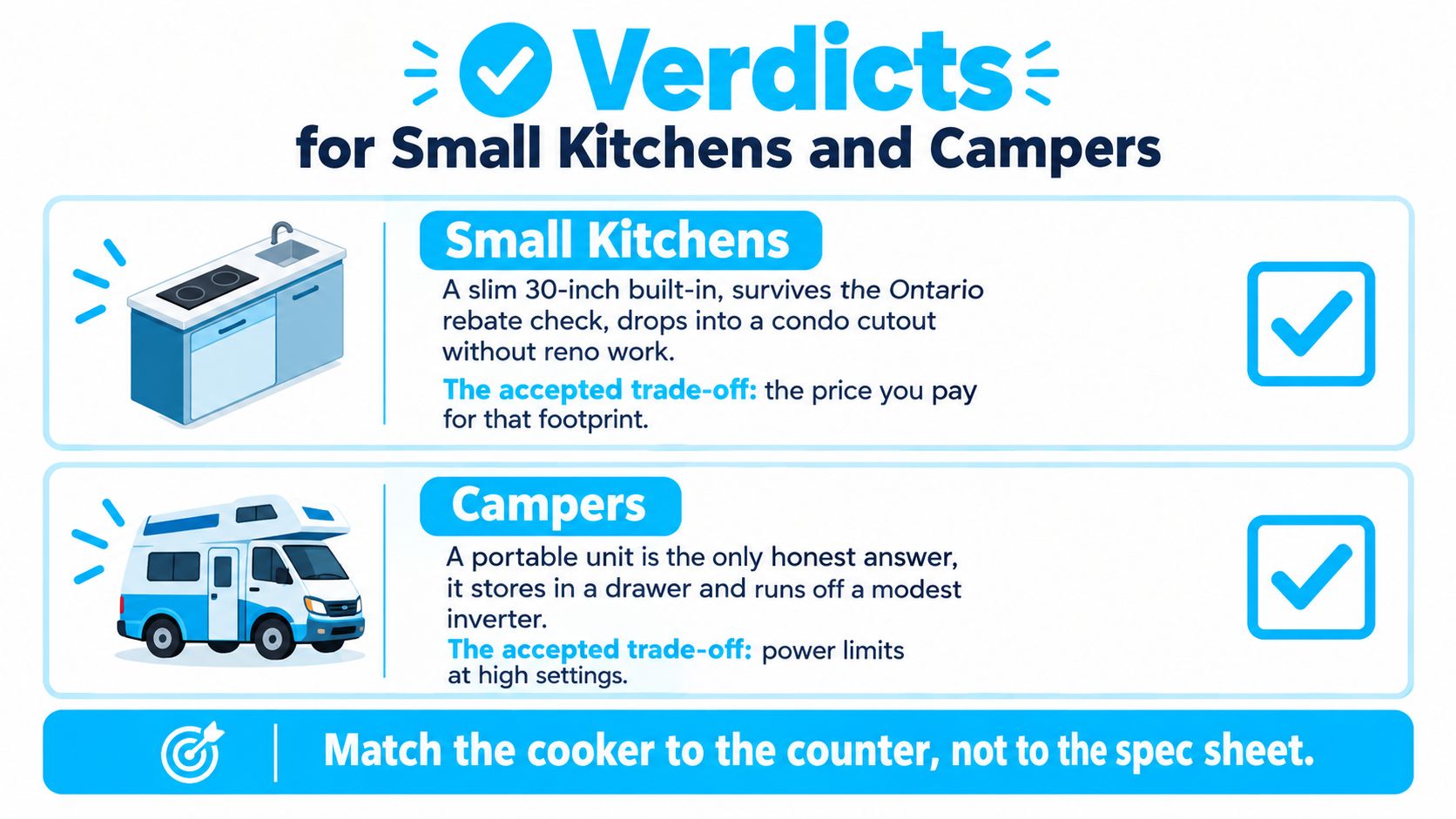
For campers and road-trippers, the answer is simpler. Buy a single-burner portable induction cooker with dependable low-end control, not the cheapest unit you can find and not a bulky dual burner that's awkward to store. If it can hold a sauce without ugly cycling and still pack away easily, it's the right travel pick.
A lot of buyers in tight homes are solving the same space problem across multiple categories, which is why Celmin's guide to kitchen appliances for small spaces fits naturally into this decision.
Here's a quick visual if you want one more pass before buying.
My final checklist is short.
- Confirm rebate class: Check the exact program rules before checkout.
- Measure properly: Go by the cutout, not by guesswork.
- Test your cookware: Use a magnet and be ruthless.
- Think about movement: If you say you'll travel with it, make sure you'll want to lift and pack it.
If you want the cleanest everyday setup, go built-in. If you want flexibility and low hassle, go portable. Those are the honest verdicts.
Celmin publishes Canada-first appliance guides that focus on the annoying details shoppers usually have to dig up themselves, including local availability, fit questions, and practical trade-offs. If you're comparing induction cookers reviews with other kitchen upgrades or trying to build a smarter small-space setup, visit Celmin for more Canadian buying guides in the same plain-spoken style.
Discussion
Sign up or sign in to join the conversation.