
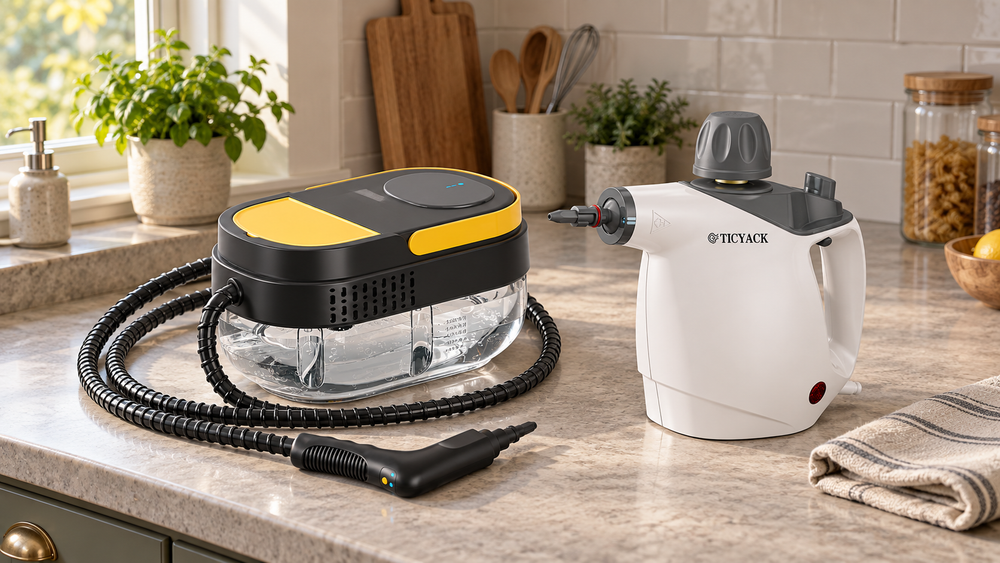
Compare Gautye G1’s tank-and-hose format with the TICYACK EM-316 handheld steamer by handling, capacity, reach and surface compatibility.
The Gautye G1 keeps a larger tank on a surface and sends steam through a hose. The TICYACK EM-316 puts a smaller tank in the handheld body. Choose the handling arrangement before comparing temperature claims.
If you move between several reachable areas, a stationary tank can save carrying the water in your working hand. For a brief, localized task, a handheld body may be simpler to position. Both still need a power cord and surfaces that permit steam cleaning.
| Specification | Gautye G1 | TICYACK EM-316 |
|---|---|---|
| Format | Tank body with hose | Handheld body |
| Advertised tank capacity | 1.6 L | 500 mL |
| Advertised warm-up | About 15 seconds | About 3–5 minutes |
| Advertised accessories | 15 pieces | 16 pieces |
| Reach detail to check | Hose and cord lengths separately | Cord advertised at 9.8 ft / about 3 m |
A brush that reaches a gap does not prove steam is safe
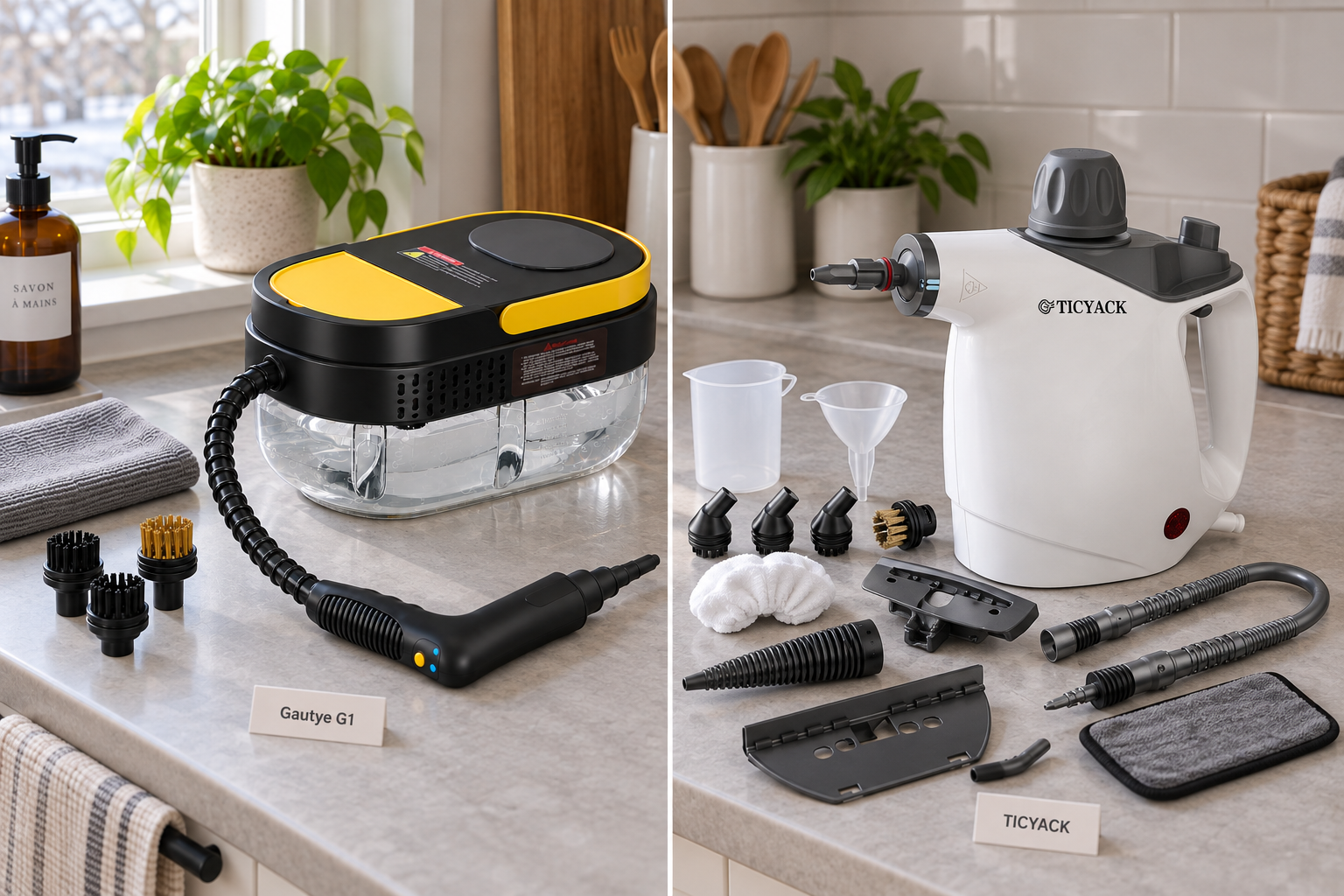
Gautye G1 steam cleaner
 Shop at Amazon.ca
TICYACK EM-316 handheld steamer
Shop at Amazon.caCompare the cleaning route, not just the machine
The Gautye's separate tank is relevant when you can place it securely and reach several small areas with the hose. You move the working tool while the water stays in the body. That arrangement needs floor or surface space and a clear route for both the hose and power cord.
The TICYACK carries its water in the handheld unit. For a brief task, that may mean fewer separate pieces to position. For repeated reaching, the filled weight and working angle become more important. Check the manual for permitted orientation rather than assuming a handheld shape can be tilted any way you like.
Walk through the intended job before choosing. Where would you set the G1 down? Would the EM-316 be held at waist height or extended away from your body? Where would a hot attachment rest during a pause? These questions expose handling differences that a tank-capacity comparison misses.
Three situations that clarify the choice
Several nearby detail-cleaning areas
If all the surfaces permit steam and lie within comfortable reach of a stable tank position, the Gautye's hose format is worth investigating. The larger capacity is relevant to a session involving several areas, although output setting and technique still determine how often water is needed.
Avoid mapping an entire room from an advertised reach radius. Confirm the separate hose and cord lengths and allow for their actual route around furniture or fixtures. A cable stretched tight across a work area is not useful reach.
A short, localized task
The TICYACK's handheld body may suit a small job where its filled weight and cord are manageable. Its advertised warm-up is longer, so include that wait and the subsequent cooldown when deciding whether taking it out is worthwhile.
The smaller tank is a handling characteristic, not automatically a drawback. If a task is short, unused capacity in a larger machine adds little. Conversely, do not buy the handheld purely for its compact appearance if you expect long periods of extended-arm work.
Upholstery that needs moisture extraction
Neither product supplies a dirty-water recovery function. If the job depends on drawing liquid back out of fabric, the difference between these two steam formats does not resolve the need. Check the furniture's care instructions and choose an appropriate method for that material.
Think about where the weight sits
With Gautye, the tank body needs a stable place within hose reach. Do not plan to pull it along by the hose or balance it on a narrow ledge. Its advertised four-metre reach is not proof of a four-metre hose.
With TICYACK, you hold the body and its water while working. A smaller tank does not automatically mean easier handling overhead or at an awkward angle. Check the filled operating weight and the permitted orientation before buying.
Try to picture the actual movement: reaching behind a fixture, moving along a short seam or changing position between areas. That tells you which format is likely to be less awkward.
Budget time for the whole session
Setup includes more than filling a tank. You need to select a permitted surface and attachment, clear the work area, arrange the cord and prepare a way to collect loosened dirt. Both machines also need safe handling after steam stops; warm-up speed is not a guide to cooldown or pressure release.
A larger tank may reduce interruptions, but it does not make an extended session automatically practical. You may need to reposition the equipment, change cloths or pause to assess a finish. The useful question is how the cleaner fits the sequence of jobs, not whether the largest number wins.
For the TICYACK, confirm the maximum permitted fill and refilling procedure in the manual. Do not assume the advertised tank volume is an instruction to fill to the brim. For the Gautye, confirm the corresponding filling and shutdown directions. Procedures for one steamer should not be transferred to the other.
Accessory quality and replacement availability
A one-piece difference between the advertised kits is unlikely to decide the purchase. Find the exact tool you would use on each approved surface, then check its material and method of attachment. A stiff brush may be inappropriate even when the surface tolerates steam.
Look beyond the first box of accessories. Brushes and cloths can need replacement, so ask what is available for the exact model. A generic fitting that appears similar is not proof of compatibility with hot, pressurised equipment.
Store small fittings together and keep each machine's instructions with its model information. A clear maintenance procedure, available wear parts and responsive support can matter more after several months than an unused attachment included at purchase.
Water-only cleaning still needs care
Neither product should be treated as harmless because it uses steam. Hot nozzles, recently used attachments and released steam can injure someone. Plan the working area so children and pets cannot approach it, and follow the manufacturer's directions for pauses and tool changes.
Do not add cleaning chemicals or a homemade descaling mixture unless the model's instructions expressly permit them. Water requirements and maintenance methods vary. A suggestion that works for an unrelated appliance is not a substitute for these cleaners' directions.
The surface remains the final authority. Finish, adhesive and joint construction matter alongside the visible material. When the care instructions prohibit steam, neither cleaner is the better choice for that surface, regardless of accessory count or temperature claims.
Tank size and heat-up are different questions
A larger tank can reduce refilling, but useful working time also depends on steam output. TICYACK advertises more than 15 minutes; the selected setting and usage pattern determine how useful that figure is for a session.
Fast warm-up does not establish better cleaning. Neither a temperature nor pressure figure alone proves that a surface has been disinfected. Use the permitted method for the material rather than treating hotter steam as a universal improvement.
Read the shutdown, cooling and refilling instructions before use. TICYACK’s trigger-lock feature is not permission to leave a hot steamer operating unattended. Never treat the advertised warm-up time as the safe time to open a hot tank.
Questions that help settle the purchase
Is Gautye's faster warm-up a reason to choose it?
It is relevant if short waiting time matters to your routine, but it does not establish better cleaning or a shorter overall session. Include placement, wiping residue, safe cooldown and storage in the comparison.
Is the TICYACK easier to hold because it is smaller?
Not necessarily for every task. You carry the body and water in your working hand. Check the filled weight and intended orientation, especially for reaching. The Gautye shifts more of that load to a stationary body but introduces a hose to manage.
Will either sanitize everything it touches?
Do not infer that from a temperature claim. Effective disinfection depends on a suitable validated process and conditions at the surface. Visible steam and a cleaner-looking finish are not evidence of a particular sanitizing result.
What if the prices are close?
Prioritise the handling format that suits your approved tasks, then compare exact bundle contents, manual clarity, electrical certification, replacement accessories and return terms. The Gautye offers the more relevant format for a stable tank and hose routine; the TICYACK offers a handheld arrangement for manageable localized work. That is a meaningful difference you can evaluate before purchase.
The surface can rule out both
Check the care instructions for the material you intend to clean, including finishes, joints and adhesives. Some flooring manufacturers prohibit steam; Shaw’s guidance is an example. Other products need their own manufacturer’s instructions.
A suitable-looking brush does not settle surface compatibility. Choose the attachment only after establishing that steam is allowed, and follow the prescribed test and cleaning method.
Neither machine extracts the loosened dirt into a recovery tank. Plan to wipe residue away with an appropriate cloth. If your intended job depends on pulling dirty liquid out of upholstery, these steamers do not provide that function.
Gautye is the format to investigate for a larger stationary tank and hose work. TICYACK is the format to investigate for a smaller handheld setup. Clear instructions, comfortable handling and compatible surfaces matter more than a one-piece difference in the accessory count.
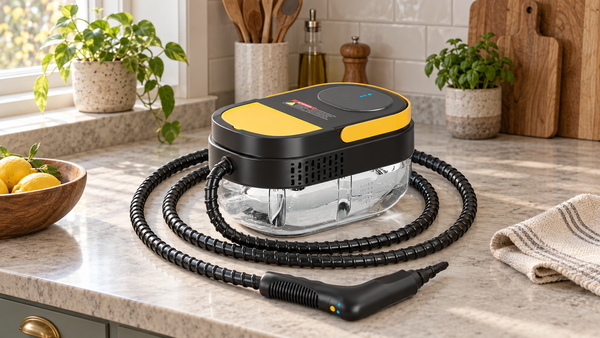
Gautye G1 steam cleaner
Shop at Amazon.caTICYACK EM-316 handheld steamer
Shop at Amazon.caImages are AI-generated illustrations based on product references.
Sign up or sign in to join the conversation.