
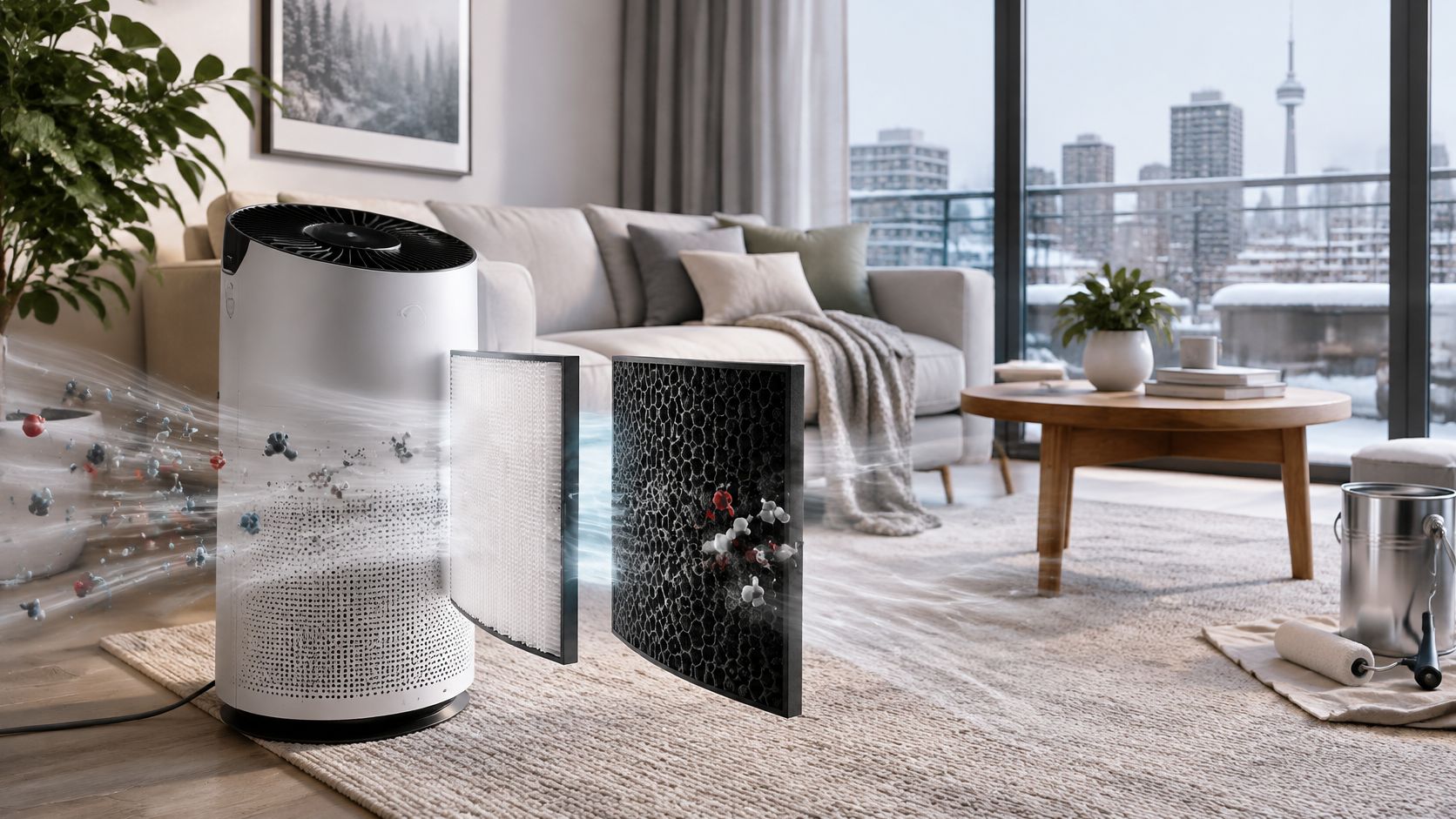
The advice to buy a HEPA purifier with a carbon filter sounds reassuring, but it leaves out the most important question: will that particular filter remove the gas in your home? HEPA and activated carbon do different jobs, and neither makes a purifier a universal solution for volatile organic compounds, or VOCs. For Canadian households, a sensible decision starts with the source, the available evidence, and what the filter can actually hold.
Table of Contents
- Why Air Purifier VOCs Claims Mislead Shoppers
- What VOCs Look Like in Canadian Homes
- Health Effects and Everyday Indoor Sources
- Filters That Remove VOCs and What They Miss
- Features That Can Make Indoor Air Worse
- Measuring VOCs and Setting Up a Canadian Home
- How to Choose a Purifier and What to Do Next
Why Air Purifier VOCs Claims Mislead Shoppers
Consider a Canadian condo in winter. The windows are shut to conserve heat, a newly delivered sofa sits beside the wall, and a HEPA purifier is running nearby. A sharp smell remains, even though the machine appears to be working normally.
That's an illustrative situation, not a product failure report. The mistake is assuming that a purifier designed to catch airborne particles must also remove gases released by furnishings or household products.
Catching particles isn't the same as holding gases
Think of particle filtration as a sieve. Dust stays in the mesh, while solvent vapour passes through. The analogy simplifies the mechanics, but it captures the buying problem: a filter can perform its intended job without addressing the pollutant you're concerned about.
A product box might advertise HEPA filtration, odour control, and cleaner air together. Those statements shouldn't be treated as interchangeable evidence. A particle-filter specification tells you about particle capture, not automatically about VOC removal.
When evaluating air purifier VOCs claims, separate these questions:
- What needs removing? Dust and a suspected furniture-related gas call for different evidence.
- What treats the gas? Look beyond the HEPA label for a clearly described adsorbent medium.
- What did the manufacturer test? A broad VOC claim is less useful than results naming the chemical and operating conditions.
- What changed in the room? A less noticeable smell doesn't establish how much of a particular pollutant remains.
A better starting point than shopping
In the condo example, the useful first question is what changed when the smell began. Was it the sofa delivery, paint touch-ups, or a recently used cleaner? Naming the likely source helps avoid buying a device for the wrong job.
Practical rule: Identify the likely pollutant, reduce its source, consider ventilation, and only then assess whether a suitable gas filter can help.
A renter may not be able to replace cabinetry or change the building's ventilation. That doesn't make a purifier pointless. It makes honest limits more important: the device should address a remaining problem, not distract from a source that can be removed.
What VOCs Look Like in Canadian Homes
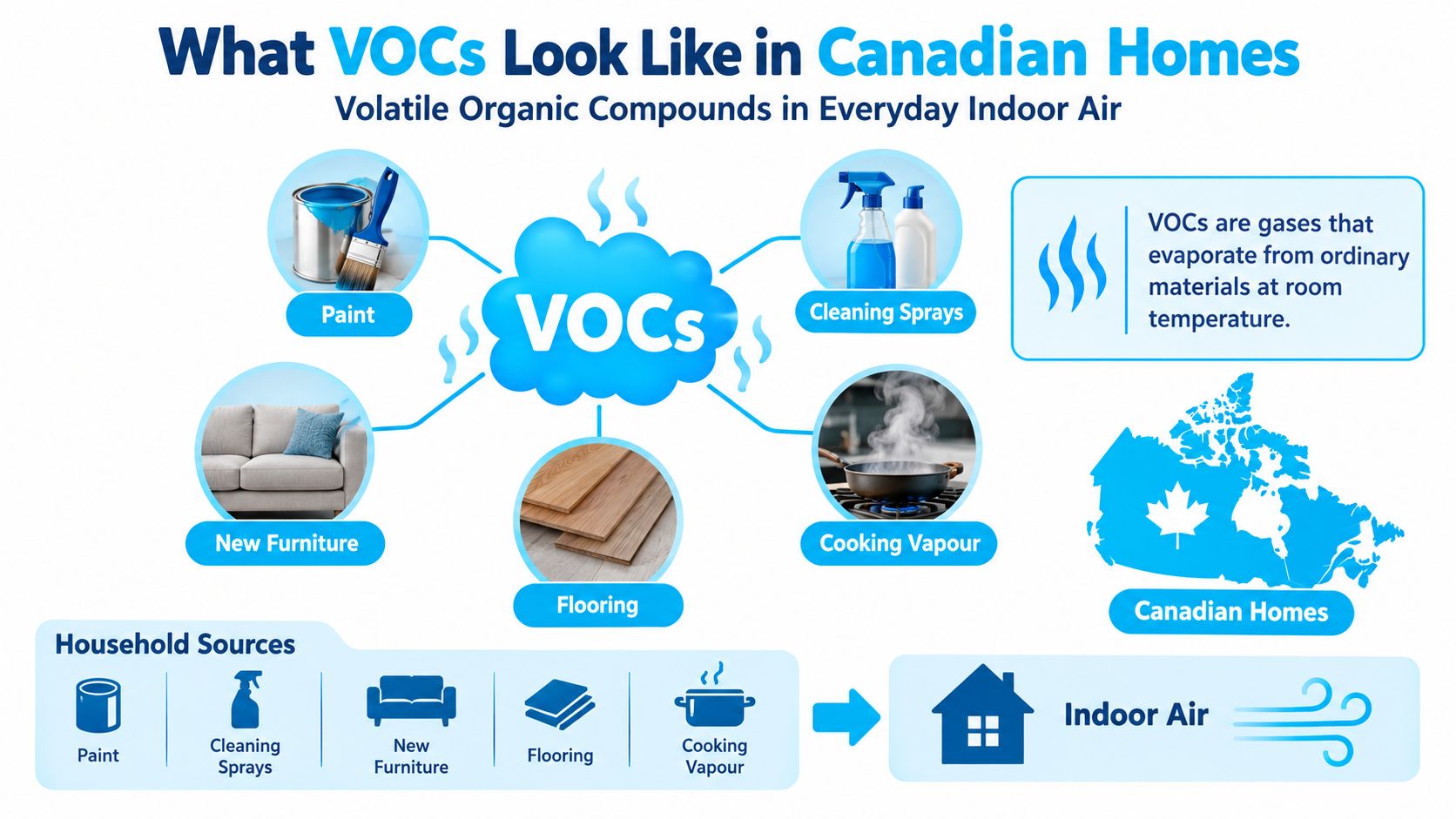
Volatile organic compounds are gases that evaporate from ordinary materials at room temperature. Paint thinner provides an obvious mental picture, but unfamiliar smells around a new mattress or scented cleaner can prompt the same practical question: what's entering the room air?
This household-source map helps connect everyday materials with the air around them.
What Canadian household measurements show
Statistics Canada's Canadian Health Measures Survey measured 88 VOCs in residential air from a representative sample of Canadian households with respondents aged 3 to 79; in 2014–2015, national average concentrations were 6.5 μg/m³ for toluene, 1.1 for benzene, 3.3 for m-/p-xylene, 1.1 for o-xylene, and 0.99 for ethylbenzene, with the toluene average far below Health Canada's chronic indoor guideline of 2,300 μg/m³, according to the Canadian household VOC survey results.
The unit μg/m³ means micrograms of a substance in a cubic metre of air. It describes concentration, not the total amount released by a product or the amount a purifier can remove.
The important lesson isn't that every home is safe, or that every detected chemical requires treatment. Measurable doesn't automatically mean dangerous. The reported national averages were generally below Health Canada guideline values, which makes blanket warnings about all Canadian homes a poor basis for shopping.
What the numbers don't tell you
A national average isn't a measurement of your bedroom. It also isn't a purifier test, so it can't tell you whether a particular machine will reduce a particular gas.
Keep these distinctions clear when reading product claims:
- Household measurements describe what researchers found in residential air.
- Health guidelines provide pollutant-specific context for interpreting concentrations.
- Product tests need to demonstrate what a device removes under stated conditions.
For VOC reduction, an adsorbent such as activated carbon is generally the relevant filter medium. Its quantity and condition matter, so the presence of carbon on a specification sheet isn't enough to predict useful performance.
Canadian household measurements offer a grounded starting point: VOCs are present, but the reason to intervene should come from the home's circumstances, not an assumption that detection alone proves danger.
Health Effects and Everyday Indoor Sources
A typical national result can coexist with a home that needs attention. A renter using a strong cleaner in a closed room faces a different situation from someone who hasn't introduced an obvious source. The useful question is what's active in this home, not whether VOCs are always an emergency.
The relationship between sources and ventilation is easier to follow when shown together.
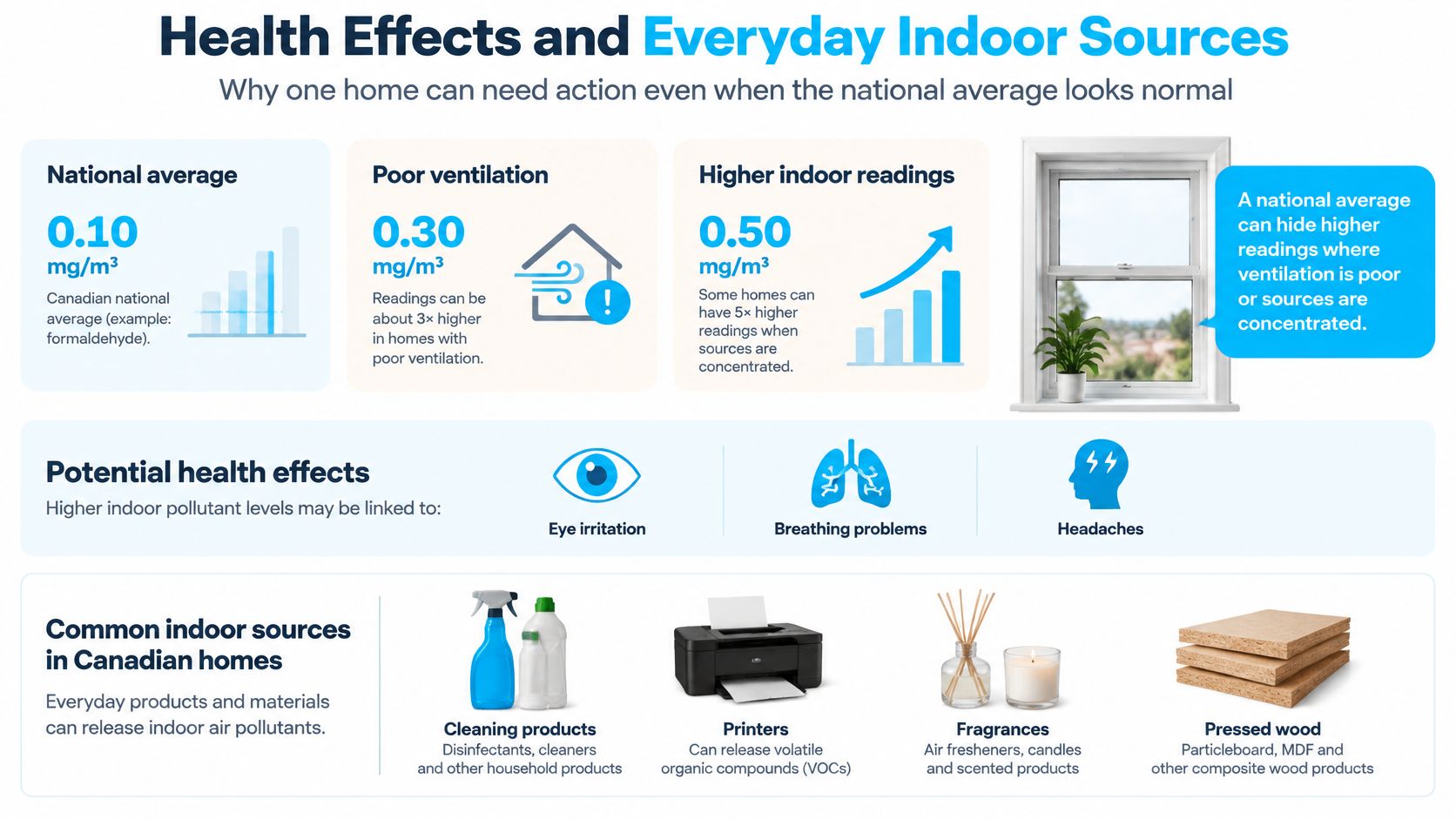
Why one home can differ from another
Health Canada's regional research found median indoor benzene concentrations ranging from 0.4 to 2.2 μg/m³, with 95th-percentile concentrations from 2.4 to 18.6 μg/m³, across studies in Edmonton, Halifax, Regina, Windsor, Ottawa, and Montreal; its Halifax investigation also examined ordinary non-smoking homes across winter and summer, as documented in the Canadian residential VOC study collection.
Those higher-end readings explain why averages shouldn't dismiss a household concern. Limited ventilation and indoor sources deserve investigation even when national measurements look reassuring.
“VOCs” is a category, not a diagnosis. Questions about irritation or longer-term health concerns need the identity of the chemical, its concentration, and the exposure circumstances. Don't use an odour, a purifier display, or this category name alone to decide what's causing symptoms; persistent symptoms warrant medical advice.
Look for the source before choosing the treatment
Household products, including air fresheners and cleaning products, are recognised VOC sources. Furnishings, composite wood, paints, and personal-care products also belong on a practical source inventory. Their presence is a reason to investigate, not proof that a specific item is creating an unsafe concentration.
Start with manageable changes:
- Remove avoidable releases. Stop using an air freshener or unnecessary scented cleaner rather than trying to filter around it.
- Review recent changes. Note furniture deliveries, decorating work, and products introduced around the time the concern began.
- Improve air exchange when appropriate. Consider outdoor conditions, weather, and building arrangements before opening windows.
- Escalate building-related concerns. Ask the landlord or property manager about sources you can't remove yourself.
A broader indoor air-quality improvement plan can help organise those actions. Substantial activated carbon may supplement them when a source can't be removed, but it shouldn't become permission to leave an avoidable source operating.
Filters That Remove VOCs and What They Miss
A useful purifier comparison starts with the pollutant, not the longest feature list. HEPA, activated carbon, reactive treatment, and a VOC sensor aren't competing versions of the same component. They have different roles, and some don't remove anything at all.
What Each Air Purifier Technology Does for VOCs
| Technology | Best matched job | What shoppers must verify | Main limit |
|---|---|---|---|
| HEPA | Capturing airborne particles | Whether a separate gas-treatment medium is included | HEPA alone isn't VOC filtration |
| Activated carbon | Adsorbing suitable gases | Carbon mass, bed design, replacement cost, airflow, and pollutant-specific test conditions | Performance depends on the compound and condition of the medium |
| Photocatalytic or other reactive treatment | A claimed chemical-treatment process | Tested removal of the named gas and documentation of by-products | A reaction claim doesn't establish safe removal |
| VOC sensor | Providing an indicator for investigation | What it measures and how the reading should be interpreted | It isn't a filter or proof of exposure reduction |
If dust is also a concern, a guide to HEPA-filter air purifiers can help distinguish the particle job from the gas-treatment job. Don't judge both using the same specification.
Carbon has pollutant-specific limits
Health Canada says carbon or other adsorbent filters may help remove gases, but there's no widely used performance-rating system for gas-removal filters; the evidence discussed in its guidance also distinguishes stronger activated-carbon performance for heavier compounds such as ethylbenzene and n-decane from poorer performance for lighter, more volatile compounds such as formaldehyde, as explained in Health Canada's portable air-purifier guidance.
Adsorption means molecules are held on a surface. That's a different task from straining particles out of passing air. It also explains why a thin carbon-coated prefilter shouldn't be treated as equivalent to a deep carbon bed.
Ask the manufacturer to disclose the amount of carbon and explain the filter's construction. Then look for tests naming the target compound, starting conditions, operating airflow, and test duration. A result without that context can be difficult to apply to an occupied room.
Less odour is a useful comfort improvement. It isn't proof that the purifier reliably reduces every relevant VOC or brings exposure below a health guideline.
Treat a VOC sensor as a rough clue rather than a chemical identification tool. Its reading may prompt you to investigate an activity, but don't assume that a falling display proves a filter removed benzene or formaldehyde.
A model that merely lists “carbon included” hasn't answered the main buying question. You need evidence that its gas-treatment design fits the pollutant you're trying to manage.
Features That Can Make Indoor Air Worse
An optional “advanced” mode isn't automatically an improvement. Ionizers, plasma systems, photocatalytic treatment, and ozone-producing modes deserve scrutiny because their names don't establish what happens to the air after treatment.
The safety question is separate from whether the machine captures particles well.
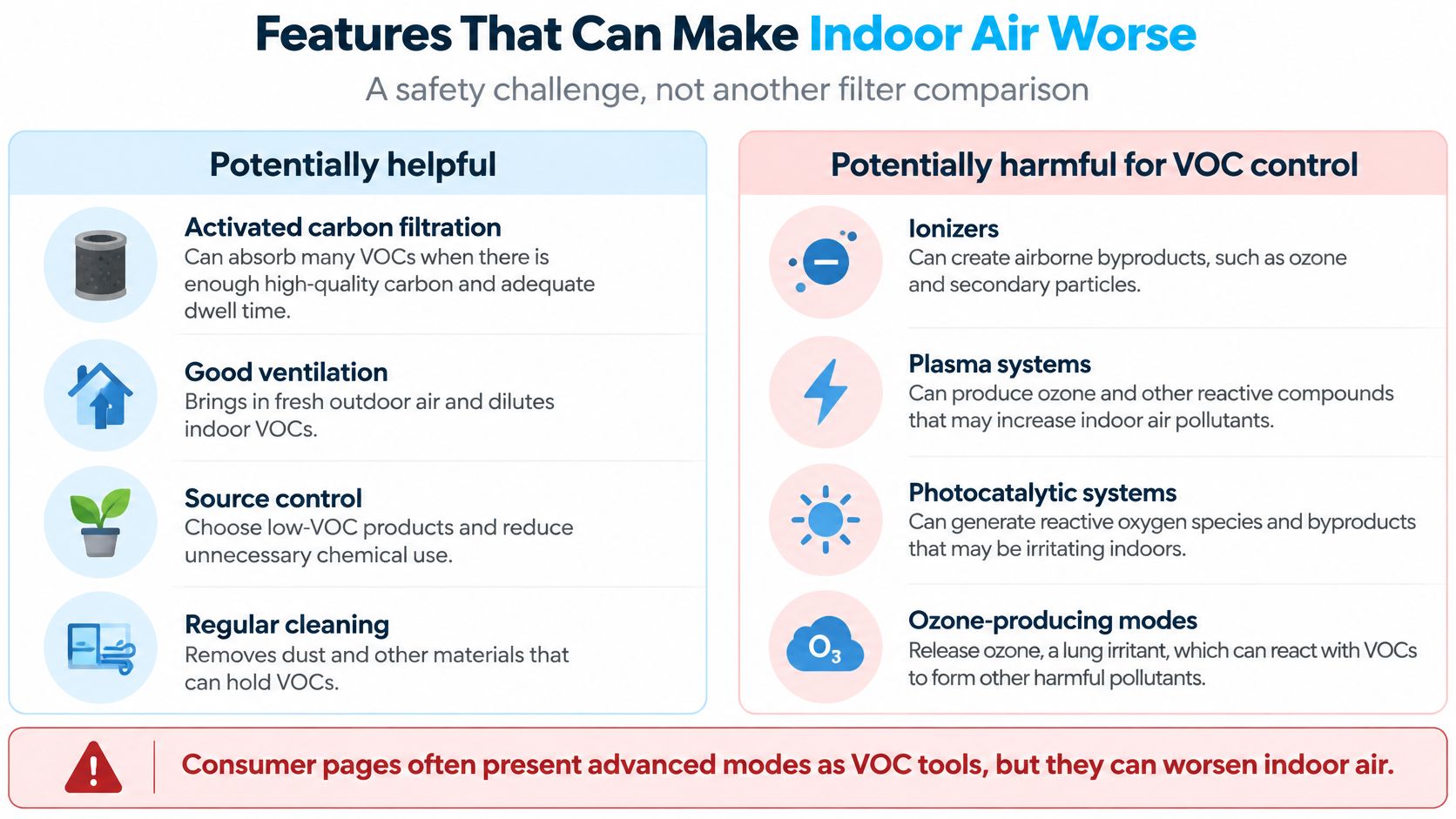
Ozone isn't a household cleaning solution
Health Canada recommends avoiding ozone generators because ozone can harm health, and sets a residential eight-hour maximum exposure limit of 40 micrograms per cubic metre, or 20 parts per billion, in its residential indoor air-quality guideline for ozone.
Canadian evidence also warns that ozone produced at residential-unit levels isn't an effective air-cleaning approach, can cause respiratory irritation, and may react with indoor chemicals to create other potentially harmful compounds. The practical concern is straightforward: treating one pollutant shouldn't introduce another.
This doesn't mean every product carrying an ionizer or reactive-treatment label has identical emissions. It means the label isn't enough to establish safety. A HEPA filter elsewhere in the machine doesn't resolve that uncertainty.
Ask about the operating mode you'll actually use
Before accepting a reactive VOC-removal claim, request documentation that answers specific questions:
- Which modes were tested? Find out whether emissions testing includes every optional setting you might enable.
- What was measured? Ask for explicit ozone-emissions data, not a general statement about fresh or clean air.
- What happened to the target chemical? Look for named pollutants and identified reaction products.
- Can the feature stay off? Check the instructions for disabling the mode and whether it returns after a restart.
A claim that a device removes VOCs by reacting with them leaves an important gap. What are the resulting compounds, and were they measured under relevant operating conditions? Without those answers, the feature shouldn't be treated as a demonstrated safety benefit.
Safety check: Choose documented emissions performance over futuristic feature names.
For renters, this verification matters because the whole room is the treatment space. There's no separate process area keeping occupants away from whatever the machine produces.
A purifier can therefore be a reasonable particle cleaner and still be a poor VOC choice. Judge the gas-treatment feature independently, and favour a straightforward, documented approach over an unexplained chemical process.
Measuring VOCs and Setting Up a Canadian Home
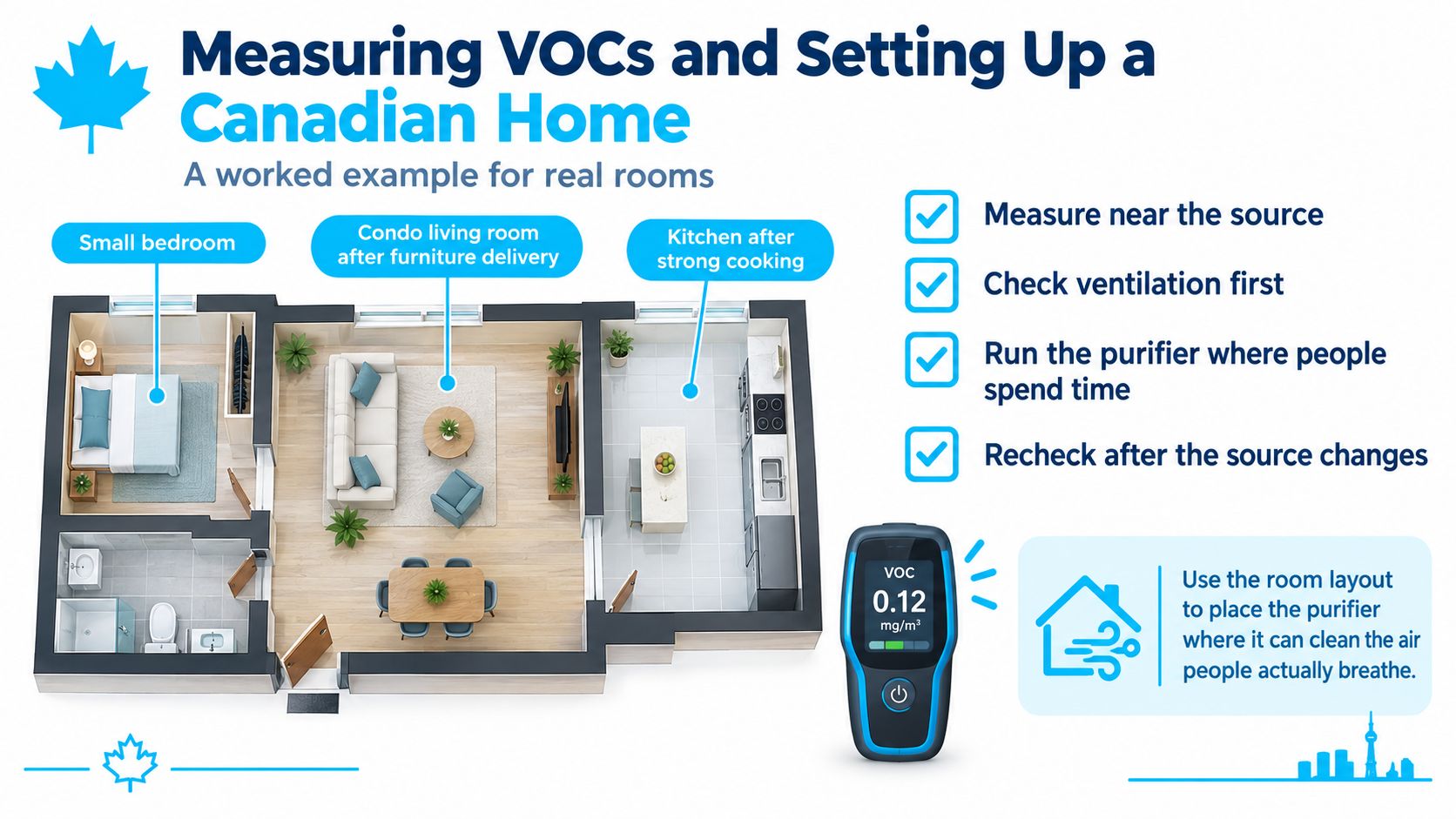
Use the room's recent history before interpreting a meter. A change after furniture delivery suggests a different investigation from a change after cleaning. Record what happened, where it happened, and whether the concern improves when that activity stops.
This room-layout checklist can help organise the investigation.
Work through ordinary rooms
In a small bedroom, check whether the concern followed a new furnishing or product. Avoid immediately adding another scented product to mask it. If you use a meter, compare observations under similar room conditions rather than treating an isolated reading as a verdict.
In a condo living room after furniture delivery, note the delivery date and contact the retailer for material and emissions information. If ventilation is constrained, discuss available options with the building manager before assuming an appliance is the only response.
In a kitchen after strong cleaners, stop the activity and follow the product's handling and ventilation instructions. Keep paints and solvents out of occupied living areas where safe storage arrangements permit, respecting labels and building rules.
A home air-quality monitor guide can help you understand what a device reports. A rise associated with painting can be a useful clue, but a general VOC reading isn't a laboratory result for formaldehyde or benzene. If identifying a specific chemical will determine your next action, seek pollutant-specific assessment rather than relying on the display.
The following video provides an additional visual resource.
Make a supplementary purifier usable
If suitable carbon filtration is warranted, follow the model's placement instructions and keep its intakes and outlets clear. Choose the occupied room rather than assuming a machine elsewhere will address the air around you.
- Match the setting to daily use. Consider airflow and noise at a speed you'll actually tolerate.
- Plan carbon maintenance separately. Don't assume the HEPA replacement schedule establishes the useful life of the gas medium.
- Check replacements before installation. Keep the filter identification and supplier details accessible.
- Review optional modes. Disable any ozone or ion mode before the first run.
Don't wait for an obvious smell to establish a maintenance plan. Use the manufacturer's gas-filter guidance and your source conditions, and reassess whenever the household activity changes.
How to Choose a Purifier and What to Do Next
Skip the purchase if removing the source and improving appropriate ventilation resolves the concern. A purifier isn't a required finishing step, and keeping an existing particle cleaner doesn't mean you need to replace it because a gas problem appeared.
Consider buying when a likely gas source remains, the proposed filter is suitable for that compound, and the manufacturer provides enough information to judge the design. Where the pollutant is unknown, better identification may be more useful than a more expensive appliance.
Turn the shortlist into a practical decision
A Canadian purchase has to work beyond the specification sheet. Check CAD pricing, replacement-filter availability through Amazon.ca or local retailers, delivery restrictions, and warranty arrangements. A filter you won't be able to obtain or afford isn't a sustainable maintenance plan.
Winter window limits also matter, but they don't turn uncertain filtration into proven filtration. In a condo, compare noise at the intended operating speed and make sure the unit fits without obstructing normal use of the room.
Before ordering, resolve these points:
- Evidence fit: Does the test name the gas you're concerned about, rather than VOCs as an undifferentiated group?
- Filter transparency: Does the maker disclose its carbon quantity and construction rather than only showing a coated sheet?
- Ownership fit: Can you buy replacement media in Canada at a cost you'll realistically pay?
- Safety documentation: Are emissions and optional operating modes explained clearly?
- Room fit: Can you operate the unit consistently without unacceptable noise or blocked airflow?
The strongest recommendation may be to postpone a purchase. That's sensible when the source is removable, the relevant test evidence is missing, or the ongoing maintenance would be impractical.
Take an action today
Write down the products or changes associated with the odour. Remove an avoidable source and air the room when outdoor conditions, weather, and building rules allow. Only then shortlist a carbon purifier that identifies its gas-treatment medium, replacement cost, and supporting test conditions.
Celmin offers Canadian buying guides and home-tech comparisons with CAD pricing, local availability, and practical trade-offs around noise, maintenance, and warranty. Visit Celmin to compare candidate purifiers against your source notes, then check the carbon specifications and replacement-filter cost before buying.
Sign up or sign in to join the conversation.