
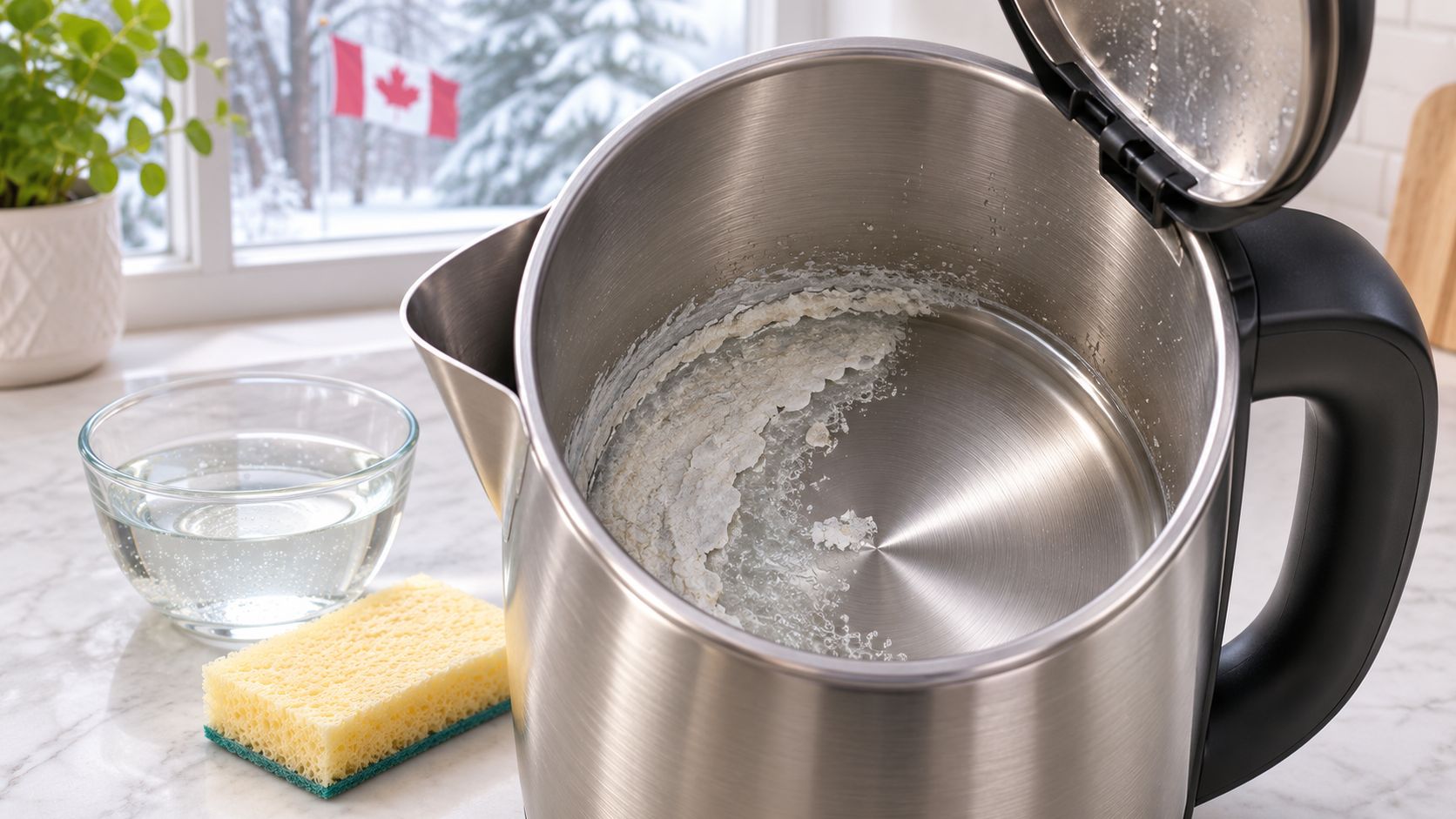
Your kettle used to reach a rolling boil in about three minutes. Lately it's closer to five, and there's a chalky white ring sitting on the base that wasn't there last winter. You've wiped at it with a sponge. It didn't move.
That ring is calcium carbonate, and it drops out of your water every time you heat it. It isn't dirt, so scrubbing won't shift it, and it isn't a health emergency, so the tea you drank this morning is fine. Acid dissolves it in about half an hour, and the only real decisions are which acid, how strong, and how often.
The "how often" question is where most advice falls short. A fixed monthly schedule is wrong for a good chunk of Canada. A household in Winnipeg and a household in Saint John are working with very different water, and your cleaning schedule should follow the scale you can see.
Table of Contents
- Descaling Solutions and Ratios for Your Kettle
- Step-by-Step Descaling Routine
- How Often to Descale Based on Your Water
- What Never to Mix and How Materials Change the Job
- Fixing Scale That Remains or Heating Slows
- Preventing Scale and Your Next Step
Descaling Solutions and Ratios for Your Kettle
Three solutions dissolve kettle scale reliably: white vinegar, food-grade citric acid, and a commercial descaler made for kettles. Choose based on the kettle's manual, the scale you can see, and how much rinsing you're willing to do.
| Solution | Ratio | Soak time | Main trade-off |
|---|---|---|---|
| White vinegar | 1:1 with water | 30 to 60 minutes | Cheap and effective, but the smell can linger and needs several rinses |
| Food-grade citric acid | About 1 tbsp per litre of water | 30 to 60 minutes | Usually less smell and rinses clean faster; sold as a powder |
| Commercial kettle descaler | As printed on the label | As printed on the label | Can be fast, but use only if your manual allows it |
Vinegar is a practical choice for a light film or a stubborn ring. Mix it equally with water, then allow time for the acid to work. Its smell can cling to plastic and rubber parts, so plan on three or four fresh-water boils afterward. One rinse may leave the kettle smelling of vinegar.
Citric acid suits a kettle that gets frequent use, especially when you want to avoid lingering vinegar odour. Use about one tablespoon per litre of water. Adding more powder does not make the soak work faster, and it leaves more residue to rinse away.
Why heat turns clear water into a white ring
Hardness depends on dissolved calcium and magnesium and is measured in milligrams per litre as calcium carbonate. The harder your local water, the more often scale may build up in the kettle; look at the interior rather than relying on one calendar schedule for every Canadian household. When water is heated repeatedly, dissolved calcium and bicarbonate form calcium-carbonate deposits on the heating element and interior surfaces. That deposit becomes the white ring.
For a typical 1.7 L kettle, use enough solution to cover the element and base plate, while leaving space for bubbling. Filling roughly halfway usually provides that coverage and headroom. Adjust to your kettle's shape rather than following the halfway mark blindly.
The rule that overrides the table: read the manual before adding a solution. Some manufacturers forbid vinegar, and an acid soak that violates the instructions can put a warranty claim at risk.
Keep steel wool, scouring pads and abrasive cream away from the interior. They can scratch stainless steel, leaving a rough surface where scale can catch more readily. Use an acidic soak to loosen deposits instead of trying to scrape them off.
Step-by-Step Descaling Routine
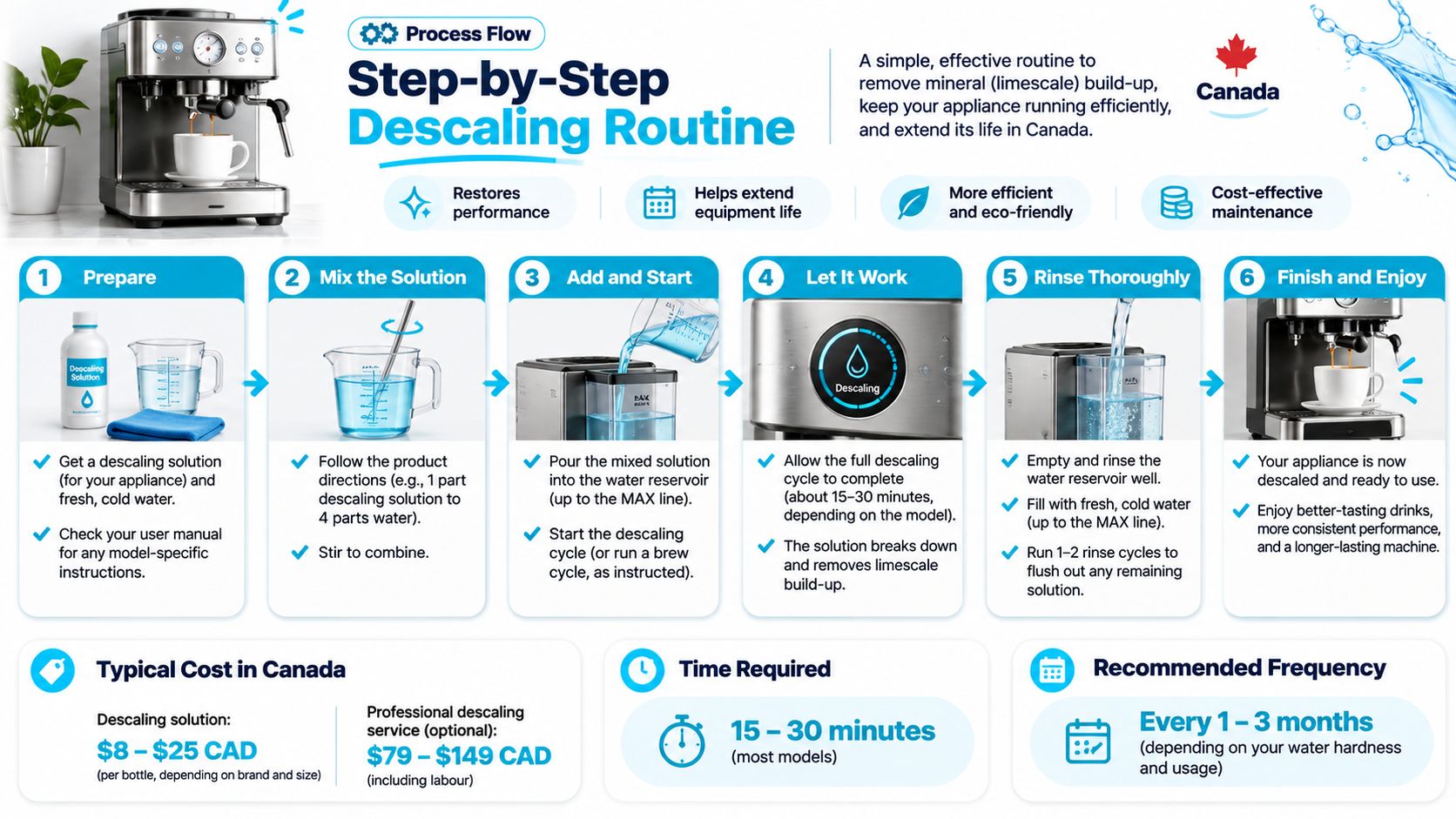
A proper descale takes about an hour elapsed, with only a few minutes of active work. The order matters: cover the scaled surfaces, let the solution work, then rinse until no acid smell remains. The same sequence applies to stainless steel, glass and plastic-bodied kettles, though the manufacturer's instructions take priority for the solution and soak time.
- Unplug the kettle and let it cool completely. Cold solution poured into hot glass can cause thermal shock, and steam near the base can reach electrical contacts. Let it cool before you start.
- Empty the kettle and wipe the exterior with a damp cloth. Use a little dish soap if needed, then wipe again with a clean, damp cloth. Keep the kettle and its base out of the sink. Water entering the base can damage the appliance.
- Add enough solution to cover the scaled surfaces. For a 1.7 L kettle, filling to about halfway is roughly 850 mL. The solution should cover the element and base plate while leaving room for bubbling. If the liquid sits below the scale line, the uncovered deposits will remain.
- Let the solution stand for 30 to 60 minutes without heat. This gives it time to loosen deposits. For thick scale, use the longer soak rather than making the solution stronger.
- Boil once, switch off, and leave the solution to finish soaking. Heating can speed the reaction and carry solution into crevices around the element. Stay nearby, and do not leave the kettle soaking overnight, which can damage seals and plastic interiors.
- Pour out the solution and gently wipe the interior. Use a soft sponge, or a nylon brush to reach around a concealed element. Avoid metal tools and abrasive scrubbers.
- Rinse thoroughly with fresh water. Fill to the maximum line, boil, and discard the water. Repeat two or three more times. If you can still smell acid when you lift the lid, rinse again before making a drink.
- Dry the base and inspect the interior. A smooth, slightly shiny plate suggests the scale has lifted. Chalky patches call for another cycle with the same solution strength, not a stronger mix.
Underfilling and adding extra acid are common ways to waste time. The first leaves scale above the liquid line; the second does not make the treatment work faster and can make rinsing harder. Cover the deposits, repeat the cycle if needed, and finish only when the kettle smells neutral and the base feels smooth to the touch.
If following a visual guide is easier, this walkthrough shows the same soak, scrub and rinse order.
How Often to Descale Based on Your Water
A kettle in a hard-water home may need attention weeks sooner than one filled from a softer supply. Use visible scale to set the schedule, then adjust how often you inspect based on the hardness of your local water. The provincial figures below are broad reference points, not a prediction for every tap.
Health Canada's consultation document on drinking-water operational parameters reports median raw-groundwater hardness of 215 mg/L as calcium carbonate in British Columbia and 368 mg/L in Manitoba, compared with 92 mg/L in New Brunswick and 120 mg/L in Nova Scotia. These figures help show why a single calendar schedule will not suit every Canadian household.
| Province | Hardness (mg/L as CaCO3) | Hardness class | Suggested check |
|---|---|---|---|
| British Columbia | 215 | Hard | Inspect monthly; descale at the first persistent film |
| Manitoba | 368 | Very hard | Inspect every two weeks; consider filtered water |
| Nova Scotia | 120 | Moderately hard | Inspect every few months |
| New Brunswick | 92 | Moderately hard | Inspect every few months |
| Newfoundland and Labrador | 96 | Moderately hard | Inspect every few months |
Reading the rows
In British Columbia, the listed figure falls in the hard range, so inspect the base monthly and descale when a film remains after ordinary rinsing. Manitoba's higher figure points to more frequent checks. With daily use, look inside every two weeks and consider filtered water if deposits return quickly. The Atlantic province figures in the table fit the moderately hard category, where checking every few months is a reasonable starting point.
Your water source matters more than the province name. Municipal customers can ask their utility for a hardness report or check its water-quality information. A private well has its own chemistry, so arrange a test rather than relying on a provincial figure. If you use a well, testing in more than one season can show whether its hardness changes.
Treat the table as a starting schedule, not a verdict on your street. A provincial median summarizes water from many treatment plants, wells and reservoirs, and your supply may differ.
Decision rule: Descale when a film, ring or rough patch appears, or when the kettle takes noticeably longer to boil. If none of these signs is present, wait and inspect again at the interval suggested for your water.
If your household uses a softener, fill the kettle from the cold tap you use for drinking and cooking. Softened water may reduce deposits, but some people dislike its taste. A hard-water household that is replacing a kettle can also consider a model with a removable, washable filter, which makes recurring deposits easier to clear.
What Never to Mix and How Materials Change the Job
The most damaging mistake with a kettle isn't the acid. It's the combination. Health Canada's household chemical safety guidance advises never mixing household chemical products, because some combinations can produce harmful gases. A kettle is a small, warm, enclosed space, which is the worst possible place to find out why.
- No bleach or disinfectant, ever. Not before, not after, not "just to be thorough". Rinse the kettle completely and do the two jobs on different days.
- One descaler at a time. Vinegar plus citric acid plus a commercial powder isn't a stronger clean. It's an unpredictable mixture with no label instructions.
- No acid boil if the manual says no. Some sealed bases and coated elements aren't rated for it, and the failure shows up months later as a leak.
- Nothing overnight. Long contact time is where seals soften and plastic interiors take on a permanent smell.
Stainless, glass, plastic and concealed elements
Stainless steel handles citric acid and vinegar without complaint and is the most forgiving interior you can own. Glass kettles show scale plainly, which makes inspection easy, but they punish thermal shock, so never add cold solution to a hot body. Plastic interiors can discolour or soften with strong acid, so use the milder concentration and the shorter soak, and if you're replacing a plastic kettle anyway, the case for kettles with no plastic in the water path is mostly about taste and long-term wear. Concealed-element kettles usually have a flat base you can't reach into properly, so rely on soaking and skip the brush entirely.
A little visible scale left behind is an aesthetic and performance issue, not a health one. Health Canada notes that hardness has significant aesthetic effects, while calcium and magnesium at typical drinking-water levels aren't generally a health concern. What does damage a kettle is aggressive scrubbing and excess acid.
Fixing Scale That Remains or Heating Slows
Done looks like this: after soaking and rinsing, the heating plate has no loose or powdery scale, the kettle pours without white flakes, there's no acidic smell when you open the lid, and the automatic shutoff still trips normally during a fresh-water test boil. That shutoff test is often skipped, and it's the one that matters.
Health Canada describes carbonate hardness as the part of hardness tied to bicarbonate and carbonate that can precipitate during heating, which is why repeated boiling concentrates visible scale on the hot base rather than spreading it evenly. The deposit sits where the heat is.
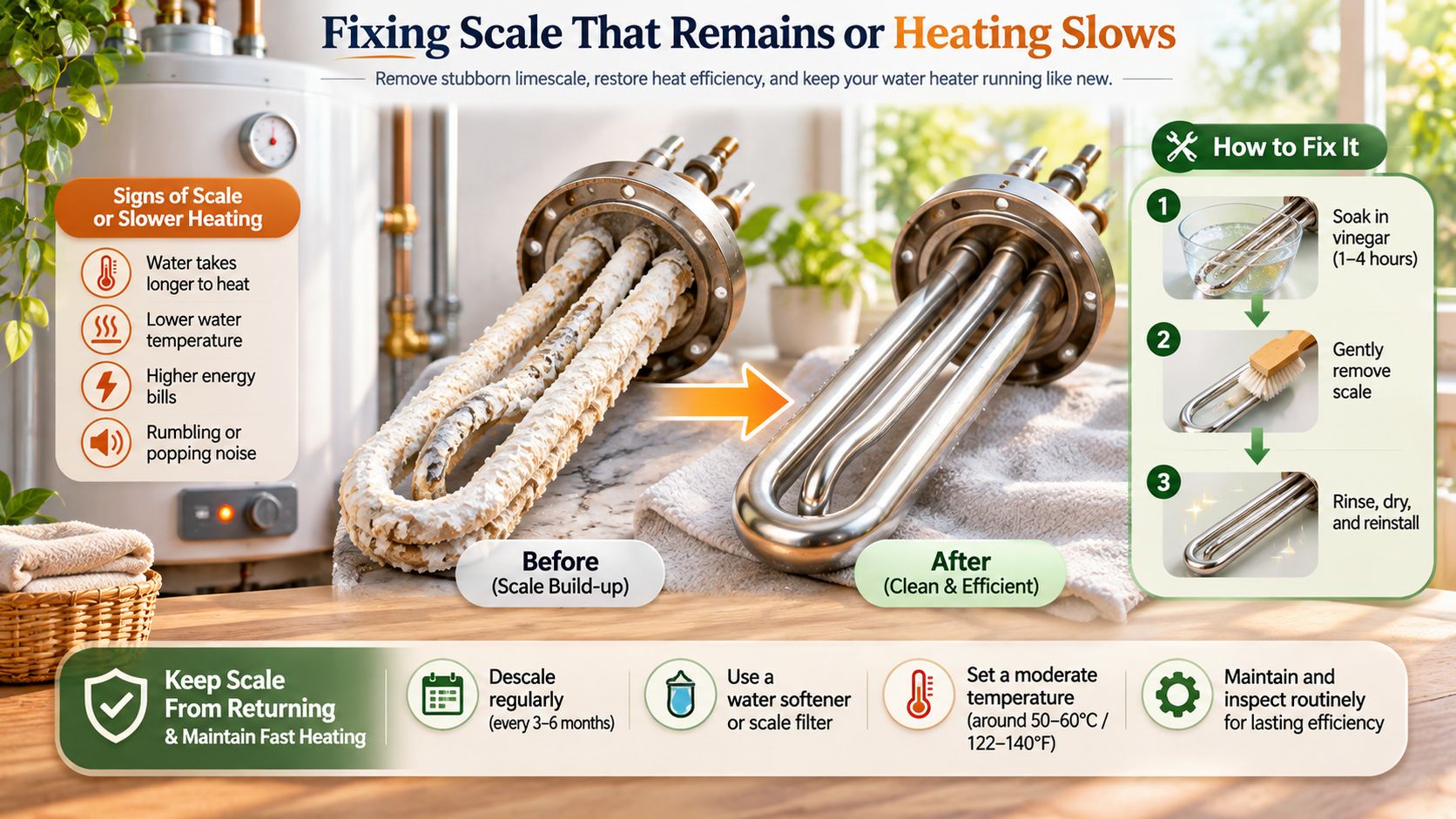
Where the scale sits decides how the fix goes, and the diagram below shows how a coated heating surface loses efficiency.
| Symptom | Likely cause | Fix |
|---|---|---|
| Heating takes noticeably longer | Scale film insulating the base | Repeat descaling with a fresh solution, then rinse thoroughly |
| White flakes in the water | Loose carbonate deposits left after soaking | Pour out, rinse three times, then descale again if needed |
| Vinegar smell after rinsing | Solution residue left in the kettle | Run two extra fresh-water boils and discard the water |
| Scale returns within weeks | Hard water with infrequent checks | Shorten the inspection interval or use filtered water |
| Auto shutoff seems late | Deposit near the thermostat area | Full descale, then a fresh-water test boil |
Most repeat failures trace back to four habits: underfilling so the acid never touches the whole base, skipping rinses, putting the kettle back into service with cleaner still inside, and boiling an acid solution in a model whose instructions forbid it. If one cycle doesn't clear the deposit, run a second cycle with a fresh batch of approved solution. Don't increase the concentration and don't combine products.
Some fixes take a single session: a light film, a faint odour, a slow boil in a soft-water kitchen. Others need a shorter schedule held over several weeks, especially in very hard water where a film re-forms between cleans. For water in the 150 to 300 mg/L hard band, shorten the interval and descale at the first persistent film. Above 300 mg/L, check very often or switch the kettle to filtered water. If you're also weighing how quickly a replacement model gets to a boil, the relationship between kettle wattage and how fast a model boils matters more than most shoppers expect.
Preventing Scale and Your Next Step
A descale clears the existing deposits. Four habits help keep them from returning quickly:
- Empty the kettle after every boil. Standing water leaves minerals behind as it evaporates, allowing them to settle on the base.
- Fill with fresh cold water each time. Reboiling water concentrates the minerals that contribute to scale.
- Wipe the base with a soft cloth every few boils. A thin film comes off easily; if it remains, it can require an acid soak.
- Inspect the base regularly. Check monthly in hard water and every few months in moderately hard water, adjusting sooner during heavy use.
Why one province, one number, never describes one kitchen
Water hardness varies across Canada, including within a province. A Health Canada fact sheet reports that a survey of Canadian surface waters from 1975 to 1977 found average values at sampling stations ranging from 7 to 180 mg/L as CaCO3 in British Columbia and 15 to 716 mg/L in Manitoba, according to the federal water hardness fact sheet. Local water sources, treatment methods, and seasonal changes can all affect hardness, so a provincial average cannot set the right descaling schedule for every kettle.
If a chalky ring or slow boil returns within a few weeks of cleaning, consider changing the water source instead of scrubbing more often. You could fill the kettle from a filtered pitcher or choose a model with a removable, washable filter that fits your counter. Check pitcher filter running costs before choosing that option, and compare Canadian kettle models with removable filters in Celmin's reviews.
Set a reminder to inspect the base, then descale when a film appears rather than relying on a fixed calendar. In hard-water areas, make the first inspection soon and shorten the interval if deposits return.
Celmin publishes Canada-focused kitchen appliance buying guides and reviews, with CAD pricing and availability for products sold in Canada. Its kettle comparisons describe which models have removable, washable filters, helping you weigh replacement options against the maintenance needs of your water.
Sign up or sign in to join the conversation.