
The LARQ Self-Cleaning Water Filter Pitcher sits in an awkward but interesting corner of the kitchen market: the premium filter pitcher that is trying to justify a much higher upfront price with broader contaminant claims, nicer materials, and lower waste over time. That matters because once ...
The LARQ Self-Cleaning Water Filter Pitcher sits in an awkward but interesting corner of the kitchen market: the premium filter pitcher that is trying to justify a much higher upfront price with broader contaminant claims, nicer materials, and lower waste over time. That matters because once a pitcher climbs past the usual Brita price band, the question changes. It stops being "does this make tap water taste better?" and becomes "is this actually worth the money compared with a cheaper pitcher or just buying cases of bottled water?"
This is not a hands-on review. Nothing here is based on personally testing the pitcher. The goal is simpler and, frankly, more useful for most buyers: explain what the LARQ Self-Cleaning Water Filter Pitcher actually is, what the listed filtration claims mean in plain English, and whether the economics make sense over a year or two. If you are staring at the price and wondering whether this is smart spending or polished branding, this is the calmer breakdown.
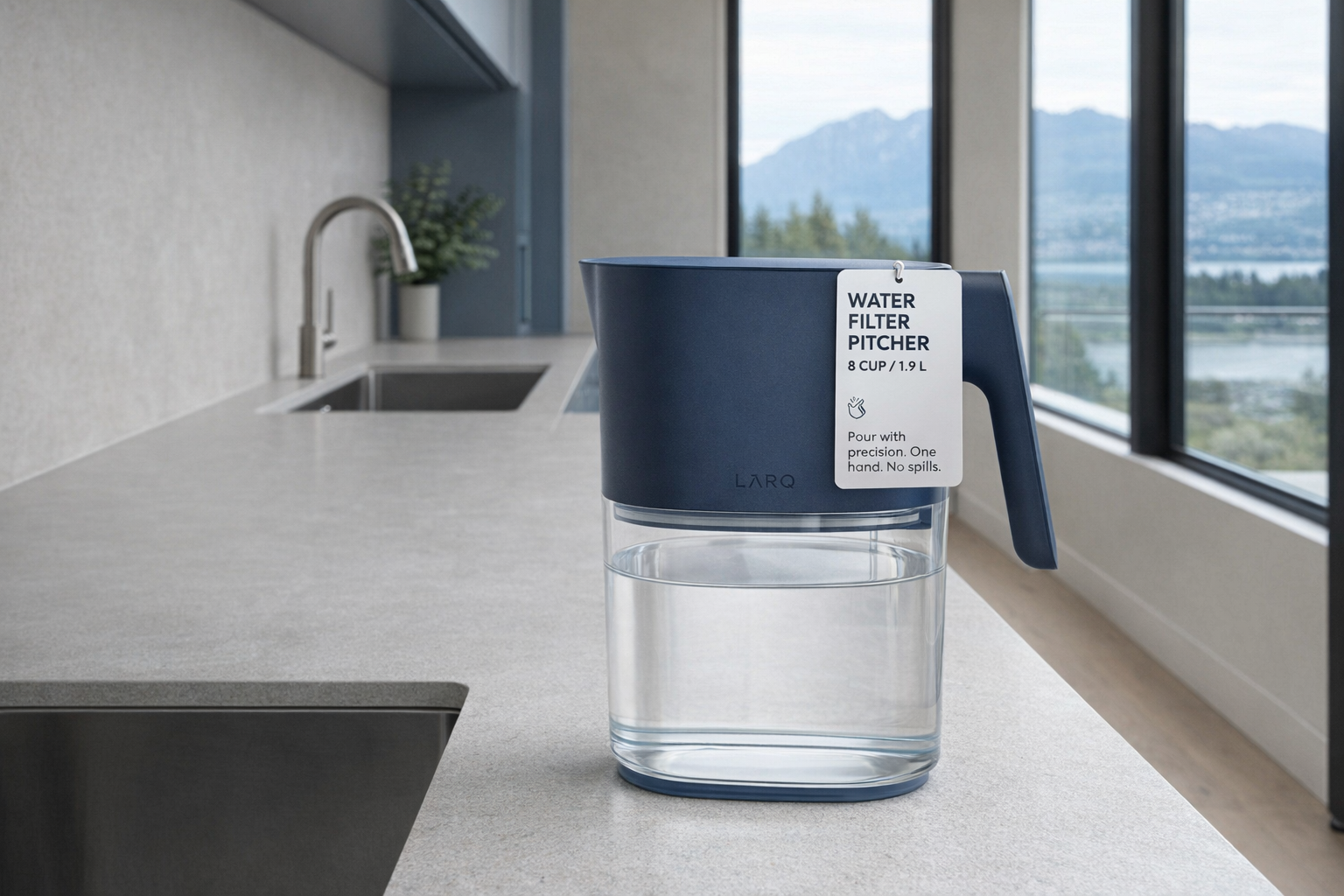
📺 Watch: LARQ Self-Cleaning Water Filter Pitcher in context
Quick snapshot
| Question | What the LARQ Self-Cleaning Water Filter Pitcher actually is |
|---|---|
| Category | Smart Kitchen |
| Made by | LARQ |
| Typical price | ~$136 CAD (listing at the time of writing — verify current pricing) |
| Rating signal | 4.4/5 on the source listing |
| Best for | Households that want broader filtration claims than a basic pitcher and care about long-term bottle savings |
| Skip if | You want the cheapest possible filtered water, a huge-capacity dispenser, or zero ongoing filter costs |
Pro tip: If you are considering this pitcher, do the math on your own water habits first. Premium pitchers only make sense when they are used constantly; if you drink one glass a day, you are paying for the idea of better filtration more than the actual benefit.
What the LARQ Self-Cleaning Water Filter Pitcher actually is
In plain English, this is a 1.9-litre countertop or fridge pitcher that uses a replaceable filter to reduce a wider set of contaminants than a basic taste-improvement pitcher, while also trying to look and feel more premium than the usual plastic jug. The important part is not the word "self-cleaning" in the product name so much as the overall package: a filter system aimed at people who want to avoid bottled water, care about contaminant reduction beyond chlorine, and are willing to pay more upfront for that.
Nano Zero Filter technology independently tested to NSF/ANSI 42, 53, & 401 standards. Plant-based carbon filter removes chlorine, lead, PFAS, benzene, VOCs, pharmaceuticals, and microplastics. 1.9L capacity, BPA/BPS-free.
That description is the real heart of the product. It is not a water cooler, not a reverse-osmosis system, and not a plumbing upgrade. It is still a pitcher. But compared with a mainstream competitor like the Brita Large Water Filter Pitcher, LARQ is clearly aiming higher on claimed contaminant coverage and design finish, while charging a lot more for the privilege. Whether that premium is sensible depends less on marketing language and more on how often you refill it, how expensive bottled water has become in your house, and whether broader filtration claims matter to you.
Key features at a glance
- Nano Zero Filter tested to NSF/ANSI 42, 53, and 401
- Plant-based carbon filter aimed at reducing chlorine, lead, PFAS, benzene, VOCs, pharmaceuticals, and microplastics
- 1.9L capacity for everyday drinking water in a small household or regular refill cycle in a larger one
- Up to 60 gallons per filter or roughly 3 months per replacement cycle, according to the listing
- Replaces 450+ single-use bottles per filter, according to LARQ's stated estimate
- BPA/BPS-free construction
- Dishwasher-safe parts
- Sized to fit in the fridge or sit on a countertop without taking over the kitchen
How the LARQ Self-Cleaning Water Filter Pitcher actually works
Mechanically, this is still a familiar gravity-fed pitcher. You pour tap water into the upper reservoir, water passes through the filter media, and the filtered water collects below for pouring. There is no plumbing, pump, or under-sink installation. That makes it accessible, but it also means filtration happens at pitcher speed, not instant-on faucet speed.
The more specific part is the filter itself. LARQ says the pitcher uses its Nano Zero Filter and cites testing to NSF/ANSI 42, 53, and 401. In normal buyer language, those standards matter because they go beyond the basic "better taste" promise that cheaper pitchers often lean on. NSF/ANSI 42 generally relates to aesthetic improvements like chlorine taste and odour, while 53 and 401 are where contaminant-reduction claims get more serious, covering things like lead and certain emerging contaminants. That is a more meaningful spec sheet than vague "cleaner water" marketing.
The day-to-day use pattern is straightforward:
- Fill the upper section with tap water.
- Wait for filtration through the replaceable cartridge.
- Store and pour from the lower chamber.
- Replace the filter roughly every 60 gallons or about 3 months, according to the listing.
The economics hinge on that last point. A pitcher is not a one-time purchase; it is a subscription by another name, even if the subscription is just a box of cartridges you remember to order every season. That does not make it a bad product. It just means you should evaluate it like a printer with ink or a coffee machine with pods: the refill cost matters as much as the hardware.
A realistic "day in the life" with LARQ Self-Cleaning Water Filter Pitcher
Because this is an informational piece, the examples below are based on what the listed features imply rather than hands-on use.
- Morning. You fill the pitcher from the tap and leave it in the fridge while getting ready. The 1.9L capacity is enough for several glasses, coffee water, or filling a couple of reusable bottles before work, but not so large that it dominates a shelf.
- Midday. Someone in the house refills a water bottle and tops up the pitcher again. This is where a premium pitcher either earns its keep or becomes annoying: if your household drinks a lot of water, regular refilling feels normal; if not, the value proposition weakens fast.
- Afternoon. You use it for cooking water, pet bowls, or a second round of bottles. The broader contaminant claims — things like lead, PFAS, VOCs, and microplastics — are the reason someone chooses this over a very basic chlorine-only improvement pitcher.
- Evening. You notice the filter replacement window is approaching. Since each filter is listed for up to 60 gallons or about 3 months, the long-term cost is tied directly to how closely your real use matches that estimate.
Who the LARQ Self-Cleaning Water Filter Pitcher is actually for (and who it isn't)
Great fits
- Apartment dwellers who do not want an under-sink install but still want filtration claims that go beyond taste.
- Families trying to cut down on cases of bottled water and willing to actually maintain a pitcher system.
- People who keep a pitcher in the fridge every day and refill reusable bottles constantly.
- Buyers who care about materials, cleaner design, and dishwasher-safe parts instead of the cheapest plastic jug available.
- Households in areas where tap water is safe but the taste, smell, or trust level pushes them toward extra filtration.
Poor fits
- Anyone looking for the lowest cost per litre, full stop. A basic Brita-style pitcher will usually win on upfront price.
- Large households that burn through water quickly and will get frustrated by a 1.9L pitcher needing frequent refills.
- People who want a permanent, high-volume solution for cooking and drinking; an under-sink system or dispenser makes more sense there.
- Shoppers attracted mainly by the premium branding but unlikely to keep buying replacement filters.
- Anyone expecting miracles from a pitcher when the real issue may require a more serious water treatment setup.
Practical trade-offs
Filter economics
This is the main conversation with this product, so it is worth being blunt. At ~$136 CAD upfront, the LARQ pitcher costs several times more than an entry-level pitcher from Brita or similar brands. That does not automatically make it bad, but it does mean it has to earn its keep over time.
Using only the numbers provided, one filter lasts up to 60 gallons, roughly 227 litres, or about 3 months. That implies around 4 filters per year if your household uses it as intended. The unknown piece is replacement filter pricing, which you should verify on the current retailer or LARQ store page before buying. Without that number, nobody can honestly tell you the exact yearly ownership cost.
What can be said safely is this: compared with bottled water, almost any regularly used pitcher can look economical pretty quickly. If your household buys cases of single-use bottles every week, the break-even point can arrive within months. Compared with a Brita Large Water Filter Pitcher, the math gets tighter. LARQ has to justify its higher hardware cost through better contaminant claims, nicer design, and possibly lower waste or better longevity — not through being the cheapest filtered water in the kitchen. Evaluate it like a premium coffee maker, not like a discount jug.
Capacity and refill friction
A 1.9L pitcher is a practical middle ground, but it is still a middle ground. For one person or a couple, it is reasonable. For a family with teenagers, constant bottle filling, or heavy cooking use, it may feel small.
That matters because convenience is a hidden cost. If the pitcher needs constant refilling, people stop using it and go back to the tap or to bottled water. A slightly cheaper but larger dispenser can sometimes be the smarter buy simply because it gets used more consistently. Premium filtration does not help much if the format annoys the household.
Maintenance and real-world ownership
LARQ does score points for dishwasher-safe parts and BPA/BPS-free materials. Those are the sorts of details that make a pitcher easier to keep in rotation instead of slowly becoming cloudy and forgotten at the back of the fridge. That's more practical than flashy.
But maintenance still exists. You need to remember filter replacement, keep the pitcher clean, and make sure the actual cost of cartridges does not drift into the territory where you start resenting it. That is the quiet reason some premium pitchers fail in real homes: not because they filter badly, but because the ongoing routine feels too expensive or too fiddly.
Where the LARQ Self-Cleaning Water Filter Pitcher fits in a modern kitchen
This pitcher makes the most sense in a kitchen that already runs on reusable habits. Think a fridge shelf with Owala or Stanley bottles lined up, a countertop coffee maker filled from filtered water, and a household that is already trying to reduce single-use plastic. In that setup, LARQ is not a novelty item. It is part of the daily hydration workflow.
It also fits best where a built-in system is either impossible or unnecessary. Renters, condo owners, and anyone not interested in installing an under-sink unit are the obvious audience. If you already have a serious filtration setup from a brand like Brita Hub, ZeroWater, or an under-sink system, this pitcher is harder to justify unless you specifically want a portable fridge option.
The smartest way to think about it is as a premium portable filter station, not as a full-house water solution. It handles drinking water and bottle filling well. It does not replace a plumbed-in system for large-volume cooking, entertaining, or whole-home concerns.
The buying decision, in plain terms
Before buying, three yes-or-no questions do most of the work here:
- Do broader contaminant claims actually matter to you, or do you mainly want better-tasting water? If you just want chlorine taste reduced, a cheaper pitcher may be enough.
- Will your household genuinely use a 1.9L pitcher every day? If yes, the upfront price spreads out over lots of use. If no, the economics get ugly fast.
- Are you willing to treat replacement filters as part of the real purchase price? If you hate recurring costs, this premium pitcher will likely annoy you.
If those answers are mostly yes, the LARQ Self-Cleaning Water Filter Pitcher is a sensible premium buy; if not, a cheaper Brita-style pitcher or a larger dispenser is probably the better call.
Got Questions About the LARQ Self-Cleaning Water Filter Pitcher? Let's Clear Things Up.
Is this a hands-on review?
No. This is an informational explainer built from the listed product details, pricing, and the broader filter-pitcher market. The goal is to help you judge fit and value, not to pretend there was a lab test behind every sentence.
What does the LARQ pitcher actually filter?
According to the listing, the Nano Zero Filter is independently tested to NSF/ANSI 42, 53, and 401 standards and is intended to reduce chlorine, lead, PFAS, benzene, VOCs, pharmaceuticals, and microplastics. That is a more ambitious claim set than many basic pitchers, which often focus mostly on taste and odour.
How big is it, and is 1.9L enough?
The listed capacity is 1.9 litres. For a single person or two people, that is usually manageable for daily drinking water and bottle refills. For larger households, it may mean frequent top-ups, which is worth thinking about before paying premium-pitcher money.
How often do you replace the filter?
LARQ says each filter lasts up to 60 gallons, or about 3 months. In practical annual terms, that usually means roughly 4 filters per year if your usage lines up with the estimate. That replacement cycle is the key number for calculating true ownership cost.
Is it cheaper than bottled water?
For most households that buy bottled water regularly, a pitcher like this should look cheaper over time, especially when you include the claim that each filter can replace 450+ single-use bottles. The harder comparison is against cheaper pitchers, not bottled water. Bottled water is usually the expensive baseline.
Where can I verify the current price or buy it?
The listing referenced for this article is on Amazon here: LARQ Self-Cleaning Water Filter Pitcher. Check that page for the current CAD price, replacement filter availability, and any updated filtration or maintenance details before buying.
What does it cost in Canada?
At the time of writing, the listed price is ~$136 CAD. That is firmly in premium-pitcher territory, so it makes sense to compare not just the sticker price but also the yearly filter cost before deciding.
Where is the Celmin Directory listing for this product?
For a catalog-style view of the same product — structured specs, pros and cons, similar picks, and FAQ — see LARQ Self-Cleaning Water Filter Pitcher on Celmin Directory.
If you're building a smarter home in Canada and want honest explainers on gadgets worth considering — plus the ones worth skipping — Celmin covers the full catalog without the marketing theater. More reviews, comparisons, and buyer guides at https://celmin.ca.
Discussion
Sign up or sign in to join the conversation.