
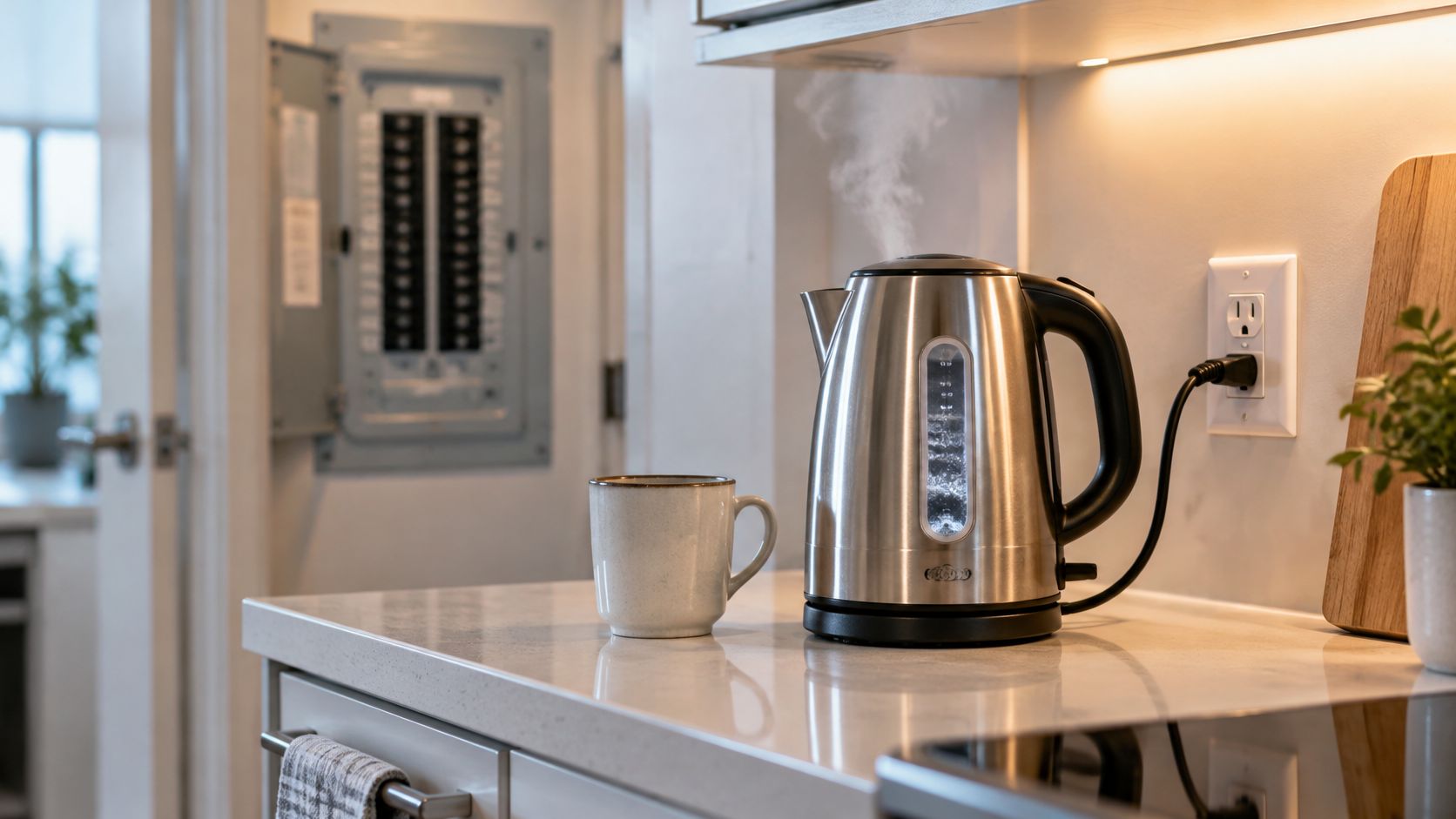
If a higher-wattage kettle finishes sooner, does it cost less to boil your water, or does it just make your tea sooner? The distinction matters when you're comparing electric kettle wattage, especially in a condo where the kettle and microwave may share a circuit.
Wattage mainly determines heating speed, not the total energy needed for the same job. Your electricity rate affects the cost of that energy. But the circuit supplying your outlet determines whether a particular kettle belongs in your kitchen at all.
Table of Contents
- Boil Time, Energy and Cost by Wattage
- Breaker Limits in Canadian Homes
- Certification and Accessory Checks
- Picking Wattage for Small Kitchens and Condos
- Habits That Matter More Than Wattage
- Confirm Your Outlet Before You Buy
Boil Time, Energy and Cost by Wattage
| Wattage | Approx. time to boil 1 L | Assumed energy per boil | Cost at Montréal comparison rate | Cost at Alberta comparison rate |
|---|---|---|---|---|
| 1,000 W | About 6.5 min | 0.11 kWh | About 0.9¢ | About 2.5¢ |
| 1,200 W | About 5.5 min | 0.11 kWh | About 0.9¢ | About 2.5¢ |
| 1,500 W | About 4.5 min | 0.11 kWh | About 0.9¢ | About 2.5¢ |
| 1,800 W | About 3.7 min | 0.11 kWh | About 0.9¢ | About 2.5¢ |
| 2,200 W | About 3 min | 0.11 kWh | About 0.9¢ | About 2.5¢ |
These are hypothetical calculations, not measured kettle performance. The example assumes heating a litre from room temperature to boiling uses the same amount of energy in every row, with an allowance for heat loss; actual results depend on kettle design, starting temperature and shut-off behaviour.
The cost columns use the residential comparison prices of 8.29¢/kWh in Montréal and 22.45¢/kWh in Alberta in Hydro-Québec's April 2025 electricity-price comparison, before taxes and under its regional methodology. These aren't guaranteed marginal rates for your household, so use your own electricity tariff when estimating your bill.
The faster rows are included to explain the relationship between power and time, not to recommend those wattages for an ordinary Canadian outlet. Electrical compatibility comes before speed.
Watts describe speed, kilowatt-hours describe consumption
Think of water flowing through a pipe. Power, measured in watts, is like the rate of flow. Energy, measured in kilowatt-hours, is like the total amount of water delivered.
A wider pipe can deliver the same bucketful faster. Similarly, a more powerful heating element can deliver the energy needed to boil water in less time.
For a hypothetical arithmetic example, a kettle drawing 1,500 W for four minutes uses approximately 0.10 kWh. A kettle drawing 1,000 W for six minutes uses the same amount: convert watts to kilowatts, then multiply by the running time expressed in hours.
Neither appliance avoids heating the water. The lower-powered kettle spreads the work over a longer period.
Buying insight: A faster kettle can shorten your wait without producing a comparable reduction in your electricity bill.
Real appliances won't have identical losses. Some energy heats the kettle body, and some escapes into the surrounding air. A quicker boil may reduce those losses, but wattage alone doesn't establish which kettle uses less energy per useful cup.
A familiar Canadian benchmark
For a concrete shopping reference, Best Buy Canada lists a Hamilton Beach electric kettle with a 1.7 L capacity and a 1,500 W rating. That gives you a useful benchmark for comparing conventional household kettles, rather than treating every higher number as an upgrade.
Capacity and power describe different things. A large kettle can heat a small batch, provided you respect its minimum-fill mark, while a compact kettle isn't necessarily low-powered.
To estimate your own running cost, use:
Energy used in kWh × your applicable electricity price per kWh = electricity cost.
If you're interested in checking consumption rather than relying on marketing claims, a smart-home energy-monitor guide can help you understand the available monitoring approaches. Any device placed between the kettle and outlet must be suitable for the appliance's electrical load.
For an occasional mug, prioritise a suitable circuit, readable fill markings and comfortable pouring. If you regularly prepare several drinks together, faster heating may be worth paying for, but primarily as a convenience rather than a bill-saving feature.
Breaker Limits in Canadian Homes
Current equals power divided by voltage. That's the calculation that connects the wattage on a kettle's label to the load on a household circuit.
The following is a worked example for a nominal household supply and branch-circuit rating, not a statement that every Canadian kitchen has that arrangement. Check your actual installation rather than assuming the example applies.
| Kettle wattage | Current at 120 V | Share of a 15 A circuit | Headroom left on the circuit |
|---|---|---|---|
| 1,000 W | About 8.3 A | About 56% | About 6.7 A |
| 1,200 W | 10 A | About 67% | 5 A |
| 1,500 W | 12.5 A | About 83% | About 2.5 A |
| 1,800 W | 15 A | 100% | None |
These are calculated values for the hypothetical circuit shown. Headroom is the arithmetic remainder, not permission to load a circuit to its limit, and it doesn't replace applicable electrical requirements or an electrician's assessment.
A kettle can look modest on the counter while using much of the circuit's capacity. Add a toaster, microwave or portable heater, and the combined demand may be too high.
Two checks that reveal the real constraint
- Read the breaker label. Identify the breaker supplying the intended outlet and read its marked amperage without removing the panel cover. If the panel is unclear, damaged or inaccessible, ask your landlord or a licensed electrician for help.
- Identify shared appliances. Determine which receptacles and appliances lose power when that breaker is switched off, taking care not to interrupt essential equipment. Include adjacent counter outlets, since separate receptacles don't necessarily mean separate circuits.
In an older home or condo, don't infer circuit capacity from the number of available sockets. A double receptacle doesn't provide a separate electrical allowance for each plug.
Suppose you usually start breakfast by turning on the kettle and toaster together. A kettle that works perfectly when used alone may trip the breaker during that routine, because the breaker responds to the combined load.
A breaker trip isn't proof that the kettle is faulty. It is a reason to stop and investigate the circuit, appliance and combined load.
Don't repeatedly reset a breaker and continue the same routine. Frequent trips, a hot receptacle, discolouration, buzzing or a burning smell require attention, not a higher-rated replacement breaker.
A lower-wattage kettle can provide more room on a shared circuit, but it doesn't automatically make simultaneous appliance use safe. Choose around the loads you run together, not the loads you hope you'll remember to avoid.
Certification and Accessory Checks
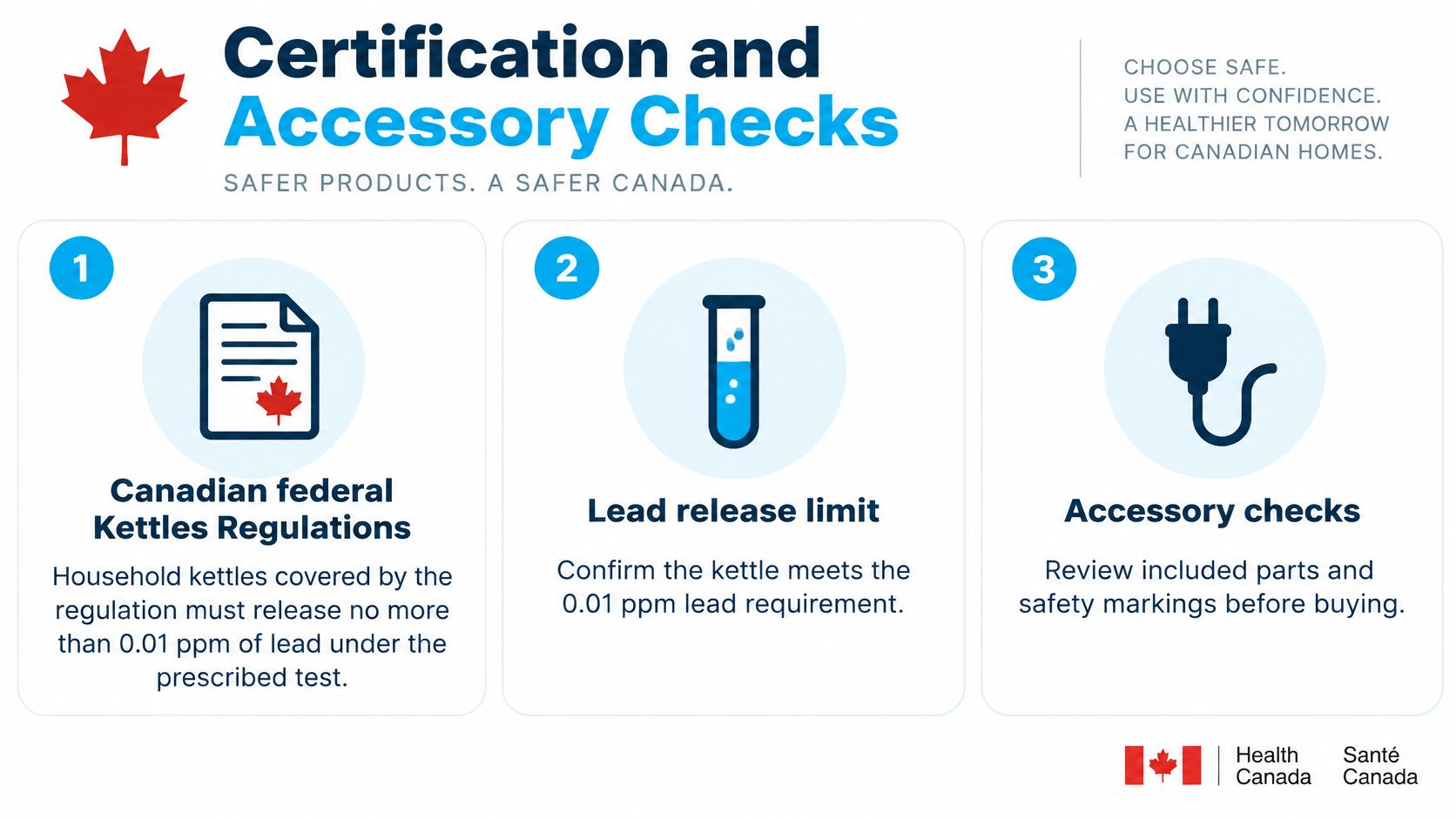
The Canadian federal Kettles Regulations require covered household kettles to release no more than 0.01 ppm of lead under the prescribed test. That's a material-safety requirement, not approval of your kitchen wiring or an accessory plugged into the outlet.
A kettle therefore needs more than a reassuring wattage label. You should be able to identify its electrical rating, certification for Canadian use and operating instructions.
Use this visual checklist as a starting point, then verify the markings on the actual appliance.
Start with the kettle label
Look for a recognised Canadian electrical certification mark and the rated voltage, wattage or current on the kettle or base. A certification logo shown only in an online product image isn't a substitute for checking the product you receive.
Read the instructions for minimum filling, maximum filling and permitted use. A travel kettle may have a different operating procedure from a conventional countertop model, particularly if it includes food-heating functions.
Auto shut-off and boil-dry protection are separate safeguards. They help manage appliance operation, but they don't increase circuit capacity or make an unsuitable adapter safe.
Keep the connection simple
Plug the kettle directly into a sound wall receptacle. Avoid power bars, extension cords and plug adapters, which add connections and may be unsuitable for the sustained heating load.
A loose plug or damaged cord needs attention even if the kettle still boils. Stop using the appliance or outlet when you notice heat damage, an intermittent connection or a burning smell.
A smart-plug timer guide can explain scheduling options, but scheduling capability doesn't establish compatibility with a kettle. Confirm that both manufacturers permit the arrangement and that the smart plug is explicitly suitable for the kettle's resistive load and intended operating duration.
Don't assume a plug marketed for lamps or fans is suitable. Also check whether the kettle supports the proposed switching method without defeating its normal controls, and avoid unattended activation.
Before keeping the packaging, complete this short check:
- On the box: Match the model and Canadian-use information to the item delivered.
- On the label: Confirm the electrical ratings and certification marking are legible.
- At the outlet: Check that the plug fits securely and the receptacle is undamaged.
- With accessories: Reject any connection arrangement the kettle manufacturer prohibits.
Picking Wattage for Small Kitchens and Condos
For a solo condo resident, a compact, moderate-power kettle is often more useful than a large rapid-boil model. Choose around available circuit headroom, usable counter space and your normal batch size, in that order.
The guide image offers a visual starting point for comparing the appliance with its intended kitchen setting.
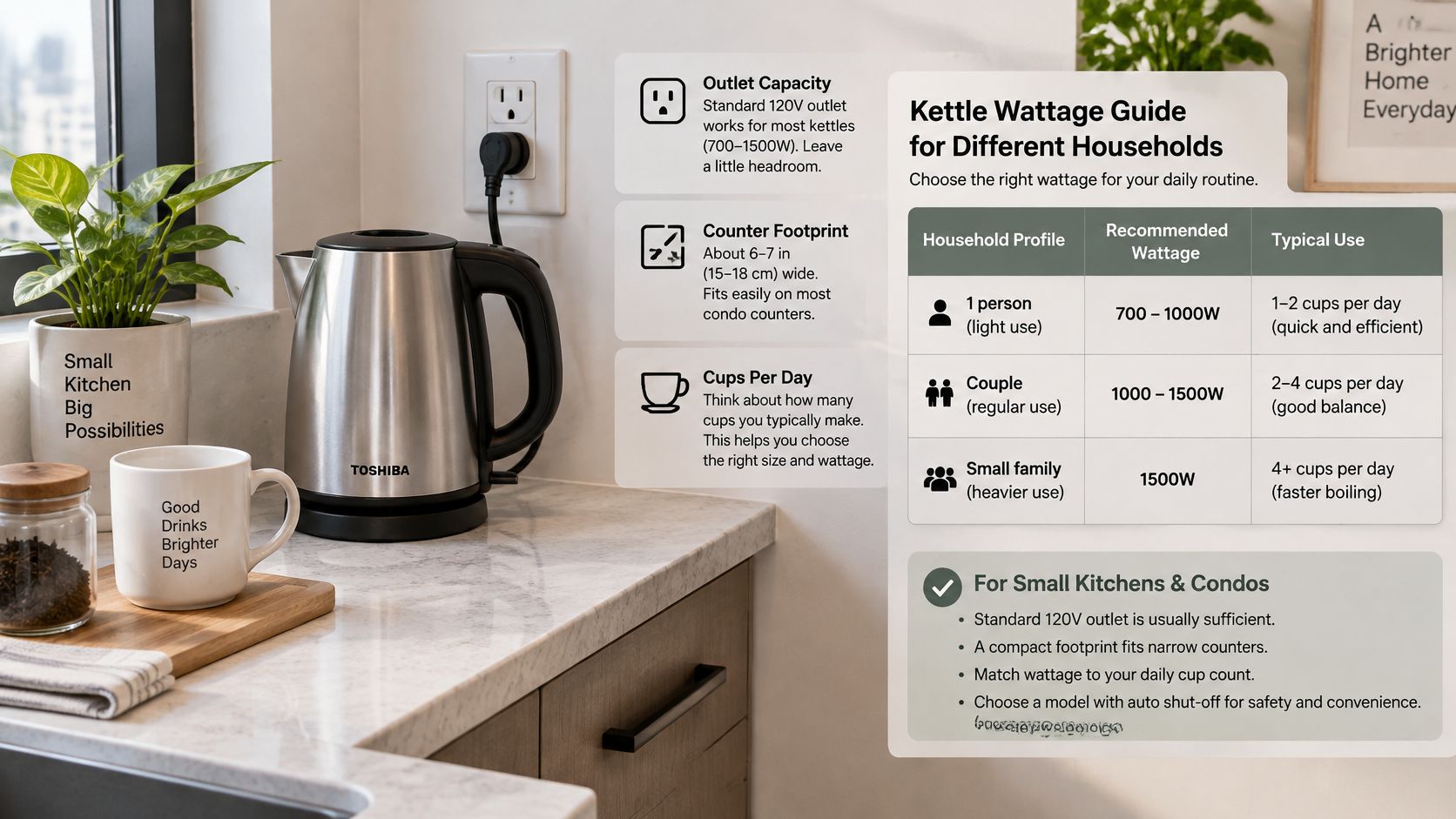
The household ranges below are illustrative shopping scenarios, not guaranteed electrical recommendations or measured market averages. Capacity should follow your actual mugs and the appliance's minimum-fill requirement.
| Household or use | Suggested wattage | Capacity to consider | Why it fits |
|---|---|---|---|
| Solo condo, one or two cups a day | 1,000 to 1,200 W | Smallest model that covers your normal batch | Lower demand than a higher-power kettle; compact models may save space |
| Two-person home, daily tea and coffee | 1,500 W | Around 1.5 to 1.7 L | Useful for shared batches when the circuit can support it |
| Shared kitchen circuit with a microwave | 1,000 to 1,200 W | Sized for your drinks, not the microwave | Reduces kettle demand, but doesn't guarantee safe simultaneous use |
| Travel or hotel room | 300 W | About 450 mL | Low-power option, subject to accommodation rules and supply compatibility |
For the travel example, Best Buy Canada lists a Green Scenic multifunctional travel kettle rated at 300 W with a 450 mL capacity. Its small batch size and low power serve a different purpose from a full-size household kettle: portability rather than quick preparation for a group.
Measure the base, not just the jug
On a shallow counter, check the complete footprint, including the handle, spout and base. Leave room to lift the kettle without catching an overhead cabinet, and position it so steam won't discharge directly onto cabinetry.
A slim body can fit neatly beside a coffee setup, but a narrow opening may be awkward to clean. Check whether your hand or a suitable cleaning brush can reach the interior, and whether the water-level markings are visible from your usual filling position.
For broader layout decisions, a guide to kitchen appliances for small spaces can help you decide which appliances deserve permanent counter space.
Use the accompanying video as an additional visual reference while comparing kettle designs.
Don't buy excess capacity merely because a larger model looks like better value. A clearly marked minimum fill, stable base and comfortable grip may improve everyday use more than an extra setting you'll rarely select.
Habits That Matter More Than Wattage
Change how much water you heat before replacing a working kettle to chase efficiency. The most useful adjustment is often visible through the water-level window, not printed on the wattage label.
A full kettle makes sense when you need a full batch. It doesn't make sense to heat spare water automatically, leave it to cool, then repeat the process for the next drink.
Make each boil serve a purpose
- Fill for the drinks you're making. Measure with your usual mug, then use the kettle's markings for future fills. Always respect the minimum-fill line, even when you want less water.
- Prepare the cups before switching on. Set out tea, coffee and any brewing equipment so you can pour when the kettle finishes. That reduces the temptation to walk away and reboil later.
- Use keep-warm deliberately. Turn it off when you won't need another drink soon. Holding water hot is an additional service that uses energy, not a free consequence of having boiled it.
- Choose the temperature your drink needs. If your kettle offers temperature control, select the setting appropriate to your tea or brewing method rather than automatically boiling every batch.
A useful routine: Fill, prepare, boil and pour. Avoid making reheating part of the routine by default.
Maintain the kettle without chasing shortcuts
Scale can coat the heated surface and interfere with heat transfer. Inspect the interior regularly and descale when deposits appear, using the manufacturer's recommended cleaner, dilution and rinsing procedure.
- Respond to deposits rather than a fixed calendar. Hard-water households may need more frequent cleaning than households with softer water. A visible coating is a more useful prompt than waiting for the kettle to become noticeably slow.
- Allow for seasonal starting temperature. Colder incoming water requires more heating, so a slower winter boil doesn't necessarily indicate a failing element.
- Start with cold drinking water. Don't use hot tap water merely to make the kettle finish sooner; suitability depends on the plumbing and local drinking-water guidance.
- Keep the lid and filter correctly fitted. Follow the operating instructions rather than propping the lid open or removing parts to speed filling.
These habits improve the usefulness of each heating cycle. They also make comparisons fairer: a clean kettle heating a carefully measured batch is a different proposition from an overfilled kettle that gets reheated repeatedly.
Confirm Your Outlet Before You Buy
A kettle purchase should start with a usable outlet, not a rapid-boil claim. The right model must fit your electrical installation and your routine, including the appliances other household members may switch on.
Use this process graphic to organise the decision before comparing finishes, temperature settings or prices.
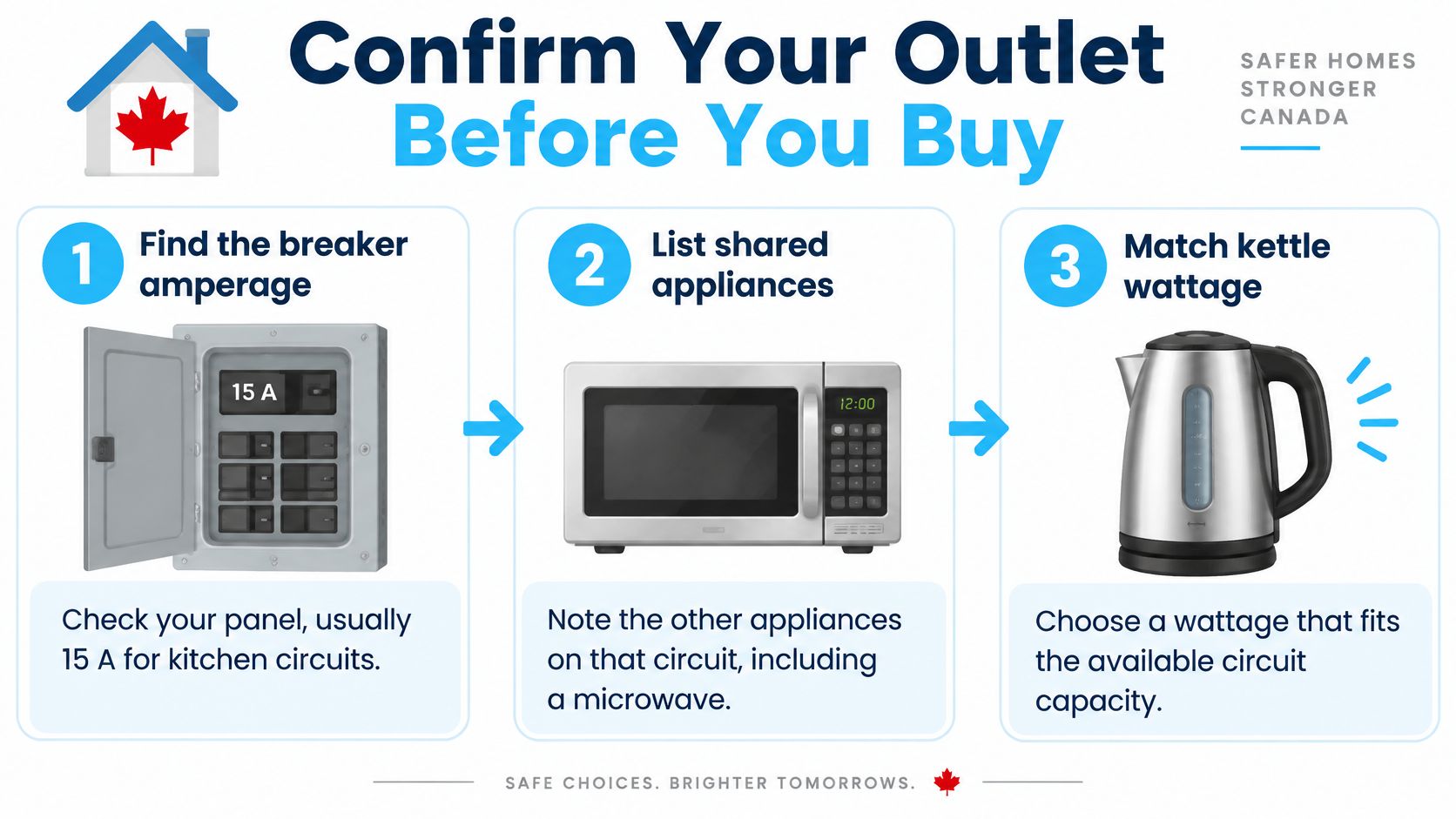
Turn your circuit checks into a shortlist
Use the breaker identification from your circuit check. Base your decision on the marked rating you confirmed, not an assumed kitchen standard.
Use your shared-appliance list. Decide which devices are likely to operate while the kettle heats, including appliances another person may start without warning.
Compare demand with available capacity. Use appliance input ratings, not a microwave's cooking-output rating, and calculate current from rated power and supply voltage where necessary. If ratings are unclear or loads vary, ask a licensed electrician rather than relying on a rough subtraction.
Leave a conservative margin. Don't treat a kettle that only just fits the arithmetic remainder as a comfortable choice. Reduce simultaneous loads, choose a lower-powered model or have a suitable circuit assessed.
Verify the exact model before paying. Check its Canadian certification marking, electrical rating and instructions, rather than assuming that similar-looking regional versions are interchangeable.
Plan a direct wall connection. If the only workable position requires an extension cord or power bar, reconsider the location before buying the appliance.
Match the kettle to the drinks and space. Confirm the minimum fill, usable capacity, base dimensions, CAD price, local availability and return policy.
Know when the calculation isn't enough
A circuit calculation can help eliminate an unsuitable kettle. It can't reveal a loose connection inside a receptacle, confirm the condition of concealed wiring or establish that a previous alteration was done correctly.
Renters should ask the property manager to address uncertain circuit identification or defective outlets. In trailers and other limited-supply settings, account for the site supply and the manufacturer's installation instructions as well as the appliance itself.
Also consider whether the household can realistically follow a shared-load routine. If safe use depends on everyone remembering never to run another countertop appliance, a different kettle or an electrician-assessed outlet arrangement may be more practical.
Choose the lowest wattage that heats your normal batch quickly enough on a circuit that can support it safely. Pay for faster boiling when it solves a real inconvenience, not because a higher wattage promises automatic electricity savings.
Celmin offers Canadian appliance reviews and practical buying guides that explain trade-offs in counter space, electrical compatibility and everyday use. Visit Celmin to compare kitchen appliances and smart-home options, then check your shortlisted kettle's label and outlet requirements before you buy.
Sign up or sign in to join the conversation.