
The Ouaken Electric Composter sits in an odd corner of the kitchen-appliance market: the machine that promises to make food waste less gross, less smelly, and easier to deal with. It is usually sold with the language of composting, fertilizer, and sustainability, but the reality is a bit narr...
The Ouaken Electric Composter sits in an odd corner of the kitchen-appliance market: the machine that promises to make food waste less gross, less smelly, and easier to deal with. It is usually sold with the language of composting, fertilizer, and sustainability, but the reality is a bit narrower than the marketing often suggests. These countertop units are not backyard compost piles in a box. They are usually heat-and-grind waste processors that dry scraps down into a much smaller, lighter output.
This article is not a hands-on review. Nothing here is based on personally using the machine. Instead, the goal is to explain what an electric composter like the Ouaken model actually does, what the listed features imply, and where the line is between waste reduction and true composting. If you are trying to decide whether one belongs on your counter, or whether a freezer scrap bin and municipal green bin would do the job just as well, this is the calmer version of that conversation.
Quick snapshot
| Question | What the Electric Composter actually is |
|---|---|
| Category | Robot Vacuums |
| Made by | Ouaken |
| Typical price | ~$320 CAD (listing at the time of writing — verify current pricing) |
| Rating signal | 4.3/5 on the source listing |
| Best for | Condo kitchens, households bothered by food-scrap smells, people who want to shrink waste volume before disposal |
| Skip if | You want true finished compost, have an easy municipal organics pickup, or dislike filter replacement and countertop clutter |
Pro tip: Treat an electric composter as a food-waste dryer and grinder, not a magic compost factory. If you buy one with that expectation, it makes much more sense.
What the Electric Composter actually is
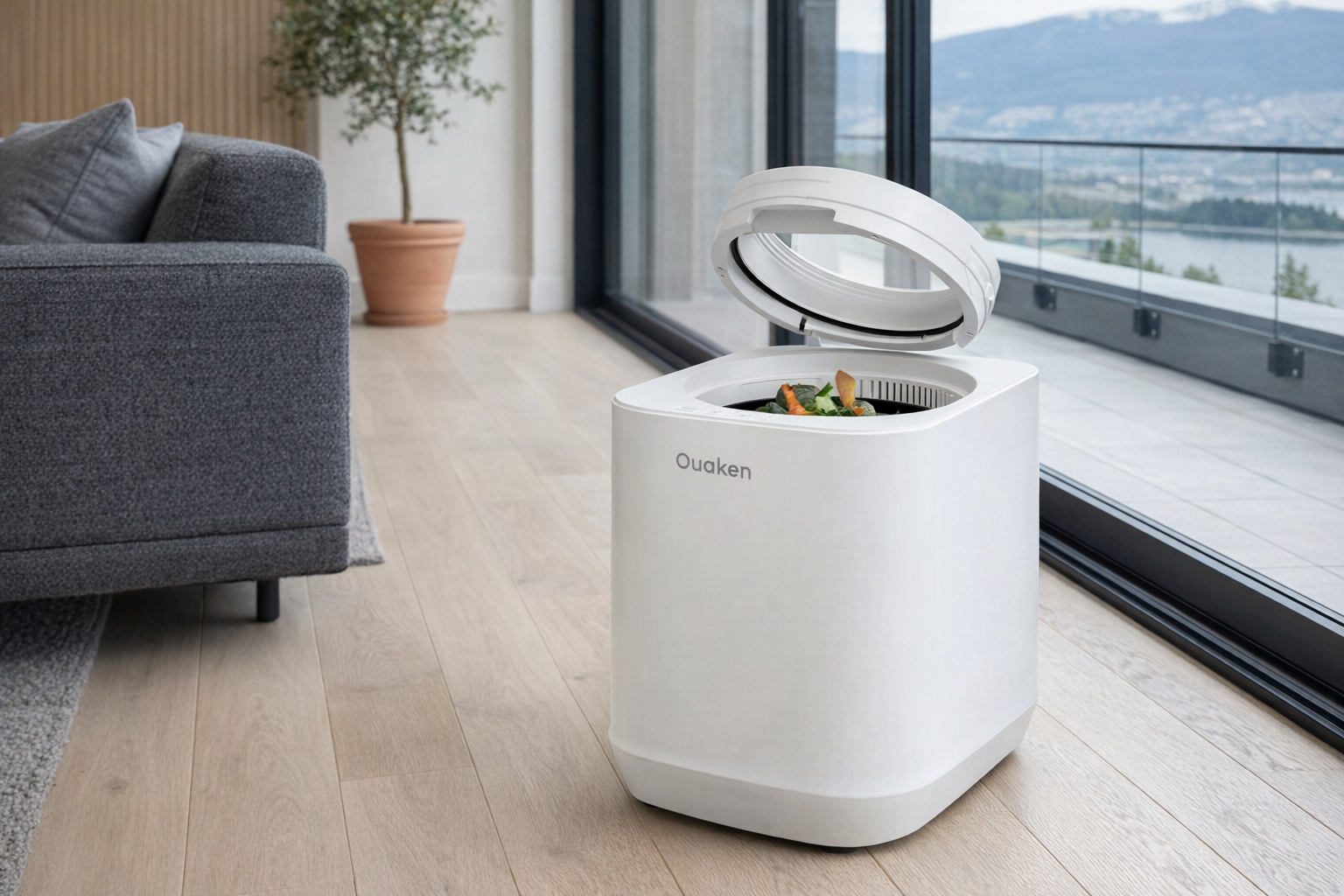
In plain English, the Ouaken Electric Composter is a countertop appliance that takes food scraps, heats them, dries them, and mechanically breaks them down into a dry, crumbly material that takes up less space and smells less than the original scraps. That can be genuinely useful. If your kitchen bin gets ripe quickly, or you live in a condo where taking organics outside is annoying in January, shrinking wet leftovers into a drier output is not nothing.
The bigger point, though, is that this is usually not the same thing as traditional composting. Real composting depends on microbes breaking organic matter down over time. A machine like this speeds up the first part of the process — reducing moisture and particle size — but it typically does not replace the biological curing stage that turns waste into stable compost. In that sense, the Ouaken unit is closer in concept to the Vitamix FoodCycler FC-50 than to an outdoor tumbler composter: both aim to reduce kitchen scraps fast, indoors, and with less mess, rather than recreate a full backyard compost ecosystem on your counter.
Key features at a glance
- Countertop food-waste processing rather than outdoor-bin composting
- Likely combines heat, airflow, and grinding to reduce scraps
- Intended to cut odour and shrink the volume of food waste
- Marketed as producing a dry output that may be used more easily than raw scraps
- Better suited to kitchens and apartments than a traditional compost pile
- Typically requires ongoing cleaning and some kind of filter maintenance
How the Electric Composter actually works
Most electric composters in this class work in three stages: dry, grind, cool. You load in food scraps, the machine heats the chamber to drive off moisture, internal blades or a grinding mechanism break the scraps into much smaller particles, and the result is a dry or semi-dry material that is easier to store or dispose of. That basic mechanism is why these products feel much faster than backyard composting. They are not waiting on worms, bacteria, fungi, and outdoor conditions. They are using electricity to brute-force the wetness out of the waste.
That distinction matters because moisture is the main reason kitchen scraps become such a nuisance. Wet onion peels, fruit trimmings, coffee grounds, leftovers, and vegetable ends get smelly fast. When a machine removes much of that moisture, the volume drops and the smell usually drops with it. That's the practical benefit most buyers are actually paying for at around $320 CAD — not agricultural-grade compost output, but a tidier way to deal with the banana peels and salad ends that pile up through the week.
A realistic way to think about the output is this:
- Fresh scraps go in. These may include fruit and vegetable scraps, coffee grounds, eggshells, and other common kitchen waste, depending on the manufacturer's guidance.
- Heat and airflow dry them out. This reduces weight and smell.
- Blades or a churn mechanism break material down. Smaller particles mean less volume and a more uniform end product.
- A dry residue comes out. That residue may be useful as a pre-compost material, soil amendment in some cases, or simply an easier-to-handle waste stream — but it is not automatically the same as finished compost.
This is why the "grinding versus true composting" conversation matters. Grinding and dehydration are mechanical shortcuts. Composting is biological transformation. A machine can help start the journey, but unless microbes have had time to stabilize the material, the output may still need curing or mixing into a larger compost system before you would want to rely on it in a garden bed. That's a more honest framing than many listings provide.
A realistic "day in the life" with Electric Composter
Because this is an informational piece, the examples below are based on how this category generally works and what the listing implies, not on direct testing.
- Morning. Coffee grounds, a paper filter if allowed by the manufacturer, eggshells, and fruit peels go into the bucket after breakfast. Instead of sitting wet in a caddy all day, the scraps are held for a processing cycle.
- Midday. After lunch prep, onion ends, carrot peels, and cucumber trimmings are added. If the machine is designed for batch use, this is usually the point where a household decides whether there is enough material to run it.
- Afternoon. The unit runs its cycle, using heat and mechanical action to break down the scraps. What that means in practical terms is less wet mass and less of that sweet-rotting smell that usually develops around food waste.
- Evening. A much drier output is emptied into a garden bin, an outdoor compost tumbler, or in some homes directly into the organics stream. For many buyers, this is the real win: not "instant compost," but less mess in the kitchen and less frequent trips to the green bin.
Who the Electric Composter is actually for (and who it isn't)
Great fits
- Condo and apartment dwellers who generate plenty of food scraps but do not have a yard compost setup.
- Busy families whose kitchen organics get smelly long before pickup day.
- People in cold climates who hate carrying dripping food scraps outside during winter.
- Gardeners with an existing outdoor compost system who want a way to pre-process scraps into a drier, smaller ingredient.
- Anyone sensitive to odours who wants less rot on the counter between bin runs.
Poor fits
- Buyers expecting finished compost overnight. That is usually not what these machines actually produce.
- Households with effortless municipal green-bin service where food waste is already easy to dispose of.
- Minimalist kitchens that do not have room for another medium-size countertop appliance.
- People who dislike maintenance tasks like emptying, wiping, and replacing odour filters.
- Anyone trying to save money above all else. At roughly $320.14, this is a convenience appliance, not a budget necessity.
Practical trade-offs
What it produces versus what the marketing suggests
This is the biggest trade-off and the one most worth understanding before buying. The phrase "electric composter" implies that banana peels go in and dark, ready-to-use compost comes out. In practice, the output is often closer to dehydrated food waste flakes or granules than finished compost. That material may still be useful, but it is not automatically stable, cured, or ready for every plant application.
For some homes, that distinction barely matters. If your goal is just to reduce smell and volume before disposal, the machine is doing the core job. But if you are imagining rich compost for raised beds with no further processing, you may be disappointed. Evaluate it like a kitchen waste-management appliance, not like a backyard soil factory.
Filters, odours, and ongoing maintenance
Electric composters are often pitched as cleaner than a countertop scrap bin, and they can be. But "cleaner" does not mean maintenance-free. These machines usually rely on some combination of a sealed bucket, airflow, and an odour-control filter — often charcoal-based in this category — to keep the kitchen from smelling like cooked leftovers.
That means there is an upkeep loop. The bucket needs emptying. Residue may cling to the chamber. Filters eventually need replacement. If you are the kind of buyer who never remembers to descale a coffee maker or replace an air purifier filter, it is worth being honest here. The product can reduce mess, but it also creates a new little maintenance ritual.
Power use, noise, and kitchen placement
Because these machines use heat and mechanical action, they are not silent and they are not passive. A cycle may run for hours depending on the model and load, and during that time you have a warm appliance on the counter doing work. Without exact Ouaken specs supplied here, it is safest to assume standard countertop-appliance logic: keep it on a stable surface, near an outlet, and somewhere the noise and heat will not annoy you.
That placement issue is more important than it sounds. In a large kitchen, an electric composter can fade into the background beside a coffee machine or toaster oven. In a small apartment galley kitchen, it can feel like one more box competing for precious prep space. That is often the real deciding factor, more than the technology itself.
Where the Electric Composter fits in a modern kitchen
The Ouaken Electric Composter makes the most sense as part of a broader kitchen-waste routine, not as a standalone environmental solution. A realistic setup looks something like this:
- A small prep scrap bowl for peels and trimmings while cooking
- The electric composter for reducing wet food waste and controlling smell
- A municipal green bin or outdoor compost tumbler for final disposal or further biological composting
- A freezer bag for items the machine should not take, depending on the manufacturer's accepted-waste list
If you already use a system like the Vitamix FoodCycler FC-50 or have considered one, the Ouaken product appears to fit that same general role: countertop pre-processing for food scraps. If you already have a proper backyard composter, the machine may serve as a convenience add-on. If you already have reliable city organics pickup and do not mind using it, the value proposition gets weaker fast.
In other words, this product fits best in homes where the pain point is kitchen handling, not landfill ethics in the abstract. It is about reducing the annoyance of food waste in daily life.
The buying decision, in plain terms
Three questions usually settle whether an electric composter is worth it:
- Do you want less smell and less volume, or do you want real finished compost? If your real goal is the first one, this kind of machine makes much more sense.
- Do you have the counter space and patience for one more appliance? If your kitchen already feels crowded, the daily convenience may not outweigh the footprint.
- Would your current setup be fine with a cheaper fix? For some homes, a sealed scrap caddy, freezer storage, or regular green-bin use solves the problem for much less money.
If you can answer yes to the first two and no to the third, the Ouaken Electric Composter is a sensible convenience buy — just buy it for what it is, not for what the name implies.
Got Questions About the Electric Composter? Let's Clear Things Up.
Is this a hands-on review?
No. This is an informational explainer based on the product listing, the broader electric-composter category, and how these machines generally work. It is meant to clarify expectations, especially around the difference between drying/grinding and true composting.
Does an electric composter make real compost?
Usually not in the same sense as backyard or municipal composting. Most countertop units primarily dry and grind food scraps into a smaller, drier material. That output may still be useful, but it often needs further decomposition or mixing into a larger compost system before acting like finished compost.
What kinds of food waste can it usually handle?
That depends on the model, and buyers should verify the current product page before assuming anything. In this category, fruit scraps, vegetable trimmings, coffee grounds, and eggshells are commonly accepted, while large bones, excess liquids, and certain fibrous or greasy foods may be more limited. The safest move is to follow the current Ouaken listing and manual.
Does it replace a green bin or outdoor composter?
Not completely for most households. It can reduce how much raw, wet, smelly waste you have to deal with, which is useful, but many homes will still use a municipal organics bin or outdoor compost setup for final disposal or further breakdown. Think of it as a preprocessing step.
Is it worth buying if I already have city organics pickup?
Maybe, but only if the smell, mess, or storage of food scraps is the actual problem. If your green-bin system already works well and you do not mind taking scraps out regularly, an electric composter may be an expensive extra. At around ~$320 CAD, it is easier to justify as a convenience tool than as a pure money-saver.
Where can I verify the current listing or buy it?
The best place to confirm the latest pricing, included parts, and accepted-waste guidance is the product listing itself. Here is the source page: Ouaken Electric Composter on Amazon. Check it before buying, because listings can change.
What does it cost in Canada?
At the time of writing, the listing price is roughly ~$320 CAD. More specifically, the supplied product data lists $320.14 CAD. As with many marketplace appliances, pricing can move around, so verify the current number on the retailer page before checkout.
Where is the Celmin Directory listing for this product?
For a catalog-style view of the same product — structured specs, pros and cons, similar picks, and FAQ — see Electric Composter on Celmin Directory.
If you're building a smarter home in Canada and want honest explainers on gadgets worth considering — plus the ones worth skipping — Celmin covers the full catalog without the marketing theater. More reviews, comparisons, and buyer guides at https://celmin.ca.
Sign up or sign in to join the conversation.