
The Dreo ChefMaker Combi Fryer sits in an interesting corner of the kitchen-appliance market: not just an air fryer, not quite a countertop steam oven, and definitely not a simple toaster-oven substitute. It is part of a newer class of smart combi cookers that try to automate technique, n...
The Dreo ChefMaker Combi Fryer sits in an interesting corner of the kitchen-appliance market: not just an air fryer, not quite a countertop steam oven, and definitely not a simple toaster-oven substitute. It is part of a newer class of smart combi cookers that try to automate technique, not just temperature. DREO's pitch is that the machine can juggle moisture, airflow, and probe-based temperature tracking so food comes out less dried out than what a basic basket-style air fryer usually produces.
This article is not a hands-on review. Nothing here is based on personally cooking with the appliance. Instead, the goal is to explain what the Dreo ChefMaker Combi Fryer appears to do from its listing, how its modes differ in plain English, and who it realistically makes sense for. If the product page makes it sound like a little robot chef and you want the calmer version, this is for you.
📺 Watch: Dreo ChefMaker Combi Fryer in context
Quick snapshot
| Question | What the Dreo ChefMaker Combi Fryer actually is |
|---|---|
| Category | Smart Kitchen |
| Made by | DREO |
| Typical price | ~$499 CAD (listing at the time of writing — verify current pricing) |
| Rating signal | 4.3/5 on the source listing |
| Best for | Home cooks who want more help with proteins, doneness, and guided cooking than a standard air fryer offers |
| Skip if | You want a cheap basket fryer, dislike app-connected appliances, or mostly reheat frozen snacks |
Pro tip: If you buy the Dreo ChefMaker Combi Fryer, think of it primarily as a protein cooker with air-fryer backup, not the other way around. That framing makes the price make a lot more sense.
What the Dreo ChefMaker Combi Fryer actually is
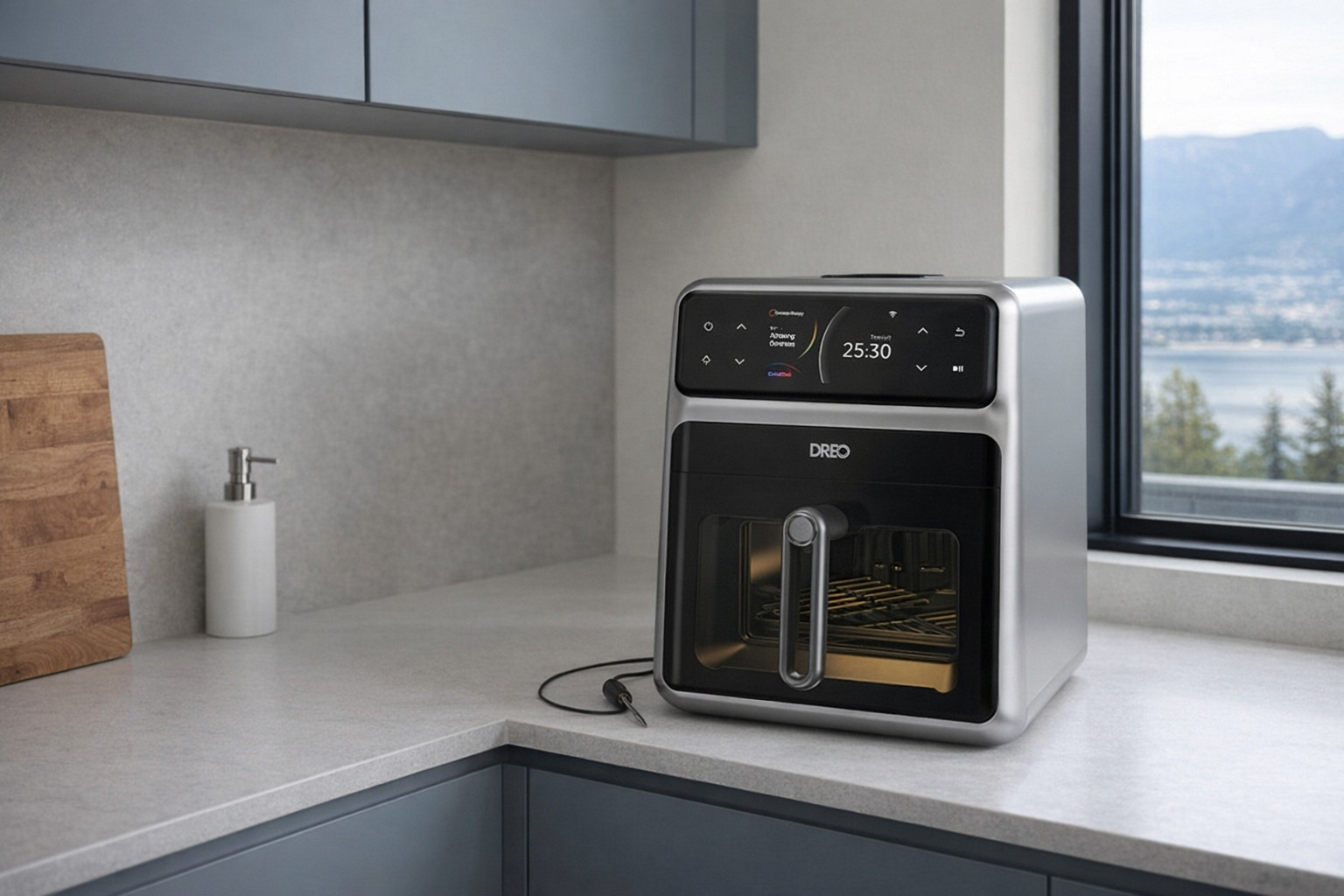
In plain English, the Dreo ChefMaker Combi Fryer is a countertop cooker that tries to solve one of the biggest air-fryer complaints: food browns quickly but can dry out before the inside is done. DREO's answer is to combine super convection heating, a temperature probe, and water atomization into one system, then wrap those into preset cooking programs and a smart app. The result is supposed to be more controlled cooking for things like steak, chicken, salmon, and roast-style meals, while still handling classic air-fryer jobs.
The DREO ChefMaker combines food science and chef mastery to deliver perfectly cooked meals. CombiCook technology translates chef techniques into a smart algorithm controlling precise cook probe, water atomization, and super convection heating.
That description is marketing-heavy, but the actual idea is fairly straightforward. Instead of blasting hot air alone, the machine appears to monitor internal temperature and add moisture when a recipe calls for it. That's the key distinction. A regular basket air fryer is basically a small convection oven with attitude; the ChefMaker is trying to be more of a guided combi cooker.
The clearest real-world comparison is the Tovala Smart Oven Air Fryer, another guided-cooking appliance that leans on software and programmed meal logic. The difference is that Tovala is more oven-shaped and meal-service-adjacent, while the Dreo ChefMaker Combi Fryer looks aimed at people who want that same "the machine knows the method" idea in a more compact, basket-style format. That is a useful niche, and honestly a more honest one than pretending every air fryer is equally good at cooking thick proteins.
Key features at a glance
- CombiCook technology using a precise cook probe, water atomization, and super convection heating
- 3 cooking modes: Chef Mode, Classic Mode, and Probe Mode
- Smart app with step-by-step video-guided recipes and remote monitoring
- 4.3-inch display with a user-friendly interface
- Dishwasher-safe design with a see-through glass basket
- Designed to handle a mix of air fry, roast-style, and temperature-guided cooking tasks
How the Dreo ChefMaker Combi Fryer actually works
The basic idea behind the Dreo ChefMaker Combi Fryer is that it cooks with more feedback than a normal air fryer. Most simple air fryers ask you to pick a temperature and a time, then hope you guessed right. This machine appears to add two extra control layers: a probe to measure the food itself, and water atomization to manage moisture during cooking. That matters most when you're cooking meat or fish, where "golden outside" and "not overcooked inside" are often in conflict.
There are really three systems working together:
- Heat and airflow. The "super convection" part is the familiar air-fryer side: fast-moving hot air for browning and crisping.
- Food-temperature tracking. The probe lets the machine watch internal doneness instead of relying only on time.
- Moisture control. Water atomization suggests the unit can introduce fine moisture during parts of the cooking cycle, which may help prevent the dry-edge problem that standard air fryers can create.
Those systems are then grouped into the unit's three main control styles. Chef Mode appears to be the most automated, using presets and guided recipes that decide how to combine heat, probe input, and moisture. Classic Mode is likely the closest to a conventional air fryer experience, where you manually choose settings for simpler tasks. Probe Mode is the one to pay attention to if you cook expensive proteins, because it shifts the cooking logic toward internal temperature rather than guesswork.
The 4.3-inch display matters more than it sounds. Guided appliances live or die by whether the interface is understandable. A smart oven with a bad screen is just a confusing hot box. The app support also makes more sense here than it does on many small appliances, because remote monitoring and step-by-step recipe guidance actually match the product's purpose. If the machine is supposed to coach you through a steak, a pork chop, or a salmon fillet, software is not just decoration.
Breaking down the modes in plain English
Here is the simpler version of what each mode likely means in actual kitchens:
- Chef Mode: "Tell me what I'm cooking and do the smart part for me." Best for guided recipes, thicker cuts of meat, and anyone who wants the appliance to handle sequencing.
- Classic Mode: "I know what I want — just give me normal air-fryer-style control." Best for fries, wings, nuggets, vegetables, reheating, and straightforward roasting.
- Probe Mode: "Cook this to doneness, not to an arbitrary timer." Best for steak, chicken breast, salmon, pork tenderloin, and anything that gets disappointing fast when overcooked.
And because the special angle here is mode clarity, it is worth spelling out the common cooking styles people will associate with CombiCook:
- Sous-vide-like results: Not literal bag-in-water sous vide, but likely a "gentler, doneness-focused" approach using probe feedback and moisture control.
- Roast: Better for thicker, heartier foods where browning plus interior control both matter.
- Air fry: Crisping-focused, faster, and more familiar.
- Reheat with less punishment: Potentially better than a standard air fryer for leftovers that dry out easily.
- Finish-and-crisp cooking: A hybrid pattern where the machine may keep food controlled first, then brown it later.
That last point is really the appeal. If the ChefMaker works as described, it is less about replacing every appliance and more about reducing the number of times dinner goes from "almost perfect" to "slightly overdone."
A realistic "day in the life" with Dreo ChefMaker Combi Fryer
Because this is an informational explainer, not a tested review, here's what a plausible day with the Dreo ChefMaker Combi Fryer might look like based on the listed features and the category.
- Morning. You use Classic Mode for quick breakfast jobs that do not need much intelligence — crisping hash browns, reheating a breakfast sandwich, or roasting a few breakfast sausages. This is the least glamorous use case, but probably one of the most common.
- Midday. Lunch is leftover chicken or salmon that would usually turn rubbery in a microwave. The ChefMaker's moisture-aware cooking concept suggests it may be better suited than a basic air fryer for reheating without stripping out what little moisture remains.
- Afternoon prep. You open the app, pick a guided recipe in Chef Mode, and follow step-by-step video prompts. This is where the appliance starts to justify being a smart product instead of just an expensive basket with Wi-Fi.
- Evening. Dinner is a thicker protein — say a steak or chicken breast — cooked in Probe Mode so the machine watches internal doneness instead of asking you to trust a timer. That is the use case most likely to separate it from a $99 air fryer.
Who the Dreo ChefMaker Combi Fryer is actually for (and who it isn't)
Great fits
- Home cooks who often make steak, salmon, chicken breast, or pork tenderloin and are tired of overcooking them in standard air fryers.
- Busy parents who want guided dinner help from a screen and app, not just a vague preset called "meat."
- Condo or apartment dwellers who do not want to heat a full-size oven for smaller meals.
- People upgrading from a cheap basket fryer and specifically wanting better results with proteins, not just crispier frozen food.
- Gift buyers shopping for someone who already owns kitchen basics but likes smart, guided appliances.
Poor fits
- Shoppers who mainly cook frozen fries, nuggets, and mozzarella sticks and do not need probe-guided precision.
- Anyone who dislikes connected devices, firmware updates, or recipe ecosystems in the kitchen.
- Cooks who already own a capable countertop combi oven or a strong smart-oven setup and would be duplicating functions.
- People with very limited counter space who want the simplest possible appliance footprint.
- Buyers expecting this to replace a full oven, pressure cooker, dehydrator, toaster, and grill all at once. It is smarter than a basic air fryer, but it is still one countertop appliance.
Practical trade-offs
Moisture control vs simplicity
The headline feature here is water atomization, and that is exactly what makes the ChefMaker more interesting than a generic fryer. It is also what makes it more complex. If you want a machine that just heats aggressively and crisps food, simpler appliances exist for far less than $499 CAD. The Dreo ChefMaker Combi Fryer makes sense only if you actually care about the extra layer of moisture and doneness control.
App dependence and guided cooking
The smart app with video-guided recipes is either a major advantage or a mild annoyance depending on your cooking style. For newer cooks, guided steps can be genuinely helpful. For confident cooks, app-based hand-holding can feel like the appliance is trying to turn dinner into software. Remote monitoring is useful, but evaluate it like a convenience feature, not a reason by itself to spend more.
Cleaning and everyday maintenance
The listing's dishwasher-safe design and see-through glass basket are practical wins. A glass viewing area is nice because it lets you watch browning without repeatedly opening the basket and dumping heat. That said, any appliance dealing with convection airflow, atomized moisture, and meat drippings will still need regular cleaning. More cooking sophistication usually means a bit more cleanup discipline. That's not a flaw; it's just the trade.
Where the Dreo ChefMaker Combi Fryer fits in a modern kitchen
The Dreo ChefMaker Combi Fryer fits best in a kitchen where the cooking lineup is already fairly normal: a full-size oven for big meals, a microwave for speed, and maybe one premium countertop appliance doing the everyday heavy lifting. In that setup, the ChefMaker becomes the weekday dinner machine.
It makes the most sense alongside ecosystems people already use, not instead of them. For example:
- An instant-read thermometer or leave-in probe still helps for double-checking other appliances.
- A meal-planning app or grocery app pairs nicely if you're using Chef Mode recipes regularly.
- A full-size range or wall oven still handles sheet-pan dinners, baking trays, and holiday volume.
- A simpler toaster or toaster oven may still be better for bread and quick snack duty.
If you already own a strong air fryer but hate what it does to lean meats, the ChefMaker may fit as a more specialized upgrade. If you already have a smart oven like the Tovala Smart Oven Air Fryer or a larger combi-style countertop oven, the case is weaker. The Dreo ChefMaker Combi Fryer is most compelling when it becomes your small-batch roasting and doneness-control appliance, not when you try to force it into every kitchen job.
For colder months especially, this kind of cooker has a nice side benefit: it avoids heating the whole kitchen the way a large oven can. That is handy in summer, but also useful during the long "cook at home a lot" stretch many households settle into.
The buying decision, in plain terms
Before buying the Dreo ChefMaker Combi Fryer, three questions usually clarify whether it is a smart purchase or just an expensive curiosity:
- Do you mainly want better results with meat and fish, or do you just want an air fryer? If it's mostly frozen snacks and reheating, this is probably overkill.
- Will you actually use probe-based and guided cooking? If you ignore presets and apps, a lot of the value disappears.
- Is $499 CAD reasonable for a premium countertop helper? This should be judged like a specialty cooking appliance, not like a bargain fryer from a warehouse club.
If those answers are mostly yes, the Dreo ChefMaker Combi Fryer looks like a sensible upgrade for protein-focused home cooking. If not, a cheaper air fryer will probably serve you just fine.
Got Questions About the Dreo ChefMaker Combi Fryer? Let's Clear Things Up.
Is this a hands-on review?
No. This is an informational explainer based on the product listing, its stated features, and the broader combi-cooking category. The goal is to clarify what the modes and features appear to mean in real kitchens, not to report first-hand testing.
What is CombiCook actually doing?
According to the listing, CombiCook combines a precise cook probe, water atomization, and super convection heating. In plain terms, that suggests the machine is trying to balance browning, internal doneness, and moisture retention instead of relying on hot air alone.
What is the difference between Chef Mode, Classic Mode, and Probe Mode?
Chef Mode appears to be the guided, preset-heavy mode for recipe-based cooking. Classic Mode is the simpler manual-style mode for regular air-fryer jobs. Probe Mode is the more precision-focused option for foods where internal temperature matters more than time, such as steak, chicken, and fish.
Can it really replace sous vide?
Not in the strict sense. Traditional sous vide involves vacuum-sealed food cooked in precisely controlled water over time. The Dreo ChefMaker Combi Fryer seems closer to a sous-vide-inspired countertop cooker that aims for gentler, doneness-aware results using a probe and moisture control, without being the same technique.
Is the app actually necessary?
Probably not for every meal, but it appears central to the product's guided-cooking appeal. If you want step-by-step video recipes and remote monitoring, the app matters. If you prefer turning a dial and setting a timer, you may not get full value from what makes this model different.
Where can I verify the current listing or buy it?
The easiest place to verify the latest price, availability, and listing details is the Amazon product page here. That is also where to confirm whether any listed features, included accessories, or software details have changed since this article was written.
What does it cost in Canada?
At the time of writing, the listing shows ~$499 CAD. As with most countertop appliances sold online, pricing can shift during promotions, so it is worth checking the retailer page before buying.
Where is the Celmin Directory listing for this product?
For a catalog-style view of the same product — structured specs, pros and cons, similar picks, and FAQ — see Dreo ChefMaker Combi Fryer on Celmin Directory.
If you're building a smarter home in Canada and want honest explainers on gadgets worth considering — plus the ones worth skipping — Celmin covers the full catalog without the marketing theater. More reviews, comparisons, and buyer guides at https://celmin.ca.
Discussion
Sign up or sign in to join the conversation.