

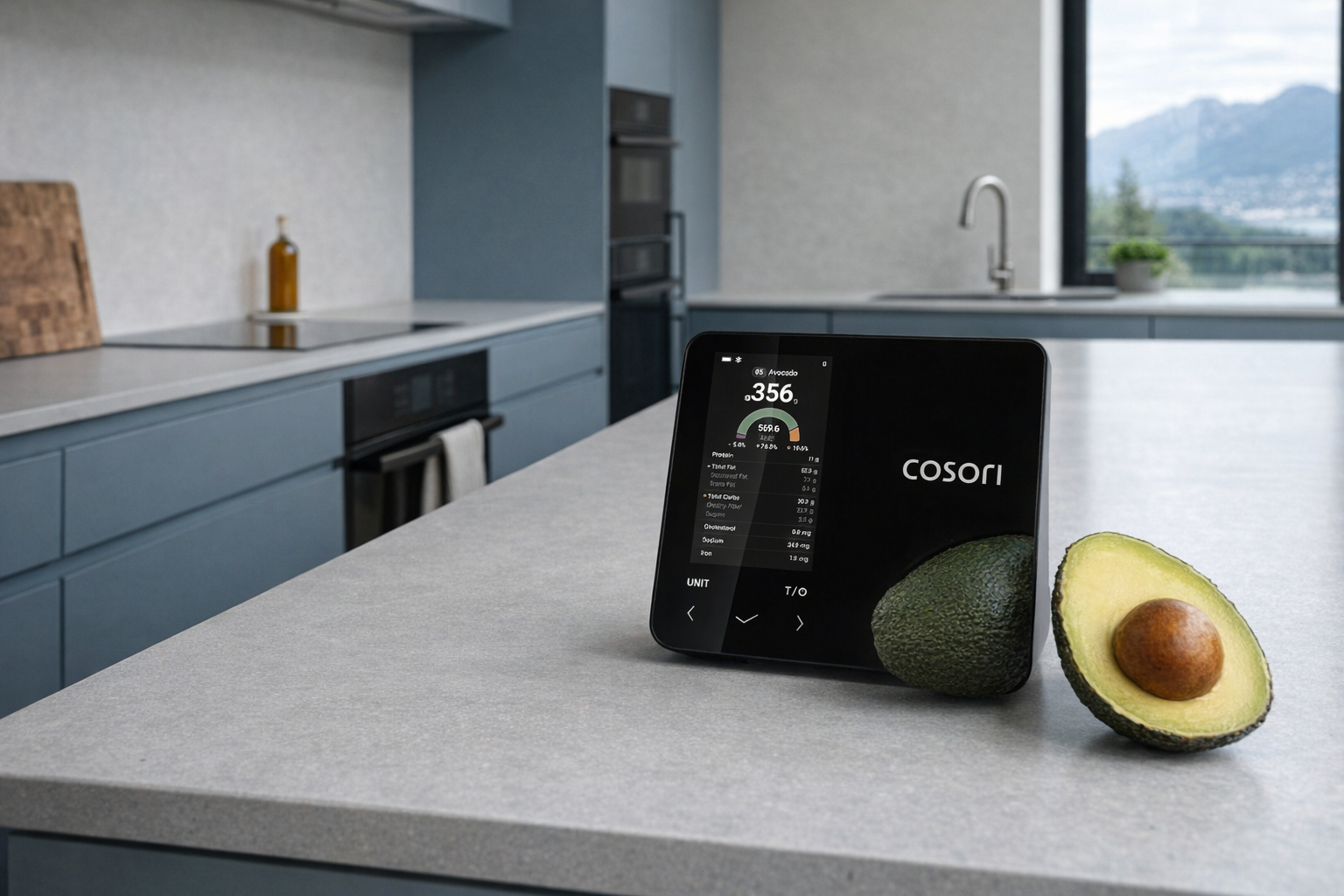
The COSORI Smart Food Scale sits in a very specific corner of the kitchen gadget world: not just a digital scale, and not really a "smart appliance" in the grand, expensive sense either. It is the kind of product aimed at people who already weigh coffee beans, meal-prep portions, baking ingre...
The COSORI Smart Food Scale sits in a very specific corner of the kitchen gadget world: not just a digital scale, and not really a "smart appliance" in the grand, expensive sense either. It is the kind of product aimed at people who already weigh coffee beans, meal-prep portions, baking ingredients, or calorie-tracked lunches — and want the number on the scale to connect to an app instead of living in isolation on a little LCD screen. That sounds minor, but for the right person, that app link is the whole point.
This is not a hands-on review. Nothing here is based on personally using the scale. The goal is simpler: explain what the COSORI Smart Food Scale likely does in real life, what the "smart" part actually adds, where it fits in a kitchen routine, and who should skip it. Because with products like this, the risk is not that they are bad — it is that people buy them expecting far more than a connected kitchen scale can realistically deliver.
📺 Watch: Product demo video available on the retailer page.
Quick snapshot
| Question | What the COSORI Smart Food Scale actually is |
|---|---|
| Category | Smart Kitchen |
| Made by | COSORI |
| Typical price | ~$56 CAD (listing at the time of writing — verify current pricing) |
| Rating signal | 4.6/5 on the source listing |
| Best for | Calorie trackers, macro-focused meal preppers, bakers who want app logging, coffee and nutrition data nerds |
| Skip if | You just want a cheap standalone kitchen scale, dislike using apps while cooking, or do not want your food data tied to a phone |
Pro tip: Buy the COSORI Smart Food Scale for the logging workflow, not for the weighing itself. If you are not realistically going to open the app while cooking or portioning food, a simpler non-smart scale will probably serve you just as well for less money.
What the COSORI Smart Food Scale actually is
In plain English, the COSORI Smart Food Scale is a digital kitchen scale with a companion app layer. The basic job is familiar: place food on the platform, get a weight reading, use tare to zero out bowls or containers, and portion ingredients more accurately than eyeballing them. The "smart" part is that it is designed to connect that measurement to nutrition tracking, recipe logging, or dietary goals on your phone.
That empty description block is telling in its own way. It means the clearest way to understand this product is not by decoding a wall of marketing copy, but by looking at the category it belongs to. A smart food scale is usually less about the physical act of weighing and more about what happens after the number appears. Instead of reading "73 g" and then manually entering that into a food diary, the scale-and-app combination is supposed to shorten that process. If it does that cleanly, it is useful. If not, it becomes a regular scale with extra friction.
The most obvious real-world comparison is the Etekcity Smart Nutrition Scale, another app-connected food scale in the same broader family of connected kitchen tools. The COSORI Smart Food Scale appears to target the same buyer: someone who wants ingredient weights tied to nutrition data and health tracking, not just a bare-bones gram readout. That is a more honest comparison than pretending this competes with a stand mixer or a countertop oven. It does not. It competes with other connected scales and with the very strong alternative of "just buy a normal digital scale."
Key features at a glance
- Digital ingredient weighing for food portions, recipes, and meal prep
- Smart app connectivity for logging or nutritional tracking
- Useful for tare-based measuring with bowls, containers, or prep dishes
- Better suited to tracked eating habits than casual cooking
- Compact countertop role compared with larger kitchen appliances
- Designed for data-minded users who want weights to feed into a wider health workflow
How the COSORI Smart Food Scale actually works
At the hardware level, a smart food scale is still doing the same basic job as any digital kitchen scale: using internal load sensors to detect the weight placed on its platform, then converting that into a readable measurement. The part that makes the COSORI Smart Food Scale different is the phone connection. The scale reading is not meant to stop at the device. It is meant to move into an app where the food can be identified, saved, and used for nutrition tracking.
That creates two layers of value:
- Measurement accuracy. You get a specific weight for ingredients or portions instead of guessing.
- Measurement context. The app can potentially interpret that weight as calories, macros, serving size, or a logged food entry.
That second layer is why people buy a smart scale instead of a plain one. If you are weighing chicken, oats, rice, protein powder, flour, berries, or coffee every day, the repetitive part is often not the weighing. It is the logging. A connected workflow tries to reduce that friction. According to the listing context, this is a scale for people who want data continuity from the kitchen counter to a nutrition app.
A realistic use pattern would look something like this: you place a bowl on the scale, tare it to zero, add one ingredient, note or sync the weight, tare again, add the next ingredient, and keep building a tracked meal or recipe. For calorie counters, that can be meaningfully better than estimating "about half a cup" or "one medium serving." For bakers, it can also help with repeatability, though baking users may care less about the app and more about dependable gram readings.
The key thing to understand is that "smart" here probably does not mean autonomous cooking, voice control, or integration with your oven. It means the scale is part of a digital nutrition workflow. Evaluate it like a fitness accessory, not like a major kitchen appliance.
A realistic "day in the life" with COSORI Smart Food Scale
Because this is an informational explainer, here is what a normal day might look like based on the product category and listing context — not a tested account.
- Morning. You make oatmeal or a smoothie and use the COSORI Smart Food Scale to weigh ingredients instead of relying on vague scoop sizes. The app connection matters most here if you are tracking calories, protein, carbs, or recipe consistency before work.
- Midday. At lunch prep, you portion leftovers into containers and weigh rice, chicken, or salad toppings directly into each one. That makes the scale more useful for meal-prep households than for people who cook loosely and serve family-style.
- Afternoon. You use it for a non-diet task like weighing coffee beans for a pour-over or measuring snack portions. This is where a good scale earns its keep: not only in formal meal logging, but in everyday repeatability.
- Evening. During dinner prep or baking, you place a mixing bowl on the platform, tare between ingredients, and build a recipe by weight. If the app supports recipe logging well, this is where the "smart" side becomes more than a novelty; if it does not, you are mostly using it like a standard digital scale.
Who the COSORI Smart Food Scale is actually for (and who it isn't)
Great fits
- Macro-focused gym-goers who already log food daily and are tired of estimating portions.
- Meal-prep households that portion lunches in batches and want more consistency container to container.
- Bakers who prefer grams over cups and like the idea of keeping recipes and ingredient weights tied to an app.
- People managing dietary goals such as calorie reduction, higher protein intake, or more accurate serving sizes.
- Coffee hobbyists who want one small kitchen scale that can also handle beans and repeatable brew inputs.
Poor fits
- Casual cooks who rarely measure anything and are comfortable with "a handful," "a splash," or "close enough."
- Anyone who dislikes app-dependent gadgets and wants a kitchen tool that works entirely on its own every time.
- Households buying on price alone, because around $56 CAD is more than many perfectly good non-smart kitchen scales cost.
- People expecting broad smart-home magic, like deep Alexa control or appliance automation, from a countertop scale.
- Users who only bake occasionally and would be better served by a plain scale with a good display and reliable tare button.
Practical trade-offs
App dependence
This is the biggest honest trade-off. A smart scale only feels smarter if the app is easy to use and genuinely saves time. If pairing, food search, logging, or syncing feels clumsy, the advantage disappears quickly. That is why products in this category live or die less on the sensors and more on the software around them.
A plain kitchen scale asks almost nothing of you: turn it on, weigh, done. The COSORI Smart Food Scale asks for at least some willingness to keep a phone nearby, open the app, and treat kitchen weighing as part of a digital routine. For some people that is efficient. For others it is kitchen admin.
Countertop practicality
Kitchen scales sound tiny and simple, but the daily reality matters. You need a platform that is easy to wipe down, a display that is readable when a plate or bowl sits on top, and controls that do not become annoying when your hands are wet or dusty with flour. Those details matter more than the word "smart."
This is also a product that needs a stable place in the kitchen. If it is always buried in a drawer, you may use it less often than expected. The buyers who get the most from smart food scales are usually the ones who keep them within reach — next to the coffee setup, meal-prep station, or baking area.
Long-term value
At 4.6/5 on the source listing, the general signal is positive, but smart kitchen tools always raise a fair long-term question: what are you paying for over a simpler version of the same object? If the app remains useful and the scale becomes part of a daily health or cooking routine, then about $56 CAD is reasonable. If the app stops mattering after two weeks, that premium starts to look unnecessary.
That is the lens to use here. Do not evaluate it like a major durable appliance. Evaluate it like a premium accessory that should make one repetitive kitchen task noticeably easier.
Where the COSORI Smart Food Scale fits in a modern kitchen
The COSORI Smart Food Scale makes the most sense in a kitchen already built around small, repeatable routines. Think of it as a companion to:
- A meal-prep setup with glass containers, a rice cooker, and a reliable set of prep bowls
- A baking station with measuring spoons, mixing bowls, and recipes written in grams
- A coffee corner with a grinder, kettle, and dripper where bean dosing matters
- A health-tracking ecosystem that may already include Apple Health, Fitbit-style logging habits, or a calorie-tracking app on your phone
It makes less sense as a centrepiece gadget. It is not the star of the kitchen, and it does not need to be. Its best role is quiet support: helping a person turn "I think this is a serving" into "I know what this weighs." For a lot of nutrition and baking tasks, that is enough.
If your kitchen already includes COSORI products such as an air fryer, the scale can conceptually fit the same style of practical, app-aware cooking setup. But it is worth keeping expectations narrow. The scale is not there to cook. It is there to measure and log. That is a smaller promise, but also a more believable one.
The buying decision, in plain terms
Before buying the COSORI Smart Food Scale, three questions usually clear things up fast:
- Will you actually log food often enough to benefit from app-connected weighing? If yes, the smart layer may be worth paying for. If no, a basic digital scale is probably the better buy.
- Do you care more about nutrition workflow or just accurate weight? If it is mostly about grams and tare, there are cheaper tools. If it is about turning those numbers into trackable food data, this product makes more sense.
- Are you comfortable giving a kitchen gadget a permanent role in your routine? The people who get value from scales like this use them repeatedly, not occasionally.
If those answers are mostly yes, the COSORI Smart Food Scale looks like a sensible buy. If they are mostly no, skip the smart layer and buy a simpler scale.
Got Questions About the COSORI Smart Food Scale? Let's Clear Things Up.
Is this a hands-on review?
No. This is an informational explainer based on the listing details, the product category, and what smart food scales generally imply in day-to-day use. It is meant to help you decide whether this type of scale fits your kitchen routine before you spend money.
What does the "smart" part actually do?
In this category, "smart" usually means the scale connects to an app so food weights can feed into nutrition tracking, recipe logging, or serving calculations. It does not mean the scale is running your kitchen or controlling other appliances. Think connected measurement, not kitchen automation.
Is the COSORI Smart Food Scale good for calorie counting and macros?
That is exactly the kind of buyer this product is most likely aimed at. If you regularly track calories, protein, carbs, or portion sizes, a connected scale can reduce guesswork and shorten the step between weighing food and recording it. If you do not track intake consistently, the smart features may not matter much.
Is it still useful if I only bake?
Possibly, but the answer depends on whether you want the app. Bakers absolutely benefit from weighing ingredients by grams instead of relying on cups, and that alone can improve repeatability. But if you only want accurate baking measurements, a standard digital kitchen scale may do the job for less money.
Does it need to be connected all the time to work?
A product like this should still function first as a scale, with the smart value layered on through the app. The real question is not whether it can weigh without the app, but whether the app experience is good enough to justify paying more than a basic scale. Check the current retailer details and companion-app information before buying.
Where can I verify the current listing or buy it?
The current retailer listing is here: COSORI Smart Food Scale on Amazon. That is the best place to verify up-to-date pricing, availability, listing images, and any app details or included materials that may change over time.
What does it cost in Canada?
At the time of writing, the listed price is roughly ~$56 CAD. As with many small imported kitchen gadgets, pricing can shift with sales, stock, and exchange-rate changes, so verify the current number before checkout.
Where is the Celmin Directory listing for this product?
For a catalog-style view of the same product — structured specs, pros and cons, similar picks, and FAQ — see COSORI Smart Food Scale on Celmin Directory.
If you're building a smarter home in Canada and want honest explainers on gadgets worth considering — plus the ones worth skipping — Celmin covers the full catalog without the marketing theater. More reviews, comparisons, and buyer guides at https://celmin.ca.


Discussion
Sign up or sign in to join the conversation.