
Most buying advice starts with peak temperature, a large cooking surface, and a long list of recipes. That's the wrong order. The best electric frying pan for a Canadian kitchen is the one that still heats evenly, cleans without drama, and has a realistic path to replacement parts after regular use. A pan that sears brilliantly for a few weeks but develops a tired coating or warped base is not a bargain. It's countertop clutter with a plug.
Electric skillets still make sense for specific homes. They can give renters, students, condo residents, and people with limited stove access a separate cooking surface without relying on the main range. Canadian retail listings also show that the category remains active, with electric griddles and skillets available through mainstream channels and secondhand marketplaces, while an electric skillet can sit in an accessible budget tier of about CAD 40 according to a Canadian grocery and appliance retailer's listing on Best Buy Canada's electric griddles and skillets category.
| Canadian buying priority | What to look for | Why it matters |
|---|---|---|
| Daily cooking | A substantial base and even heat distribution | Prevents constant food rotation and burnt zones |
| Low-and-slow cooking | A thermostat with fine adjustment and stable cycling | Broad temperature steps can make simmering unreliable |
| Small kitchens | Removable probe, manageable lid, and vertical storage options | The appliance has to earn its cabinet space |
| Long ownership | Durable coating, washable cooking surface, and available parts | Replacement reality matters more than a glossy feature list |
| Canadian compatibility | A model sold through a Canadian channel with local support | Warranty and parts are harder to resolve across the border |
Table of Contents
- Why Most Electric Frying Pans Fail in Canadian Kitchens
- Technical Specs That Actually Matter for Canadian Homes
- Top Contenders Available in Canada for 2026
- Energy Use and the Reality of Condo Cooking
- Durability, Cleaning, and the Non-Stick Lifespan
- Electric Skillet Versus High-Quality Stovetop Cookware
- Navigating Canadian Retailers and CAD Pricing
Why Most Electric Frying Pans Fail in Canadian Kitchens
An electric frying pan isn't a universal kitchen upgrade. In a standard kitchen with a dependable range and one good skillet, it often duplicates equipment while demanding more storage. The appliance becomes useful when it solves a constraint, such as a weak stove, a shared kitchen, a basement suite, or a condo counter where a second cooking surface is more valuable than another pan in a drawer.
The first failure is usually poor fit, not poor cooking performance. Buyers see a lid, adjustable heat, and a generous shape, then discover that the unit is awkward to lift, difficult to wash, and too large for the cabinet where it was meant to live. A bulky lid can consume more storage space than the pan itself. A permanently attached control assembly makes an otherwise washable surface harder to handle at the sink.
Practical rule: If you can't name the meals this appliance will cook every week, don't buy it yet.
The second failure is the cooking surface. Non-stick makes an electric skillet convenient, but convenience depends on treating the coating gently and accepting that it remains a consumable surface. Metal utensils, abrasive pads, high heat without food, and sudden temperature changes all shorten its useful life. Once the surface starts sticking, many owners stop reaching for the pan, even if the heating element still works.
The storage problem is bigger than the counter problem
Measure the cabinet, not just the counter. You need room for the pan, lid, temperature probe, cord, and any drip tray. A model that fits on the counter can still become a nuisance if the lid can't sit securely on top or the probe has to be wrapped around the appliance.
Shape matters, too. A deep square skillet is more versatile for saucy meals, while a shallow griddle suits pancakes and sandwiches but may not replace a frying pan for stews or braises. Don't confuse a flat electric griddle with a lidded electric skillet just because retailers group them together.
Canadian marketplace feedback reflects the category's uneven reputation. Buyers report disagreements about heat performance and durability, with recurring complaints involving uneven heating, flimsy construction, and coating wear. That doesn't mean every model is poor. It means shoppers should judge the complete ownership experience, not just the first meal.
Technical Specs That Actually Matter for Canadian Homes
Peak wattage is a poor buying shortcut. For Canadian-market electric skillets, mainstream listings commonly sit around 1200 to 1400 watts, including Starfrit The Rock at 1200 watts and Ovente at 1400 watts, as shown in Canadian electric skillet listings on Amazon.ca. That range suits standard 120-volt household circuits, but it does not predict searing quality, temperature stability, or how long the coating will remain usable.
A higher-wattage unit can preheat faster and recover better after cold food goes in. It can also cycle aggressively when the thermostat is poorly calibrated. A well-built 1200-watt skillet with a thick, stable base may cook more evenly than a hotter model that swings between undercooking and scorching.
Thermostat precision beats a dramatic maximum
Most skillets use a removable probe with settings from warming temperatures to roughly 400 to 450°F. Reviews of electric skillets commonly identify thermostat overshoot and broad 50°F increment steps as practical weaknesses. The Oster Canadian instruction manual shows the type of removable-probe system Canadian shoppers will encounter.
That matters most during simmering. A pan may reach a high setting quickly, but overshoot can reduce delicate sauces too aggressively before the temperature settles. Broad controls also force you to manage heat by lifting the lid, stirring, or moving ingredients instead of selecting a dependable setting.
Check the specification sheet and manual for:
- Removable probe: Safer washing and less risk of wetting the control assembly.
- Clear temperature markings: A numbered dial helps only when the manual explains the settings.
- A preheat indicator: It helps prevent cooking on a cold surface, though it cannot prove even heating.
- A thick cooking base: It should limit sharp temperature drops when refrigerated ingredients hit the pan.
- A secure lid: A loose lid wastes heat and makes simmering messier.
Repairability deserves equal attention. Check whether the probe, lid, and other practical replacement parts are sold separately in Canada. If the heating element fails and the appliance has no supported service path, a low purchase price can still lead straight to disposal. Choose controls you can read from above, a manual with useful guidance, and a coating that you can protect with non-metal utensils. Skip a higher maximum setting if your regular cooking depends on controlled heat rather than speed.
Top Contenders Available in Canada for 2026
Canadian shoppers will find a scattered selection rather than a clearly supported lineup. The familiar options differ less in headline wattage than in coating quality, control design, replacement parts, and warranty support. Starfrit The Rock is a recognisable Canadian-market option, while Ovente appears in Canadian listings with a higher rated output. Those figures describe electrical capacity. They do not confirm even heating, durable non-stick performance, or a practical repair path.
Choose an electric skillet only if its countertop convenience solves a real problem. A student may value a low purchase price and simple cleanup. A condo resident may need cooking space away from the range and a lid that stores without taking over a cabinet. A batch cooker should prioritise a stable cooking surface and dependable recovery when refrigerated food hits the pan.
| Model Profile | Capacity & Wattage | Coating & Build | Best For |
|---|---|---|---|
| Starfrit The Rock | Capacity should be confirmed on the current Canadian listing; 1200 watts according to Amazon.ca's Canadian skillet listings | Confirm the current surface specification, base, and construction before purchase | Buyers who want a recognisable Canadian-market option |
| Ovente | Capacity should be confirmed on the current Canadian listing; 1400 watts in the same Canadian listing | Confirm the current coating, base, and parts support before purchase | Buyers who value quicker preheat and recovery |
| Budget electric skillet profile | Often sold as an accessible purchase, with one Canadian retailer listing an electric skillet at about CAD 40 through the Best Buy Canada category | Inspect the probe, lid, cooking surface, and warranty carefully | Students and occasional users |
| Durability-first profile | Capacity and wattage vary by model and should be checked against the Canadian listing | Choose the model with credible parts and warranty support, not the longest feature list | Frequent cooks and batch-prep households |
My recommendation by user type
For a student or occasional cook, buy the simplest Canadian-supported skillet with a removable probe and a washable cooking surface. Eggs, grilled sandwiches, sausages, vegetables, and a one-pan meal do not require an elaborate control panel. If the coating is difficult to clean or replacement parts are unavailable, the appliance may not last through regular use.
For a condo resident, choose a secure lid, readable controls, and a base that stores without complicated disassembly. Keep the unit on a heat-resistant counter section while it runs, with the cord clear of walkways. Countertop cooking is useful when range space is limited, but a bulky appliance that permanently occupies the work surface is a poor trade.
For a batch cooker, favour thermal stability over maximum wattage. Cold ingredients expose weak skillets quickly. A cooler centre or harsh thermostat cycling leaves you stirring and rearranging food instead of cooking a full batch evenly. A thick base, clear settings, and a lid that holds heat matter more than a broad versatility claim.
Inspect the probe, cooking insert, lid hinge, and coating before ordering. If the manufacturer does not support practical replacement parts in Canada, a failed component can turn a modest purchase into disposable cookware.
My strongest recommendation is simple: buy the electric skillet for its access and convenience, not for its peak heating number. If your stovetop already handles frying, simmering, and batch cooking well, put the money toward better stovetop cookware instead. A model deserves the title best electric frying pan only when its coating, controls, and support appear likely to survive daily use.
Energy Use and the Reality of Condo Cooking
Small countertop appliances have become a more important part of Canadian household energy use. Natural Resources Canada reports that energy used by smaller appliances in Canadian homes more than tripled over the past 28 years, even though larger appliances such as electric ranges still dominate direct cooking loads, as shown in its national residential energy trends data. The same dataset lists an electric range at 772 kWh of total annual energy use and 554 kWh of electricity use per household, which puts everyday cooking equipment into a broader household electricity picture.
That doesn't mean an electric skillet automatically uses less energy than a range. Your result depends on cooking time, food quantity, thermostat cycling, and whether the range would otherwise heat a larger cooking zone or oven. The practical advantage is placement. A skillet can move a meal onto a countertop, which may be more comfortable in a small apartment during warm weather when you don't want to heat the room with the main oven.
Counter space and circuit discipline
Measure the operating footprint, not only the stored footprint. Leave room around the hot surface, keep the cord away from the edge, and account for the handle or lid when you turn or serve food. A narrow galley counter may technically fit the pan but leave no safe space for a plate, utensils, or a hot lid.
Don't assume that adding more plug-in appliances is harmless. A kettle, toaster, microwave, and electric skillet competing for the same small kitchen setup can create an inconvenient workflow and may overload a circuit if used together. You don't need to calculate a complex energy model to make a sensible decision. Use one high-load cooking appliance at a time and keep the skillet where you can unplug it easily.
A plug-in energy monitor can help you understand how the appliance fits into your home routine. The smart home energy monitor guide is useful if you want to observe countertop appliance use rather than rely on assumptions.
The strongest condo case is not “this appliance is automatically efficient.” It's “this appliance gives me a practical second cooking surface without turning on the oven.” If that solves a real constraint, the extra footprint can be justified. If you already have a spacious range and ample counter space, the energy argument alone isn't strong enough to warrant another device.
Durability, Cleaning, and the Non-Stick Lifespan
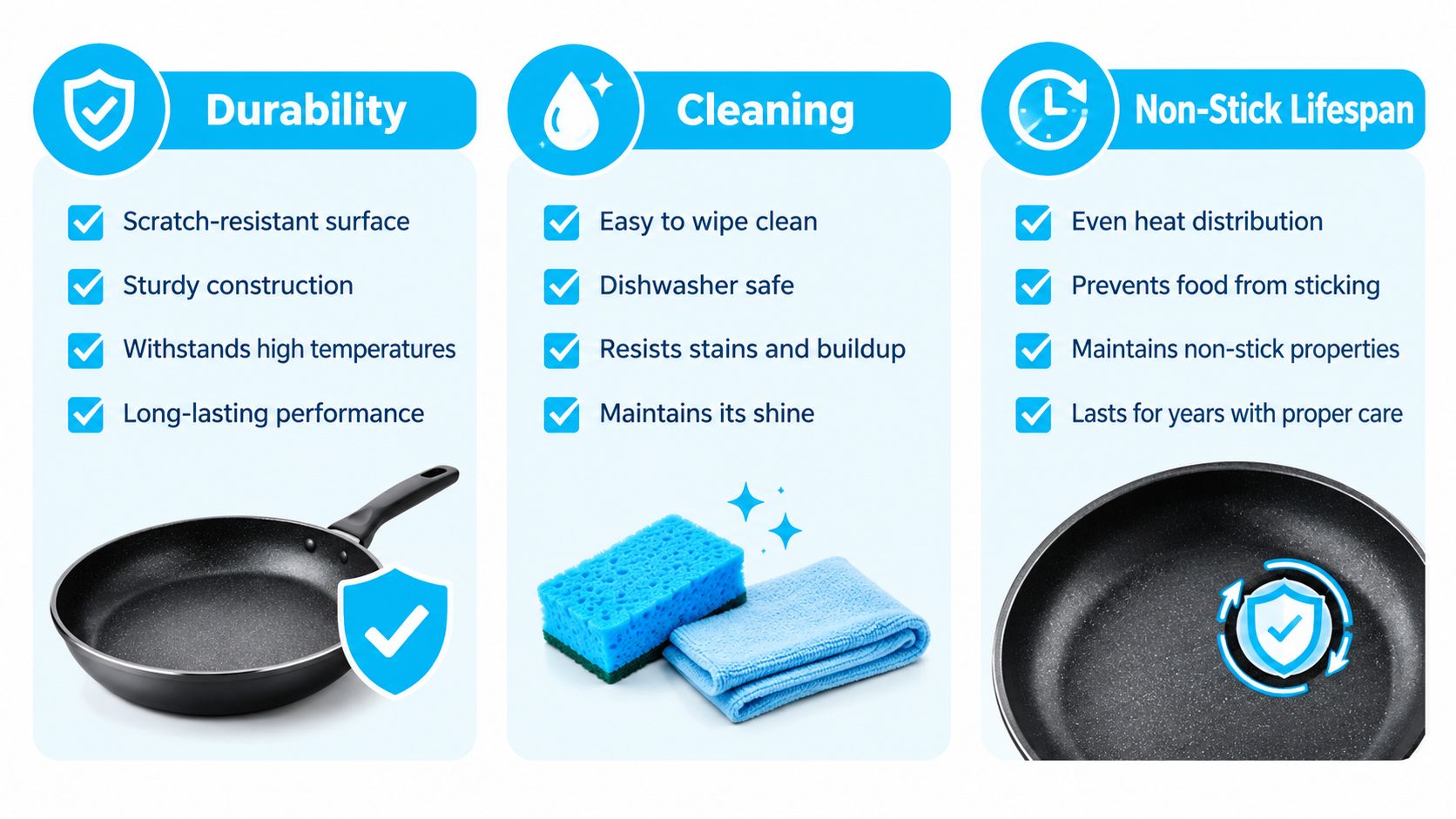
The coating is the part you touch, but the repair path is the part that determines whether the appliance survives. Electric skillets combine a cooking surface, heating element, probe, lid, handles, and sometimes a separate drip system. One weak component can make the whole unit unpleasant to use.
Canadian feedback shows recurring concern about uneven heating, flimsy construction, and coating wear. Some owners report satisfactory performance while others question durability, so you shouldn't treat a high review average as proof that a model will last in your kitchen. The Elite Gourmet Canadian-market feedback and product listing is a useful reminder that opinions can split on both heat performance and long-term build quality.
Cleaning determines whether you use it
A pan that wipes clean in the sink will get used again. A pan with corners that trap grease, a probe that can't be removed, or a lid that needs special handling will gradually lose its place in the weekly routine.
Use the surface like a non-stick pan:
- Use silicone or wooden utensils: Metal tools can scratch the coating and create places where food begins to stick.
- Let the pan cool before washing: Sudden temperature changes can stress the cooking surface and make cleanup less predictable.
- Remove the probe first: Keep the control assembly dry and follow the manual before putting any component near water.
- Treat dishwasher claims narrowly: A dishwasher-safe drip tray or lid component doesn't mean the complete skillet is dishwasher-safe.
- Avoid abrasive cleaners: A soft sponge and mild dish soap protect the surface better than aggressive scrubbing.
A removable probe is a cleaning feature first and a temperature feature second.
The lid deserves close inspection. Glass can make cooking easier to monitor, but it adds weight and needs a safe storage position. Check whether the handle feels secure, whether condensation can drain without running into the control area, and whether the manufacturer sells the lid separately.
Ask what fails first
The heating element may continue working while the coating becomes unusable. The probe may fail while the pan itself remains structurally sound. A lid handle can loosen, or a plastic drip tray can warp. Before buying, search the Canadian product page for replacement probes, lids, inserts, and warranty terms. If the answer is unclear, assume replacement support will be difficult rather than assuming it will appear later.
A slightly higher purchase price can be sensible when it buys a sturdier base, a better-fitted lid, and credible support. It isn't sensible when it only buys decorative trim or a higher maximum setting. The landfill-resistant choice is the product with fewer fragile parts and a clear maintenance routine.
Electric Skillet Versus High-Quality Stovetop Cookware
An electric skillet earns its place when portability or stove access matters more than maximum searing performance. If you have a reliable range, a well-made stovetop pan is usually the better long-term investment. Tri-ply stainless steel and carbon steel offer a more durable cooking path than a short-life non-stick appliance, provided you're prepared to learn their maintenance requirements.
Use this decision matrix:
| Your situation | Better choice | Reason |
|---|---|---|
| Limited or shared stove access | Electric skillet | It creates a separate cooking surface wherever a safe outlet is available |
| Reliable range and regular searing | Stovetop stainless steel or carbon steel | Direct burner control and durable materials suit high-heat cooking |
| One-pan breakfasts and low-mess meals | Electric skillet | The lid, raised sides, and countertop placement can simplify the routine |
| Frequent stove-to-oven cooking | Stovetop pan | An electric skillet usually isn't the natural tool for changing heat sources |
| Need for unattended simmering | Electric skillet, but only with a stable thermostat | The control can maintain heat without occupying a burner |
| Tiny kitchen with almost no storage | Whichever tool replaces more equipment | A compact stovetop pan may win if the electric unit needs a lid and probe |
Choose the electric option when the constraint is physical. Dorms, rentals with poor kitchens, retirement living, temporary renovations, and travel situations can justify the extra appliance. Choose stovetop cookware when the constraint is performance. Browning, rapid heat changes, pan mobility, and long service life favour a conventional pan.
A multi-cooker may be the smarter third option if your priority is pressure cooking, rice, stews, or hands-off meals. It won't behave like a frying pan, so don't buy one expecting a broad shallow searing surface.
Before choosing another plug-in appliance, compare the alternatives in Celmin's induction cooker reviews. An induction cooker with a suitable pan can offer portability without committing you to a permanently coated electric skillet, although it still requires compatible cookware and a safe counter setup.
The honest verdict is simple. Don't buy an electric frying pan because every buying guide calls it versatile. Buy one because its specific shape, lid, and independent heat source solve a problem your existing cookware can't.
Navigating Canadian Retailers and CAD Pricing
Buy from a Canadian retailer or Canadian-facing marketplace, then investigate the seller before checkout. A familiar store may simplify returns, while a marketplace can offer more choice but leaves you checking warranty coverage, plug compatibility, seller reliability, and replacement parts.
The budget tier suits occasional cooking. A Canadian retailer listing an electric skillet at about CAD 40 shows the category is not limited to premium purchases. Verify the current listing, included accessories, and return terms before buying. At this price, inspect the lid, temperature probe, and non-stick coating closely. A cheap pan that loses its coating quickly is not a bargain.
Pay more only for construction and support that can extend the appliance's useful life. Look for a Canadian warranty, a manufacturer that identifies replacement components, and a retailer with a workable return window. Repairability matters because a failed probe or cracked lid can end an otherwise serviceable pan. Cross-border purchases add shipping, warranty exclusions, and unavailable parts that can erase the saving.
Use Celmin's Canadian kitchen-appliance buying guides to compare the skillet with other countertop appliances before committing. Seasonal sales can lower the purchase price, but a discount does not fix weak coating or poor support. Confirm the model number, Canadian availability, support address, and return conditions.
Celmin publishes Canadian appliance reviews and practical buying guides covering local availability, CAD pricing, small-kitchen constraints, and ownership trade-offs. Visit Celmin before choosing an electric frying pan over durable stovetop cookware.
Sign up or sign in to join the conversation.