
Wildfire week changes the way a Canadian home feels. The windows stay shut, the hallway smells faintly smoky, and the question isn't whether to buy an air purifier, it's whether the one sitting in your cart can clear the room you live in.
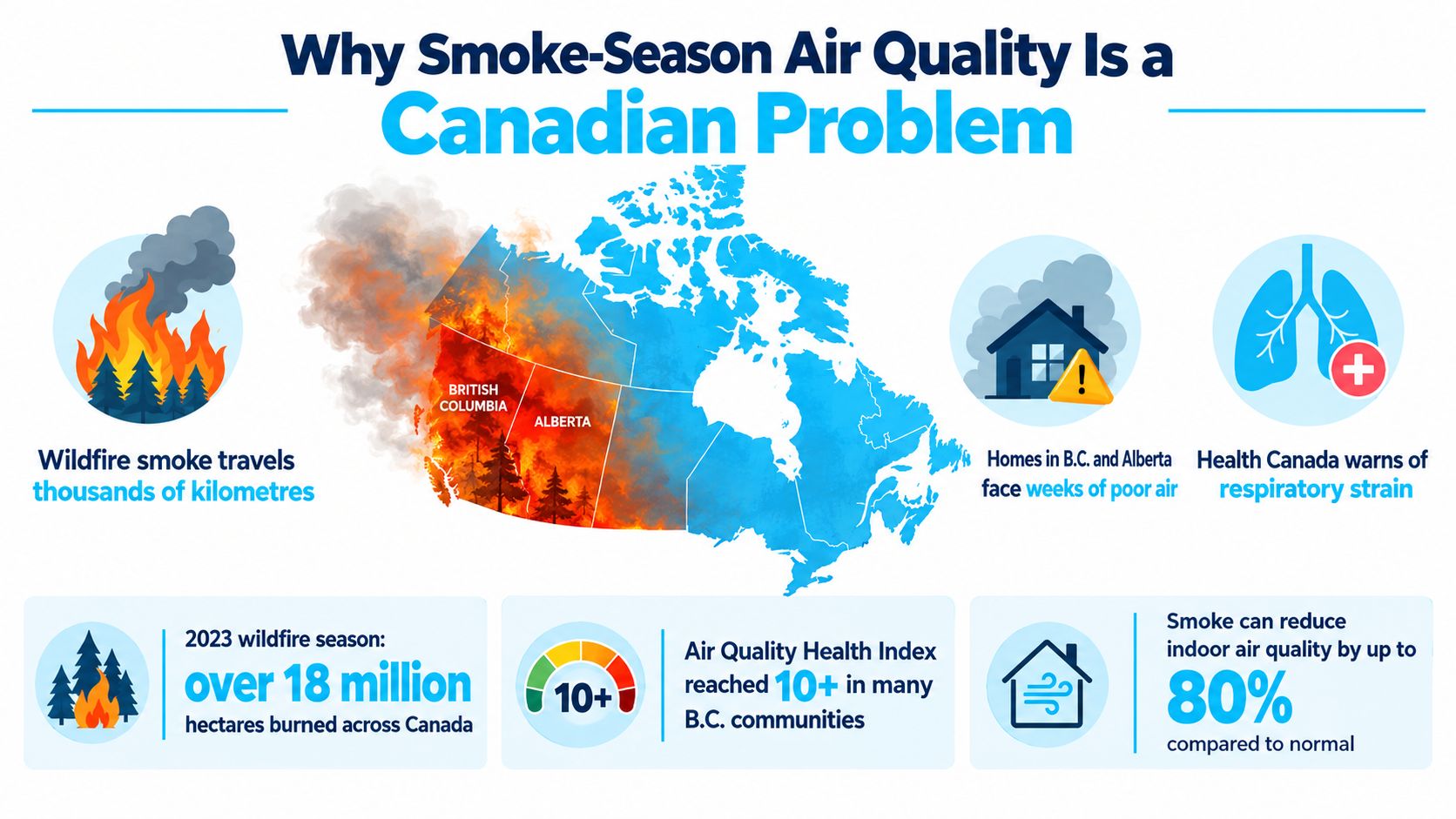
If you're in B.C. or Alberta, this isn't a niche concern. The province's fine-particle assessment found that during the May to October wildfire season, 58 monitoring stations in the 2021 to 2023 period recorded at least one day when wildfire smoke pushed daily PM2.5 above the 24-hour Canadian Ambient Air Quality Standard of 27 µg/m³, and only 66% of assessed stations met the applicable standards over that period, showing how uneven smoke conditions can be from one place, and one year, to the next (B.C. fine PM assessment). A Canadian health-impact analysis also estimated about 1,900 premature deaths per year attributable to wildfire smoke, with an economic valuation of about $18 billion annually, which is why the right purifier has to be sized for smoke, not for everyday dust (Canadian wildfire-smoke health impact analysis).
| Model tier | Smoke CADR (cfm) | Best-fit room | Annual filter cost (CAD) | Notable trait |
|---|---|---|---|---|
| Entry HEPA | 80 to 120 | Small bedroom | Lower end of the range | Good for one closed room |
| Mid-range HEPA | 150 to 220 | Condo bedroom or small living room | Mid-range budget | Strong balance of CADR and cost |
| Large-room HEPA | 250 to 350 | Open-concept apartment or basement | Higher annual budget | Better for bigger Canadian rooms |
| Premium smoke unit | 350+ | Large main floor zone | Highest annual budget | Best when smoke season is relentless |
Table of Contents
- Why Smoke-Season Air Quality Is a Canadian Problem
- The Two Numbers That Decide Which Purifier to Buy
- HEPA, Activated Carbon, and Pre-Filters Explained
- Top CAD-Priced Picks for Canadian Households
- Sizing the Purifier to Your Actual Room
- Filter Replacement and Real Smoke-Season Costs in CAD
- Why Sealing the Room Matters as Much as the Purifier
- Which Purifier to Buy for Your Situation
Why Smoke-Season Air Quality Is a Canadian Problem
A Vancouver condo with its windows taped shut and a Calgary townhouse running the furnace on recirculation face the same indoor-air problem. During wildfire season, you are buying for smoke that travels hundreds of kilometres and enters through normal gaps, ventilation, and opened doors. The purifier must handle fine particles for hours at a time.
Smoke changes the buying decision
Wildfire smoke is more than an odour problem. The main concern is PM2.5, the fine particulate matter that creates the indoor-air burden during smoke events. Activated carbon can reduce some odours and smoke gases, but particle removal remains the first requirement. A unit with weak filtration or insufficient airflow will struggle, regardless of its extra features.
That is why a season-specific buying guide matters in Canada. Homes in the Lower Mainland, the Interior, Ontario, and other areas affected by transported smoke need a purifier sized to the room, with enough smoke CADR to support roughly two to three air changes per hour. Health Canada's two-thirds floor-area rule gives a practical starting point: a purifier should have a smoke CADR of at least two-thirds of the room's floor area in square feet. A 120 ft² bedroom therefore calls for at least an 80-CADR unit.
The strongest smoke performance matters far more than an impressive-looking spec sheet. Annual filter cost matters too, because a purifier that runs through a Canadian smoke season needs replacement filters available at a reasonable CAD price.
Practical rule: If smoke is bad enough to keep the windows closed for the day, make particle filtration the priority and treat odour control as a bonus.
The right setup also depends on what is happening inside the room. A monitor can show whether PM2.5 levels are falling after the purifier starts or whether smoky air continues entering from another area. Celmin's air-quality monitor guide explains how to choose a monitor for that check.
Canadian households do not all need the same machine. A small closed bedroom may suit an entry HEPA unit, while an open living area needs substantially more airflow and a larger annual filter budget. For context on the health burden of wildfire smoke, see the Canadian wildfire-smoke health impact analysis.
The Two Numbers That Decide Which Purifier to Buy
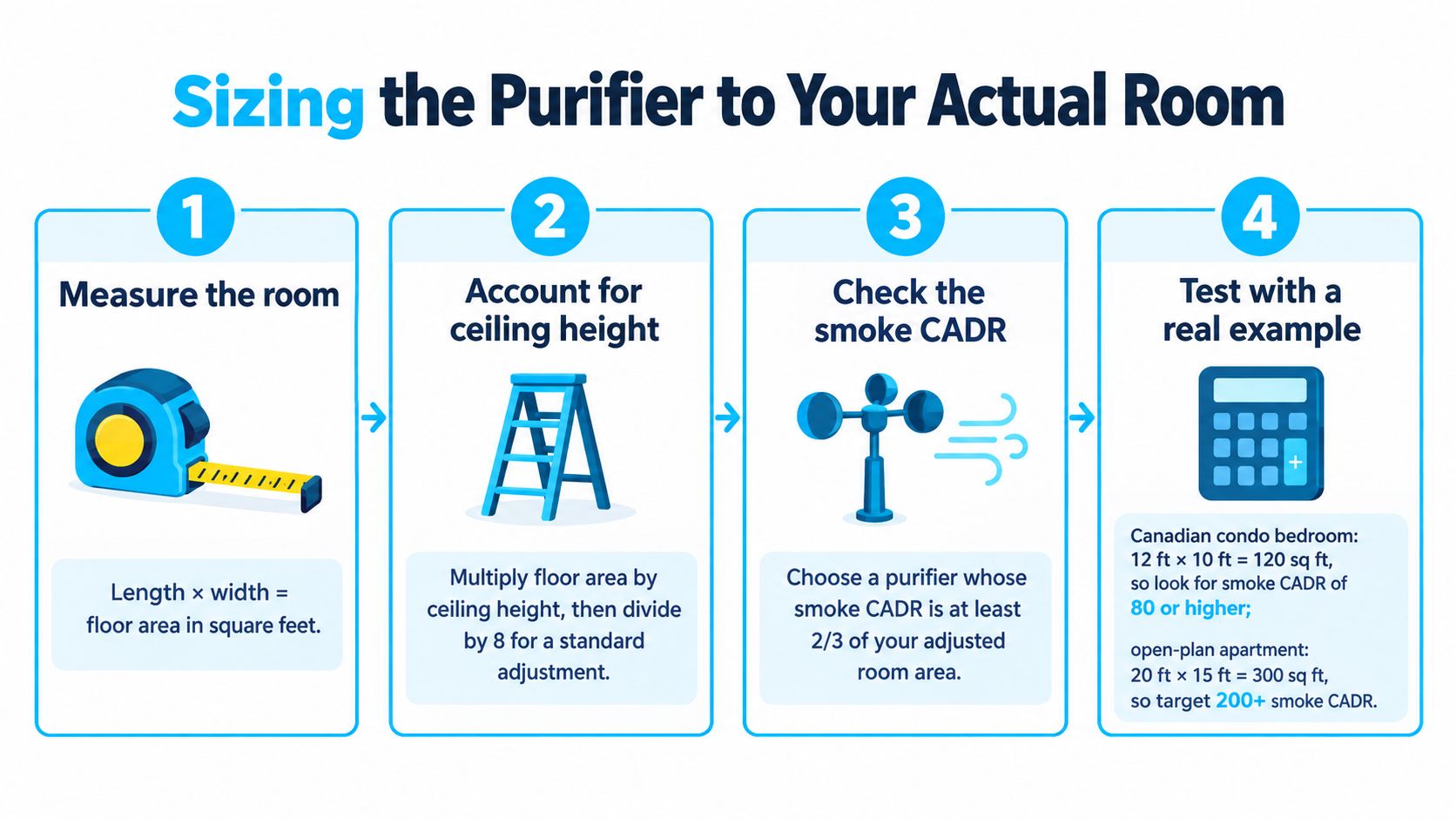
Shoppers comparing purifiers on a retailer page tend to start with brand names and price. Start with smoke CADR and the room size you need to clean, then judge every model against those numbers.
Use smoke CADR, not the marketing room claim
Health Canada's practical rule is clear: choose a portable purifier with a smoke CADR of at least two-thirds of the room's floor area in square feet. A 120 ft² bedroom therefore needs at least an 80-CADR purifier (Health Canada portable purifier guidance). Use that figure while comparing product pages.
Generic coverage claims deserve less trust. Manufacturers often base them on an idealised 8-foot ceiling and present an “up to” room size that can look generous until smoke enters the home. A taller ceiling, open doorway, hallway, or connected kitchen increases the air volume the purifier must handle.
Use the biggest real room, not the smallest convenient one. If one purifier has to protect a bedroom with the door open, size it for the larger connected space.
The second number is air changes. Health Canada recommends filtered airflow equivalent to about two to three room-volume air changes per hour for smoke (Health Canada wildfire-smoke guidance). A purifier can meet a retailer's square-footage claim and still move too little clean air during a serious smoke event.
What the rule means in practice
Treat a purifier that only clears the floor-area test as the minimum. For a smoke week, choose more capacity when your budget and noise tolerance allow it. That gives the unit room to run continuously without relying on its loudest setting.
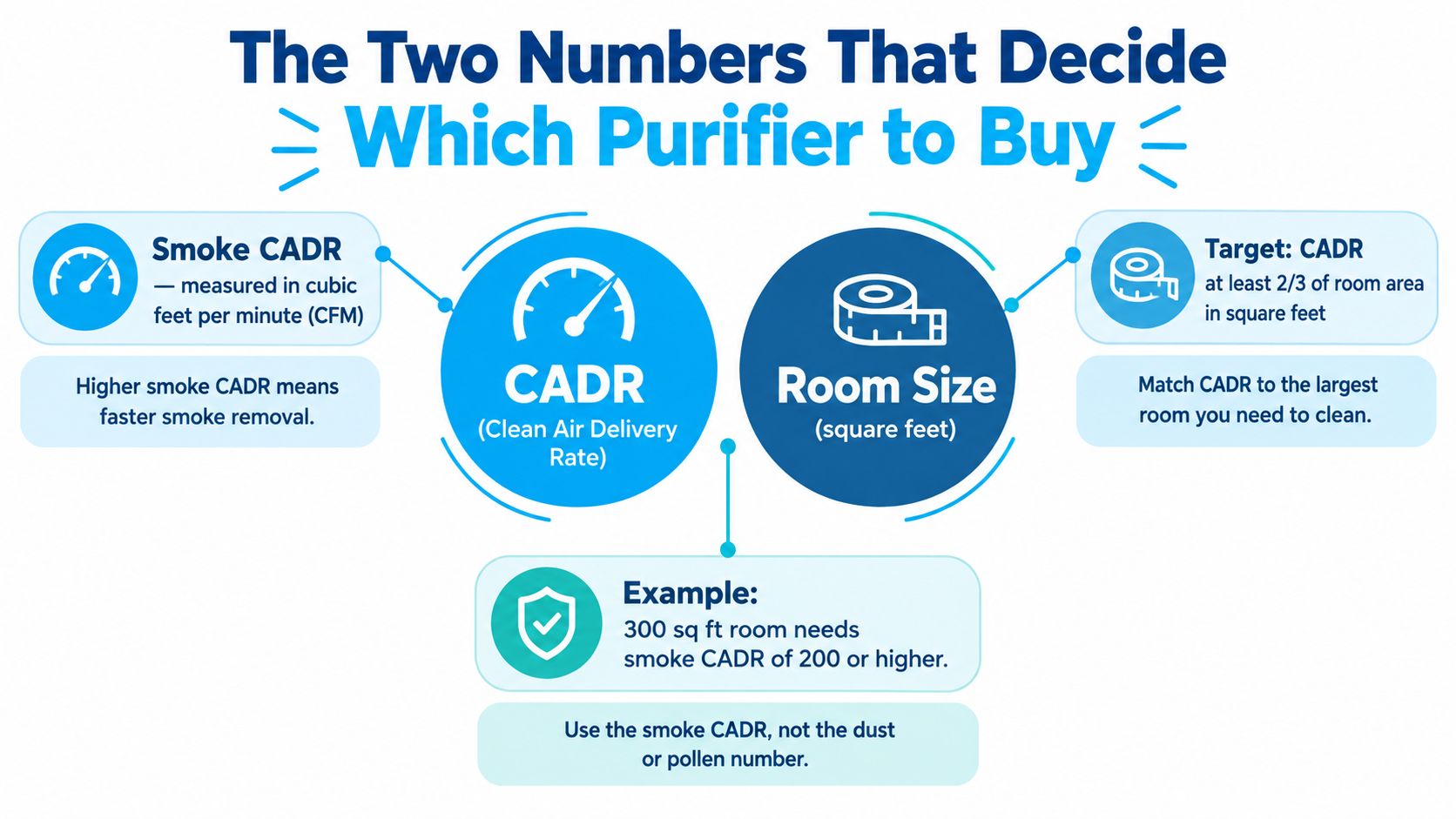
Use this sequence for any room:
- Measure the floor area. Multiply length by width.
- Check the smoke CADR. Use the smoke rating, not the dust or pollen figure.
- Account for ceiling height and open flow. Taller rooms and open-concept layouts need more capacity.
- Aim above the minimum. Oversizing makes sense for a bedroom, nursery, or room used throughout the day.
Celmin's dust-removal guide offers useful context for comparing particle-cleaning behaviour across room types. For wildfire smoke, however, smoke CADR remains the deciding metric. Size the machine to the space you will close off, then budget for the replacement filters required to keep it running through the season.
HEPA, Activated Carbon, and Pre-Filters Explained
A lot of purifier listings make the filter stack sound complicated. It isn't. The order of importance is pretty clear for smoke, and Canadian buyers should read it in that order.
HEPA does the heavy lifting
A true HEPA filter is the workhorse for wildfire smoke because it captures the fine particles that matter most. For PM2.5, that's the core job. If a purifier does not have strong particle filtration, the rest of the spec sheet is window dressing.
That doesn't mean carbon is useless. It isn't. It just means carbon plays a different role. It can help with some smoke smells and certain gases, but it is not the foundation of smoke protection, and Canadian evidence reviews have found only very-low-certainty evidence for sorbent filtration during combustion events (Canadian guidance on cleaner air spaces during wildfire smoke events).
Carbon helps with odour, not the main particle burden
Shoppers get misled here. A thicker carbon layer or a bigger carbon block sounds impressive, but carbon weight is not a standard performance metric. You can't judge smoke cleaning by carbon alone, and you certainly shouldn't pay extra just because a listing uses the word "smoke" next to a carbon cartridge.
A purifier with good HEPA performance and a modest carbon stage is often a smarter buy than a flashy model that over-promises on smell control. If your priority is keeping a bedroom usable during wildfire week, particle removal comes first. Odour reduction is secondary.
Pre-filters protect the expensive part
The pre-filter is the unsung part of the stack. It catches bigger dust and hair before they reach the main HEPA layer, which helps extend the life of the expensive filter. That matters in Canadian homes with pets, older ducting, or a lot of outdoor debris tracked in during smoky weather.
Read the listing like an owner, not a marketer. Ask what the purifier removes first, what the carbon stage is actually for, and how often replacement filters are sold in Canada.
If the spec sheet is vague, look for three things: a true HEPA stage, a visible pre-filter, and replacement availability from a Canadian retailer. Those three details tell you more about smoke-season performance than a glossy lifestyle photo ever will.
Top CAD-Priced Picks for Canadian Households
Here's the quick answer. Pick the tier that matches the room, then check whether the smoke CADR clears the Health Canada rule from the section above.
| Model tier | Smoke CADR (cfm) | Best-fit room | Annual filter cost (CAD) | Notable trait |
|---|---|---|---|---|
| Entry HEPA | 80 to 120 | Small bedroom | Lower end of the range | Best for a single closed room |
| Mid-range HEPA | 150 to 220 | Condo bedroom or small living room | Mid-range budget | Strong all-round choice |
| Large-room HEPA | 250 to 350 | Open-concept apartment or basement | Higher annual budget | Handles larger floor plans better |
| Premium smoke unit | 350+ | Large main-floor zone | Highest annual budget | Better for repeat smoke events |
| Budget compact HEPA | 80 to 100 | Tight bedroom or office | Lowest annual budget | Works only if the room stays closed |
A small condo bedroom should start with the entry tier if the room is closed and the ceiling is standard height. You're aiming for enough smoke CADR to clear the room without paying for more machine than you need. That is where a compact HEPA purifier makes sense, especially if the bed is the clean-air zone and the door stays shut.
A mid-size open-concept room needs the mid-range tier, and many shoppers underbuy here. Open layouts leak air into kitchens and hallways, so the purifier needs spare capacity. A unit at this level is the sweet spot for many Canadian apartments because it balances cleaning speed, noise, and replacement cost.
A finished basement or larger main-floor living zone pushes you into the large-room tier. You're not buying luxury here, you're buying the ability to keep up when the whole house smells smoky. This is the category where continuous operation matters most, because a weak machine never catches up.
A budget-conscious renter should not chase the cheapest unit without checking smoke CADR. A small purifier can be a good buy if it's sized to the bedroom and the door stays closed. For some readers, the smartest option is a single clean-air room, not an underpowered attempt to cover the whole apartment.
Celmin also publishes a Canada-focused purifier guide that compares smoke cleaning, room coverage, HEPA filtration, activated carbon, noise, filter replacement, and local availability, which is a useful cross-check if you want a broader shortlist from a Canadian retailer lens.
Sizing the Purifier to Your Actual Room
Start with the room you use, not the biggest space in the listing. Smoke CADR only works if the purifier matches the room volume and the door stays closed enough to keep the air moving through that room, not the whole apartment.
The bedroom test
A closed 12 ft by 15 ft bedroom gives you 180 ft² to work with. With a standard ceiling, that points to a purifier rated around 120 smoke CADR under the room-sizing rule already laid out earlier. That is the right range for a sleep room you want to keep usable during a smoke week.
Ceiling height changes the math fast. A 10-foot ceiling adds air volume, so the same floor area needs more cleaning power than a standard bedroom with the same footprint. In a room like that, I would not shop by floor area alone. I would size up and look for a stronger smoke CADR than the bare minimum.
The open-plan example
Now take a 180 ft² room with 10-foot ceilings. The floor area looks manageable, but the taller ceiling means the purifier has more air to clear than a typical bedroom. If that room opens to a hall or kitchen, treat it as a tougher space than the square footage suggests.
That is where buyers get tripped up. A purifier can look fine on paper and still feel slow in real smoke. For an open layout, I want more headroom, not a machine that only barely clears the target when the air is calm.
The practical shortcut
Use this rule of thumb while shopping:
- Closed bedroom: Buy to the room volume, not the marketing label.
- Open-plan apartment: Step up one size, because air leaks into adjoining spaces.
- Basement or shared living area: Choose a purifier with clear spare capacity.
- Sleep space first: If one unit cannot cover everything, protect the room where you sleep.
The right purifier is the one that fits your actual room and ceiling height, not the biggest coverage claim on the box.
Filter Replacement and Real Smoke-Season Costs in CAD
The purchase price is only the first bill. Smoke season is where filter budgets get real, and Canadian households should plan for that before the first haze alert hits.
Why maintenance gets expensive in smoke weather
Canadian guidance says clogged portable-cleaner and ventilation filters are not effective during wildfire events, so they need regular replacement. A loaded filter traps smoke particles and chokes airflow at the exact moment you need the most air movement.
That is why real running cost matters. A mid-range unit usually lands in the $50 to $90 per year range for filters in Canada during a normal smoke season. A premium unit with a larger carbon stage can go beyond $120 per year. Those costs belong in the buying decision, not just the sticker price.
Replacement availability matters
A cheap filter that is hard to source is a poor buy. Stick with models that have replacements sold by Canadian retailers or through the manufacturer's Canadian storefront, because cross-border shipping becomes a headache exactly when you need a fresh filter quickly. See our replacement filter cost guide for model-by-model CAD pricing.
There is also a trade-off in how you use the machine. Higher fan speeds clear smoke faster, but they are louder and can wear through filters sooner. Sleep mode helps overnight, yet on a smoky day the purifier still has to move enough air, so do not choose it on quietness alone.
Budget for smoke, not for showroom use. A purifier that looks affordable can become the expensive one after one hard wildfire season.
For renters and condo owners, the smart approach is simple. Buy a unit sized for the room, keep a spare filter on hand, and treat replacements as part of the seasonal cost of living in Canada. If the model is sold through a Canadian retailer and the filters are easy to order, you are more likely to keep using it when the air turns ugly.
Why Sealing the Room Matters as Much as the Purifier
A purifier only cleans the air that stays in the room. If smoky air keeps slipping in through gaps, vents, and open windows, the unit spends its time chasing a moving target.
The first-hour checklist
Close windows and doors, cut off unnecessary exhaust fans, use HVAC recirculation if your system allows it, and install a MERV 13 or higher furnace filter if the system can handle it. In a leaky Canadian apartment, those steps can matter as much as the purifier itself.
A clean-air bedroom usually beats trying to treat an entire home with one portable unit. A sealed room gives the purifier a fighting chance, because it is working on the air inside instead of constantly replacing smoke that gets pulled in from outside.
Do this as soon as a smoke advisory starts:
- Close the space: Shut windows and doors in the room you want to protect.
- Cut unnecessary exhaust: Avoid fans that pull in outside air unless you need them.
- Seal obvious gaps: Use weatherstripping, a towel at the door gap, or other simple fixes.
- Run the purifier continuously: Do not wait until the room smells smoky.
- Use HVAC recirculation if available: Keep outdoor intake as low as possible during the event.
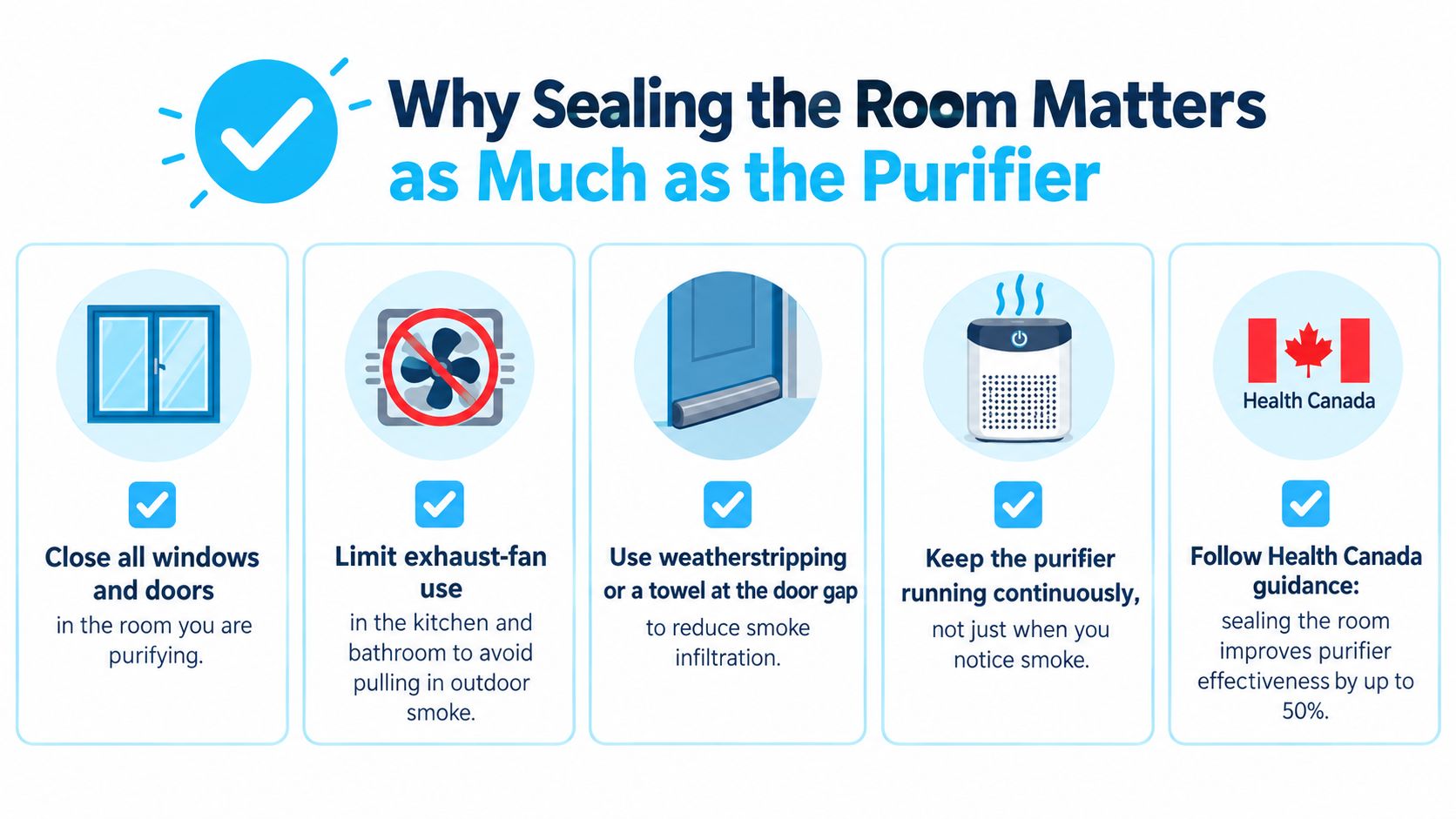
Portable purifiers have a clear limit. They are mainly single-room devices, even though some studies have found lower whole-home PM2.5 under certain conditions. In older homes and draftier apartments, sealing the room is what turns a decent machine into real protection.
Which Purifier to Buy for Your Situation
A Vancouver condo renter with one bedroom should buy a compact or entry HEPA unit with a smoke CADR of at least 80, and ideally a little more if the room stays open to a hallway. Keep the bedroom closed, run the unit continuously, and treat that room as your clean-air zone. The filter budget should stay at the lower end unless smoke season drags on.
A Toronto open-concept apartment should step up to the mid-range tier, because open layouts punish undersized machines. You want a purifier that comfortably clears the main living area, not one that barely covers a brochure-sized room. Expect a mid-range annual filter budget and keep the doors shut to the bedroom if you want the unit to work hard where you sleep.
A Calgary single-family home with a finished basement needs the large-room tier or two strategically placed units. One purifier rarely protects an entire floor plan during a smoky stretch. If you insist on one machine, make the basement or bedroom the priority and seal the room aggressively.
A household with a regular indoor smoker or fireplace user needs stronger particle removal and a filter plan that assumes faster clogging. Smoke load rises fast, so buying at the minimum doesn't make sense. Go up a tier, keep replacement filters on hand, and don't expect odour control alone to solve the problem.
A budget buyer under $200 CAD should focus on a small bedroom or office, not a whole apartment. If the unit lacks the smoke CADR for the room, save longer. A correctly sized cheap purifier beats an underpowered one every time.
A few quick answers:
- Sleep mode noise: Good units get quiet enough for bedrooms, but smoke-cleaning usually needs a higher setting during the day.
- Ozone-emitting models: Skip them. Smoke problems need filtration, not extra chemistry.
- Pet hair and dander: A pre-filter helps, but smoke is still the priority.
- Baby nursery: Yes, if the purifier is correctly sized, runs continuously, and the room stays sealed.
Celmin publishes Canadian buying guides that focus on room fit, local availability, and realistic ownership costs, which is exactly what matters during wildfire season. If you want more Canada-first product advice with CAD pricing and practical room sizing, visit Celmin and use the same smoke CADR rule to narrow your shortlist before you buy.
Sign up or sign in to join the conversation.