

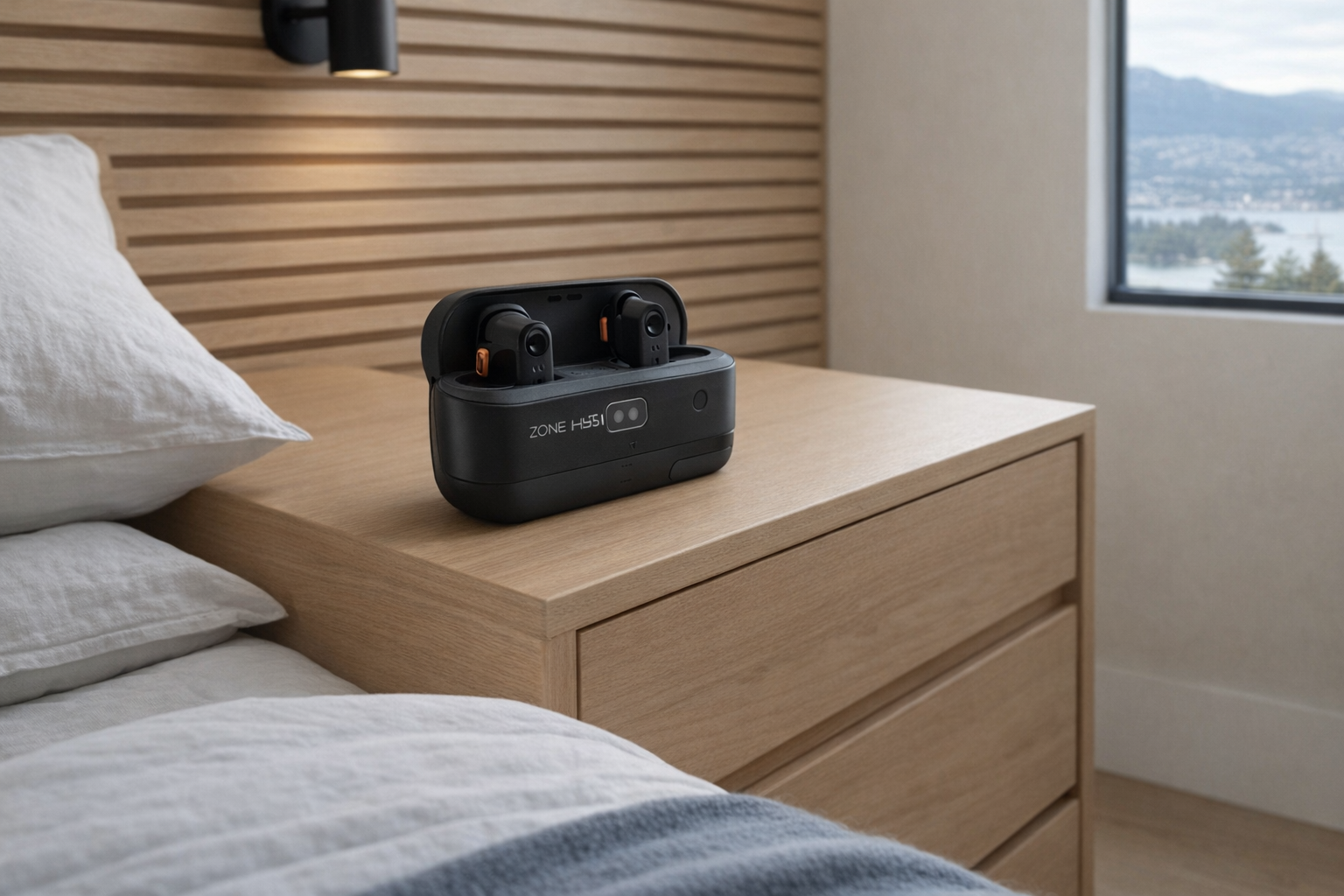
The ZONE HSS1 AI Companion by CT5 Inc. sits in an awkward but genuinely interesting category: the AI wearable that is meant to stay on your body, not in your pocket. That sounds like a small distinction, but it matters. Most "AI devices" are still just phones in disguise, or smart glasses tha...
The ZONE HSS1 AI Companion by CT5 Inc. sits in an awkward but genuinely interesting category: the AI wearable that is meant to stay on your body, not in your pocket. That sounds like a small distinction, but it matters. Most "AI devices" are still just phones in disguise, or smart glasses that ask you to tolerate a camera on your face all day. The ZONE HSS1 is trying a different approach — a screen-free, voice-first wearable with hybrid audio, live translation, and a built-in 12MP camera with 2K video, all in a body that reportedly weighs 90g.
This is not a hands-on review. Nothing here is based on personally testing the device. The goal is simpler: explain what the ZONE HSS1 AI Companion actually is, how its design differs from more familiar AI wearables and earbuds, and who it realistically makes sense for. If you are curious about screenless AI gadgets but want a calmer read than the marketing page, this is for you.
📺 Watch: ZONE HSS1 AI Companion in context
Quick snapshot
| Question | What the ZONE HSS1 AI Companion actually is |
|---|---|
| Category | AI Wearables |
| Made by | CT5 Inc. |
| Typical price | ~$345 CAD (listing at the time of writing — verify current pricing) |
| Rating signal | Check current reviews |
| Best for | Travellers, voice-first gadget fans, people who want translation and quick AI access without staring at a screen |
| Skip if | You want a display, all-day private listening without an external speaker, or a camera-free wearable |
Pro tip: Think of the ZONE HSS1 as a wearable voice layer, not a phone replacement. It makes more sense beside your smartphone and regular earbuds than instead of them.
What the ZONE HSS1 AI Companion actually is
In plain English, the ZONE HSS1 AI Companion is a lightweight wearable built around the idea that AI should be something you can talk to naturally while moving through the day. Instead of making you pull out a phone, tap a screen, and squint at text, it aims to deliver responses through audio — using an open speaker when appropriate and a detachable in-ear module when you want more direct listening. Add live translation, a camera for photos and 2K video, and a companion app with privacy controls, and the pitch becomes clearer: this is part assistant, part translator, part body-worn capture device.
ZONE HSS1 is the world's first multi-user AI wearable designed for a natural, screenless AI experience. Developed by South Korean innovator CT5 Inc., it combines hybrid audio (open speaker + detachable in-ear module), real-time AI translation, a 12MP camera with 2K video, and privacy-first settings — all at just 90g.
The most obvious comparison is the Humane Ai Pin, another screen-light AI wearable that tried to move phone tasks into a voice-driven gadget you wear on your body. Based on the listed features, the ZONE HSS1 looks more grounded. It does not appear to be chasing projector tricks or pretending to replace every computing device you own. A 1200mAh battery rated for up to 24 hours, hybrid audio, and a simpler screen-free model are, on paper, a more honest design than many competitors in this still-immature category.
Key features at a glance
- Screen-free voice-first AI interaction
- Real-time AI translation
- 12MP camera with 2K video
- Hybrid audio with open speaker and detachable in-ear module
- 1200mAh battery rated for up to 24 hours
- Privacy-first companion app
- Lightweight 90g design
- Multi-user wearable concept according to the listing
How the ZONE HSS1 AI Companion actually works
The basic idea is straightforward: instead of looking down at a phone, you speak to a wearable and hear the response back through either the open speaker or the detachable ear module. That means the ZONE HSS1 is built around audio as the main interface, not a display. If that sounds obvious, it is worth spelling out, because it changes the entire user experience. This is not a smartwatch where notifications flash on your wrist. It is closer to wearing a small AI comms device that happens to include a camera.
There are a few layers to how the listed feature set likely comes together:
- Voice input. You speak commands, questions, or translation prompts to the device.
- Audio output. Responses can play through the open speaker for quick, ambient use, or through the detachable in-ear module for more private listening.
- Camera-assisted capture. The 12MP camera and 2K video capability suggest it can record moments or possibly support visual context for the app ecosystem, though buyers should verify exactly how visual AI features are handled on the current spec page.
- Companion app and cloud services. The privacy-first app likely handles setup, permissions, updates, and feature management. Real-time translation especially tends to rely on cloud processing or connected app support, so treat internet dependence as something to verify before buying.
What makes the ZONE HSS1 distinct is the hybrid audio setup. A lot of wearables force a single compromise: either everyone around you hears the device, or you stay isolated inside earbuds all day. CT5's design is trying to split the difference. Open speaker audio is convenient for quick prompts when you are walking, cooking, or working at a desk. The detachable earbud is the escape hatch for translations, longer responses, or situations where broadcasting the answer would be rude.
The "multi-user" language in the listing is also notable. That suggests the device is meant to function in shared environments rather than assuming one person, one isolated earbud, one personal screen. In practical terms, that may matter most for translation use, family use, or quick back-and-forth conversations where more than one person is involved. It is an intriguing idea, though one that buyers should interpret carefully until CT5's documentation spells out exactly what multi-user support means in practice.
A realistic "day in the life" with ZONE HSS1 AI Companion
Because this is an informational piece, the scenario below is based on what the listed features imply, not on direct use.
- Morning. You clip or wear the ZONE HSS1 before leaving home and use voice commands for a quick question without unlocking your phone. The open-speaker mode makes sense here: you want a fast answer while making coffee or packing a bag, not a deep private session.
- Midday. On transit, at an airport, or in a meeting break, the detachable in-ear module becomes more useful. A translation exchange or longer AI response is easier to hear privately than through an outward-facing speaker, especially in a noisy space.
- Afternoon. You spot something worth capturing and use the built-in 12MP camera for a photo or 2K video clip. That is not the same as replacing a good phone camera, but it does make more sense than asking an audio-only wearable to somehow document the moment.
- Evening. Battery life matters most late in the day. If the listed 1200mAh battery really delivers close to the promised up to 24 hours, the device can remain useful into the evening rather than becoming yet another thing to recharge by dinner. That claim should still be treated like any battery estimate: best case, not guaranteed.
Who the ZONE HSS1 AI Companion is actually for (and who it isn't)
Great fits
- People who already use voice assistants heavily and are tired of constantly pulling out a phone for simple tasks.
- Frequent travellers who see real value in real-time AI translation and do not want to rely only on a handset screen in the middle of a conversation.
- Commuters, walkers, and delivery or field workers who need hands-free access to short answers, audio prompts, or quick capture.
- Gadget enthusiasts who are curious about the post-smartphone category and are comfortable living with early-generation trade-offs.
- Users who want occasional private listening but do not want both ears blocked all day by standard earbuds.
Poor fits
- Anyone expecting a full phone replacement. This is still a companion device, not the centre of your digital life.
- Buyers who dislike wearing visible tech on the body or who already find earbuds, smartwatches, and glasses annoying.
- Privacy-sensitive households or workplaces where a wearable 12MP camera is likely to make other people uncomfortable.
- People who want everything to happen on-device without app setup, updates, permissions, or possible cloud dependence.
- Users who need a screen for maps, long text, visual confirmations, or accessibility reasons. A screenless device is not automatically simpler for everyone.
Practical trade-offs
Privacy
This is the first real buying question, and it is not a small one. The ZONE HSS1 combines always-available voice interaction with a 12MP camera. Even if CT5 emphasizes privacy-first settings, the device still asks for a high level of trust because it can hear and see parts of your day.
That does not make it uniquely dangerous; it makes it a wearable that deserves the same scrutiny you would give smart glasses, a doorbell cam, or a voice assistant in the kitchen. Check how recording works, what the visual capture indicators are, what the app stores, and how data can be deleted. If you already know you do not want a body-worn camera, the rest of the product becomes irrelevant very quickly.
Audio realism in public
The hybrid audio idea is smart, but it also points to a practical tension. Open-speaker responses are convenient only when the environment allows them. In a quiet office, on a packed bus, or in a waiting room, having your wearable talk out loud may be awkward fast.
That is why the detachable ear module matters so much. It is not just a bonus accessory; it is what keeps the product usable in the real world. Even so, buyers should go in expecting to switch modes depending on context. Evaluate it like a flexible audio tool, not a magic one-mode solution.
Battery and charging discipline
A 1200mAh battery with a claim of up to 24 hours sounds encouraging, especially in a category where some AI wearables struggle to make it through normal routines. But battery claims are almost always based on ideal conditions. Frequent translation, camera use, and active AI interactions are the exact kinds of features that tend to reduce runtime.
So the healthy assumption is this: the ZONE HSS1 may be capable of lasting through a long day, but you should not buy it expecting phone-like endurance with constant heavy use. If you are the type of person who already juggles a phone, smartwatch, earbuds, and laptop charger, this becomes another device in that routine.
Where the ZONE HSS1 AI Companion fits in a smart life
The ZONE HSS1 does not fit neatly into a traditional smart-home stack because it is not really a home device. It fits better as a mobile edge device in a broader personal-tech setup.
A realistic arrangement looks something like this:
- Your smartphone still handles maps, long messages, payments, photos that need proper framing, and all the things screens are actually good at.
- Regular earbuds such as AirPods or Galaxy Buds still make sense for music, calls, and long-form listening comfort.
- Smart-home assistants like Amazon Alexa, Google Home, or Apple HomePod still run lights, plugs, thermostats, and routines at home.
- The ZONE HSS1 AI Companion sits in between those categories as the thing you wear when you want immediate AI access, quick translation, and occasional capture without diving into a phone.
That is the healthiest way to think about it. Not as the new centre of your tech life, but as a specialist layer. If you frame it that way, the product makes more sense. If you expect it to replace your phone, earbuds, and smart speaker all at once, disappointment is much more likely.
For travel, it arguably fits even better. A phone handles boarding passes and booking apps. Noise-cancelling earbuds handle flights. The ZONE HSS1 becomes the lightweight conversation and quick-query tool you keep ready while moving through airports, hotels, and unfamiliar streets. That is a narrower role, but often a more believable one.
The buying decision, in plain terms
Before buying, three questions usually get you to the right answer:
- Do you actually want a screenless AI device, or are you just tired of your phone? If you still rely on visual feedback for most tasks, a wearable without a screen may feel limiting rather than freeing.
- Will you use the translation and hybrid audio features enough to justify the price? At about $345 CAD, this is easier to defend as a travel or communication tool than as a novelty gadget.
- Are you comfortable wearing a microphone-and-camera device in public and around other people? If that social and privacy friction already sounds annoying, it will not get better after purchase.
Three yeses make the ZONE HSS1 a plausible buy. If even one of those is a firm no, you are probably better off with good earbuds and the AI apps already on your phone.
Got Questions About the ZONE HSS1 AI Companion? Let's Clear Things Up.
Is this a hands-on review?
No. This is an informational explainer based on CT5 Inc.'s published details and the broader state of AI wearables. It is meant to clarify what the ZONE HSS1 appears to offer, not replace direct testing or long-term reviews.
Does the ZONE HSS1 have a screen?
The listed features position it as a screen-free voice-first AI wearable. That means the interaction model is based on speaking and listening rather than tapping on a display. If you need visible menus, maps, or long text, that is an important limitation to think through before buying.
What makes it different from normal wireless earbuds?
The big difference is that the ZONE HSS1 is not just an earbud set with voice access. According to the listing, it combines open-speaker audio, a detachable in-ear module, real-time translation, and a 12MP camera with 2K video in a body-worn AI device. In other words, it is trying to be a wearable assistant platform, not just an audio accessory.
Is the camera likely to replace your phone camera?
Probably not, and buyers should keep expectations sensible. A 12MP camera with 2K video is useful because it gives the wearable its own capture ability, but that does not automatically mean flagship-phone image quality or the flexibility of a phone screen for framing and editing. Think convenience first, not photography-first.
Does the ZONE HSS1 work well for travel and translation?
On paper, yes — that is one of the most convincing parts of the pitch. Real-time AI translation paired with wearable audio makes more practical sense than many AI gimmicks because it addresses a real situation: conversation across languages while your hands are busy. The details that still matter are supported languages, connection requirements, and how the translation flows in noisy environments, all of which are worth verifying on the official site.
Where can you verify the latest details or buy it?
The safest place to confirm current pricing, feature details, and availability is the official retailer page here: https://zonehss.com/. Because AI products can change quickly through app updates, service changes, or revised bundles, it is smart to check the live listing before ordering.
What does it cost in Canada?
At the time of writing, the listed price is ~$345 CAD. As with many niche gadgets, that can change with promotions, shipping, or bundle adjustments, so verify the current price on the seller's page before buying.
Where is the Celmin Directory listing for this product?
For a catalog-style view of the same product — structured specs, pros and cons, similar picks, and FAQ — see ZONE HSS1 AI Companion on Celmin Directory.
If you're building a smarter home in Canada and want honest explainers on gadgets worth considering — plus the ones worth skipping — Celmin covers the full catalog without the marketing theater. More reviews, comparisons, and buyer guides at https://celmin.ca.



Discussion
Sign up or sign in to join the conversation.