
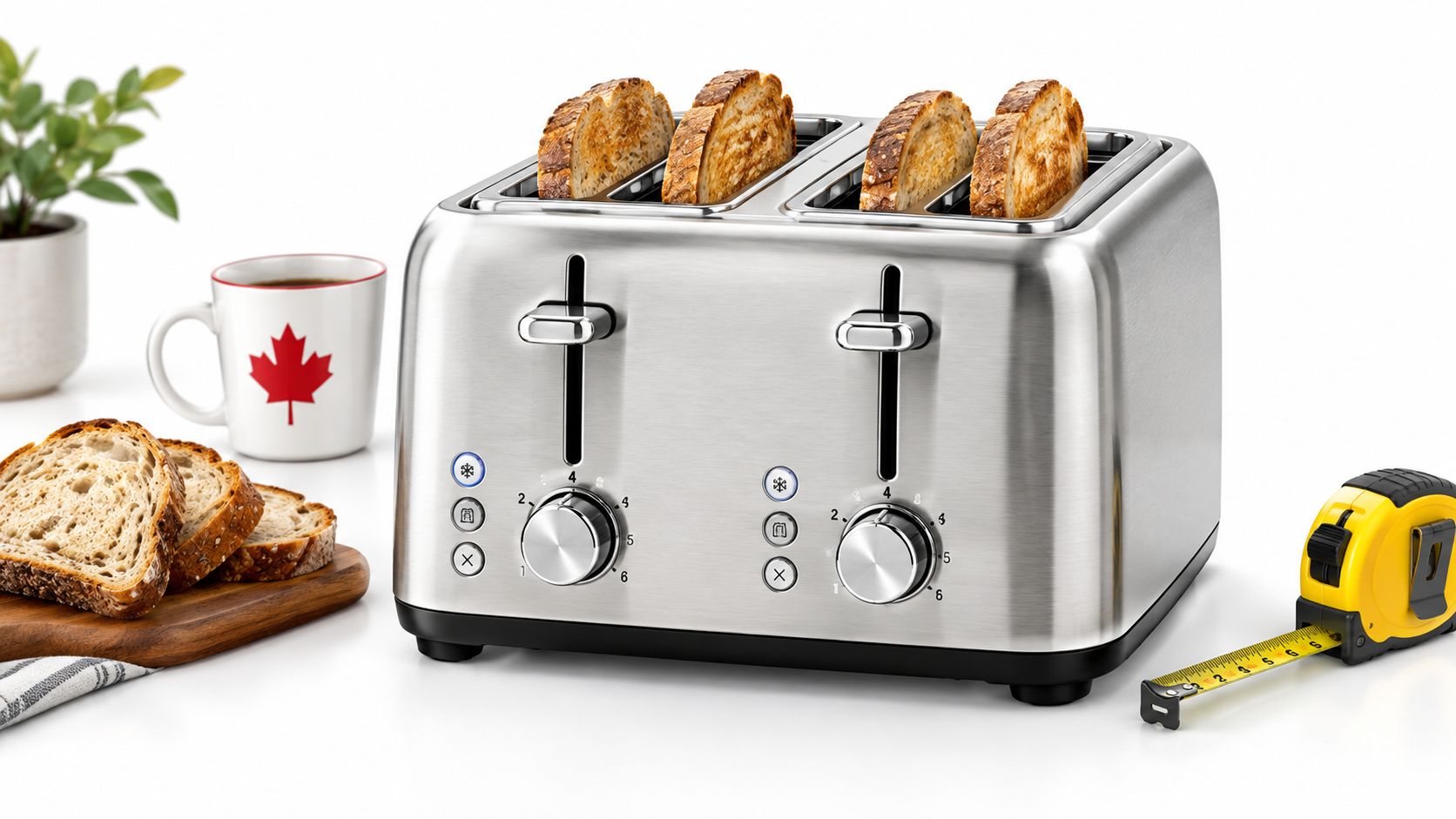
The popular advice is simple: choose a stainless steel 4-slice toaster because the metal looks premium and should last longer. That shortcut misses the decisions that matter most in a Canadian kitchen. Stainless steel describes the exterior, not the quality of the heating elements, the electrical protection, the repair pathway, or the amount of counter space the appliance will occupy every morning.
A four-slot toaster can be a sensible upgrade for a household that prepares several slices at once. It can also become an oversized countertop fixture that saves little electricity, performs poorly with half-loads, and gets replaced rather than repaired after the warranty ends. The right choice depends on capacity, control layout, slot design, certification, serviceability, and available space, not the finish alone.
Table of Contents
- Looking Past the Stainless Steel Finish
- Evaluating Countertop Footprint and Controls
- Understanding Slot Configurations and Wattage
- The Reality of Energy Use and Batch Convenience
- Navigating Repairability and Long-Term Value
- Maintenance Routines and Final Buying Verdict
Looking Past the Stainless Steel Finish
Stainless steel is mainly a material and finish choice. It can complement other appliances, resist some surface wear, and make crumbs or fingerprints easier to notice, but it doesn't prove that the internal wiring is safe or that the heating system will remain reliable. A polished shell can hide an inexpensive carriage, fragile controls, or a design that offers no practical post-warranty service.
A Canadian recall makes the distinction clear. On July 17, 2019, Health Canada announced a recall of Bodum Bistro stainless-steel two-slice and four-slice toasters because the appliances could leak electric current while operating at their maximum normal temperature, creating a shock hazard. The affected four-slice model was SKU 11840-16, and the products had been sold in Canada from January 2018 through June 2019. By July 9, 2019, the company had received 8 reports of electrical shock in Canada, although no injuries were reported. Approximately 1,480 affected units were sold in Canada, compared with about 2,400 in the United States. Health Canada's recall notice identifies the affected Bodum Bistro toaster models and hazard.
Practical rule: Treat stainless steel as an appearance and cleaning feature. Treat certification, model identification, and recall status as safety checks.
What to verify before buying
Look for recognized Canadian electrical certification on the appliance or its documentation. Don't assume that a stainless enclosure, a familiar brand name, or a higher shelf position means the product has better electrical protection. If the product listing makes certification difficult to verify, ask the retailer or manufacturer before ordering.
Record the exact model number, not just the product family. A recall can apply to a specific SKU rather than every stainless-steel toaster made by the brand. Keep the receipt and packaging information until you've confirmed that the model is eligible for Canadian support and isn't subject to a federal recall.
Durability also starts inside the shell. A sturdy-looking exterior won't compensate for a carriage that sticks, controls that fail to register settings, or elements that brown one side more aggressively than the other. Product photos can't answer those questions, so prioritise manuals, warranty terms, replacement-part information, and clear Canadian availability.
The finish still has value. It suits modern kitchens and usually wipes clean easily, provided you avoid abrasive pads that scratch the surface. It just shouldn't be your reason for assuming the toaster is safer or longer-lived.
Evaluating Countertop Footprint and Controls
A four-slice toaster earns its space by changing the morning workflow. It can produce a full round of toast in one cycle, but it also occupies a wide, permanent area on a counter that may already hold a kettle, coffee machine, microwave, or dish rack. In a condo kitchen, the relevant question isn't whether four slots sound useful. It's whether the appliance can stay accessible without turning food preparation into a daily rearrangement exercise.
Measure the counter area before shopping. Include clearance above the toaster when the carriage is raised, room around the sides for safe handling, and enough access to the crumb tray. Don't measure only the metal base. A toaster that fits between two cabinets may still be awkward if the lever hits an underside or if you can't remove the tray without moving the appliance.
Compare the space you actually have
| Toaster Type | Average Footprint | Control Zones | Best For |
|---|---|---|---|
| Two-slice toaster | Compact counter presence | Usually one zone | One or two people with limited space |
| Four-slice toaster with shared controls | Broad counter presence | One zone | Batch use where matching settings matter |
| Four-slice toaster with independent controls | Broad counter presence | Two zones | Households toasting different breads or quantities |
| Compact toaster oven | Larger depth and clearance needs | Varies by model | Users who need broader cooking functions |
“Average footprint” isn't a fixed industry measurement, so use the retailer's published dimensions and measure your own counter. For renters who store appliances after use, check the weight and cable position as well. A wide appliance may be manageable once, but tiresome to lift into a cupboard every morning.
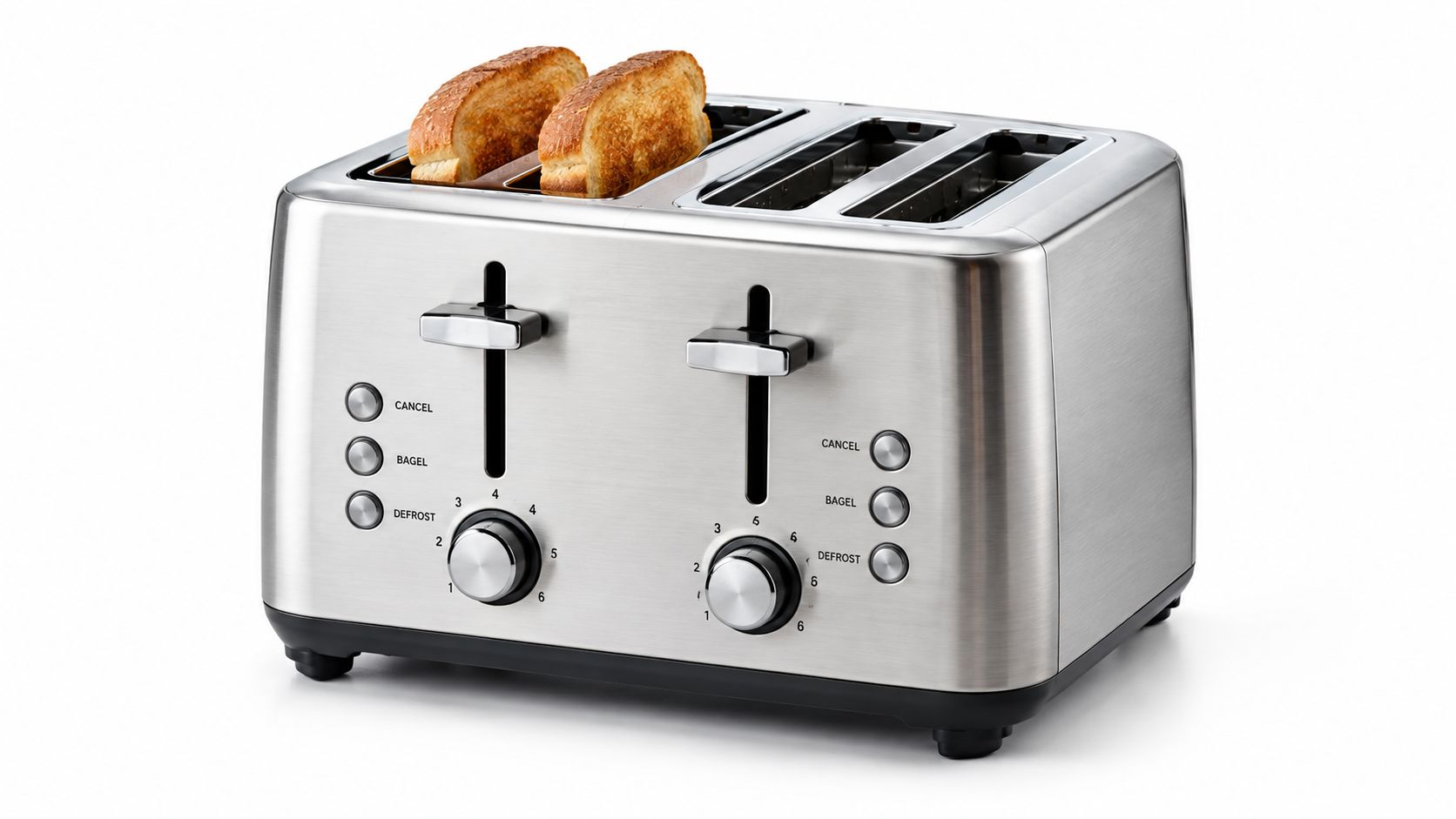
Independent controls are usually the more useful design. They let one pair of slots operate while the other pair remains empty, and they allow different browning settings for white bread and dense sourdough. Shared controls simplify the front panel, but they reduce flexibility and can make a four-slot body feel wasteful when only two people are eating.
Small-kitchen test: Put masking tape on the counter around the published footprint. Leave it there during a normal breakfast routine. If the taped area blocks your preferred work surface, the toaster is already telling you something.
A four-slice appliance also competes with a compact toaster oven. If you want to compare that alternative, Celmin's mini toaster oven guide is relevant because a smaller oven may consolidate functions, though it usually needs more depth and ventilation clearance.
Choose four slots when simultaneous timing improves your routine. Choose two slots when the larger body would remain in storage, obstruct your prep area, or force you to unplug and move other appliances each day.
Understanding Slot Configurations and Wattage
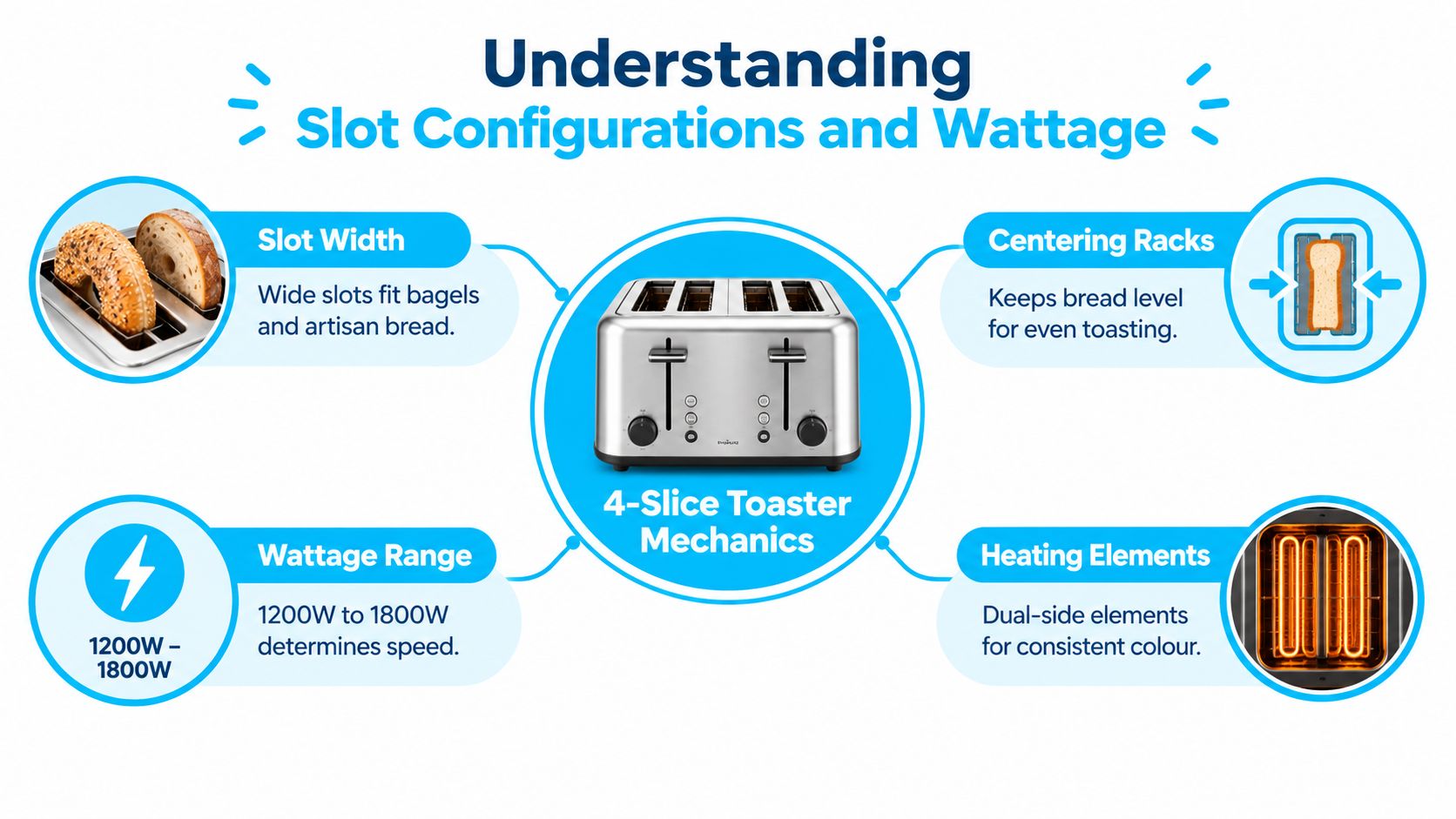
Slot width determines what you can toast without forcing the food down or leaving exposed edges. Standard sandwich bread is forgiving, but thick-cut sourdough, bakery loaves, and bagels need enough room for the centering racks to hold the slice upright. Wide slots are useful only when the internal guides still centre thin bread properly. Otherwise, a broad opening can produce uneven colour because the bread sits too close to one heating element.
Start with the food you buy. Check the slot dimensions, not just the phrase “extra wide”, and look for centring racks that grip different thicknesses. A high-lift carriage is helpful when small pieces sit below the normal rim, because it lets you raise the toast without reaching near hot metal.
Read the wattage in context
Wattage indicates the electrical demand and potential heating speed, but it doesn't guarantee better colour. Heating element placement, thermostat behaviour, bread centring, and the carriage timer all affect the result. A model with stronger elements may recover faster between cycles, while a poorly regulated model can burn thin slices before a thick one is ready.
Check the circuit serving the counter, especially in an older apartment. A toaster used beside a kettle, microwave, or other high-draw appliance may overload the circuit even if each product works properly on its own. Don't treat a high wattage figure as a quality score. Treat it as part of the electrical compatibility check.
A Canadian Oster four-slice instruction manual states that the appliance can toast one, two, three, or four slices and is designed to heat up to four slices. It also directs users to select a lower browning setting when toasting a single slice, which confirms that loading pattern affects results. The Canadian Oster instruction manual explains slice capacity, single-slice settings, and hot metal parts.
Use this practical loading routine:
- One slice: Start lower than your normal setting and watch the first cycle closely.
- Two slices: Place them according to the manual, rather than assuming either side of the appliance behaves identically.
- Three slices: Expect the occupied pairings to matter, particularly on models with independent zones.
- Four slices: Use matching bread thicknesses when you want similar colour across the batch.
For a closer look at one touchscreen design, Celmin's Oster 4-Slice Touch Screen Toaster explanation can help you evaluate whether electronic controls add useful precision or merely another failure point.
The Reality of Energy Use and Batch Convenience
A four-slice toaster is primarily a workflow appliance, not a major household energy strategy. It can avoid the delay of running two consecutive batches, but the electricity saved depends on the model's control system, heating cycle, warm-up behaviour, and whether you use all four slots. Marketing language that treats four slots as automatically more efficient oversimplifies the comparison.
The broader household context matters. Natural Resources Canada reports that 78% of Canadian residential energy consumption goes to space and water heating, so toaster electricity is a comparatively small part of a home's total energy profile. Natural Resources Canada's Energy Fact Book provides the residential energy-use context.
That doesn't make toaster consumption irrelevant. It changes the buying question. A four-slot model may reduce waiting, help everyone eat at the same time, and prevent the irritation of managing repeated cycles while preparing lunches. Those are real benefits, especially in a busy family kitchen. They just shouldn't be presented as a major reduction in the household electricity bill.
Compare the use cases honestly
With independent controls, you can run only the pair you need. That avoids heating empty slots and gives you more control over a small breakfast. A shared-control model may energise a broader system, depending on its design, so read the manual rather than assuming that unused openings remain electrically inactive.
The meaningful Canadian test would compare watt-hours for two slices in a four-slot toaster, four slices simultaneously, and two sequential cycles in a two-slice toaster. It would also record warm-up time and any re-toast behaviour. Without those measurements for a specific model, “energy efficient” is a marketing description, not a verified buying conclusion.
Use your electricity rate if you want a personal comparison. Record the appliance's wattage, measure the duration of a typical cycle if you have a suitable energy meter, and compare the result with your actual routine. The result may show that four slots save time without materially changing your overall energy costs.
Buy four slots for consistent batch timing and convenience. Buy them for energy savings only when measurements from the specific models support that conclusion.
Navigating Repairability and Long-Term Value
The most revealing ownership question comes after the warranty ends. If a carriage jams, a control board fails, or one heating element stops working, can a Canadian technician diagnose and repair the toaster economically? A stainless-steel body may resist surface wear, but it doesn't guarantee access to parts, service documents, or an affordable repair.
Canada's federal right-to-repair consultation explicitly includes small household appliances such as kitchen mixers, coffee machines, blenders, and microwaves, signalling that access to manuals, parts, tools, and independent repair is an emerging consumer issue. The federal right-to-repair consultation discusses access and repair considerations for household appliances.
Simple controls versus electronic features
A mechanically simple toaster with physical dials and a conventional carriage may be easier for a technician to assess than a feature-heavy model with a proprietary circuit board. That doesn't make every dial model repairable, and it doesn't make every digital model disposable. It gives you a useful starting distinction when comparing designs.
Ask the manufacturer these questions before purchase:
- Parts access: Are heating elements, control components, carriage mechanisms, and crumb trays available separately?
- Documentation: Does the company provide a service manual, exploded parts diagram, or repair instructions?
- Canadian support: Can you obtain service through a Canadian channel rather than shipping the toaster across the border?
- Warranty scope: Does the warranty cover the whole appliance, and what happens when the warranty expires?
- Failure diagnosis: Can a repair shop inspect the unit without replacing a sealed module?
Provincial rules aren't uniform. Quebec's mandated written repair evaluation for jobs estimated above $50 covers microwaves, air conditioners, and dehumidifiers, while toasters and other small appliances are excluded from that specific requirement. The province-specific rule therefore doesn't guarantee a toaster repair estimate under the same framework. Check the local repair shop's policy before authorising work.
Put repair cost beside replacement cost
Get an estimate before approving a repair, particularly if the problem involves a control board or sealed assembly. Compare the estimate with the cost of a comparable replacement, the remaining condition of the carriage and elements, and the availability of parts. A repair makes more sense when the toaster is well built, the fault is isolated, and the manufacturer supports the repair process. Replacement may be more realistic when parts are discontinued or labour dominates the bill.
Feature count deserves scrutiny. Screens, memory settings, countdowns, and touch interfaces can improve usability, but each additional electronic component may create another failure point without creating a viable Canadian repair market. For long-term value, prioritise accessible parts and documented service over decorative complexity.
Maintenance Routines and Final Buying Verdict
Maintenance won't rescue a badly designed toaster, but it can prevent small problems from becoming safety or performance issues. Crumbs collect around heating elements, bread can scorch when the tray stays full, and fingerprints or water marks can make stainless steel look worse than it is. Cleaning should be gentle, regular, and done with the appliance disconnected from power.
Start with the crumb tray. Remove it according to the manual, empty it over a bin, and wipe it before returning it. Never shake a plugged-in toaster over the sink, and don't pour water into the slots. For the exterior, use a soft damp cloth followed by a dry cloth, working with the grain where the finish has a visible direction.
A workable ownership checklist
- Before purchase: Confirm the exact model, Canadian availability, recognized electrical certification, warranty terms, and recall status.
- Before placing it: Measure the full footprint, carriage clearance, crumb-tray access, and storage route.
- Before first use: Read the manual's guidance for single-slice operation, browning settings, hot surfaces, and unplugging.
- During use: Keep the slots free of oversized food, avoid metal tools, and watch the first cycles with unfamiliar bread.
- During cleaning: Unplug the toaster before removing crumbs or brushing the interior. Let hot parts cool first.
- After a fault: Stop using the unit if the cord, plug, controls, or carriage behaves abnormally. Ask about parts and obtain a repair estimate before assuming replacement is the only option.
The Canadian Oster manual specifically warns that metal parts can become hot and instructs users to unplug the toaster when it isn't in use and before cleaning. That advice matters regardless of the exterior material. Stainless steel doesn't make a hot appliance safe to handle carelessly.
My buying verdict is straightforward. Choose a stainless steel 4-slice toaster when you regularly need simultaneous capacity, have enough counter space to leave it accessible, and can use independent controls for different loads. Choose a two-slice model when your kitchen is tight, your batches are small, or the larger footprint would force daily storage. In either case, select the model with the clearest Canadian support and the simplest controls that meet your needs.
Don't accept an unverified CAD price range as a quality guarantee. Retail pricing changes by brand, retailer, promotion, and season, so compare current Canadian listings and confirm what the warranty covers. A good purchase is the one whose capacity you use, whose electrical status you can verify, and whose likely repair pathway you understand before paying.
Celmin publishes Canadian buying guides and appliance comparisons that focus on local availability, CAD context, small-kitchen constraints, and practical ownership trade-offs. Visit Celmin to compare kitchen appliances and find guidance that fits your counter space and daily routine.
Sign up or sign in to join the conversation.