
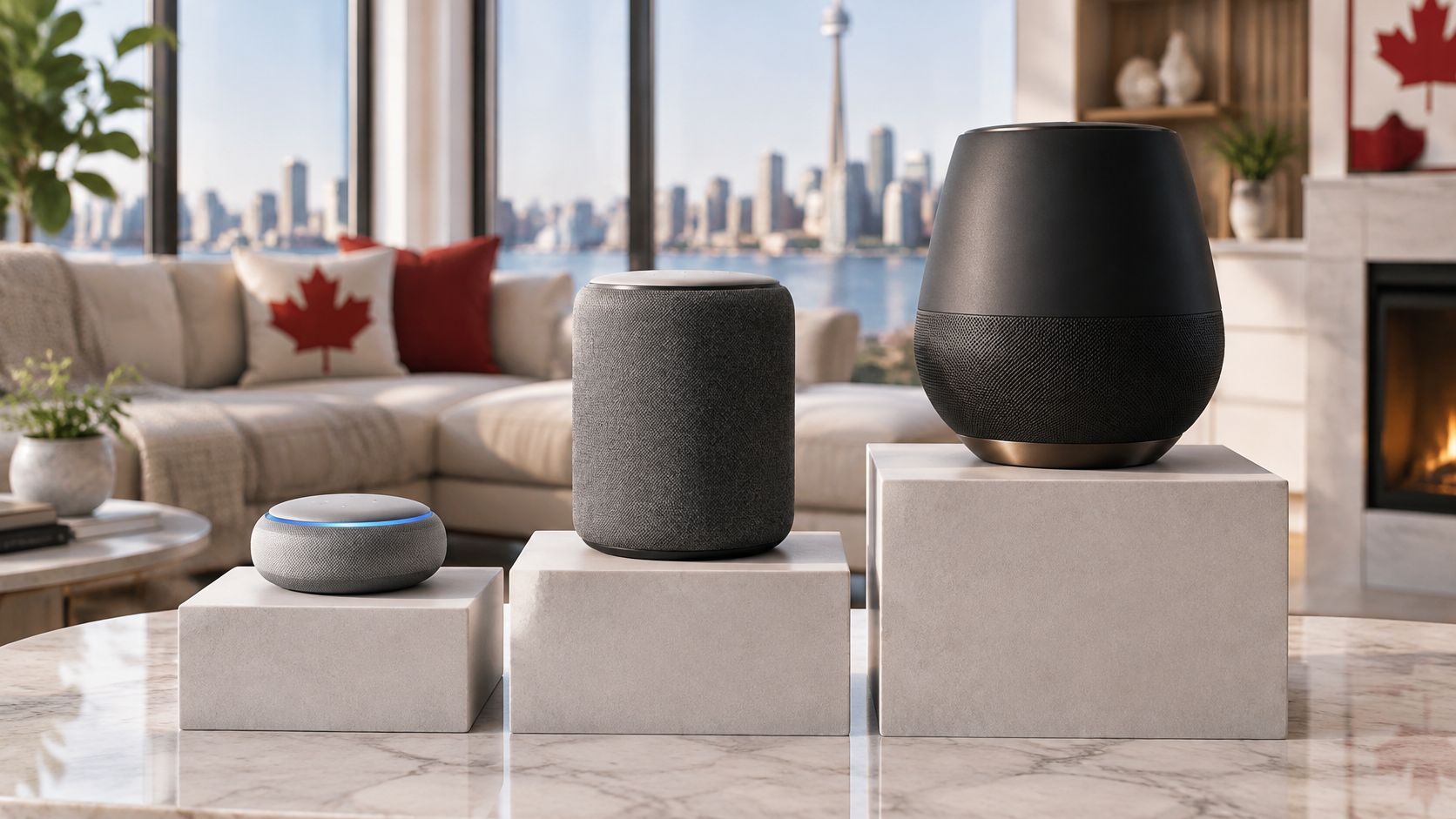
In 2026, a typical Canadian smart speaker price is about CAD 105–170 for a compact voice speaker, CAD 130–250 for room-filling sound, and CAD 300–650 for premium audio, with cinema systems far above that. The lowest shelf tag is a weak guide, because the useful figure is what the speaker does in one room for three years, including the privacy features you give up to keep it convenient.
Popular advice still says to wait for a sale and buy the cheapest voice speaker that turns on. That advice treats every puck, room cabinet, and spatial speaker as the same product with a different sticker. It isn't. A compact assistant can be the right buy for a bedroom alarm and a poor buy for music across an open condo. A premium cabinet can be cheaper than two small speakers that still don't cover the room. Colour, generation, refurbished stock, and a US-version listing can move the same name by more than a real discount.
Read every figure below as an observed Canadian retail price, not a lasting MSRP. Match the band to the job. Then ask what the household pays later in subscriptions, a second speaker, a platform switch, and controls you mute because you don't want the mic always listening.
Table of Contents
- Smart Speaker Price Ranges in CAD
- Price Bands by Form Factor and Job
- What Named Models Include at Each Price
- Retailer Prices and Seasonal Swings
- Three-Year Cost After the Sticker Price
- Privacy Trade-Offs Beside the Hardware Price
- Condo and Living Room Price Pointers
- Confirm the Listing Before You Pay
Smart Speaker Price Ranges in CAD
A low sticker price can make a smart speaker look like the obvious buy, but its job determines whether it remains useful. This article groups Canadian prices into three practical bands: compact voice speakers at about CAD 100–170, mainstream room speakers at CAD 130–250, and premium audio models at CAD 300–650. These are overlapping price ranges, not fixed retailer tiers.
A compact speaker such as the Amazon Echo Dot (5th Gen) appears around CAD 104.99. In the mainstream band, the Google Home Speaker is listed at about CAD 139.99, while Google Nest Audio listings run around CAD 199–249.99. Premium examples include the Amazon Echo Studio at CAD 299.99 and the Sonos Era 300 at CAD 629.99.
| Band | Typical CAD | Job | Example listing |
|---|---|---|---|
| Compact voice | About 100–170 | Alarms, timers, voice commands, basic playback | Echo Dot 5th Gen about 104.99 |
| Mainstream room | About 130–250 | Fuller sound and one-room coverage | Google Home Speaker about 139.99; Nest Audio about 199–249.99 |
| Premium audio | About 300–650 | Higher output, multi-driver or spatial playback | Echo Studio about 299.99; Sonos Era 300 about 629.99 |
| Cinema and pro wireless | Above these voice-speaker bands | Towers or integrated soundbars, not a puck | Separate from voice-speaker averages |
How to read a discount
A price change within a speaker's usual band may reflect colour, generation, refurbished condition, seller, or a promotion. Nest Audio listings, for example, range from about CAD 199 to CAD 249.99. Check the model generation, Canadian model number, seller, and condition before comparing listings.
A premium model priced in the mainstream band changes the room-level choice. A compact speaker dropping from CAD 140 to CAD 110 is still a compact speaker, with the same limits on output and coverage. The gaps around CAD 120–130 and CAD 250–300 depend on the speaker's job, not an exact cutoff. Keep cinema towers and integrated soundbars separate from voice-speaker averages.
Price Bands by Form Factor and Job
A low sticker price can still buy the wrong speaker for the room. Compare Canadian prices by deployment role: a portable Bluetooth speaker, a voice puck, a room-filling Wi-Fi speaker, and a cinema system serve different jobs.
A Canada-focused wireless-speaker market assessment places entry-level portable Bluetooth speakers at approximately CAD 85–190, mid-range Wi-Fi home speakers at CAD 350–650, and professional wireless towers and cinema-integrated soundbars at roughly CAD 1,100 to more than CAD 4,500.
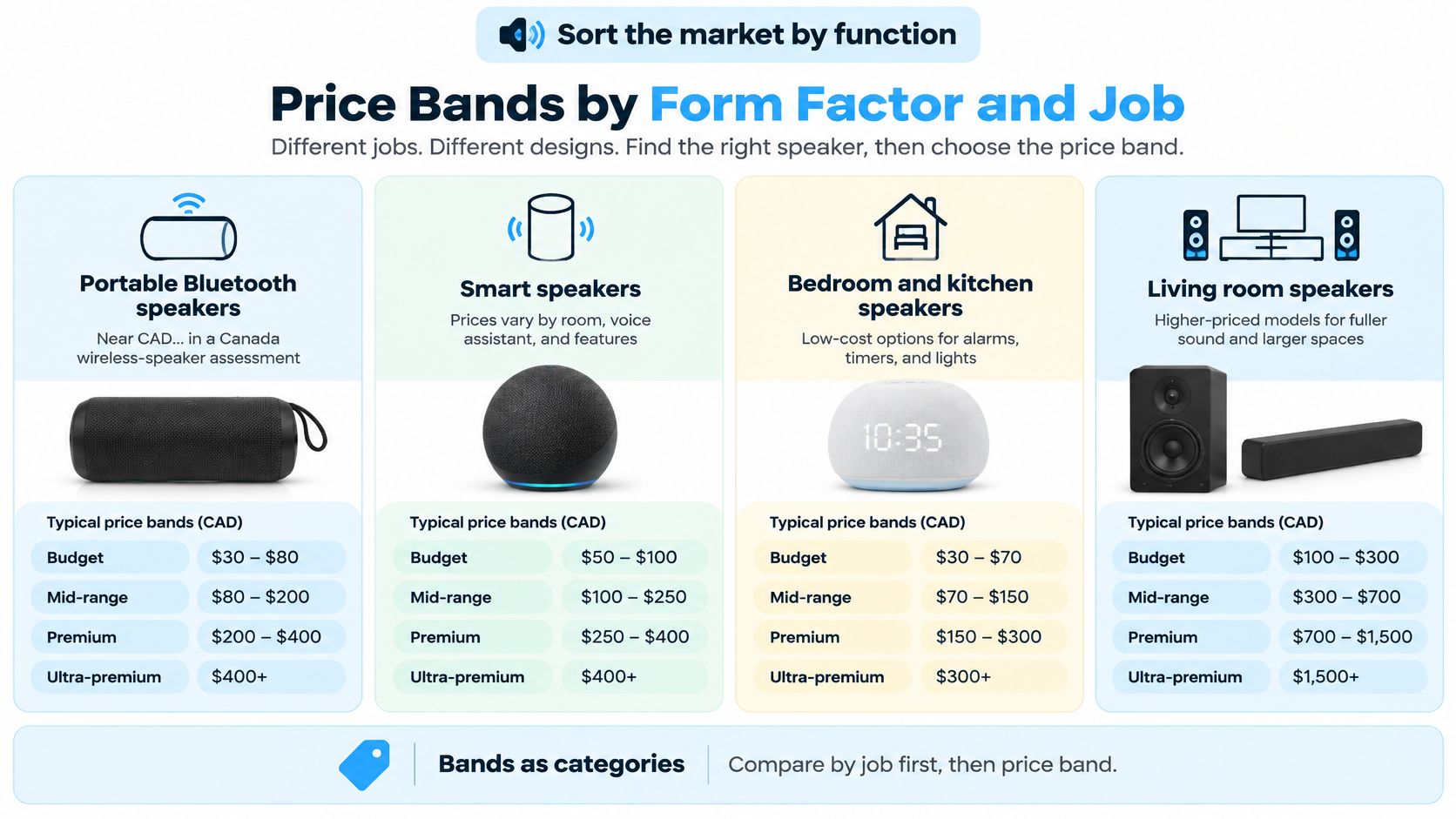
Voice-assistant speakers occupy several price bands because their price includes Wi-Fi, Bluetooth, and an assistant such as Alexa or Google Assistant, as well as the audio hardware. Best Buy Canada's portable smart speaker listings show voice-assistant models from CAD 104.99 to CAD 169.99, with premium listings reaching CAD 299.99 and CAD 359.99. Compact voice speakers generally sit around CAD 100–170; larger models focused on sound, multi-room grouping, or more substantial cabinets can reach CAD 300–650 and beyond.
Five jobs, not five models
Portable Bluetooth. Around CAD 85–190, this is a carry-around speaker. Bluetooth alone does not provide a household voice assistant: compare it with an Echo or Nest only if the model also supports Wi-Fi and an assistant.
Voice puck. Mini speakers generally cost around CAD 100–170. They suit bedroom alarms and kitchen timers, while their compact form limits their usefulness for music across an open-plan room.
Room speaker. A Wi-Fi cabinet for one-room listening sits between compact voice speakers and more expensive connected audio. This category fits buyers seeking fuller sound without paying for spatial features.
Spatial or multi-driver speaker. Models emphasizing sound quality, grouping, or premium cabinets generally fall around CAD 300–650. Their price reflects a different listening role from a voice puck.
Cinema system. Wireless towers and integrated soundbars start around CAD 1,100 in the cited market assessment. They belong in a cinema-system comparison, not a voice-speaker price comparison.
Hybrid Bluetooth and Wi-Fi models blur category labels, so compare each speaker by how it will be used. For a three-year ownership decision, the relevant comparison is the price of a speaker that meets the need, not just the lowest listing. A discount matters most when it makes a better-suited category affordable, rather than shaving a little off a puck that still cannot fill the room.
What Named Models Include at Each Price
The same price can buy a room-filling speaker or a compact voice assistant. Compare each model by the job it handles, not just its position on a price ladder. Best Buy Canada's cool smart gadgets listings show the Echo Dot 5th Gen near CAD 104.99, the Echo Studio near CAD 299.99, and the Sonos Era 300 at CAD 629.99.
Echo Dot 5th Gen, about CAD 104.99. It suits a bedroom or kitchen corner for alarms, timers, weather, and voice commands. The Echo Dot 5th Gen guide explains what this generation controls. For music across an open living room, its compact form is a limitation.
Google Home Speaker. A mainstream room speaker is aimed at filling one ordinary room, rather than competing in a premium audio category. It may suit a household already using Google's assistant that wants one speaker cabinet.
Google Nest Audio. Consider it when you want a more music-oriented speaker than a mini. Check that the Canadian listing identifies the generation and version clearly. Older stock and US-version inventory can complicate comparisons.
Echo Studio, CAD 299.99. This is the premium Amazon example in the cited listings, with a role suited to stronger output and more ambitious acoustics in an open living area.
Sonos Era 300, CAD 629.99. This is the spatial, room-oriented example. Its price reflects a different audio role from a compact speaker used mainly for voice commands.
One room versus two boxes
A compact speaker can handle household commands; a larger speaker may cover an open living area without adding another box. Multi-packs can list well above the price of a single room speaker, so compare the pair's total cost with one speaker suited to the space. Two small units are worthwhile only if you need coverage in separate rooms or multi-room playback.
Price is only one part of the comparison. Check that the Canadian version supports your preferred assistant and language, works with your Wi-Fi setup and music services, and can control the plugs and lights you own. New, refurbished, imported, and US-version listings are not directly comparable just because their product names match.
Retailer Prices and Seasonal Swings
Listings are dated observations. Treat them that way or you will compare a 2024 category page with a 2026 model page and call the gap a sale.
Best Buy Canada's Amazon voice-assistant catalogue, updated in 2026, listed the Echo Studio at CAD 299.99. Best Buy Canada's smart-speakers-for-music catalogue, also updated in 2026, listed the Google Nest Audio at CAD 249.99. Amazon.ca's smart-speaker category showed products at CAD 169.99 and CAD 289.00 on a page dated 2024. Those Amazon figures are category snapshots, not current prices for one model.
| Listing | Seller | Observed CAD | Caveat | Page timing |
|---|---|---|---|---|
| Echo Dot 5th Gen | Best Buy Canada | 104.99 | Entry compact, new-stock comparison | Current catalogue context |
| Google Home Speaker | Best Buy Canada | 139.99 | Mainstream room speaker | Current catalogue context |
| Google Nest Audio | Best Buy Canada | 249.99 | Other listings near 199; watch generation | Updated 2026 |
| Echo Studio | Best Buy Canada | 299.99 | Premium Amazon audio model | Updated 2026 |
| Sonos Era 300 | Best Buy Canada | 629.99 | Spatial premium, not a voice puck | Current catalogue context |
| Smart-speaker category sample | Amazon.ca | 169.99 and 289.00 | Category page, not one model | Dated 2024 |
What to write down before you trust a tag
For every claim you save, record model generation, Canadian model number, seller, condition, and the date checked. The same name diverges across colourways, previous generations, refurbished units, marketplace sellers, and US-version stock sitting beside Canadian stock. We price recommendations in Canadian dollars and check products against local retailers and Amazon.ca, and we revisit high-traffic guides because prices and models change.
Direction, not a smart-speaker index
A Canada market analysis of portable Bluetooth speakers estimates average selling prices rose from approximately CAD 75–85 in 2020 to CAD 95–110 in 2025. That is an increase of about CAD 10–35, roughly 12% at the low end of the comparison to 47% at the high end, depending on which points you compare. Average declared import values rose by approximately 8–12%. The analysis ties the rise to buyers paying more for durability, sound quality, and smart features.
That dataset covers portable Bluetooth speakers, not voice-assistant models alone. It signals direction for hybrid Wi-Fi and voice speakers. It is not a benchmark for an Echo or Nest. The same analysis sets five broad bands: under CAD 25 ultra-value, CAD 25–100 mass market, CAD 100–250 premium branded, CAD 250–600 high-fidelity or prestige, and above CAD 600 luxury or designer. A smart speaker around CAD 100 can sit at the upper end of mass-market pricing. CAD 100–250 is a fair comparison range for a named brand with stronger audio or connected-home features.
Prime-style sales, Black Friday, and Boxing Day can pull a current-generation puck toward the bottom of its band. A new generation tends to launch near the top. No sale percentage is assumed here. A 2024 category price is not a current model price.
Three-Year Cost After the Sticker Price
The lowest upfront price is not necessarily the lowest-cost Canadian option. Mintel's Canada technology in the home outlook indicates smart speakers are among the country's most widely owned smart-home products, while affordability remains a primary adoption barrier. It also estimates that about 9.6 million households had adopted at least one smart-home device in 2025. Many of those purchases are entry points into an ecosystem, not isolated gadgets. Market-size estimates vary by method, so that household figure is not unit sales of speakers.
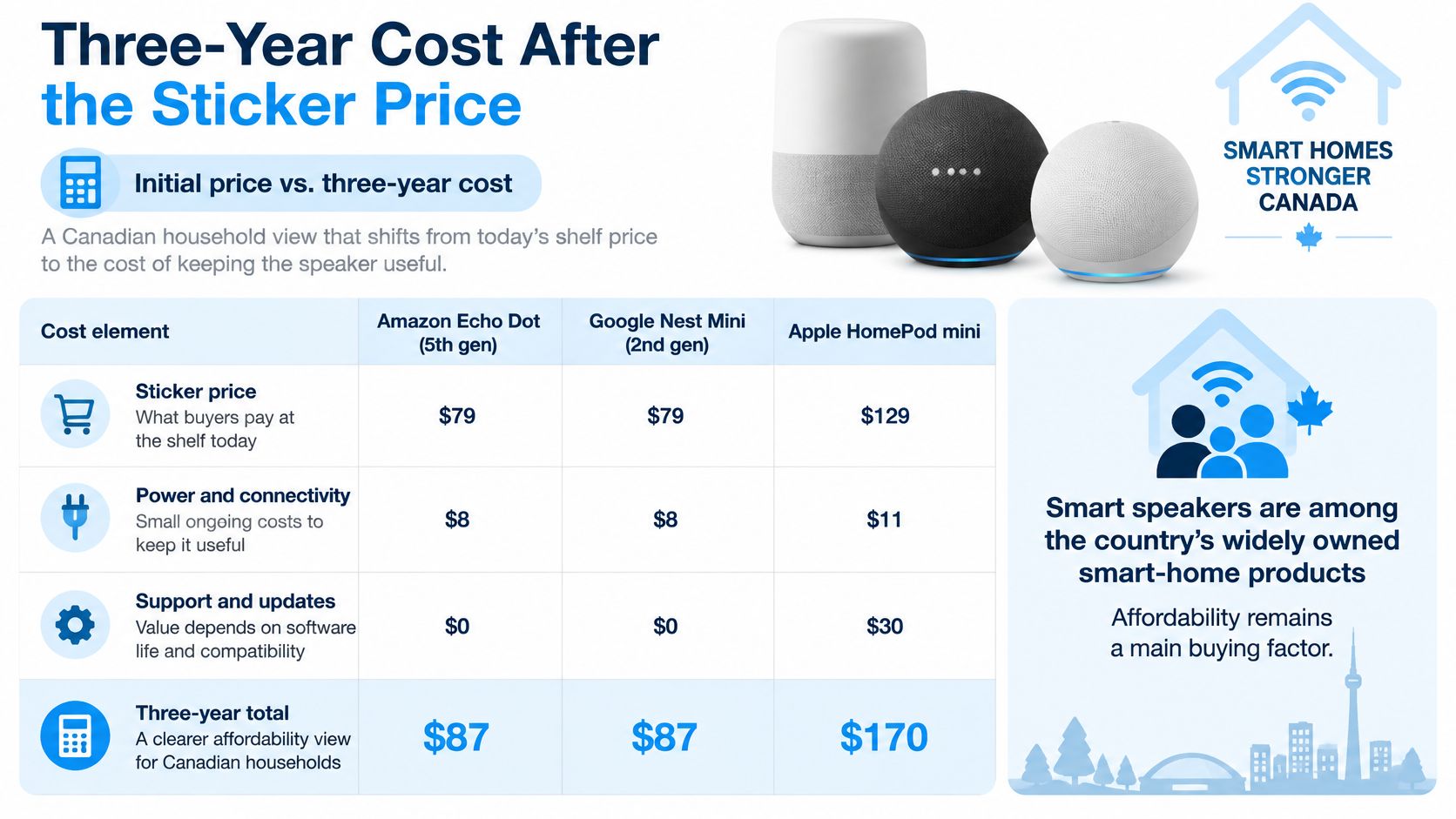
Price articles often stop at the sale tag. Ownership also includes Canadian taxes and regional availability, required subscriptions, a replacement power adapter, multi-room expansion, streaming services, and the cost of switching ecosystems later. A CA$50 speaker can become the expensive choice if it needs paid services, duplicates a platform you already use, or cannot run the devices you own.
Three households, three bills
A single bedroom. A compact speaker near the entry band stays cheap when you already have the assistant account and a music plan, and you only need timers and voice control. Provincial tax is extra on top of the shelf price. If you don't already pay for a music or audiobook service, the "cheap" puck adds a monthly bill the sticker never showed. Launch MSRP and a typical Canadian sale price are different numbers. Judge the sale price you can check out, not the launch figure in an old press note.
A condo-wide pair. Two compatible speakers near CAD 200 each are about CAD 400 before tax. One room speaker near CAD 300 can cost less if the open area doesn't need a second box. Price the pair, then price the single stronger speaker, and keep the lower total that still does the job.
A family with several accounts. Extra profiles, a music or audiobook subscription, a lost power adapter, and a platform that will not run the plugs and lights you already own all sit outside the sticker. Paying more upfront is the cheaper path when it avoids a second ecosystem and a second set of hubs.
Separate the sale price from the three-year bill. If the speaker cannot group with the next room or cannot see the gear you own, the discount is a down payment on a replacement.
Privacy Trade-Offs Beside the Hardware Price
Hardware bands don't capture what you trade to keep the speaker useful. A Canadian study of 572 smart-speaker users found that 42.3% felt their devices made their homes less private, 44.6% worried that companies monitored them, and 40.6% were unsure whether their own precautions worked. The same study found that 84.3% willingly sacrificed privacy for convenience. And 84.8% did not believe their device collected personal information, even while monitoring worries were widespread.
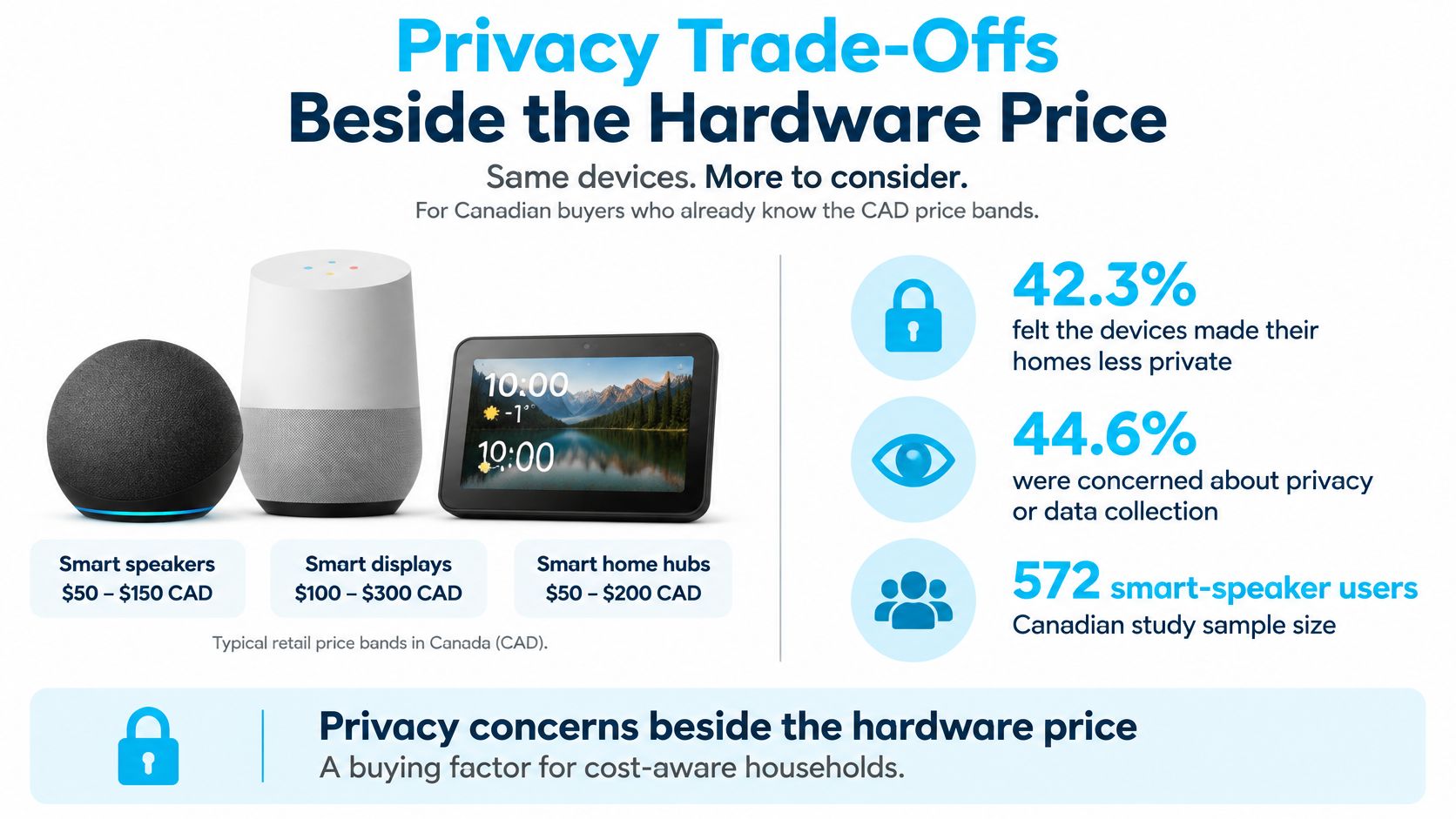
That is not a generic warning to unplug the speaker. It is a buying test. Affordability, complexity, and privacy are all major barriers to smart-home adoption in Canada, which is why a low sticker is not automatically the low-friction start. If you are choosing a whole platform, our guide to the best smart home system in Canada is the wider comparison. Here, privacy belongs beside the CAD band.
Controls you can actually check
Don't treat a model as private unless the listing says so. Check these on the product page and in the app notes:
- Microphone mute: A physical switch you can see is different from a software toggle buried in an account.
- Voice-history deletion: You should be able to wipe requests without retiring the speaker.
- Account requirement: Many conveniences assume a signed-in household account from day one.
- Local versus cloud handling: Use only what the maker documents. If the page doesn't say local processing, don't assume it.
- Guest use: Roommates and visitors in a shared condo are not one Amazon or Google profile.
Tightening collection often removes the feature the low price assumed. Routines, voice purchasing, and personalized music commonly depend on that account. A cheaper speaker can increase dependence on one cloud ecosystem. That matters for renters, roommates, and families who do not share one login.
If muting the mic or deleting history removes the feature you wanted, put that lost convenience in the price comparison next to sound. A CAD 105 puck that only works the way you want with the mic open is not the same product as a slightly dearer model with a hardware mute you will use.
Condo and Living Room Price Pointers
Two rooms drive most Canadian smart speaker price decisions: a small corner, and the living area where you listen. Match the ceiling to the job, then apply the skip rule.
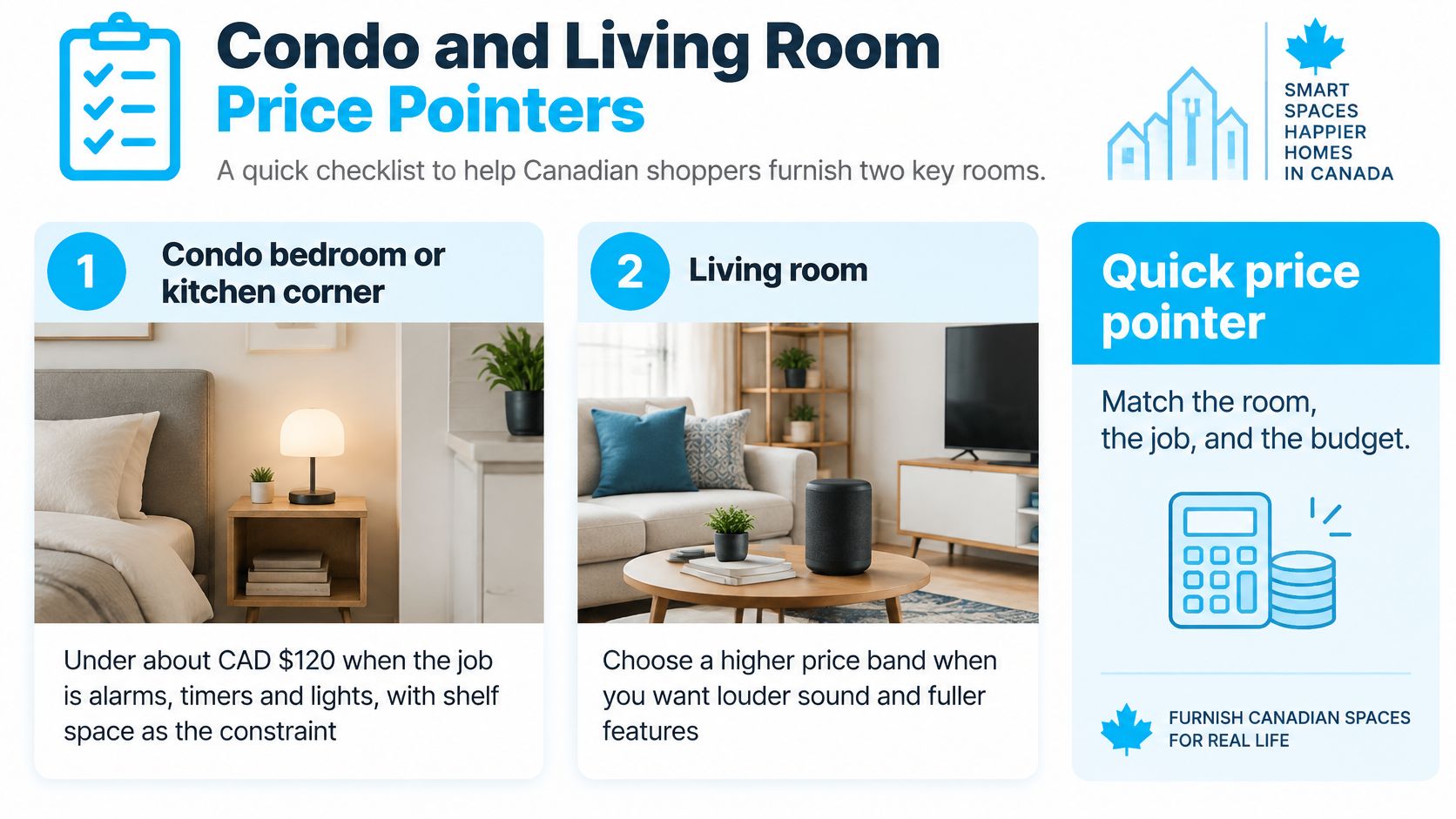
1. Condo bedroom or kitchen corner. Stay under about CAD 120 when the job is alarms, timers, and lights, and shelf space is the constraint. A puck fits a nightstand. A room cabinet usually doesn't earn its width there. Skip rule: don't pay for a room speaker in this corner.
2. Small open living room. CAD 130–250 usually sounds better than two tiny pucks competing, provided the assistant matches gear you already own. One cabinet in this band is the default when people sit in the room and expect speech and music to be intelligible from the sofa. Skip rule: skip pucks if the job is music.
3. Living room as a music room. Move to CAD 300 or more when you want spatial or multi-driver playback, or one stronger speaker that avoids a second purchase. Skip rule: skip this tier if a single room speaker already covers the open plan.
4. Condo-wide pair. Price two compatible speakers. Stop if the pair exceeds one better room speaker for the open plan. Compatibility matters more than matching colours. Two assistants that won't group are two products, not a system.
5. Renters. Prefer a speaker that moves with you and needs no in-wall gear. Our notes on smart home devices for renters cover the wider constraint: you leave the walls as you found them. Skip rules: ignore ultra-value speakers under CAD 25 for voice control, because that band is a different Bluetooth product. Ignore cinema pricing unless the project is a soundbar.
Several rooms, one preference
If you are furnishing more than a bedroom and a living room, pick the assistant that already runs your lights and plugs, put the better speaker in the room where people listen, and use compact voice speakers only where the job is commands. Don't average the rooms into one mid price and buy three of the same puck.
Confirm the Listing Before You Pay
Buy only inside the band that fits the room. Run these checks on the live listing, in order.
- Match the line item to the band. Compact voice near CAD 100–170, room speaker near CAD 130–250, or premium audio from about CAD 300. If the job is a kitchen timer, a spatial speaker is the wrong band even at a sale price.
- Confirm generation, Canadian model number, seller, and condition. New, refurbished, and imported are different offers. A previous generation with the same family name is not this year's speaker.
- Confirm the price is in CAD, and that tax and shipping are still to be added. We don't set tax, shipping, returns, or third-party availability. The checkout total is the retailer's, and it can differ by province.
- Reject a US-version or imported listing as a false discount against Canadian stock. Plug type, warranty, and assistant features are part of the price you think you saved.
- Check the decisions that change the bill without changing the speaker. The assistant must run devices you already own. The music service should be one the home already pays for. A second room means pricing a compatible pair. A soundbar in the cinema range is a different project.
- If privacy settings would switch off the feature you are buying, compare a model with a hardware mute even if it costs more. The mute is part of the product, not an accessory.
- Walk away when the listing cannot show generation, condition, and Canadian availability. A missing model number is not a detail to sort out after you pay.
After those checks, our Smart Speaker Finder can narrow choices from lifestyle and audio preferences. Editorial recommendations may be influenced by affiliate relationships, and product links to Amazon.ca are paid links. Retailer prices, specs, and availability can change without notice, so the listing you checked is the one that counts.
We publish Canadian buying guides that price smart speakers in CAD, by room and by what you keep paying after the sticker. If you are choosing a compact voice speaker, a room cabinet, or a premium audio model, start with the bands above and then use our comparisons of what is sold here. Visit Celmin to check current guides and the Smart Speaker Finder before you pay.
Sign up or sign in to join the conversation.