
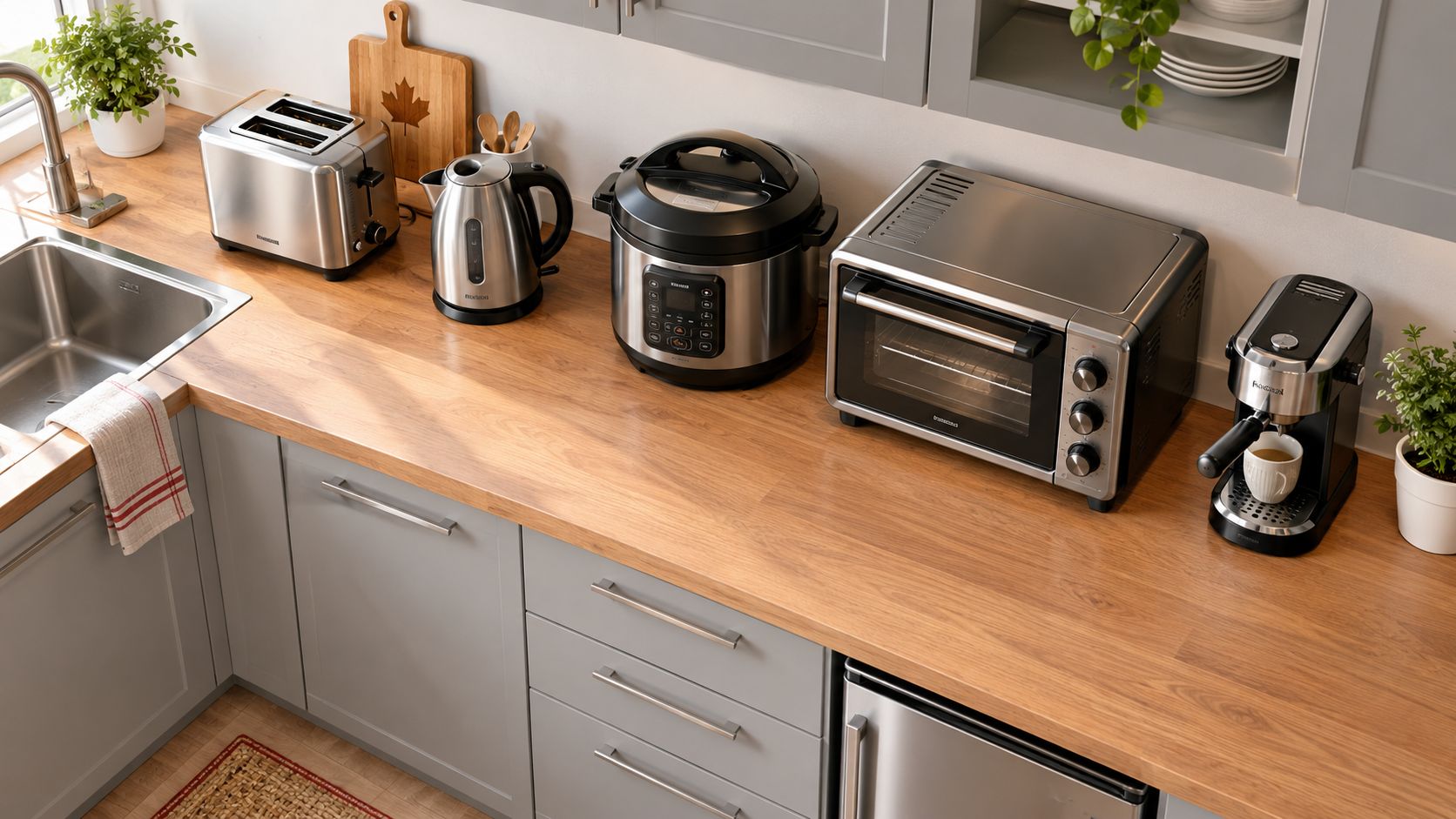
You've got a coffee maker, kettle, toaster, blender, and perhaps an air fryer fighting for the same stretch of counter. In a Canadian condo, the problem isn't finding another appliance. It's deciding which one deserves a permanent address, which one belongs in a cupboard, and which one should never have made it past the checkout page.
The best small kitchen appliances in Canada earn their space through frequent use, consolidated functions, manageable energy consumption, and easy maintenance. A low purchase price doesn't make a device good value if it occupies valuable counter space, draws power while idle, or becomes difficult to clean after the novelty fades.
Table of Contents
- Countertop Clutter in Canadian Condos
- Core Appliance Categories and Function Consolidation
- Evaluating Counter Footprint and Spatial Utility
- Energy Efficiency and Phantom Power Draw
- Navigating CAD Pricing and Seasonal Retail Trends
- Maintenance and Longevity in Hard-Water Regions
- Building an Intentional Kitchen Appliance Ecosystem
Countertop Clutter in Canadian Condos
In a 500-square-foot condo, one weekend espresso maker can start a chain reaction. Add a rice cooker for faster weekday meals, then a toaster oven for small snacks that do not justify heating the full range. Each purchase solves a genuine problem. Together, they can erase the only clear counter space.
Clutter carries a daily cost. You shift the kettle to reach the toaster, lift the blender to wipe beneath it, and store the multi-cooker in a cupboard where its weight discourages regular use. An appliance intended to save time can instead add friction to every meal, while several devices continue drawing standby power between uses.
Canadian demand reflects this convenience-first buying pattern. The country's small kitchen appliances market generated about USD 433.3 million in 2024, roughly CAD 590 million, and is projected to reach USD 572.0 million by 2030, with a projected 4.8% CAGR from 2025 to 2030, according to Mordor Intelligence's Canada kitchen appliances market overview. Coffee makers produced the largest revenue among product segments in 2024, while rice cookers and steamers ranked among the faster-growing categories.
Those figures point to a practical buying habit. Canadian shoppers are assembling compact cooking systems around repeated routines, not just collecting novelty gadgets. A kettle used several times daily can justify permanent counter space. A multi-cooker that replaces a rice cooker, steamer, and slow cooker may deserve a corner or an accessible shelf. An occasional waffle maker usually does not.
Practical rule: Every appliance should justify its footprint through frequent use or by replacing several other tools.
The 2020 sales surge reinforces how thoroughly these products entered household routines. Canadian small appliance sales rose by $486 million, or 23%, to $2.58 billion, kitchen appliances generated nearly 60% of those gains, and unit sales surpassed 23 million, according to NPD Group reporting cited in Grand View Research's Canada household appliances market report. Air fryers, single-serve brewing systems, and espresso makers all contributed to that broad adoption.
Treat permanent counter space as a limited budget. Before buying, ask whether the device will survive the next busy Monday, cramped grocery delivery, and winter evening. If it cannot earn that space through regular use, consolidated functions, or lower standby waste, keep it stored or leave it at the retailer.
Core Appliance Categories and Function Consolidation
Small kitchen appliances fall into a handful of practical groups, but their value varies sharply. Some devices replace several cooking steps. Others perform one task well and then sit idle.
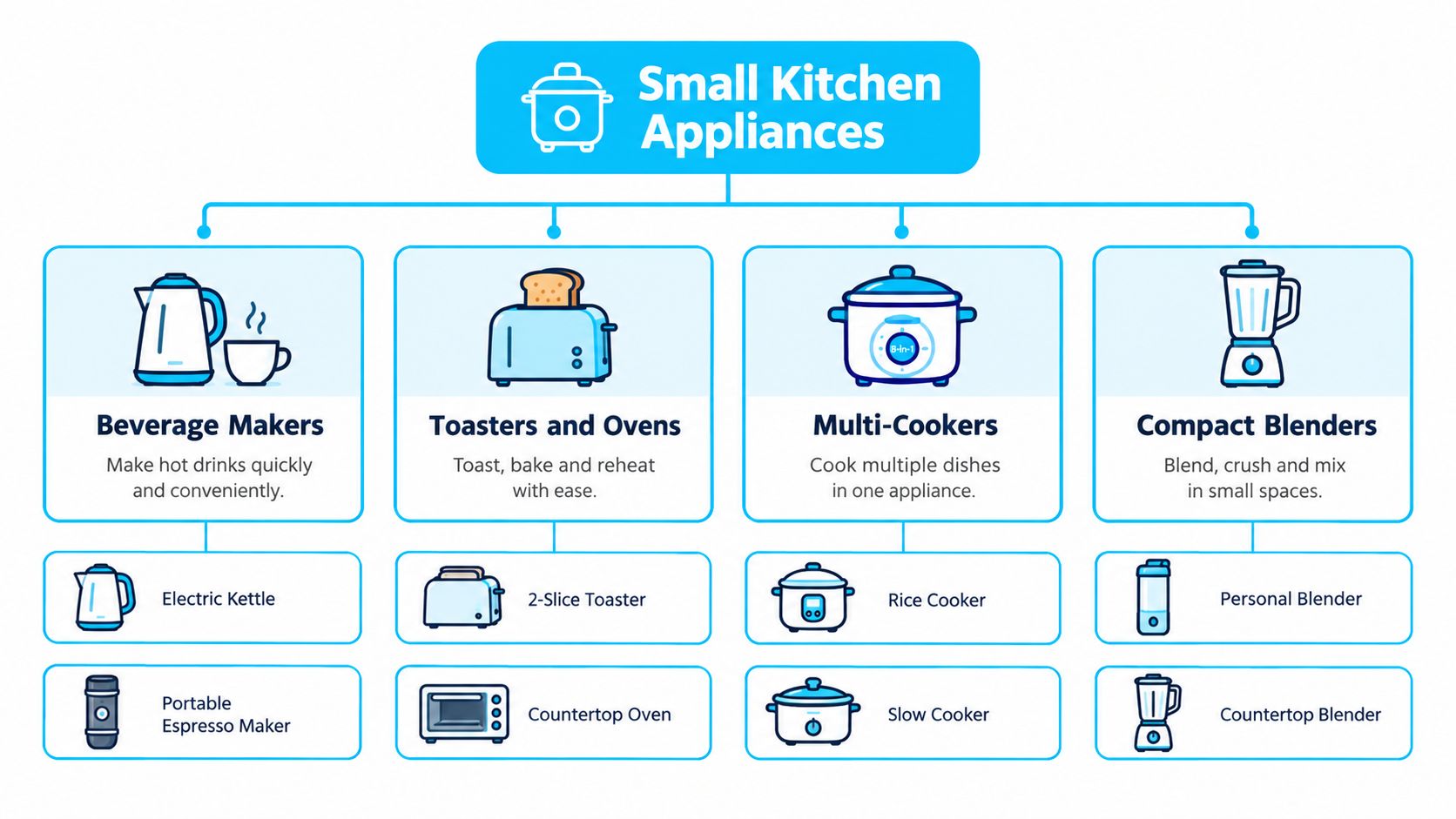
Beverage makers
An electric kettle is one of the easiest appliances to justify in a Canadian home. It handles tea, instant coffee, oatmeal, pour-over preparation, and boiling water for cooking. A temperature-controlled model adds precision for coffee and delicate teas, but the extra controls only matter if you'll use them.
Coffee makers deserve a stricter test. A basic drip machine is sensible for repeat coffee drinkers, while a single-serve brewer reduces waste and speeds up individual cups. Portable espresso makers are useful for small portions, travel, or renters who don't want a large machine. They're not a substitute for a full coffee station if several people need drinks at once.
Toasters and compact ovens
A two-slice toaster remains a single-purpose device, but it can still earn permanent space when breakfast is a daily routine. Choose it for consistency, easy crumb removal, and a footprint that fits the counter, not for a long list of browning settings.
A toaster oven has broader utility. It can toast, reheat, roast small portions, and handle foods that would be wasteful to cook in a full-size oven. Convection improves circulation, but the key advantage is replacing several cooking trips to the main range. Compact ovens do need clearance around vents, so their usable footprint is larger than the base dimensions suggest.
Multi-cookers
Function consolidation becomes meaningful here. A capable multi-cooker can handle pressure cooking, slow cooking, steaming, rice preparation, sautéing, and reheating. It won't replace every pan, and its cooking surface may not suit crisping or high-heat searing, but it can eliminate the need for separate rice cookers and steamers.
The best model for your kitchen is the one whose common modes match your meals. If you mostly cook grains and soups, a simpler machine beats a complicated connected model. If you want air-frying, check whether the required lid or basket creates another storage problem.
Compact blenders
A personal blender works well for smoothies, sauces, and small batches. Its narrow container stores more easily than a full-size jug, but it's a poor choice for family-sized soups or repeated preparation. Immersion blenders often deliver better function consolidation because they can blend directly in a pot and occupy less cupboard volume.
Use Celmin's kitchen appliance buying guide to compare categories through Canadian availability and use-case considerations. The central buying principle is simple: prioritise repeated functions over impressive specifications.
Evaluating Counter Footprint and Spatial Utility
Measure the appliance in use, not just in the product listing. A toaster oven needs ventilation clearance. A multi-cooker releases steam above its lid. A blender needs room to assemble the jug, and a kettle needs enough space to lift safely without striking an upper cabinet.
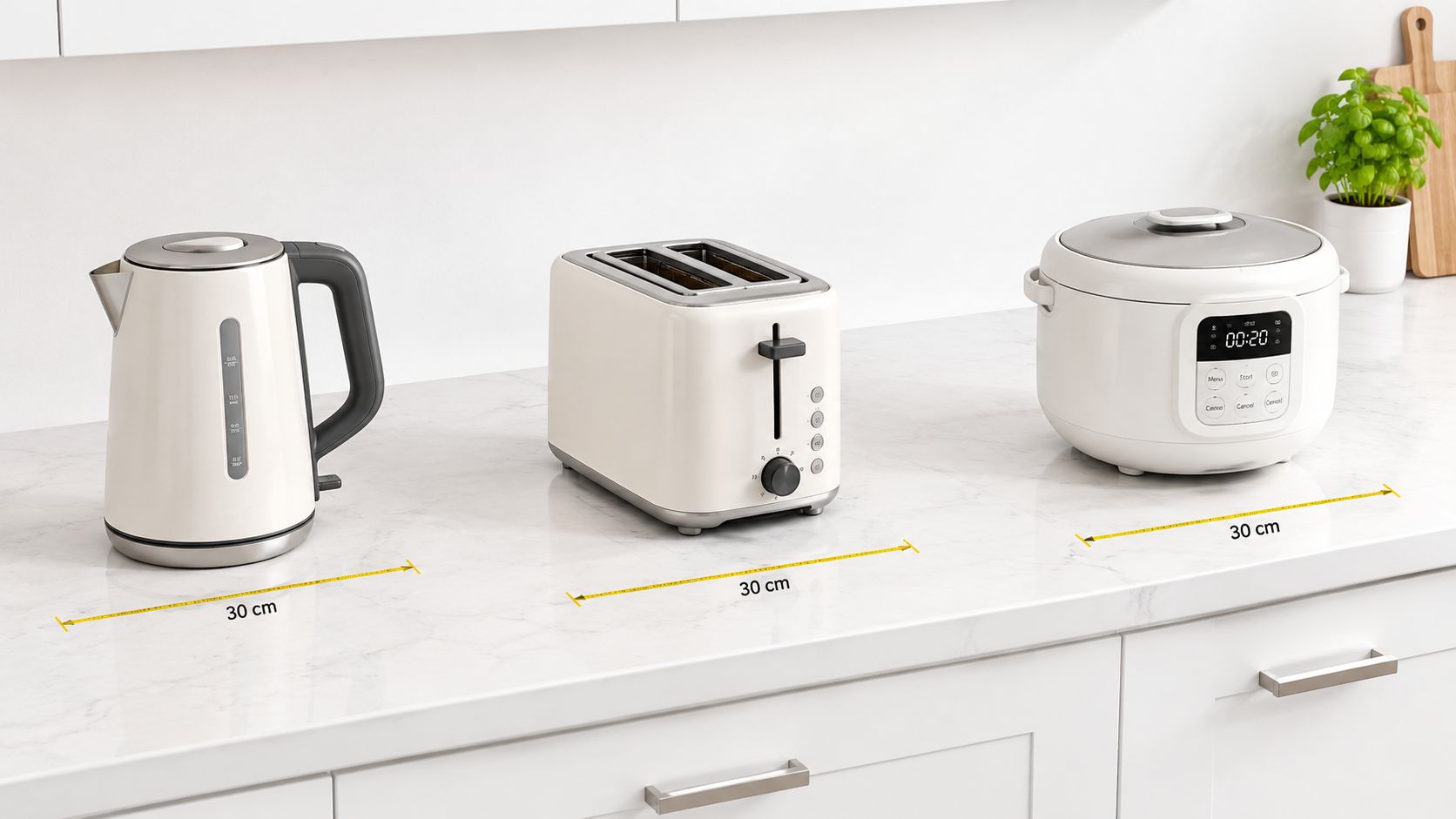
Measure the operating zone
Start with the appliance's base, then add the space required for the cord, controls, lid, handle, and food preparation. A kettle placed under a cabinet may technically fit, but it may be unsafe or awkward to fill. A multi-cooker tucked beneath a shelf may force steam into the cabinetry.
Mark the operating zone with painter's tape. Leave the appliance there for a day and use the kitchen normally. You'll quickly see whether it blocks a drawer, interferes with food preparation, or turns a narrow passage into an obstacle.
Calculate utility per occupied area
A permanent appliance should perform a job that occurs often enough to offset its physical cost. The coffee maker usually passes this test in a coffee-drinking household. A compact oven may pass if it handles breakfast, reheating, and small dinners. A specialised slicer or dessert maker generally needs to be stored unless it's part of a frequent routine.
Consider storage access as part of the footprint. An appliance that fits inside a cupboard but requires removing three other items isn't compact in daily use. The same applies to accessories. A multi-cooker with several lids and baskets can consume more organised storage than its main body suggests.
Build a counter hierarchy
Give the most accessible locations to devices used daily. Store weekly appliances at eye level or in a reachable lower cupboard. Keep seasonal or occasional tools boxed and labelled rather than allowing them to colonise the counter.
For more examples of this approach, see Celmin's guide to kitchen appliances for small spaces. The practical target isn't an empty counter. It's a counter where every visible object supports a routine you actually have.
Energy Efficiency and Phantom Power Draw
Small appliances can reduce cooking energy compared with a full-size electric range, but the saving depends on what you cook, how long you cook it, and whether the device remains powered between uses. A compact appliance used efficiently can be sensible. A collection of always-on displays and connected gadgets undermines that advantage.
Canadian cooking appliances sold as residential products fall under the federal Energy Efficiency Regulations and cooking-appliance guidance. Most cooking appliances, except gas ranges, must display an EnerGuide label showing the model number and average annual electricity use in kWh. A lower labelled number indicates greater efficiency compared with similar products, which gives you a better comparison than wattage alone.
Compare the cooking task, not just the appliance
Public utility guidance gives useful task-level comparisons. Quebec says a microwave can consume five times less energy than a stove for small quantities, while a toaster oven can use two times less energy than a stove for the same cooking time. An electric kettle can use 40% to 70% less energy than a stovetop burner. These figures are documented in Quebec's household appliance energy-management guidance.
| Appliance Type | Energy Savings vs Stove | Best Use Case |
|---|---|---|
| Microwave | Five times less energy for small quantities | Reheating and small portions |
| Toaster oven | Two times less energy for the same cooking time | Toasting, reheating, and compact meals |
| Electric kettle | 40% to 70% less energy than a stovetop burner | Boiling water efficiently |
| Full-size electric range | Baseline comparison | Large pots and broad cooking tasks |
Hydro Ottawa also reports that microwaves can use up to 50% less electricity than an electric stove and recommends unplugging small kitchen appliances when they're not in use. Its guidance on small-appliance electricity use is especially relevant in condos, where kettles, coffee machines, toaster ovens, and smart devices often stay connected all day.
Treat standby power as a design issue
Phantom draw matters most with appliances that include clocks, touch displays, Wi-Fi radios, warming plates, or remote-start functions. The amount varies by product, so don't assign a universal cost to it. Instead, look for a physical power switch, an automatic shutoff, or a smart plug rated for the appliance's load.
A smart plug can make sense for a coffee station or display-heavy appliance, but never use one as a substitute for proper electrical safety. For device-specific considerations, consult Celmin's smart plug review. Unplug simple kettles and toasters manually, and group rarely used appliances on one accessible power bar with a switch.
Navigating CAD Pricing and Seasonal Retail Trends
In a 500-square-foot condo, a discount does not justify another appliance unless it earns permanent counter space. Canadian retailers often change bundles, colours, accessories, and model numbers beside headline discounts. A lower sticker price can hide a near-identical product with fewer useful inclusions.
Statistics Canada reported that cooking appliances rose only 0.2% in 2025, while small household appliances such as toasters and kettles rose 0.4%, according to the Canadian pricing information referenced by Celmin. These modest movements favour disciplined buying over waiting for a dramatic collapse in prices. Compare today's CAD price with the appliance's normal price, then ask whether its functions replace an item already occupying your counter.
Track the baseline before the sale
Create a shortlist of exact models and record each normal CAD price, included accessory, warranty, return window, and delivery charge. Compare model numbers, not product photos. Visually similar versions may have different controls, bowls, baskets, capacities, or attachments.
Boxing Day and Black Friday can produce worthwhile deals on toasters, kettles, blenders, and coffee machines. Spring clearance can also reduce prices as retailers make room for updated packaging or replacement models. Clearance stock is less predictable, so choose a model family with interchangeable parts rather than buying a discontinued oddity.
A sale is only valuable when the appliance already fits your kitchen plan.
Pay for useful hardware, not connected decoration
A kettle's temperature control can suit specific coffee or tea routines. A removable multi-cooker pot simplifies washing, while a convection fan in a compact oven broadens the meals it can handle. Wi-Fi control, recipe libraries, voice commands, and illuminated displays need a stricter test.
Ask whether a feature changes a task you perform every week. If it adds only a notification or another interface, leave it out. Connected appliances also create another idle device, app, and possible failure point, which matters in a condo where countertop clutter and standby draw have a real cost.
Calculate the total ownership cost before buying. Include filters, replacement seals, specialty baskets, delivery, and accessories. A cheaper appliance that depends on proprietary consumables can cost more to keep useful than a plain model with washable, widely available parts. Use Celmin's kitchen appliance buying guide only once as a pricing reference, then verify the retailer's current package and return terms.
Maintenance and Longevity in Hard-Water Regions
Mineral deposits are an appliance problem, not merely a cosmetic one. Kettles, espresso makers, steam-producing multi-cookers, and coffee machines all move water through narrow passages where residue can affect heating and flow.
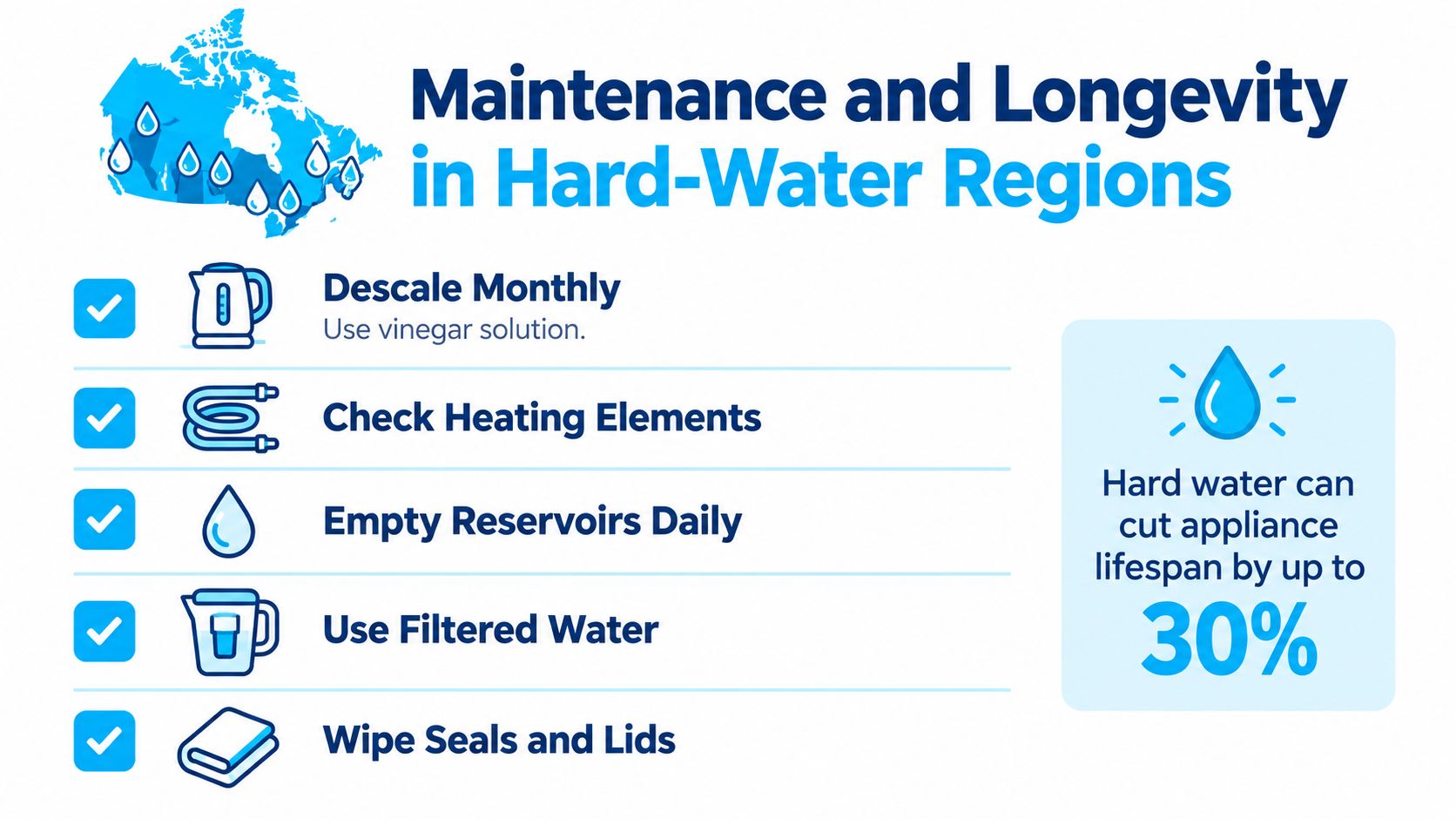
Establish a simple cleaning rhythm
Use the manufacturer's cleaning instructions first, especially for espresso machines and appliances with coated interiors. If the manual permits descaling with a vinegar solution, follow its dilution and rinsing directions. Don't assume that a stronger solution cleans better. It can damage seals, finishes, or internal components.
A practical routine looks like this:
- Kettles: Empty them after use rather than leaving mineral-rich water standing. Descale when deposits appear or when boiling becomes noticeably slower.
- Coffee and espresso machines: Empty reservoirs and drip trays regularly. Run the approved descaling cycle, then rinse thoroughly before brewing.
- Multi-cookers: Wash the inner pot, lid, sealing ring, and steam-release components according to the manual. Food residue around the seal can create odours and interfere with pressure management.
- Toaster ovens: Remove crumbs only after the unit is cool and unplugged. Keep debris away from heating elements, and don't cover ventilation openings.
- Blenders: Rinse immediately after use, then clean the blade assembly safely. Dried food becomes harder to remove and can damage seals during aggressive scrubbing.
Protect the parts that fail first
Sealing rings, non-stick coatings, hinges, heating elements, and power cords need gentle handling. Don't use metal tools on coated multi-cooker surfaces. Don't pull a toaster or kettle by its cord, and don't immerse an electrical base in water.
Hard water also makes filtered water a sensible choice for appliances that heat or steam frequently. It won't eliminate maintenance, but it can reduce the material that accumulates inside reservoirs and heating chambers.
Maintenance is part of the purchase price. If you won't clean the reservoir, descale the kettle, or wash the sealing ring, choose a simpler appliance that you will maintain.
Review the warranty before using any cleaning product. Keep receipts, manuals, and model numbers together, because service support often depends on following the specified care procedure.
Use this video as a visual reminder of the cleaning tasks that protect frequently used countertop devices:
Building an Intentional Kitchen Appliance Ecosystem
A useful kitchen appliance ecosystem has fewer devices, clearer jobs, and less daily rearranging. Start by emptying the counter and placing each appliance into one of three groups: used every day, used occasionally, or rarely used. The third group is a strong candidate for donation, resale, or recycling, particularly if you bought it for a meal pattern you don't follow.
Next, identify overlaps. A toaster oven may cover reheating and small roasting. A multi-cooker may cover rice, steaming, soups, and slow cooking. An immersion blender may replace a bulky jug blender for the sauces and soups you make most often. Keep one specialist appliance only when it delivers a result or convenience that your consolidated setup can't match.
Your replacement test should include four questions:
- Does it earn permanent counter space?
- Can it replace another appliance or cooking method?
- Will I maintain it without resentment?
- Does its CAD price reflect useful hardware rather than feature clutter?
The Canadian market offers plenty of capable countertop technology, but more choice doesn't require more ownership. A kettle, compact oven, multi-cooker, or blender should make your kitchen easier to use, not turn the counter into storage.
Choose the appliance that supports your real weekday routine. Ignore the feature list until you've confirmed the dimensions, operating clearance, energy label, cleaning process, and storage plan. The best small kitchen appliances in Canada are the ones you use often enough to justify every centimetre they occupy.
Visit Celmin for Canada-focused buying guides and reviews that compare kitchen appliances, smart home devices, CAD pricing, and practical small-space trade-offs. Use those guides to audit your current counter, shortlist appliances that consolidate functions, and buy with local availability and maintenance in mind.
Sign up or sign in to join the conversation.