
The Saker Silicone Caulking Tools 3-in-1 lives in a very practical corner of home improvement: the small, cheap tool meant to make one of the most annoying DIY jobs less messy. It is not a power tool, not a fancy contractor system, and not something you buy for the thrill of owning it. It is ...
The Saker Silicone Caulking Tools 3-in-1 lives in a very practical corner of home improvement: the small, cheap tool meant to make one of the most annoying DIY jobs less messy. It is not a power tool, not a fancy contractor system, and not something you buy for the thrill of owning it. It is a hand tool for scraping out old caulk, shaping new sealant, and trying to get cleaner lines around tubs, sinks, windows, and counters without turning the whole job into a sticky cleanup session.
This is not a hands-on review. Nothing here is based on personally using the tool. The goal is simpler: explain what the Saker Silicone Caulking Tools 3-in-1 actually is, what the listed features suggest in real use, where it helps, and where expectations should stay modest. If you are staring at cracked bathroom caulk or a kitchen sink edge that needs resealing and want a calmer read than an Amazon listing, this is for you.
📺 Watch: Saker Silicone Caulking Tools 3-in-1 in context
Quick snapshot
| Question | What the Saker Silicone Caulking Tools 3-in-1 actually is |
|---|---|
| Category | Tools & Home Improvement |
| Made by | Saker |
| Typical price | ~$25 CAD (listing at the time of writing — verify current pricing) |
| Rating signal | 4.1/5 on the source listing |
| Best for | Renters, homeowners, and DIYers doing light resealing jobs around bathrooms, kitchens, windows, and sinks |
| Skip if | You want a powered remover, do large commercial sealing work, or expect a hand tool to fix poor-quality caulk technique by itself |
Pro tip: Buy this tool for cleanup and finishing, not for magic. Good caulk lines still depend on removing old material properly, cleaning the surface, and using the right sealant for the gap.
What the Saker Silicone Caulking Tools 3-in-1 actually is
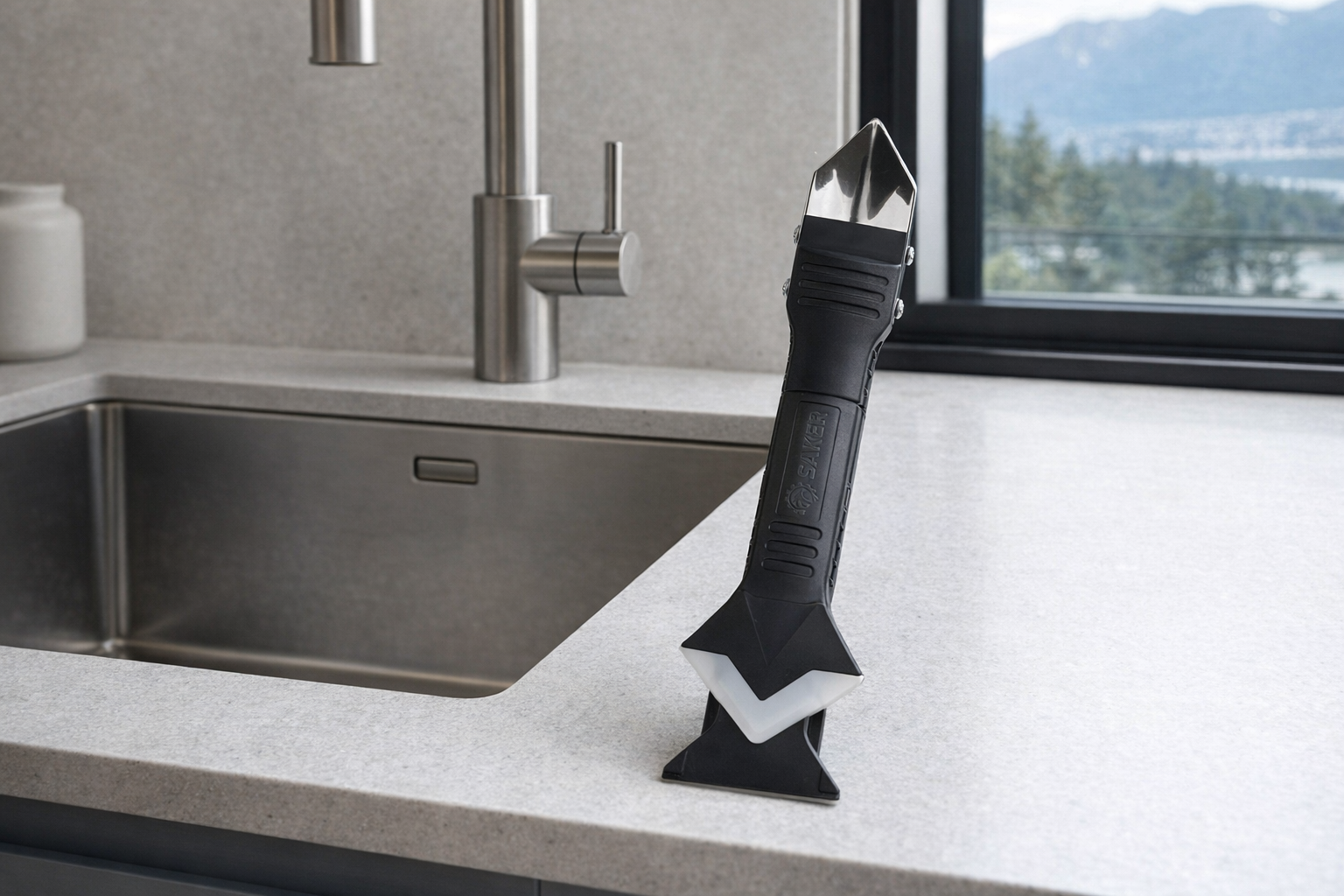
In plain English, the Saker Silicone Caulking Tools 3-in-1 is a multi-purpose caulking helper. One part is meant to scrape or cut out old caulk, another part is meant to smooth fresh silicone, and the included shaped pads or heads are there to help form a cleaner bead in corners and along edges. If you have ever tried to redo a sink edge with just a utility knife and your finger, this is aimed squarely at that frustration.
3-in-1 silicone caulking tool combining internal angle scraper, flat angle scraper, and silicone smoother. Features stainless steel blade for removing old caulk and silicone pads for smooth application. Ideal for bathroom, kitchen, floor, window, and sink joint sealing.
That 3-in-1 pitch matters because the real annoyance with small sealing jobs is not usually applying caulk from the tube. It is the before-and-after: getting the old stuff out and making the new line look intentional. Compared with a simpler single-shape tool like the Cramer Fugi Sealant Profiling Tool, the Saker set appears more general-purpose and more budget-focused. The trade-off is usually that a cheaper all-in-one tool gives you more functions in one package, while a specialist profiling tool can feel more refined for finish work. For many households, though, one $25 tool that handles removal and smoothing is the more realistic buy.
Key features at a glance
- 3-in-1 design for scraping, removing, and smoothing
- Sharp stainless steel blade for lifting or cutting out old caulk
- Silicone trowel and pads for shaping fresh sealant
- No masking tape needed, according to the listing
- Multiple silicone heads for different edges and gap shapes
- Works on bathroom, kitchen, floor, window, and sink joints
How the Saker Silicone Caulking Tools 3-in-1 actually works
The basic idea is straightforward: you use different parts of the tool at different stages of the caulking job. The stainless steel edge is there for old material removal, especially where brittle silicone or acrylic caulk has started peeling, cracking, or separating from tile, glass, or countertop edges. That is important because new caulk over bad old caulk usually looks rough and fails early. A remover blade does not replace patience, but it is more honest than pretending the finishing tool alone will solve prep.
Once the joint is clean and dry, the smoothing side comes into play. Instead of using a wet finger or a wad of paper towel, you drag the shaped silicone head along the fresh bead to compress it into the joint and leave a more consistent profile. That is the real promise here: not miracle-grade results, but repeatability. Different heads should help match different seams, whether you are dealing with an inside corner near a bathtub or a flatter transition around a countertop edge.
There are really three working stages implied by the listing:
- Removal. Use the stainless steel blade or scraping edge to cut, lift, and remove old caulk.
- Application shaping. Lay a fresh bead from your caulk tube, then guide the smoother over it.
- Finishing. Swap to the silicone pad or head that best matches the corner or joint size for a cleaner line.
The “no masking tape needed” claim is worth reading with some caution. In a perfect situation — straight joint, right amount of caulk, steady hand — a shaping tool can absolutely reduce or eliminate the need for tape. But tape is not just for amateurs; it is often what makes awkward edges look clean. What the Saker tool likely does is lower the odds of a sloppy bead, especially on short household jobs. That is useful. It just is not a substitute for surface prep or restraint with the caulk gun.
A realistic "day in the life" with Saker Silicone Caulking Tools 3-in-1
Because this is an informational explainer, here is what a likely household use pattern looks like based on the listed features rather than firsthand testing.
- Morning. You notice the caulk line around a bathroom sink has darkened, cracked, or pulled away from the backsplash. The stainless steel remover edge is the first thing you reach for, because the old bead needs to come out before any new silicone goes down.
- Midday. After cleaning and drying the area, you run a fresh bead along the joint. Instead of smoothing it with a finger, you use one of the silicone heads to shape the bead in a single pass, aiming for a more even line and less excess smeared onto the counter.
- Afternoon. You move to a different problem spot — maybe a window edge or the seam where the kitchen sink meets the countertop. The multiple heads matter here, because a tool that works in a tight inside corner may not be the right shape for a flatter joint.
- Evening. You wipe down the tool, set it aside, and leave the new caulk to cure. That is a small but real benefit of a simple manual tool: there is no battery to charge, no motor to burn out, and no setup beyond cleaning it before the silicone hardens.
Who the Saker Silicone Caulking Tools 3-in-1 is actually for (and who it isn't)
Great fits
- Renters fixing up a bathroom vanity edge before a move-out inspection, where cleaner sealant lines can make a tired sink area look maintained.
- Homeowners doing seasonal touch-ups around tubs, backsplashes, or drafty window trim, especially in older homes where caulk tends to fail in small sections.
- DIY beginners who want more control than “apply caulk and smooth it with a finger” but are not buying a full contractor kit.
- Landlords or property managers handling repeated light maintenance in kitchens and bathrooms across multiple units.
- Anyone doing short repair jobs rather than whole-house reno work, where a simple multi-tool is more sensible than a box of separate specialty tools.
Poor fits
- Contractors doing heavy daily sealant work, who will usually want more durable, specialized, and replaceable tools.
- Anyone expecting perfect results without prep, because no smoother can rescue dirty surfaces, moldy joints, or badly applied material.
- People removing large amounts of hardened caulk across long runs, where a dedicated scraper, utility knife, oscillating tool, or chemical remover may be faster.
- DIYers working with many different specialty sealants who may prefer professional profiling sets with more precise profile sizes.
- Anyone treating this as a one-tool solution for every sealing problem in the house. It is useful, but it is still a small hand tool.
Practical trade-offs
Removal ability
The stainless steel blade is one of the most important parts of this product because old caulk removal is where many cheap tools fall apart. A metal blade is more credible than a fully soft-plastic remover tip, especially when dealing with aged silicone that has gone brittle. But it is still a small hand tool, not a powered solution. On stubborn old caulk, especially around textured tile or heavily bonded joints, expect effort and probably some backup from a utility knife.
Finish quality versus technique
The smoother side can absolutely help produce cleaner beads, especially for beginners. But this is not a shortcut past the fundamentals: cut the tube properly, do not overapply, clean the joint thoroughly, and move at a steady pace. The tool can improve consistency, which is different from guaranteeing a professional finish. Evaluate it like a guide rail, not a robotic painter.
Durability and cleanup
A simple tool at ~$25 CAD is appealing because it is cheap enough to keep in a drawer for occasional repairs. The flip side is that budget hand tools live or die on material quality and cleanup habits. If silicone dries on the pads and edges, performance drops quickly. And with any tool that includes a sharp blade and soft finishing parts, one side may outlast the other. Clean it immediately after use and it should be more useful over time than if it gets tossed, dirty, into a toolbox.
Where the Saker Silicone Caulking Tools 3-in-1 fits in a smart home
This is not a smart-home gadget, but it absolutely has a place in a modern home maintenance setup. If you already spend money on connected leak sensors, under-sink water monitors, and smart humidity control, you still need boring physical maintenance. A cracked bead around a sink or tub is a low-tech problem that can lead to very non-trivial moisture damage.
In practical terms, the Saker tool fits alongside things like:
- A quality silicone or kitchen-and-bath sealant from brands such as GE or DAP
- A basic caulk gun for controlled application
- Leak sensors from ecosystems like Aqara, Ring, or Govee under sinks and near tubs
- Bathroom ventilation routines tied to a smart switch or humidity sensor to reduce moisture stress on joints
That is the right mental model. Smart sensors can tell you there is water where there should not be water. A manual caulking tool helps prevent some of those problems in the first place. One is alerting; the other is maintenance. Both matter.
The buying decision, in plain terms
Before clicking buy, three questions usually tell you whether this tool makes sense.
- Do you actually have recurring small caulking jobs? If the answer is yes — bathroom sink, tub edge, kitchen counter seam, window trim — then a dedicated tool is easier to justify than if you are buying it for a one-time vague “maybe.”
- Do you need help with removal, finishing, or both? If both are annoying for you, the 3-in-1 design makes more sense than a single-profile finishing tool.
- Are your expectations realistic for a $25 hand tool? If you want cleaner lines and less mess, this is a sensible buy. If you want contractor-level speed on stubborn old sealant, look at more specialized gear.
If those answers lean yes, the Saker Silicone Caulking Tools 3-in-1 looks like a reasonable, low-cost tool to keep around for household sealing jobs.
Got Questions About the Saker Silicone Caulking Tools 3-in-1? Let's Clear Things Up.
Is this a hands-on review?
No. This is an informational explainer based on the product listing, stated features, and what those features usually imply in real DIY use. It is meant to help you decide whether the tool is worth considering, not to stand in for direct testing.
Does it really replace masking tape?
Sometimes, probably; always, no. On simple straight joints, a shaping tool can reduce the need for tape and speed things up. On awkward edges, visible finish work, or where you want the cleanest possible boundary, masking tape can still be the safer move.
Can it remove all old silicone by itself?
Not necessarily. The listed stainless steel blade should help lift and scrape old caulk, which is better than relying on a soft plastic edge alone. But for hardened, stubborn, or deeply bonded sealant, many people will still need a utility knife, scraper, or dedicated remover product as backup.
What kinds of jobs is it best suited for?
According to the listing, it is intended for bathroom, kitchen, floor, window, and sink joint sealing. In real terms, think small to medium household seams rather than major construction work. It is most useful where appearance matters and where old sealant needs a tidy refresh.
Is it better than using your finger to smooth caulk?
For consistency, usually yes. A shaped silicone head should leave a more repeatable profile than a finger, and it can keep more excess sealant off the surrounding surface. That said, the final result still depends heavily on how much caulk you apply and how clean the joint is before you begin.
Where can I verify the current listing or buy it?
The easiest place to verify the current description, price, and availability is the source listing here: Saker Silicone Caulking Tools 3-in-1 on Amazon. Since marketplace listings can change, it is worth checking the latest photos and included accessories before ordering.
What does it cost in Canada?
At the time of writing, the listed price is roughly ~$25 CAD. That puts it squarely in the impulse-buy range for basic home maintenance tools, but it still makes sense to verify current pricing before buying, especially if exchange rates or marketplace sellers shift.
Where is the Celmin Directory listing for this product?
For a catalog-style view of the same product — structured specs, pros and cons, similar picks, and FAQ — see Saker Silicone Caulking Tools 3-in-1 on Celmin Directory.
If you're building a smarter home in Canada and want honest explainers on gadgets worth considering — plus the ones worth skipping — Celmin covers the full catalog without the marketing theater. More reviews, comparisons, and buyer guides at https://celmin.ca.
Discussion
Sign up or sign in to join the conversation.