
The One Beat Surge Protector Outlet Extender sits in a very ordinary product category that most people only think about when they run out of plugs: the wall-tap surge protector. But this one is trying to solve a few specific annoyances at once. It adds 6 AC outlets, 4 USB ports, and a...
The One Beat Surge Protector Outlet Extender sits in a very ordinary product category that most people only think about when they run out of plugs: the wall-tap surge protector. But this one is trying to solve a few specific annoyances at once. It adds 6 AC outlets, 4 USB ports, and a 180-degree rotating plug to a single wall socket, which makes it more than just a cheap splitter. It is basically a compact way to turn one awkward outlet behind a desk, nightstand, or kitchen counter into something much more usable.
This is not a hands-on review. Nothing here is based on personal testing. The goal is simpler: explain what the One Beat Surge Protector Outlet Extender actually is, what the listed features suggest about real-world use, and where a product like this genuinely makes sense. If you are deciding between a wall extender like this, a power strip, or just doing nothing and living with charger clutter, this is the calmer breakdown.
📺 Watch: One Beat Surge Protector Outlet Extender in context
Quick snapshot
| Question | What the One Beat Surge Protector Outlet Extender actually is |
|---|---|
| Category | Tools & Home Improvement |
| Made by | One Beat |
| Typical price | ~$14 CAD (listing at the time of writing — verify current pricing) |
| Rating signal | 4.7/5 on the source listing |
| Best for | Bedsides, home offices, kitchens, dorm rooms, and anywhere one duplex outlet is doing too much |
| Skip if | You need a long cord, high-power appliance support across many devices, or serious whole-room cable management |
Pro tip: Buy this kind of wall extender for fixed, low-drama charging spots — a nightstand, entryway table, or desk corner — not for heavy appliance duty. Evaluate it like a convenience upgrade, not like a full replacement for a proper surge bar.
What the One Beat Surge Protector Outlet Extender actually is
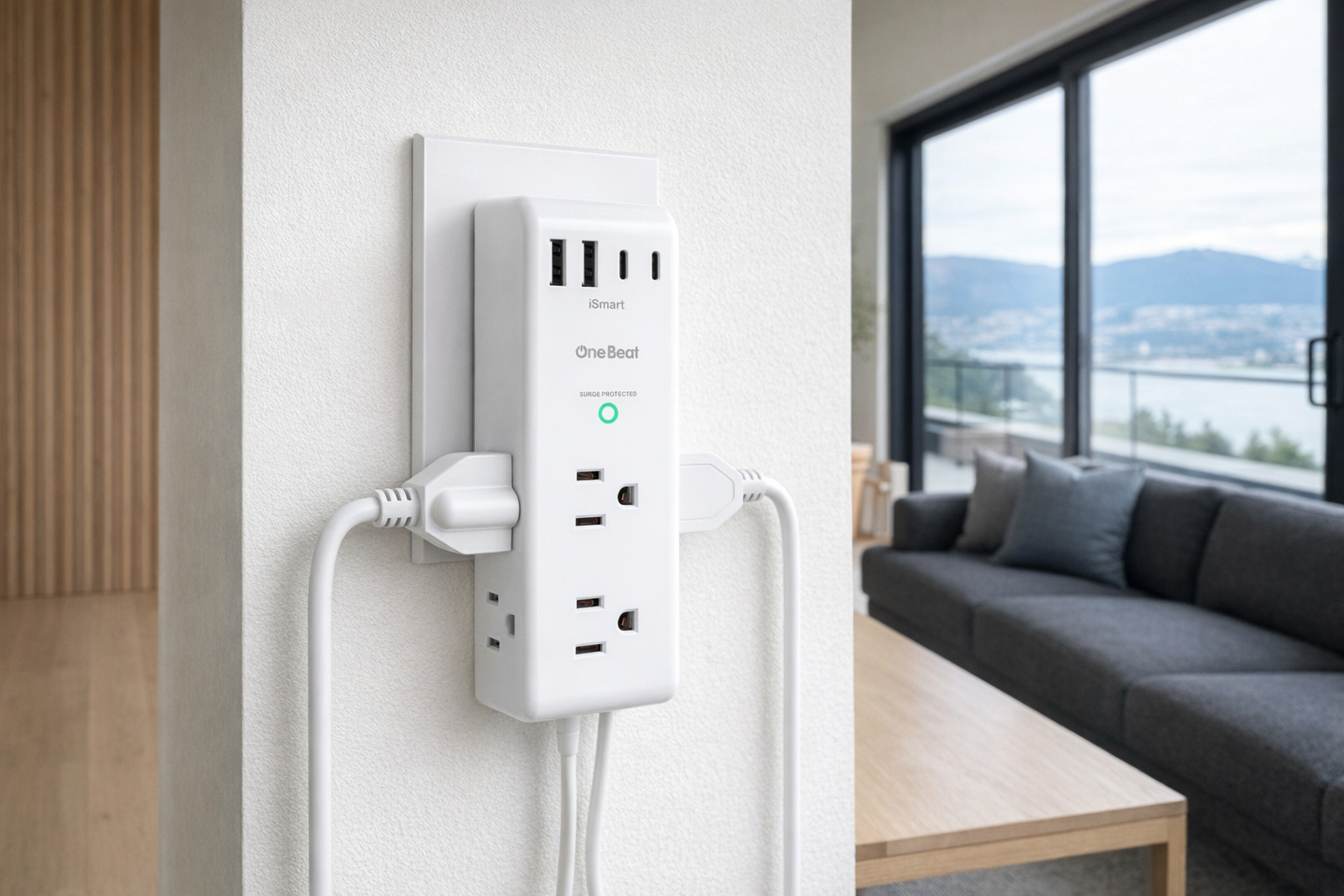
In plain English, this is a wall-mounted outlet multiplier with built-in USB charging and basic surge protection. You plug it directly into an existing wall outlet, and instead of having the usual two receptacles, you get 10 usable outputs: 6 AC outlets, 2 USB-A ports, and 2 USB-C ports. The rotating plug is the part that makes it more flexible than the cheapest outlet extenders, because it can adapt to outlets mounted horizontally or vertically.
Surge protector outlet extender with 180-degree rotating plug, 6 AC outlets (3-sided), 4 USB ports (2 USB-C), 1800J surge protection. ETL certified with fire-resistant ABS shell. Compact design (5.7x1.9x1.7 inches) with widely spaced outlets for big plugs.
That description tells you almost everything important. The real appeal is not raw power; it is convenience and space efficiency. The housing is 5.7 x 1.9 x 1.7 inches, so this is meant to sit tight to the wall and add access where a regular power strip would look messy or take up floor space. The 3-sided layout and wider outlet spacing also suggest it is designed for actual chargers and adapters, not just idealized slim plugs from a product mockup.
A useful comparison here is the Addtam outlet extender with USB ports, which lives in the same general category on Amazon. Products like that typically offer the same promise: more outlets, some USB, no cord. The One Beat model stands out mainly because of the 180-degree rotating plug and the mix of 2 USB-C plus 2 USB-A. That is a more practical setup than older extenders that still assume everything charges through USB-A forever.
Key features at a glance
- 10-in-1 design with 6 AC outlets, 2 USB-A, and 2 USB-C
- 180° rotating plug for vertical or horizontal wall sockets
- 3-sided space-saving layout with wider spacing for large power bricks
- USB-C smart charging up to 3A/5V per port, according to the listing
- 1800J surge protection using TVS, MOV, and GDT protection circuits
- ETL certified construction with a 1382°F fire-resistant ABS shell
- 15A, 125V, 1875W max electrical rating
How the One Beat Surge Protector Outlet Extender actually works
The basic mechanism is simple: this unit takes one wall outlet location and redistributes that power across more connection points. Internally, it is combining two jobs. First, it acts as a passive AC outlet expander. Second, it includes a USB charging module that converts household AC power into 5V DC output for phones, earbuds, watches, and similar low-power devices.
The electrical limits matter here. The listing gives a maximum of 15A, 125V, and 1875W, which is standard territory for many North American household outlet accessories. That means the device is built for ordinary room-level electronics, not for stacking multiple space heaters, kettles, or hair tools into one wall point. If you see "6 outlets" and imagine six high-draw devices at once, that is the wrong mental model.
There are really three functional layers to understand:
- Outlet expansion. The 3-sided body physically spreads out plugs so bulky adapters do not block each other as badly.
- USB charging. The USB system provides DC 5V/3.1A total according to the specs, with USB-C charging listed as up to 3A/5V per port. In practice, that means light-duty charging convenience, not fast USB-C laptop charging.
- Surge protection. The unit claims 1800 joules of surge protection and names TVS, MOV, and GDT circuits. That is the part meant to absorb or divert voltage spikes before they reach connected electronics.
The rotating plug deserves a separate mention because it solves a very real annoyance. Many wall extenders fit nicely in one outlet orientation and awkwardly in another. A 180-degree rotating plug means the body can be positioned more cleanly on older wall plates, bedside outlets behind furniture, or kitchen backsplash plugs. That is a small feature, but it is often the difference between "useful" and "annoying enough to return."
A realistic "day in the life" with One Beat Surge Protector Outlet Extender
Because this is an informational explainer, the scenario below is based on the listed features and what products in this category are typically used for.
- Morning. On a bedroom nightstand, the extender handles a lamp, a phone charger, and maybe a white-noise machine, while one of the USB-C ports tops up your phone without needing a separate wall brick.
- Midday. At a home office desk, the 3-sided outlets make it easier to plug in a monitor power adapter, laptop charger, and printer cable without one chunky brick hogging half the unit.
- Afternoon. In a kitchen corner, it can power a small appliance temporarily while also keeping a tablet or wireless earbuds charging over USB. That said, this is where wattage discipline matters; a toaster and an air fryer at the same time would be a bad idea.
- Evening. In a family charging zone near the entryway, the mix of USB-A and USB-C is genuinely useful because not every cable in the house has modernized at the same speed.
That is the pattern this kind of product fits best: small electronics, chargers, lamps, routers, speakers, and desk gear. It is less about "powering everything" and more about making one outlet stop being a bottleneck.
Who the One Beat Surge Protector Outlet Extender is actually for (and who it isn't)
Great fits
- People with a nightstand outlet buried behind a bed frame who want fewer charger bricks sticking out of the wall.
- Home office users trying to power a monitor, laptop adapter, desk lamp, and phone charger from one accessible spot.
- Students in a dorm room where floor space is limited and a full-length power strip is one more thing to trip over.
- Apartment dwellers with older rooms that simply do not have enough convenient outlets near where devices actually live.
- Families building a shared charging station for phones, earbuds, smartwatches, and portable speakers.
Poor fits
- Anyone needing a corded power strip that can reach behind furniture or span across a desk.
- People planning to run multiple high-wattage appliances from one wall point at the same time.
- Buyers who expect the USB-C ports to behave like a modern USB-C PD laptop charger. This is not that.
- Households looking for a serious whole-home surge strategy. A wall extender with 1800J protection is useful, but it is not the same thing as a full electrical protection plan.
- People with unusually loose, damaged, or awkwardly mounted outlets where a plug-in extender may not sit firmly.
Practical trade-offs
Power limits
The most important trade-off is capacity. The unit is rated for 1875W max, which sounds high until you remember how quickly heating devices eat that budget. A space heater, kettle, toaster oven, or hair dryer can take a huge bite out of that on its own. This extender makes the most sense for electronics and chargers, not for trying to turn one outlet into a mini appliance hub.
The USB side also has limits. The listed DC 5V/3.1A total output tells you the USB charging is built for convenience, not speed. For phones overnight or casual daytime top-ups, that is fine. For fast charging a newer tablet or anything laptop-sized, manage expectations.
Wall fit and stability
A wall-tap design is cleaner than a power strip, but it asks more from the outlet itself. The device weighs 8.1 ounces, which is not heavy in absolute terms, but once you add six plugs and a few cables, the outlet fit matters. In a newer, tight outlet, that is usually fine. In an older receptacle that already feels loose, any direct-plug extender can start to feel less reassuring.
The rotating plug helps, and that is one of the smarter features here. It should reduce weird sideways stress when the outlet is mounted in an awkward orientation. That's a more honest design than many bargain extenders that pretend every wall socket lives in a showroom.
Surge protection expectations
1800 joules is a useful spec, but it should be understood properly. It is there to help protect against routine surges and spikes, especially for things like chargers, smart speakers, routers, lamps, and small office electronics. It does not make connected devices invincible, and it does not replace whole-home surge protection if you live in an area with poor power quality or frequent storm activity.
The listing also mentions TVS, MOV, and GDT circuits, which is more detail than some cheap accessories bother to provide. That is a good sign, though not a reason to stop thinking critically. Surge products are best treated like seatbelts: important, worthwhile, and not magic.
Where the One Beat Surge Protector Outlet Extender fits in a smart home
This product fits best at the edges of a smart home, not at the center of one. It is the thing you use to make the messy device clusters more manageable: the smart speaker corner, the modem shelf, the bedside automation stack, or the kitchen counter where a voice assistant and a display already live.
A few examples make that clearer:
- Bedroom setup: one wall outlet can handle a bedside lamp, a phone charger, a smart speaker like an Amazon Echo Dot, and maybe a white-noise machine.
- Home office setup: pair it with a monitor, desk lamp, charging cables, and perhaps a Wi-Fi router or small desktop speakers.
- Entryway charging station: use the USB ports for phones and earbuds, while the AC outlets power something like a battery charger for a cordless vacuum or a small smart display.
- Kitchen corner: useful beside an Echo Show or Google Nest Hub, with enough flexibility for occasional small appliance use, as long as you respect the wattage cap.
What it does not replace is a proper surge bar for an entertainment system, or a UPS for networking gear, or a long extension solution for furniture layouts. Think of it as a compact outlet organizer. That is its lane, and it is a reasonable lane for ~$14 CAD.
The buying decision, in plain terms
Before buying this kind of outlet extender, three questions usually surface the right answer:
- Do you actually need more outlets at the wall, or do you need outlets farther away? If the issue is reach, buy a corded power strip instead.
- Are you mainly plugging in chargers and electronics, or are you thinking about high-heat appliances? For the first use case, this makes sense. For the second, be much more cautious.
- Will the built-in USB save you clutter, or would you still prefer your own fast chargers? If you already rely on high-speed USB-C charging bricks, the USB ports here may be a convenience bonus rather than the main reason to buy.
If those answers line up with a fixed charging spot, light electronics, and a cramped outlet situation, this is a sensible low-cost buy.
Got Questions About the One Beat Surge Protector Outlet Extender? Let's Clear Things Up.
Is this a hands-on review?
No. This is an informational explainer based on the product listing, published specs, and the normal use patterns of wall-mounted surge protectors. It is meant to help you decide whether this type of product fits your setup before you dig deeper.
Does the One Beat Surge Protector Outlet Extender support fast USB-C charging?
Not in the way most people mean when they say "fast charging." The listing says the USB-C ports can deliver up to 3A/5V per port, and the overall USB output is listed as 5V/3.1A total. That points to basic device charging, not higher-wattage USB-C Power Delivery for laptops or very fast phone charging.
Can you plug high-power appliances into it?
Technically, the AC outlets are rated within a normal 15A / 125V / 1875W max range, but that does not mean it is wise to load it with multiple high-draw appliances. This type of extender is better suited to chargers, lamps, routers, speakers, and office gear than to stacking heaters, kettles, and hair tools in one place.
Is the rotating plug actually useful, or just marketing?
It is one of the more practical features in the listing. A 180-degree rotating plug can make a real difference when your wall socket is sideways, behind furniture, or mounted in a spot where cable direction matters. That is especially helpful for keeping the extender sitting more naturally against the wall.
Is this safer than a basic outlet splitter?
On paper, yes, it is trying to do more for safety than a bare splitter. The listing mentions 1800J surge protection, ETL certification, and a 1382°F fire-resistant ABS shell. That does not mean risk disappears, but it is a more reassuring spec sheet than the no-name splitters that offer extra outlets and little else.
Where can you verify the current listing or buy it?
The easiest place to verify the current price, specs, photos, and availability is the Amazon product page. Here is the listing: One Beat Surge Protector Outlet Extender on Amazon. Since marketplace listings can change, it is worth checking the current details before buying.
What does it cost in Canada?
At the time of writing, the listed price is ~$14 CAD. That is firmly in impulse-buy territory for a utility accessory, but pricing can shift with promotions, exchange rates, and seller availability, so verify the current listing before checkout.
Where is the Celmin Directory listing for this product?
For a catalog-style view of the same product — structured specs, pros and cons, similar picks, and FAQ — see One Beat Surge Protector Outlet Extender on Celmin Directory.
If you're building a smarter home in Canada and want honest explainers on gadgets worth considering — plus the ones worth skipping — Celmin covers the full catalog without the marketing theater. More reviews, comparisons, and buyer guides at https://celmin.ca.

Discussion
Sign up or sign in to join the conversation.