
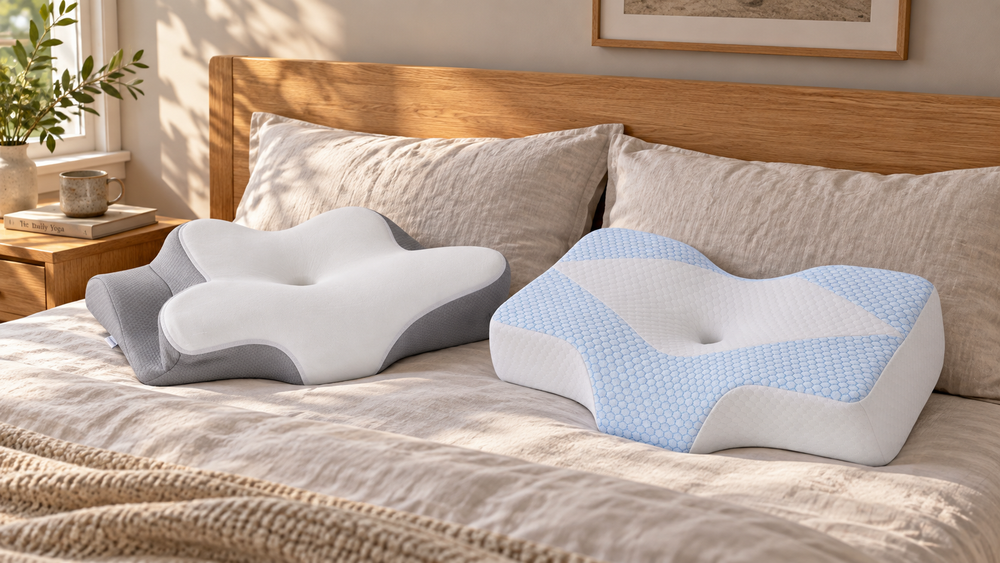
Compare Missleep and Mkicesky contour pillows by contour heights, cover texture, care and return terms to choose a shape that suits your bed.
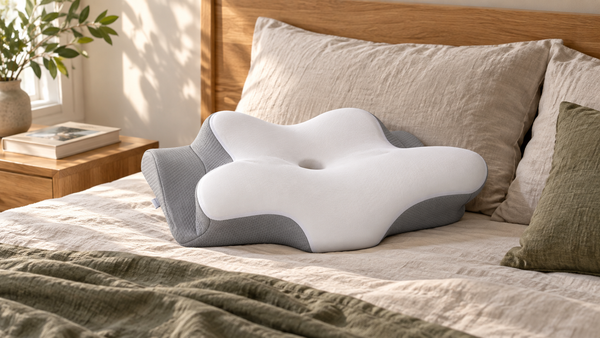
The Missleep and Mkicesky ZT-31-06 are closer in design than their product descriptions might suggest. Both use moulded memory foam, offer two contour heights and have removable covers. Neither gives you loose filling to take out or move around.
If you want a noticeably different way to adjust a pillow, this comparison will not produce one. The useful differences are the shape you can confirm, the cover you prefer and the terms under which you can try it.
Start with the height, not the health language
Support and comfort depend on the pillow, mattress and sleeper together. Neither shape establishes treatment for neck pain. If discomfort persists or worsens, seek appropriate advice rather than relying on a pillow claim.
Mkicesky specifies contours of about 10.7 and 13.2 cm, with an overall size of 63.5 × 40.6 cm. Confirm both Missleep contour heights for the selected size before comparing fit. A lower or higher edge is not automatically better; your mattress and sleeping position determine the gap it needs to support.
Your mattress belongs in this decision. How far your shoulder sinks changes the gap beneath your head. HealthLink BC’s guidance describes keeping the neck supported without forcing the head forward or leaving it too low; it does not prescribe one pillow height for everyone.
Flip the pillow; the foam filling is not adjustable
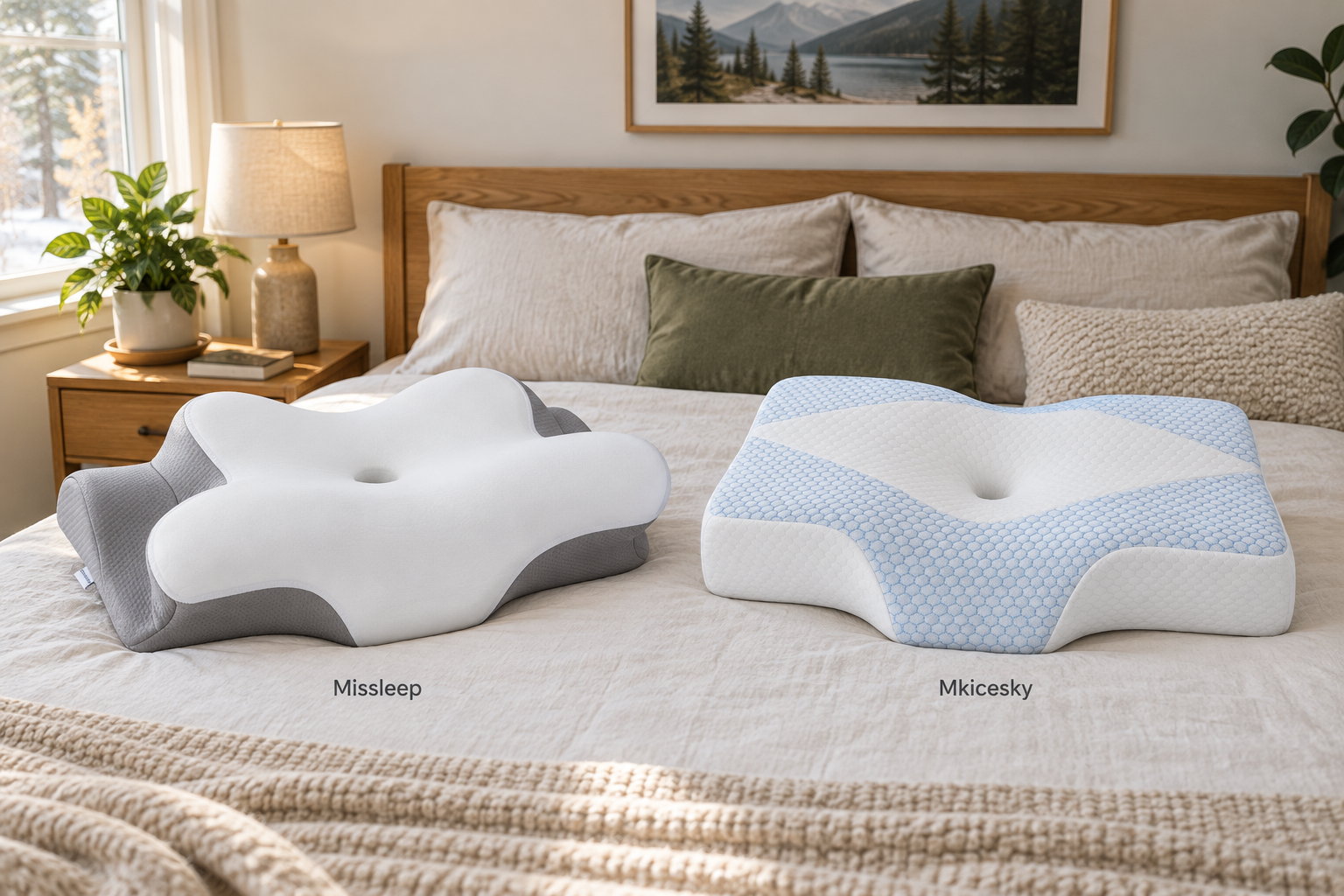
Missleep cervical pillow
 Shop at Amazon.ca
Mkicesky ZT-31-06 contour pillow
Shop at Amazon.caWhich difference should matter most to you?
For someone replacing a comfortable but worn pillow, dimensions and contour shape should lead the comparison. Mkicesky gives you two stated edge heights to compare with your current setup. That is a useful information advantage; it is not proof that its taller or lower edge will be comfortable for you.
For someone who has never used moulded foam, the return conditions may be more important than either product's surface fabric. Both ask you to adapt to a defined shape. A purchase that allows an informed trial can be more useful than a small discount on a pillow you cannot return after opening.
For someone who already likes a contoured pillow, smaller practical details move up the list: the room available around the head cradle, how the supplied cover feels, whether a normal pillowcase fits, and whether replacement covers are available. These are sensible reasons to prefer one offer even when the basic constructions are similar.
Compare the entire shape, not one edge
Mkicesky's roughly 63.5 × 40.6 cm footprint helps you judge bed space and pillowcase fit. The 10.7 and 13.2 cm contours describe the unloaded product. Your head compresses the foam in use, so those measurements should not be treated as the final height beneath your neck.
For Missleep, get the equivalent measurements for the exact option you intend to order. A package measurement or an illustration with no scale does not provide the missing comparison. Once you have both diagrams, look at the centre as well as the edge heights: the shape beneath the head is part of the support arrangement.
There is no reason to assume the larger number wins. The useful question is whether the contour leaves you in a comfortable position on your own mattress. Someone whose shoulder sinks deeply may need a different arrangement from a person lying on a firmer surface, even if their height and shoulder width are similar.
Cover texture is a practical difference
| Detail | Missleep | Mkicesky ZT-31-06 |
|---|---|---|
| Core | Slow-rebound memory foam | Slow-rebound memory foam |
| Height choice | Rotate between two contours | Two contours |
| Cover description | Smooth “ice silk” fabric | Breathable centre with smooth surrounding fabric |
| Cleaning | Removable; seller says machine washable | Removable and washable; check the care label |
Missleep may interest you if you prefer a smooth surface. Mkicesky’s mixed-fabric cover is worth examining if you like a different texture around the centre. Those are preferences you can understand before buying, even though a photograph cannot tell you how either feels against your skin.
A smooth cover can feel different from a textured one, but “cooling” is not a promise of all-night temperature control. If you add your own pillowcase, its fabric and fit become part of the experience too.
Two heights still leave you with a fixed shape
Turning either pillow around gives you another edge. It cannot make the entire core flatter or give the centre more room.
That matters if you move often during sleep. A shape that feels comfortable while lying carefully in the middle may be less appealing when you roll over. Look at the usable surface around the contour, not just the raised edges.
Think about your current pillow habits. Do you keep rearranging the filling, fold a corner, or prefer something that stays put? The first two habits might make a fixed contour frustrating. The last one is a better reason to investigate these designs.
How the choice changes with sleeping habits
You mostly stay on one side
A stable contour may appeal if you settle into one position and prefer the pillow to remain shaped. Both designs are candidates for that preference. Compare the contour you would actually use, and include the feel of the centre beneath your head rather than choosing from the highest edge alone.
Mkicesky is easier to screen from its published height measurements. Missleep remains a possibility once the seller confirms equivalent information. A clearer measurement can reduce uncertainty before ordering, but comfort still needs an appropriate trial.
You switch between your back and side
The space for turning becomes more important. Try to picture your usual movement across the pillow rather than a carefully arranged product photograph. Neither pillow automatically changes its core height when you roll over.
If you tend to fold or bunch filling while changing position, remember that both offer fixed foam. Their shared design may be the more important finding than the difference between their covers. Choosing between two unsuitable shapes will not solve a preference for a different kind of adjustment.
You always use your own pillowcase
Compare dimensions and how the case sits over the contour. The supplied cover may be less important against your skin once it is covered, while its fit, washability and drying routine remain relevant. A tight extra case can also change how freely the pillow's shape sits on the bed.
In that situation, a small price premium for a particular surface texture is harder to justify unless you plan to sleep directly on the supplied cover. Spend attention on the part of the product you will actually interact with each night.
Cooling, firmness and comfort claims
Neither a cooling label nor slow-rebound foam gives you a matched overnight comparison. Cover feel can be a valid preference without becoming a promise that one pillow will keep every sleeper cooler for longer.
The same applies to firmness. A description such as supportive does not tell you exactly how far either foam will compress under your head. Avoid trying to turn unrelated seller adjectives into a numerical ranking. Ask about the construction and use a permitted trial to assess the result.
If neck pain is the reason you are shopping, keep the purchase decision separate from a treatment decision. An unfamiliar pillow should not become a substitute for assessment of persistent symptoms. Neither of these products has earned a recommendation as a treatment simply through its shape or marketing language.
Laundry and returns can settle a close choice
A washable cover is useful; a washable foam core is a different claim. Follow the care directions for each component, and ask whether a spare fitted cover is available in Canada. An awkward drying routine can become more annoying than a small difference in texture.
Before checkout, establish whether you may open and try the pillow and still return it. Ask about the deadline, condition requirements and shipping cost. A return window does not automatically amount to a sleep trial.
Missleep mentions a six-month warranty. Confirm its coverage and ask Mkicesky for its own written terms. Do not assume that a fault warranty covers a pillow that feels uncomfortable.
Compare the offer as carefully as the pillow
Before paying, find out whether opening and sleeping on the pillow changes your ability to return it. Check who pays return postage and whether the product must retain its packaging. A short policy with clear answers is more useful than an impressive satisfaction claim with unclear conditions.
Ask each seller how a defective zip, damaged cover or misshapen core is handled. A warranty can cover a manufacturing fault while excluding a change of mind or a comfort preference. That distinction matters with both products and should be settled before you rely on the warranty as a trial period.
Consider the price of keeping the pillow usable too. A replacement cover that fits, straightforward care instructions and responsive help can make a modest purchase easier to live with. Do not assume the lower checkout price is the whole cost if its cover is difficult to replace.
Quick answers before choosing
Does either offer adjustable filling?
Both offer a choice between fixed contours. If you want to remove or rearrange filling, neither design described here provides that adjustment.
Which has the clearer sizing information?
Mkicesky provides stated dimensions and both contour heights. Obtain equivalent Missleep measurements before making a like-for-like size comparison. Clearer information is a buying advantage, not a comfort result.
Is the smoother cover the safer choice for a warm sleeper?
A smooth texture can be appealing, but it does not settle overnight temperature. Your own case, bedding and room become part of the experience. Choose the texture you prefer without treating it as a cooling guarantee.
What if both seem equally suitable?
Prefer the offer with confirmed dimensions, clear opened-product return terms and workable cover care. When the designs share so much, reducing uncertainty about fit and ownership is more valuable than choosing the stronger promotional promise.
How to assess the one you order
Follow the unpacking instructions, then try each contour on your normal bed. Keep your bedding and mattress unchanged while you compare the two edges. Notice whether you can relax and turn naturally, rather than trying to give the pillow a technical score.
You should not have to endure worsening discomfort to complete an assumed adjustment period. Persistent symptoms warrant separate advice.
Missleep is a reasonable starting point if its smooth cover and confirmed dimensions appeal to you. Mkicesky is equally worth considering if you prefer its cover construction and the seller gives you clearer fit and return information. With so much shared design, a well-documented offer is a more useful advantage than a stronger comfort claim.
Missleep cervical pillow
Shop at Amazon.caMkicesky ZT-31-06 contour pillow
Shop at Amazon.caImages are AI-generated illustrations based on product references.
Sign up or sign in to join the conversation.