
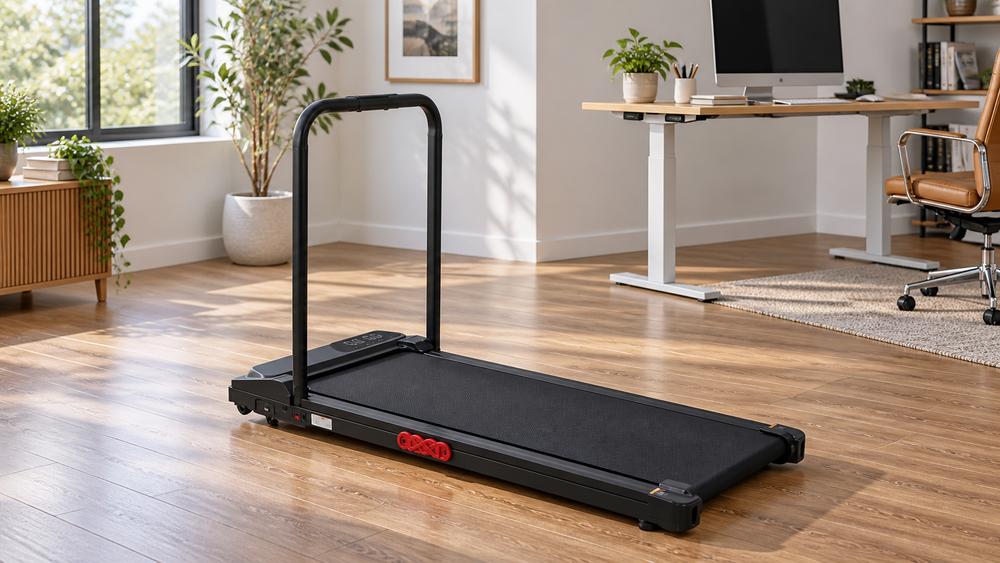
Will the KASSADIN V300-STR fit your desk and walking routine? Check belt size, handle removal, controls, storage and Canadian electrical certification.
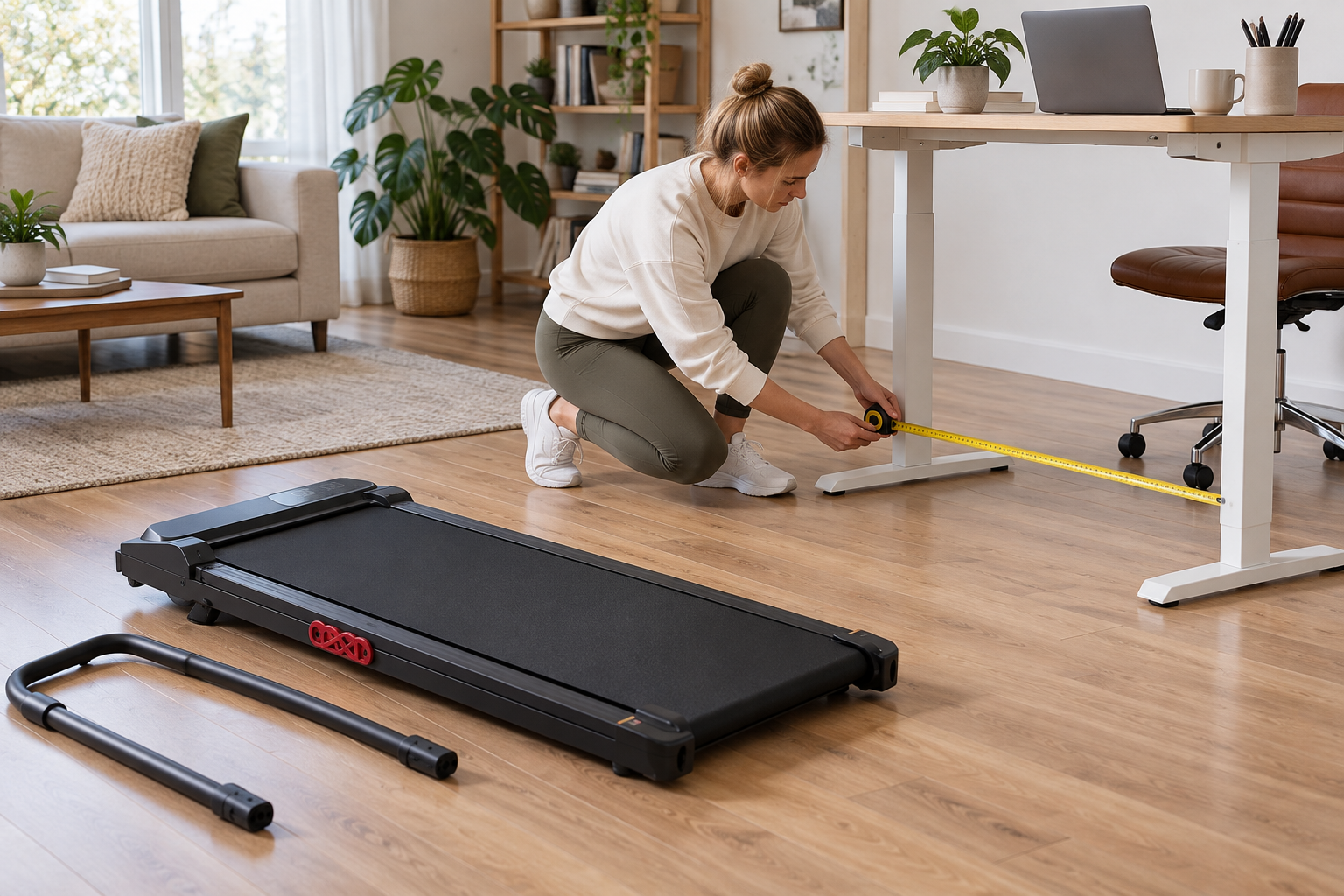
Measure your desk before ordering this walking pad. Include the feet and crossbars, not just the gap between the desktop’s edges. Then work out where your chair will go while you walk.
The KASSADIN V300-STR has a removable handlebar, which gives it a practical appeal: you can use the handle for a separate session, then configure the machine for a desk if its instructions allow that setup. Whether you will want to make that change every day is another question.
Which part of your workday would you actually use it for?
The strongest reason to consider the V300-STR is a routine with two distinct uses: gentle walking during suitable desk tasks, plus separate sessions with the handle fitted. If you only want one of those arrangements, the removable hardware matters less. Start with a specific window in the day, such as reading documents or working through straightforward messages, rather than planning to walk through every meeting and deadline.
Work requiring very precise cursor control, extended handwriting or frequent turning away from the screen may be easier while stationary. Walking also introduces another activity to manage when a call becomes demanding. Being able to stop, step off safely and return to a chair without moving half the room is part of a useful setup.
There is no need to treat the maximum speed as a productivity goal. The appropriate pace is one that stays within the instructions for the configuration and lets you remain in control. If your attention keeps shifting from the task to keeping your position on the belt, the arrangement needs reconsidering.
Measure three spaces, not just one
First measure the machine's working location, including the operating clearance required in its manual. Then measure its storage location. Finally, check the route between them. A desk and a spare corner can both accommodate the treadmill while a narrow doorway, chair base or rug edge makes moving between them awkward.
Make the desk measurement at floor level as well as desktop level. Feet, modesty panels, cable trays and low crossbars can reduce the usable space. Check whether the controls remain visible and reachable from the position where you will walk. A screen hidden beneath the desk will not become easier to read once work begins.
For storage, account for anything that protrudes beyond the deck. Get the permitted storage orientation from the instructions; a removable handle is not evidence that the base can stand safely on its end. If the machine must move daily, its weight and lifting points deserve the same attention as its motor specification.
Plan the space while the machine is running
Storage dimensions are only part of the job. You need room to get on and off, reach the controls and leave the clearance specified by the manufacturer. A machine that slides under a bed may still be awkward beneath a desk.
The deck also raises your standing position. If your desk is already near its maximum height, you may no longer be able to type comfortably. Include the deck and your shoes when checking the working height.
Trace the cable route to an appropriate outlet. You should not have to step over the cord, pull it taut or connect the machine through a desk power bar simply because a socket is free. Follow the electrical instructions for the treadmill.
Deck height also changes your keyboard height
KASSADIN V300-STR
 Shop at Amazon.ca
Your desk still has to work as a desk
Standing on the deck changes the relationship between your hands, screen and work surface. A desk that feels comfortable when you stand on the floor may be too low once the treadmill is underneath it. Measure with footwear in mind and check the desk's actual height range before ordering.
Arrange frequently used controls within easy reach. Leaning across the keyboard to retrieve a phone or reaching down for a remote adds an avoidable distraction. Keep loose charging leads and headphone cables clear of the moving area, following the machine's clearance instructions rather than trying to tuck them beside the belt.
Allow for a seated arrangement too. If every switch requires dragging the treadmill across the room, consider whether fewer, more deliberate walking sessions would suit the layout better. A useful workday setup supports changes of position; it should not leave you feeling committed to walking because sitting down is inconvenient.
Find out what “removable” involves
Ask how the handle comes off. Does it need tools? Are any wires or controls attached? Where will the detached part sit while you work?
Those answers affect everyday use more than a product photograph showing two configurations. A change that takes some care may be perfectly acceptable once a week and irritating twice a day.
You also need to know how the machine stops in each arrangement. Confirm the emergency-stop or safety-key setup and whether it remains accessible with the handle removed. A remote is useful, but it does not answer every stopping question.
Treat the top speed as a limit, not a target
The seller advertises 0.6–7.6 mph, roughly 1–12.2 km/h. Do not assume the whole range is permitted under a desk or with the handle removed. Ask for the operating limits for each configuration.
If incline is a deciding feature, confirm its grade, adjustment method and permitted configuration before buying. Do not assume the adjustment works while you are walking or that every handle configuration permits the same setup.
Reading email and doing precise mouse work are different tasks. Start with the sort of work you expect to do while walking, rather than imagining that every hour at your desk will become a walking session.
Noise has more than one source
For calls, the relevant question is what your microphone picks up at your intended pace. For an apartment, it is also what travels through the floor. Motor noise, footfalls, belt movement and vibration are different parts of that experience. A single decibel claim does not settle all of them.
Hard flooring, room layout and the building below you can change how noticeable the machine is. A mat may be appropriate if the treadmill and flooring instructions permit it, but it is not a guarantee of neighbour-friendly operation. Avoid covering vents or compromising stability to chase a quieter result.
If noise is a deciding factor, read the return conditions before purchase. In particular, find out whether an opened, assembled treadmill can be returned, who arranges collection and who pays the transport charge. A large-item return is a different commitment from returning a small desk accessory.
Maintenance is part of the ownership decision
Before purchase, request the manual and look for belt inspection, cleaning and lubrication requirements. Do not assume every treadmill uses the same lubricant or maintenance interval. The instructions should also explain what to do if the belt moves out of position or the machine behaves unexpectedly.
Ask about replacement controls, safety components and local support. A remote or safety key that looks generic may not be interchangeable. Keep the model number and purchase record somewhere accessible so a future support request does not depend on finding an old sales page.
After delivery, compare the product label with the model ordered and inspect for transit damage before operation. Retain packaging until you have checked the permitted configurations and basic operation. Establish where the detached handle and any fasteners will live; losing a small part can make the advertised flexibility less useful.
The specifications leave a few important gaps
| Seller’s claim | What to confirm |
|---|---|
| 3.0 HP motor | Duty-cycle and maintenance instructions |
| 160 kg user capacity | The limit on the delivered model’s label |
| Below 45 dB operation | Measurement conditions; footfall vibration is separate |
| Removable handle and incline | Permitted combinations and safety controls |
The usable belt length and width deserve a direct answer. Overall frame dimensions do not tell you how much space your stride has. Nor does a stated capacity establish that the belt will feel roomy or the handle will provide substantial balance support.
For an apartment, consider the floor below you as well as the motor beside you. Footsteps and vibration can travel even when a motor sounds unobtrusive. Any mat must be suitable for the treadmill and floor without obstructing ventilation or making the base unstable.
Questions worth settling before ordering
Can this replace a full-size running treadmill?
Do not make that assumption from the top speed. Belt dimensions, permitted operating modes, handle design and the manufacturer's intended use all matter. Buy for the activity the delivered model expressly supports, within its instructions, rather than extrapolating from the motor label.
Can you leave it under the desk permanently?
Only if that arrangement leaves safe access and works for the rest of your day. Consider the chair, feet, cables and anyone else using the desk. Keeping it in place can reduce setup time, but a permanently occupied floor area may make seated work or cleaning inconvenient.
Does a higher weight limit mean a roomier belt?
No. Capacity and usable walking space are separate specifications. Confirm both. A machine can be rated for a person's weight without offering the stride room or configuration that person wants.
Is the handle a mobility aid?
Do not treat it as one without specific manufacturer guidance. A removable handlebar is a configuration feature, not proof of suitability for balance assistance or rehabilitation. Anyone needing that support should choose equipment with appropriate professional guidance.
The buying decision comes down to a workable room, a manageable changeover and clear instructions. Once those are settled, the V300-STR's dual arrangement becomes a useful feature rather than an extra promise to fit into an already crowded desk area.
Delivery, storage and the first setup
Check the assembled weight and the route from your door to the intended room. Wheels help across a level floor; they do not remove stairs or thresholds.
Ask whether vertical storage is allowed rather than copying a leaning position from a photo. Keep children and pets out of the operating area, and learn the stopping procedure before starting a session. The treadmill safety guide explains common hazards; the KASSADIN manual should govern this machine’s setup.
Canadian buyers should also request a clear photo of the applicable electrical certification mark. Health Canada explains what to look for. Marketplace availability alone is not confirmation.
The V300-STR is most interesting when you will use both handlebar and desk configurations. If the belt dimensions, changeover procedure or operating limits remain unclear, wait for those answers. They determine whether the machine fits your day.
KASSADIN V300-STR
Shop at Amazon.caImages are AI-generated illustrations based on product references.
Sign up or sign in to join the conversation.