
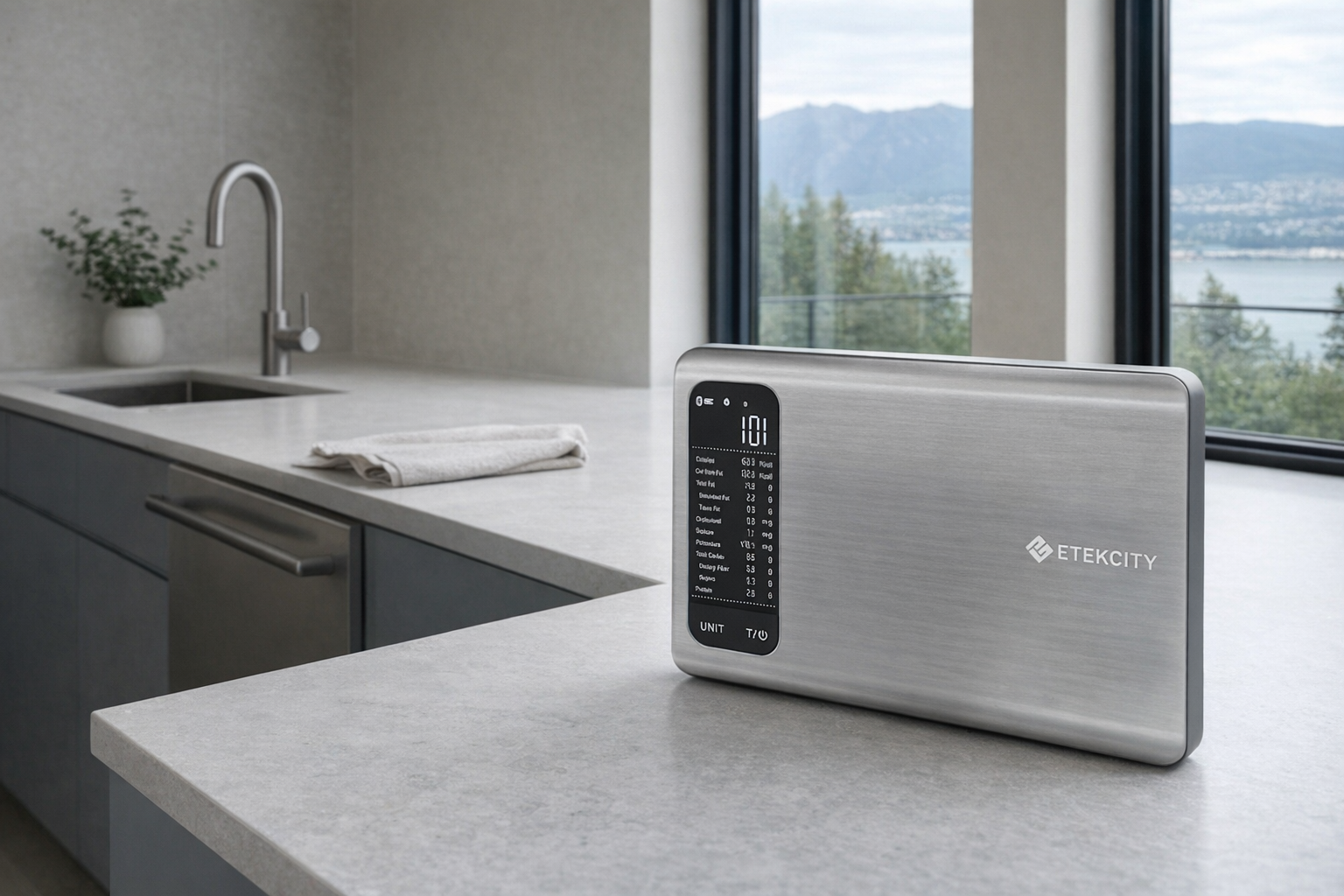
The Etekcity Smart Nutrition Scale sits in a very practical corner of the smart-kitchen world: not the flashy countertop gadget that promises to "transform" cooking, but the humble digital scale that tries to make calorie and macro tracking less annoying. That is the real category here. It is...
The Etekcity Smart Nutrition Scale sits in a very practical corner of the smart-kitchen world: not the flashy countertop gadget that promises to "transform" cooking, but the humble digital scale that tries to make calorie and macro tracking less annoying. That is the real category here. It is a kitchen scale first, and a nutrition-data tool second. If you meal prep, count macros, track portions for medical reasons, or just want more accuracy than eyeballing a tablespoon of peanut butter, that can be genuinely useful.
This is not a hands-on review. Nothing here is based on personally using the scale. The goal is simpler: explain what the Etekcity Smart Nutrition Scale appears to do, where it fits, what trade-offs come with a phone-connected food scale, and who it realistically makes sense for. If you are deciding between this and a basic digital scale for half the price, that is the question worth answering.
📺 Watch: Product demo video available on the retailer page.
Quick snapshot
| Question | What the Etekcity Smart Nutrition Scale actually is |
|---|---|
| Category | Smart Kitchen |
| Made by | Etekcity |
| Typical price | Pricing varies — check current Canadian listings |
| Rating signal | 4.5/5 on the source listing |
| Best for | Macro trackers, meal preppers, calorie counters, and people who want app-linked food logging |
| Skip if | You want a dead-simple scale with no app, no account, and no nutrition database dependency |
Pro tip: Buy this for food logging convenience, not for weighing performance alone. If all you need is grams and ounces on a countertop display, a cheaper non-smart scale will often do the job just fine.
What the Etekcity Smart Nutrition Scale actually is
In plain English, the Etekcity Smart Nutrition Scale is a digital kitchen scale designed to work with a nutrition app so the weight of your food can be tied to calorie and nutrient information. That is the pitch. Instead of weighing a bowl of rice, then manually searching for "cooked white rice 173 g" in an app, this kind of product tries to combine those steps into one smoother workflow. It is less about smarter hardware than about reducing friction in tracking.
That empty description block tells you something by omission: the listing is leaning more on the product category and its app ecosystem than on a dramatic one-line claim. That is not necessarily bad. In practice, products like this live or die on the basics: stable measurements, readable display, sensible tare function, and a companion app with a food database that is not a mess. Compared with a plain digital kitchen scale like the OXO Good Grips 11 lb Food Scale, the Etekcity model is clearly aimed at people who care about the nutrition layer, not just baking accuracy. The OXO is the classic "weigh ingredients and move on" option; the Etekcity tries to be part of a tracking system.
Key features at a glance
- Digital food weighing for portioning ingredients and meals
- Smart nutrition focus through a connected app ecosystem
- Calorie and macro tracking use case rather than just raw weight measurement
- Tare-style workflow implied by its category and intended kitchen use
- Compact countertop form factor typical of slim kitchen scales
- Affordable entry point at around $39.07 CAD on the supplied listing
How the Etekcity Smart Nutrition Scale actually works
At a basic level, this is still a kitchen scale. You place a bowl, plate, or ingredient on top, the sensors measure weight, and the display gives you a number. The "smart nutrition" part comes when that number is paired with a food entry in the companion app, which can then calculate calories, macronutrients, and sometimes more detailed nutritional information based on the measured amount.
That matters because weighing food alone is easy; translating that weight into something useful for diet tracking is where most people get tired. A standard scale will tell you you have 86 grams of almonds. A nutrition scale wants to take the next step and tell you what 86 g of almonds means in calories, fat, protein, and carbs. That is the real appeal, especially for people logging several meals a day.
The likely workflow is straightforward:
- Put a container on the scale and tare it to zero.
- Add the food and note the weight.
- Match that food in the app so the weight can be converted into nutrition data.
- Log the portion into your daily intake record.
That sounds minor, but it changes how the product should be judged. This is not just hardware; it is a hardware-plus-database system. If the app is well maintained and the food matching is sensible, the scale becomes genuinely handy. If the app is clunky, requires too much correction, or pushes you into account creation and syncing you did not want, the hardware stops feeling "smart" very quickly. That is a more honest way to think about it than the usual marketing language.
A realistic "day in the life" with Etekcity Smart Nutrition Scale
Because this is an informational explainer, the examples below are based on what the product category and listing imply, not on direct testing.
- Morning. You make oatmeal and want an actual serving rather than a guess. The Etekcity Smart Nutrition Scale helps weigh oats, fruit, or nut butter, then the app turns those weights into a breakfast log instead of leaving you to estimate everything manually.
- Midday. You are meal prepping lunches for the week. Chicken, rice, and vegetables get portioned by weight so each container is closer to consistent. That is useful for people trying to hit the same calories or protein target across 4 or 5 prepared meals.
- Afternoon. You grab a snack and realize this is where tracking usually breaks down. A smart nutrition scale is most helpful in exactly these moments: nuts, cereal, yogurt, granola, or leftovers that are easy to under- or over-estimate if you rely on visual guesses.
- Evening. You cook dinner for the household but only want to log your portion. Instead of trying to reverse-engineer a serving size from a recipe card, you weigh the amount actually on your plate. That is often more useful than broad "1 serving" labels, which can be wildly inconsistent.
Who the Etekcity Smart Nutrition Scale is actually for (and who it isn't)
Great fits
- Macro trackers who already log protein, carbs, and fat and want less friction than manual entry.
- Meal preppers making 3, 4, or 5 near-identical containers and wanting portion consistency.
- People managing weight loss or gain who need more accuracy than cups and spoons provide.
- Fitness-focused home cooks who weigh ingredients like rice, oats, meat, or nut butter regularly.
- People following clinician-directed nutrition plans where portion accuracy matters more than casual cooking convenience.
Poor fits
- Casual bakers who just need grams and do not care about calorie databases or food logging.
- Anyone who dislikes using apps in the kitchen or does not want another account to manage.
- Households with multiple cooks who want pure simplicity; a smart scale can feel fussy in shared kitchens.
- People expecting automatic nutrition magic for every homemade mixed dish. App matching is rarely that effortless.
- Users who only weigh food occasionally; if it comes out once a month, the smart features may never justify the extra complexity.
Practical trade-offs
App dependency
This is the central trade-off, and it is the one many buyers underestimate. A digital scale can last for years as a simple measuring tool, but the "nutrition" side of a smart nutrition scale depends on software. That means the usefulness of the product is tied to app support, food database quality, phone compatibility, and whatever account system the brand chooses to maintain over time.
That does not make it a bad buy. It just means you should evaluate it like a small connected service, not just a slab of kitchen hardware. If your goal is pure longevity with no maintenance, a dumb scale is the safer bet.
Accuracy versus database accuracy
There are really two kinds of accuracy here. First is weight accuracy: does the scale properly measure your food in grams or ounces? Second is nutrition accuracy: is the app matching the correct food entry with sensible nutrition data? Buyers often focus on the first and forget the second.
A scale can weigh perfectly and still produce messy logs if the app database is cluttered with duplicate or inconsistent food entries. That is not unique to Etekcity; it is a category-wide problem. So the question is not only "Does it weigh correctly?" but also "Does the software make logging feel cleaner than just using MyFitnessPal, Cronometer, or Lose It on its own?"
Countertop practicality
Kitchen scales live or die by convenience. They need to be thin enough to store easily, easy to wipe down, and quick to read while a bowl is on top. A smart scale adds another layer: your phone often needs to be nearby if you want the nutrition side to matter. For some people, that is fine. For others, it turns a 30-second weighing task into a more involved routine.
That is why this product makes more sense for repeat use than occasional use. If you log food every day, the extra step may save time overall. If you only weigh ingredients once in a while, it may feel like admin.
Where the Etekcity Smart Nutrition Scale fits in a modern kitchen
The Etekcity Smart Nutrition Scale fits best in a kitchen that already has a small system around intentional eating. Think of it as one piece of a routine, not a star appliance. It makes the most sense alongside:
- A calorie or macro tracking app routine on your phone
- Meal prep containers for portioning lunches and dinners
- A decent blender or air fryer if you regularly make repeatable health-focused meals
- A standard measuring toolkit for recipes that still use cups, teaspoons, and tablespoons
It is less important in a kitchen built around baking precision alone. For baking, many people are better served by a strong non-smart scale from brands like OXO or Escali. But in a kitchen where the daily question is "How much did I actually eat?" this kind of scale fills a more specific role.
It also pairs naturally with health ecosystems rather than smart-home ecosystems. This is not a Matter device, not a HomeKit tool, and not something that belongs in Alexa routines. Its real companions are your phone, your nutrition app, and your meal planning habits. That narrower role is actually a strength. It is trying to solve one problem.
The buying decision, in plain terms
Three questions will usually make the answer clear.
- Do you actually log food more than a few times a week? If yes, the smart nutrition angle can save hassle. If no, the app layer is probably wasted.
- Do you want calorie and macro data tied to actual weighed portions, or do you just want a number in grams? If it is just grams, buy a simpler scale and keep life easy.
- Are you comfortable relying on an app for part of the product's value? If that sounds fine, this is a reasonable low-cost entry into smarter food tracking. If that sounds irritating, skip it.
If you answer yes to all three, the Etekcity Smart Nutrition Scale looks like a sensible buy at around $39.07 CAD; if not, a standard digital kitchen scale is probably the better tool.
Got Questions About the Etekcity Smart Nutrition Scale? Let's Clear Things Up.
Is this a hands-on review?
No. This is an informational explainer based on the supplied listing details, the product category, and what the smart nutrition scale concept generally implies. It is meant to help you decide whether the product type makes sense for you before you dig into user reviews or retailer details.
Does the Etekcity Smart Nutrition Scale work as a regular kitchen scale?
That is the core job it appears to be built for. Even without getting excited about the nutrition features, the point is still to weigh ingredients and portions. The smart part adds value only if you intend to connect those measurements to food logging.
Is this better than a normal digital food scale?
Only for certain people. If you actively count calories or macros, yes, the app-connected workflow can be more useful than a basic scale. If you mostly bake, portion coffee beans, or occasionally weigh ingredients, a normal scale may be just as good and less complicated.
Does it replace calorie tracking apps?
Not really. It works better as an input tool for nutrition tracking than as a full replacement for the larger app ecosystem people already use. Think of it as a way to improve data entry, not a magic fix for diet tracking.
Is it good for meal prep?
On paper, yes — that is one of the strongest use cases. The scale is well suited to dividing cooked food into repeatable portions, which is exactly what meal preppers want. That is especially handy when you are trying to keep lunch containers consistent across several days.
Where can I verify the current listing or buy it?
The simplest place to verify current price, availability, and the latest retailer details is the Amazon listing: Etekcity Smart Nutrition Scale on Amazon Canada. That is also where you can check whether the listing has added newer specs, app notes, or updated images since this article was written.
What does it cost in Canada?
The supplied listing price is $39.07 CAD, but retail pricing moves around. For the quick snapshot above, the safer shorthand is "Pricing varies — check current Canadian listings." That is the right mindset for small kitchen gadgets, especially on Amazon where discounts and coupons can change often.
Where is the Celmin Directory listing for this product?
For a catalog-style view of the same product — structured specs, pros and cons, similar picks, and FAQ — see Etekcity Smart Nutrition Scale on Celmin Directory.
If you're building a smarter home in Canada and want honest explainers on gadgets worth considering — plus the ones worth skipping — Celmin covers the full catalog without the marketing theater. More reviews, comparisons, and buyer guides at https://celmin.ca.
Discussion
Sign up or sign in to join the conversation.