
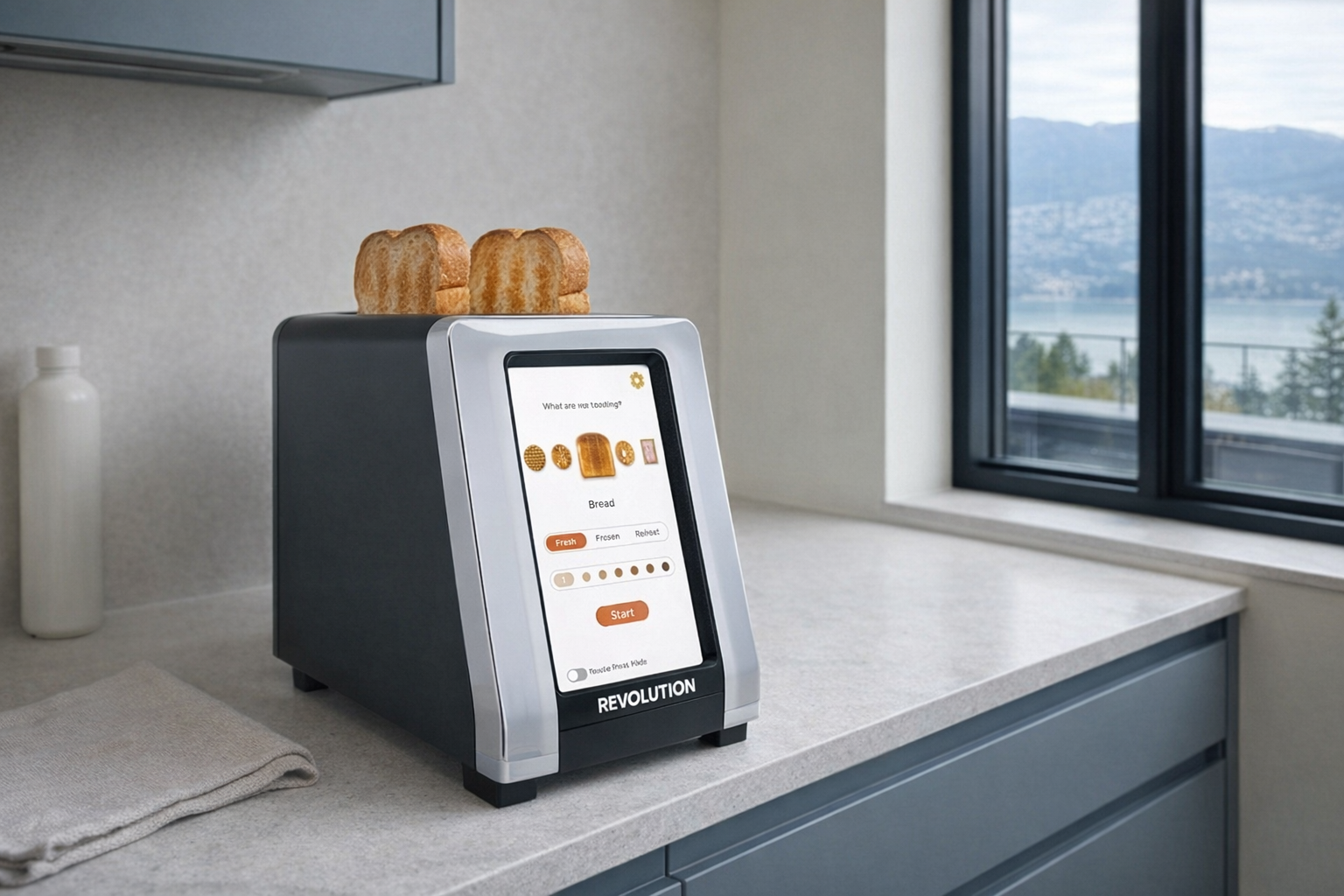
Walk down the small-appliance aisle in any Canadian kitchen store and the "smart toaster" pitch lands in two very different places. At one end, a $35 BELLA with a single knob and a slightly fancier slot. At the other, a $450 Revolution Cooking with Wi-Fi, a full-color touchscreen, and a cla...
Walk down the small-appliance aisle in any Canadian kitchen store and the "smart toaster" pitch lands in two very different places. At one end, a $35 BELLA with a single knob and a slightly fancier slot. At the other, a $450 Revolution Cooking with Wi-Fi, a full-color touchscreen, and a claim of reaching full heat in two seconds. Between them sit half a dozen units with touch panels, LCD countdowns, and "smart" mode names that mostly mean "toast, but with a screen." The category has quietly inflated to cover three different products pretending to be the same one.
This guide isn't a hands-on review. Nothing here is based on us personally testing these toasters against each other. Instead, it's an honest comparison of seven smart-leaning 2-slice and 4-slice toasters already covered on Celmin — organized by what they actually do well, what they quietly skip, and who each one genuinely fits. If you're trying to figure out whether "smart" is worth the markup, or which tier of smart is enough for how you actually eat breakfast, this is the version of the buying question without the affiliate-card blur.
Quick comparison
| Toaster | Price (CAD) | Slots | Display | Best for |
|---|---|---|---|---|
| BELLA 2 Slice Slim | ~$35 | 2 × long slot | Analog dial | Single-person households, small counters |
| Chefman Smart Touch 2 Slice | ~$50 | 2 × extra-wide | Touchscreen, no timer | Low-cost touchscreen upgrade |
| Hommater 2 Slice LCD | ~$57 | 2 × 1.5" wide | LCD countdown timer | People who like to see time left |
| SEEDEEM 2 Slice | ~$60 | 2 × 1.4" wide | Color LCD | Multi-bread households (gluten-free, waffle, etc.) |
| Oster 4-Slice | ~$68 | 4 × wide | Touchscreen | Small families, dual-person breakfasts |
| Mecity 2 Slice | ~$69 | 2 × 1.5" wide | 4.4" touchscreen | Counter statement piece |
| Revolution Cooking 2 Slice | ~$450 | 2 × extra-wide | Full-color touchscreen + Wi-Fi | Frequent toaster users, bagel & frozen fanatics |
Pro tip: Buy a smart toaster for consistency, not "innovation." The honest win from going past $35 is repeatable, same-result toast across different breads — not novelty features you'll use twice.
What "smart" actually adds to a toaster (and what it doesn't)
A regular spring-mechanism toaster has one job: keep the bread pressed against a heating element for n seconds, then pop it up. The "smart" upgrades in this category fall into four groups, and only two of them are genuinely useful for most households.
Touchscreen UI. Replacing a dial with a screen — done by the Chefman, Mecity, Oster, Hommater, SEEDEEM, and Revolution — is mostly cosmetic. It looks premium, and it's easier to adjust in 1-shade increments. But a physical dial works perfectly for toast. The screen matters only when it unlocks something a dial can't: a countdown timer, preset modes for specific breads, or memory of your last setting.
Countdown timers. The Hommater's LCD and the Mecity's 4.4-inch screen both show time remaining. That's a small quality-of-life win when you're multitasking breakfast — you know whether you've got time to scramble eggs or whether toast lands first. Not essential, but the kind of thing you stop noticing the day you go back to a toaster without one.
Bread presets. The SEEDEEM and Mecity both offer 6 bread-type modes — white, wheat, bagel, waffle, gluten-free, muffin. The SEEDEEM goes further with a memory function that remembers your last choice. These presets are not doing magic chemistry; they're just pre-tuned time-and-shade combinations for each bread density. Worth it if your household rotates through multiple bread types weekly. Unnecessary if you eat the same sourdough every morning.
Actually new technology. Only one toaster in this lineup does something genuinely different: the Revolution Cooking uses InstaGLO 2.0, which reaches full heating temperature in roughly two seconds. Instead of slow-roasting bread like a conventional coil toaster, it sears the surface fast, which Revolution argues locks in moisture on the inside. That's a real thermodynamic difference, not marketing. Whether it justifies 13× the BELLA's price is a separate question.
The other "smart" features — Wi-Fi clock sync, weather on the Revolution's screen, +10-second buttons — range from genuinely handy (the +10 button) to quietly pointless (checking weather from a toaster).
The 7 toasters, ranked by what they actually do well
BELLA 2 Slice Slim — the no-nonsense budget pick
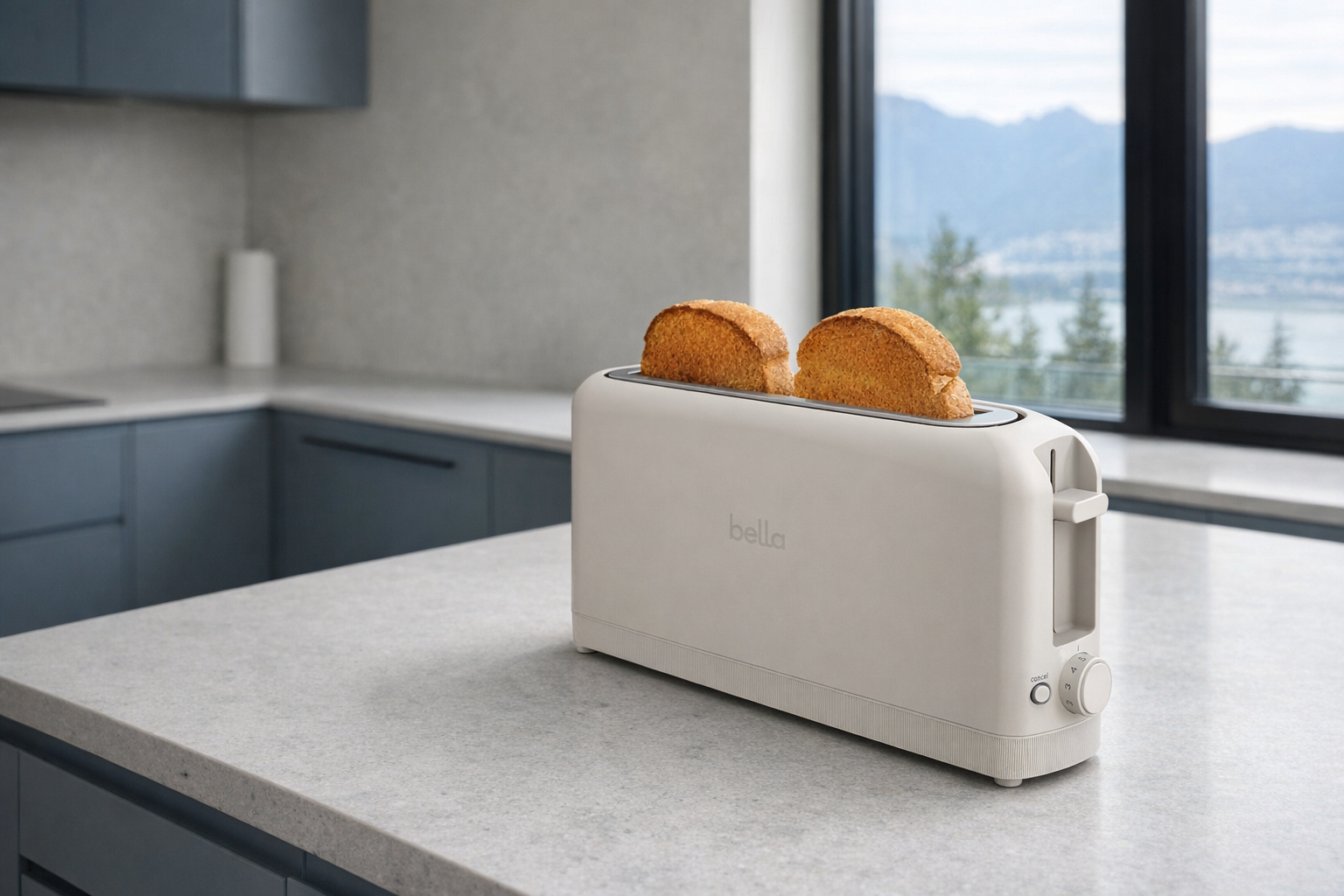
At roughly $35 CAD with a 900W element and a 10-inch long slot that accepts two slices side by side or one artisan loaf slice, the BELLA is the only toaster here that makes no pretense of being smart. It's a dial, six shade settings, a reheat button, a cancel button. That's it. The slim 3.58-inch profile earns its spot in studio kitchens and condo counters where a 4-slice toaster feels like furniture.
What the BELLA quietly gets right is slot geometry. Most budget toasters have stingy 1.2-inch slots that crush thick bread or refuse bagels. The 10-inch long slot gives you genuine flexibility without eating extra counter width. If your household is one or two people, eats mostly normal bread, and "smart" sounds like a tax on toast, the BELLA is the answer and you're done.
- Best for: Single-person or couple households. Small counters. People who just want toast.
- Full explainer: BELLA 2 Slice Slim Toaster on Celmin · Directory: product page
Chefman Smart Touch 2 Slice Digital — the cheapest touchscreen
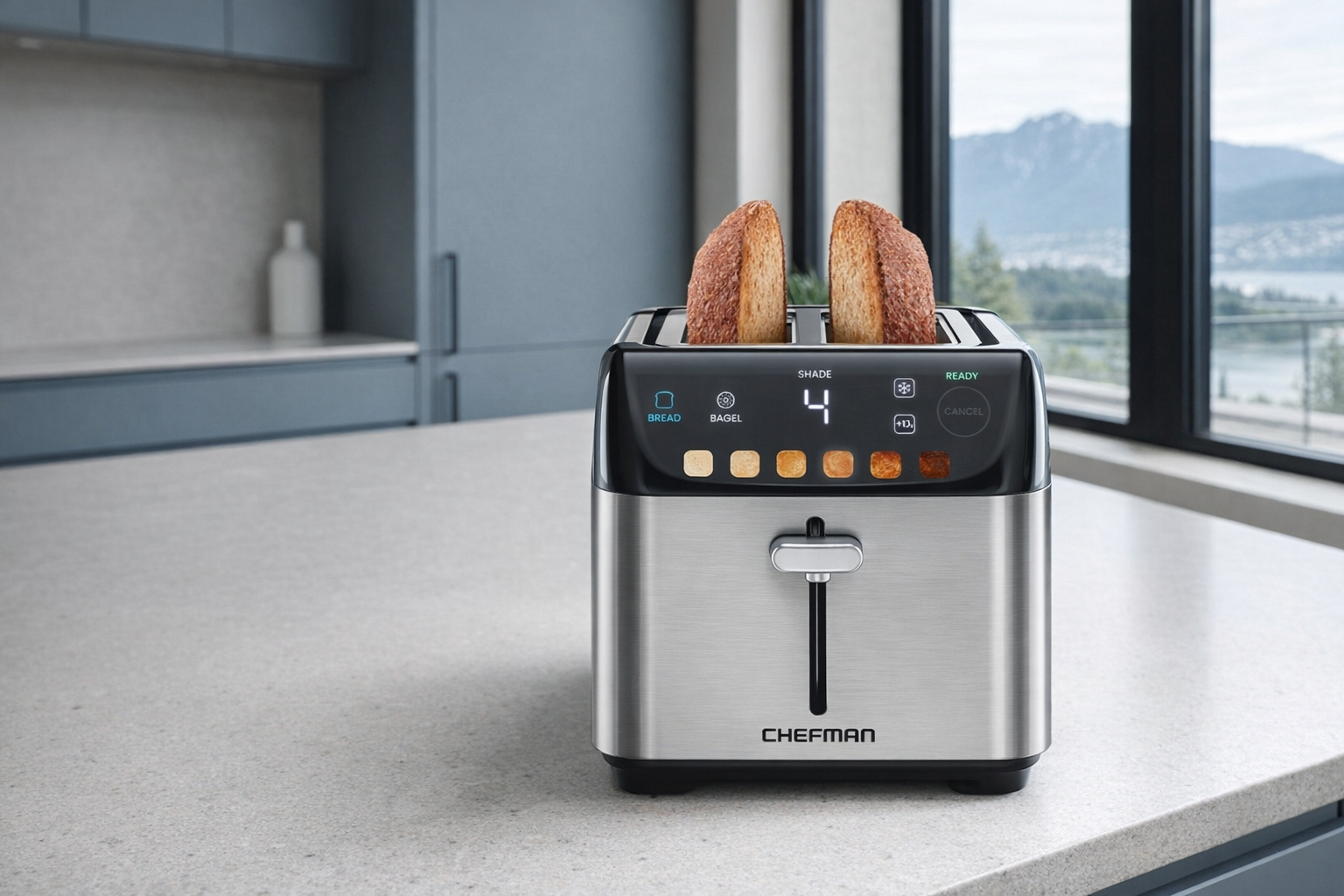
The Chefman lands around $50 CAD — the lowest-priced unit in this lineup that replaces the dial with a touchscreen. You get 6 shade levels, three cooking modes (toast, bagel, frozen), a +10 second button for that "almost, but not quite crisp enough" moment, and a stainless steel finish that photographs better than the BELLA.
What the Chefman doesn't give you is a countdown timer. You'll hear the toast is done when it pops. That's a real tradeoff versus the Hommater or SEEDEEM at roughly the same price, and it's the single reason I'd hesitate to crown this one unless you genuinely prefer minimal displays. At 3.9/5 on the source listing, review sentiment is also a touch softer than the $50-and-up competition — typical for brands that price-compress to squeeze in at an entry point.
- Best for: People upgrading from a dial but still budget-conscious. Secondary-home or apartment kitchens.
- Full explainer: Chefman Smart Touch Toaster on Celmin · Directory: product page
Hommater 2 Slice Smart Toaster — the quiet workhorse
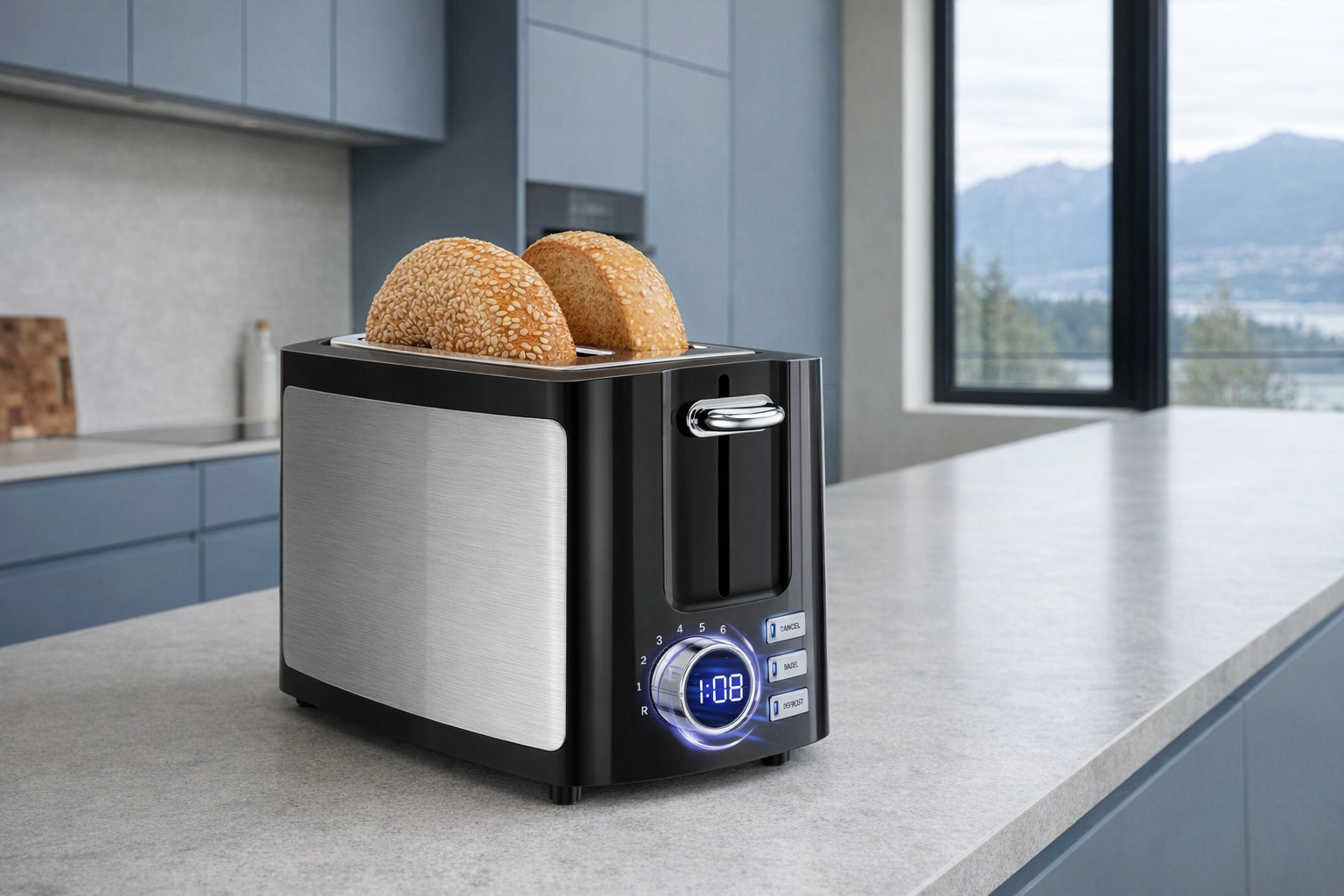
At around $57 CAD, the Hommater is where this comparison gets interesting. It has the LCD digital countdown timer the Chefman skips, 9 adjustable browning levels (more than any other unit here), 1.5-inch extra-wide slots, and the four functions that matter: reheat, cancel, defrost, and bagel. Built-in cord storage is one of those quiet kitchen wins you appreciate about a week after moving in.
Nine browning levels sound like overkill, and they sort of are — nobody meaningfully distinguishes level 5 from level 6. But combined with the countdown timer, the Hommater ends up doing the most "useful smart" for the least money in this lineup. The 4.4/5 rating on the source listing tracks with that — this is a product that doesn't try to impress, it tries to just work.
- Best for: Households that want a visible timer and slightly finer shade control without paying $70+.
- Full explainer: Hommater 2 Slice Toaster on Celmin · Directory: product page
SEEDEEM 2 Slice Touch Control — the bread-type specialist
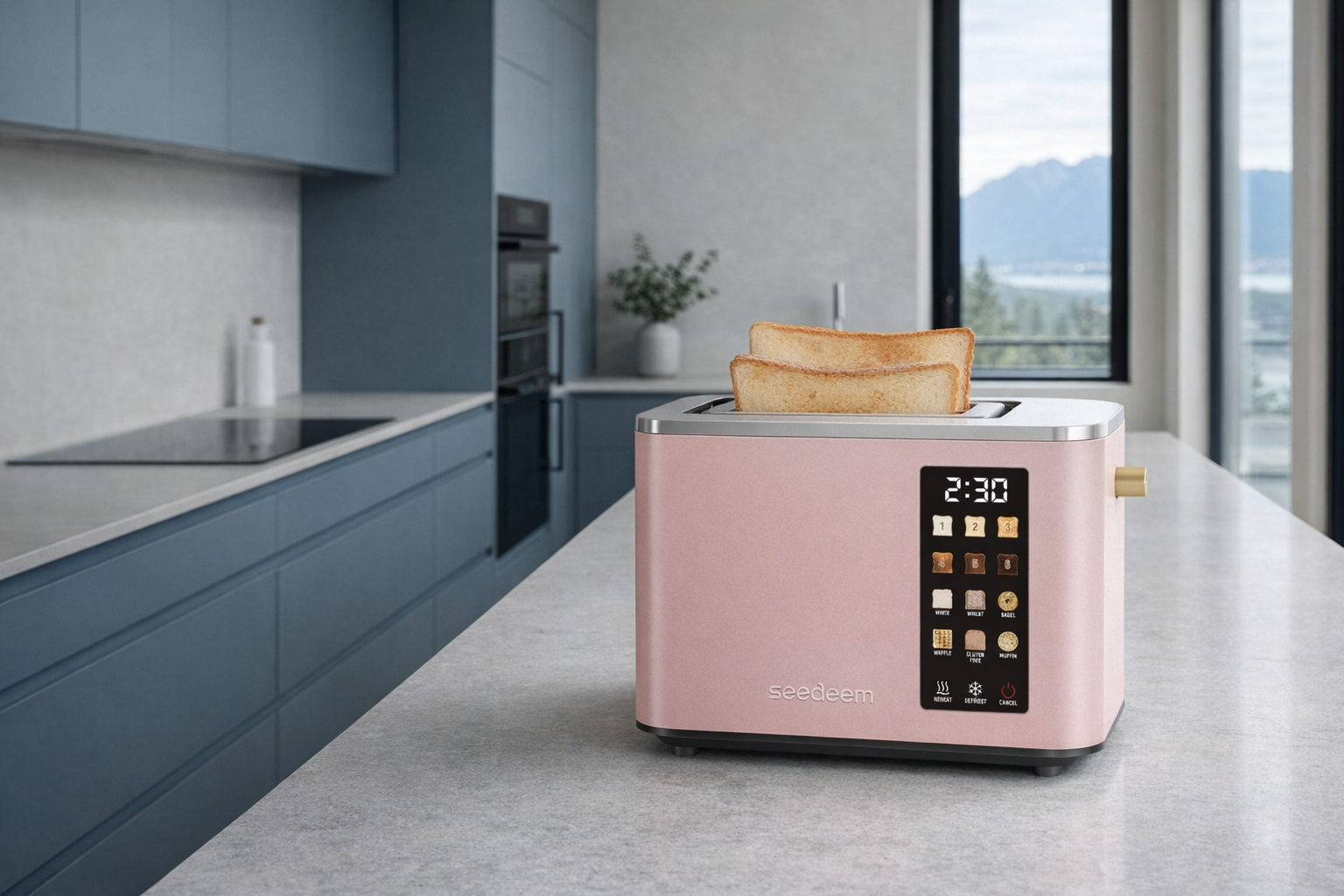
The SEEDEEM sits at about $60 CAD with 900W, a color LCD countdown display, and the lineup's most useful preset system: 6 bread-type selections (white, wheat, bagel, waffle, gluten-free, muffin) plus a memory function that remembers your last setting. That last detail matters more than it sounds. If one person in the house does gluten-free toast and the other does regular sourdough, memory means nobody's re-adjusting at 7 AM.
The 1.4-inch extra-wide slots are slightly narrower than the Hommater's 1.5 inches — unlikely to matter unless you're regularly toasting very thick bakery bagels. Otherwise the SEEDEEM is basically a Hommater with a nicer color screen, a better preset system, and a more considered UX. That extra $3 buys real quality-of-life gains for variety-eating households.
- Best for: Households that regularly cycle between 3+ bread types (gluten-free, waffles, regular, bagels).
- Full explainer: SEEDEEM Smart Toaster on Celmin · Directory: product page
Oster 4-Slice Touch Screen — the only 4-slice contender
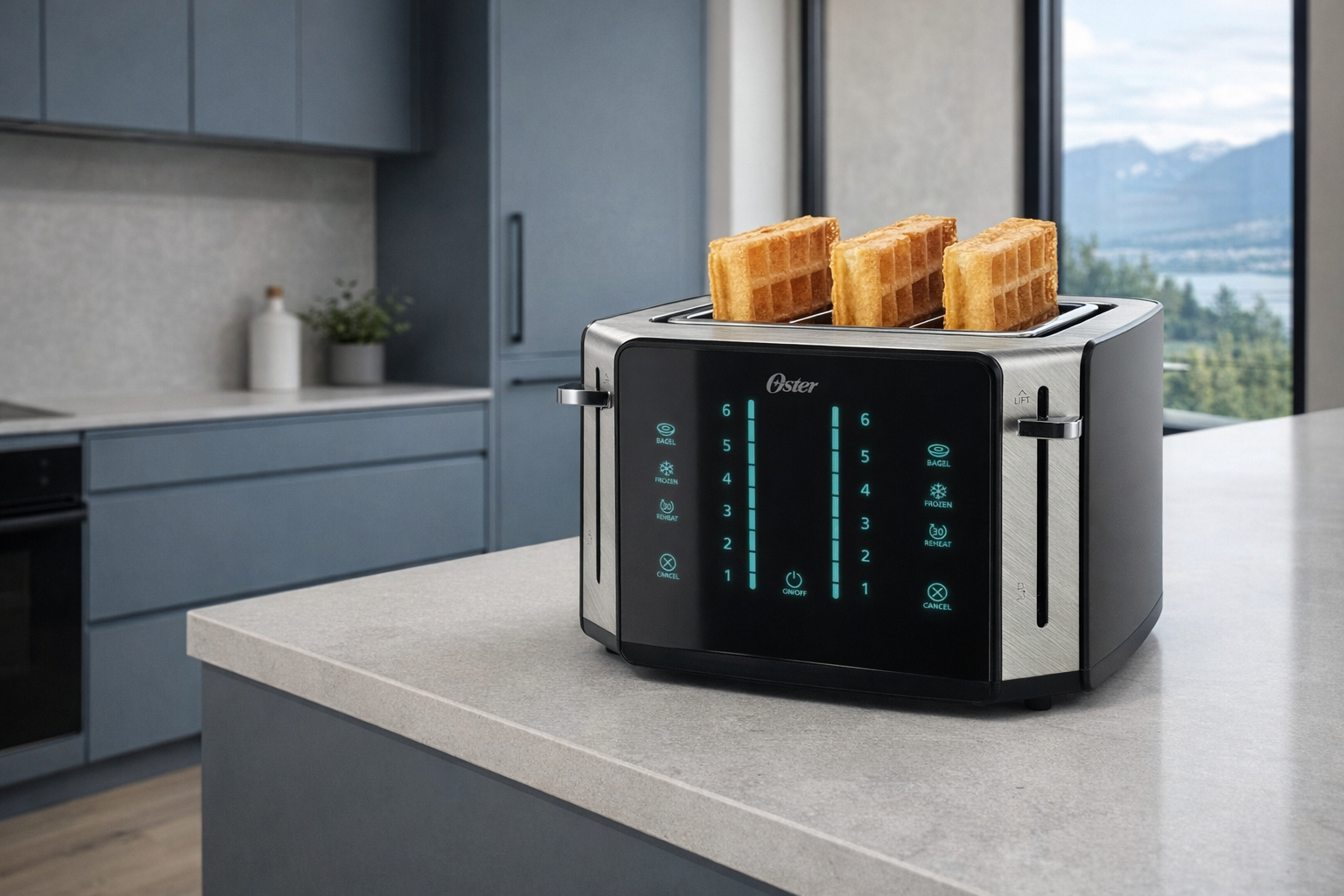
The Oster is the lineup's only 4-slot unit, priced at about $68 CAD — roughly the same as most 2-slice smart toasters. If your household is three or more people, this is where the conversation starts, because a 2-slice toaster for a family means someone's waiting two rotations for toast that's already cooler by the time the second batch lands.
The Oster offers the usual smart toppings: 6 shade settings, 3 modes (Bagel, Reheat, Frozen), a digital countdown timer, and a quick-check lever that lets you peek at browning without interrupting the cycle. It's less feature-rich than the SEEDEEM in presets but compensates by doing four slices at once. What you're paying $68 for is capacity, not sophistication. If you have the counter width and the household size, it's a sensible spend.
- Best for: Families of 3+, people who cook weekend breakfasts for guests.
- Full explainer: Oster 4-Slice Toaster on Celmin · Directory: product page
Mecity 2 Slice Smart Toaster Touch Screen — the counter statement piece
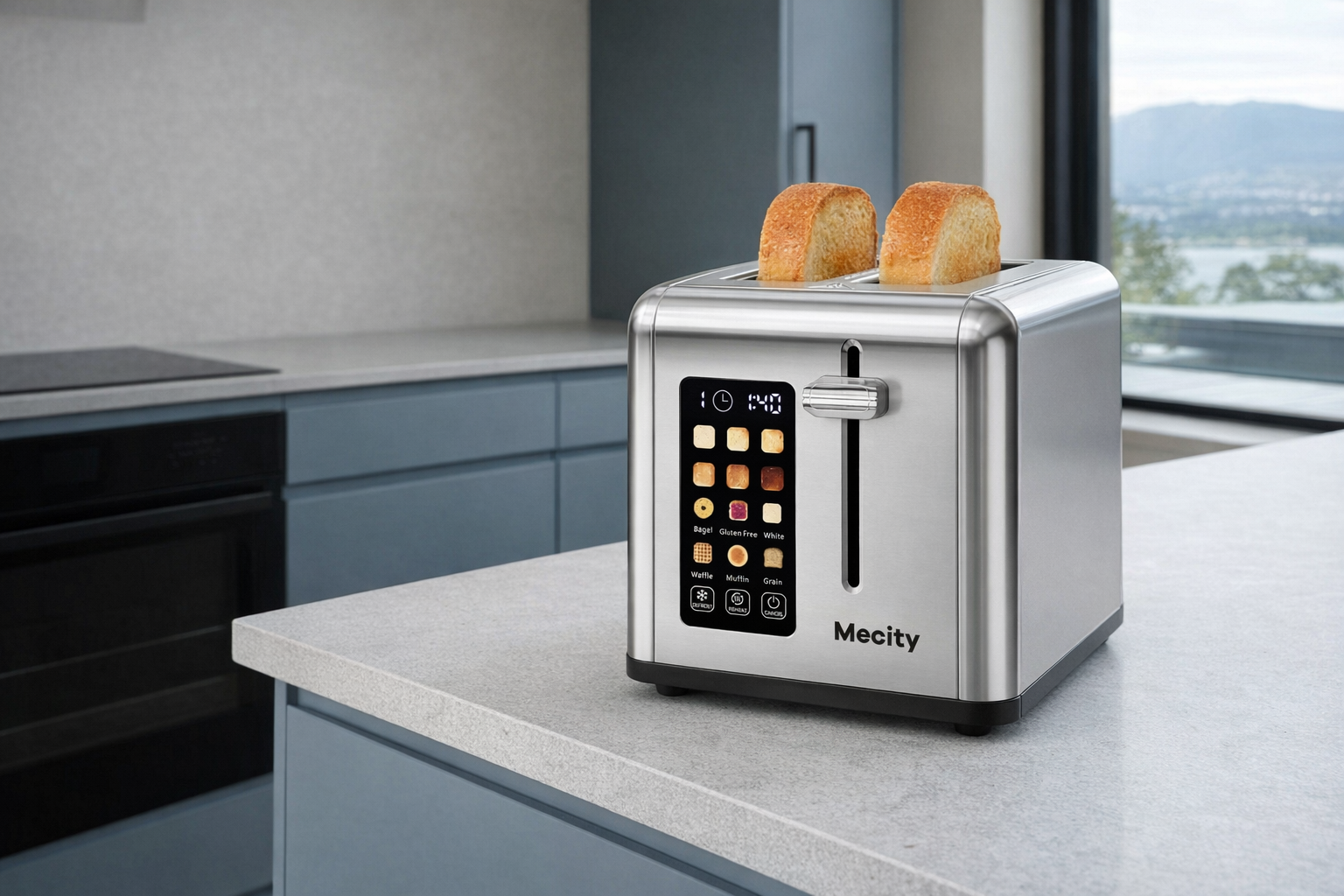
The Mecity lists at about $69 CAD — the most expensive non-Revolution unit here — and the headline feature is a 4.4-inch touch screen that dwarfs every other display in this lineup. It also does 6 browning levels, 6 bread-type presets (bagel, gluten-free, waffle, muffin, plus white and wheat), 1.5-inch wide slots, and non-stick food-grade stainless steel slots that simplify cleanup.
The 4.6/5 rating on the source listing is the highest in this comparison. Part of that is almost certainly aesthetic halo — a toaster with a 4.4-inch color screen looks expensive in a way a dial-and-lever toaster doesn't, and that biases reviews. Functionally, you're paying roughly $10 more than the SEEDEEM for a bigger screen and a mirror/brushed stainless finish. If that matters in your kitchen — open concept, countertops on Instagram, guests see it — the premium is reasonable. If it doesn't, the SEEDEEM is the smarter $10.
- Best for: Design-forward kitchens where counter appliances are visible and judged.
- Full explainer: Mecity 2 Slice Toaster on Celmin · Directory: product page
Revolution Cooking 2 Slice High-Speed — the only "real" smart toaster
At roughly $450 CAD, the Revolution is by far the most expensive toaster in this lineup and the only one doing something genuinely different. Its InstaGLO 2.0 heating system reaches full heat in about two seconds (conventional coil elements take 10–20), which sears the bread surface fast. Revolution's claim — backed by the physics of fast surface searing — is that this locks moisture inside, producing crisper exterior and softer interior than any coil toaster can manage.
On top of the heating tech, the Revolution layers a full-color touchscreen, Wi-Fi connectivity (auto-sets the clock, shows weather, reminds you to empty the crumb tray), and toasting algorithms for dozens of bread types with sensors that tune mid-cycle. The feature list is a little much — weather from a toaster is a novelty — but the core claim about sear-speed and consistency is real.
Is it worth 13× a BELLA? Not for most households. It's worth considering if (a) you eat toast nearly every day, (b) you cycle through many bread types, especially bagels and frozen bread, (c) you value a "nothing left to get right" experience and have the budget to buy a toaster like it's a coffee machine. Otherwise, you're paying $415 over a SEEDEEM for a better breakfast story.
📺 Watch: Revolution InstaGLO explained
- Best for: Daily toast eaters, frequent-bagel households, kitchen-appliance enthusiasts with room in the budget.
- Full explainer: Revolution Smart Toaster on Celmin · Directory: product page
The three questions worth asking before you buy
Strip away the feature lists and the screen sizes and almost every smart-toaster decision comes down to three questions. Answering them honestly points you at the right unit in under five minutes.
- How many slices does your household need at once? Two people or fewer — 2-slice is fine, and 95% of this guide applies. Three or more — the Oster 4-Slice is basically the default answer, and going back to 2-slice will annoy you by week two.
- Do you eat mostly one bread type or many? If your household rotates between regular bread, gluten-free, bagels, and waffles, the SEEDEEM's memory and bread presets genuinely save fiddling. If everyone eats the same sourdough, a BELLA or Hommater covers you for less.
- Is toast an event in your home, or a background task? If toast is something you eat fast and don't think about, stop reading at the $60 tier. If toast is part of how you actually cook (weekend brunches, bagel rituals, multi-bread breakfasts, frozen bread everyday), the Revolution becomes defensible. Between those ends, almost nobody needs to go past $70.
Where each one genuinely fits
| If this sounds like your kitchen... | ...buy this |
|---|---|
| Tiny counter, one or two people, "just make toast" | BELLA 2 Slice Slim (~$35) |
| Want a touchscreen on a budget, don't care about timers | Chefman Smart Touch (~$50) |
| Want a useful upgrade without overpaying — quiet workhorse | Hommater 2 Slice with LCD (~$57) |
| Multiple bread types, gluten-free household, variety | SEEDEEM 2 Slice (~$60) |
| Family of 3+, weekend guests, dual-breakfast timing | Oster 4-Slice (~$68) |
| Open-concept kitchen, design-first, premium feel | Mecity 2 Slice (~$69) |
| Toast is a daily ritual and budget isn't the limit | Revolution Cooking (~$450) |
Two meta-notes: nobody should buy two of these toasters. And if you genuinely want smart cooking, a toaster is the wrong category — look at a combi air fryer or smart oven instead of stacking toaster features until the bill hits Revolution money.
Got Questions About Smart Toasters? Let's Clear Things Up.
Is this a hands-on review?
No. This is an editorial comparison based on each product's listing, specs, and broader category patterns. It's meant to help you decide which tier of smart toaster fits your household — not to replace cooking with each of them yourself.
Is a $450 toaster really 13× better than a $35 one?
In terms of speed and consistency, the Revolution is genuinely better than anything else here — the InstaGLO 2.0 heating system does something conventional coils can't. But "13× better at making toast" is not the right frame. For most households, the jump from a $35 BELLA to a $60 SEEDEEM captures 80% of the useful difference. The Revolution is for the people who are already past that 80% and want the ceiling.
Do bread-type presets actually do different things?
Yes, but less magically than the marketing suggests. A "bagel" preset usually heats one side harder (the cut side) for a shorter total time. A "gluten-free" preset typically runs a bit longer at a lower intensity, because GF bread needs more time to dry out. A "waffle" preset is usually tuned for a medium-dry shelf-stable product. The presets are time-and-shade recipes, not AI.
Do any of these work with Alexa, Google Home, or Matter?
Only the Revolution Cooking has Wi-Fi, but even it doesn't expose a generic Matter or Alexa skill for remote "start toasting" commands — and honestly, you shouldn't start a toaster remotely anyway. The Wi-Fi mostly exists for clock sync, weather, and firmware updates. For a deeper primer on Matter in general, see our Matter, in Plain English explainer (once batch 7 is live).
What does the +10 second button really do?
Exactly what it says: adds 10 seconds to whatever cycle is already running, or starts a 10-second mini-cycle on already-popped toast. It's the single best "smart" feature in this lineup because it eliminates the "almost perfect, just needed 5 more seconds" problem that every toaster user knows. The Chefman, Hommater, and others all include some variant.
Where should I buy these to verify the latest details?
Before ordering, verify listing details, current price, and any updated accessories on the retailer page directly. Quick links: BELLA · Chefman · Hommater · SEEDEEM · Oster · Mecity · Revolution. Pricing can shift, especially on Amazon imports that cross the US/Canada listings.
Which one would Celmin pick for a typical Canadian household?
The SEEDEEM 2 Slice at around $60 CAD is the most honest value in this lineup — it delivers the timer, the presets, the memory function, and a color display for roughly the same price as much simpler competitors. For families of three or more, swap it for the Oster 4-Slice at a similar price point. Neither is flashy. Both will still be working in five years.
If you're building a smarter kitchen in Canada and want honest comparisons of gadgets worth considering — plus the ones worth skipping — Celmin covers the full catalog without the marketing theater. More comparisons, reviews, and buyer guides at https://celmin.ca.
Discussion
Sign up or sign in to join the conversation.