
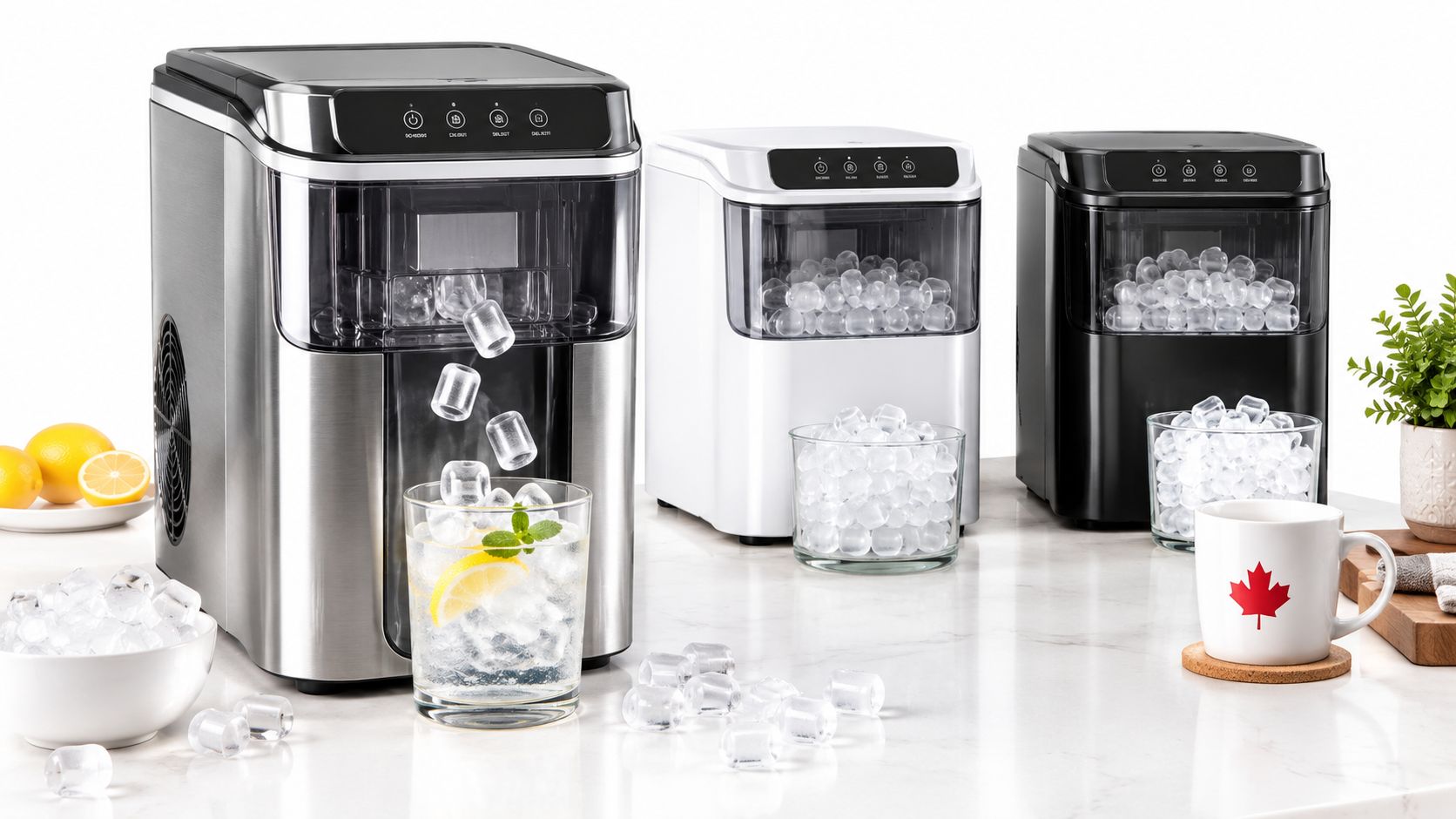
About 26 lb of ice per day with the first ice ready in 6 to 15 minutes is the practical benchmark for many Canadian countertop machines. But usable ice depends more on what happens after production than on how quickly the first batch appears.
That's the advice most buying guides get wrong. A fast countertop ice maker can still disappoint if its small basket fills quickly, the ice melts back into the reservoir, and the machine warms an already cramped condo kitchen. The best ice maker countertop choice isn't necessarily the model with the biggest daily-output claim. It's the one that produces enough usable ice for your routine without creating more noise, heat, refilling, and cleaning than the convenience is worth.
| Buyer priority | Best fit | Main compromise |
|---|---|---|
| Occasional drinks and guests | Compact bullet-ice maker | Ice needs to be moved to the freezer |
| Small condo kitchen | Narrow, under-cabinet unit | Smaller basket and more frequent refills |
| Family entertaining | Higher-capacity portable unit | More counter space, heat, and operating time |
| Cottage or seasonal use | Portable unit with simple controls | Storage and transport require planning |
| Few drinks at a time | Basic entry-level machine | Less useful for sustained demand |
Table of Contents
- Why Countertop Ice Makers Are Not Just About Speed
- How to Compare Countertop Ice Makers That Actually Matters
- Best Countertop Ice Makers for Common Canadian Use Cases
- What Canadian Shoppers Should Expect on Price and Availability
- The Hidden Trade-Offs Most Guides Skip
- How to Choose the Right Countertop Ice Maker for Your Kitchen
- Verify Before You Buy
Why Countertop Ice Makers Are Not Just About Speed
A Toronto condo resident hosting friends on a Saturday evening usually doesn't have an ice-production problem. They have a storage and timing problem. The machine may produce its first bullet-shaped pieces quickly, but the basket can fill before guests arrive, and the ice may start melting while the appliance continues cycling.
That changes the question from “How fast does it make ice?” to “How much ice can I use when I need it?” Canadian listings establish a useful category benchmark, with countertop units commonly rated around 26 lb of ice per 24 hours and first ice often available in roughly 6 to 15 minutes. Home Depot Canada's countertop ice-maker listings show how this performance level appears across mainstream household models.
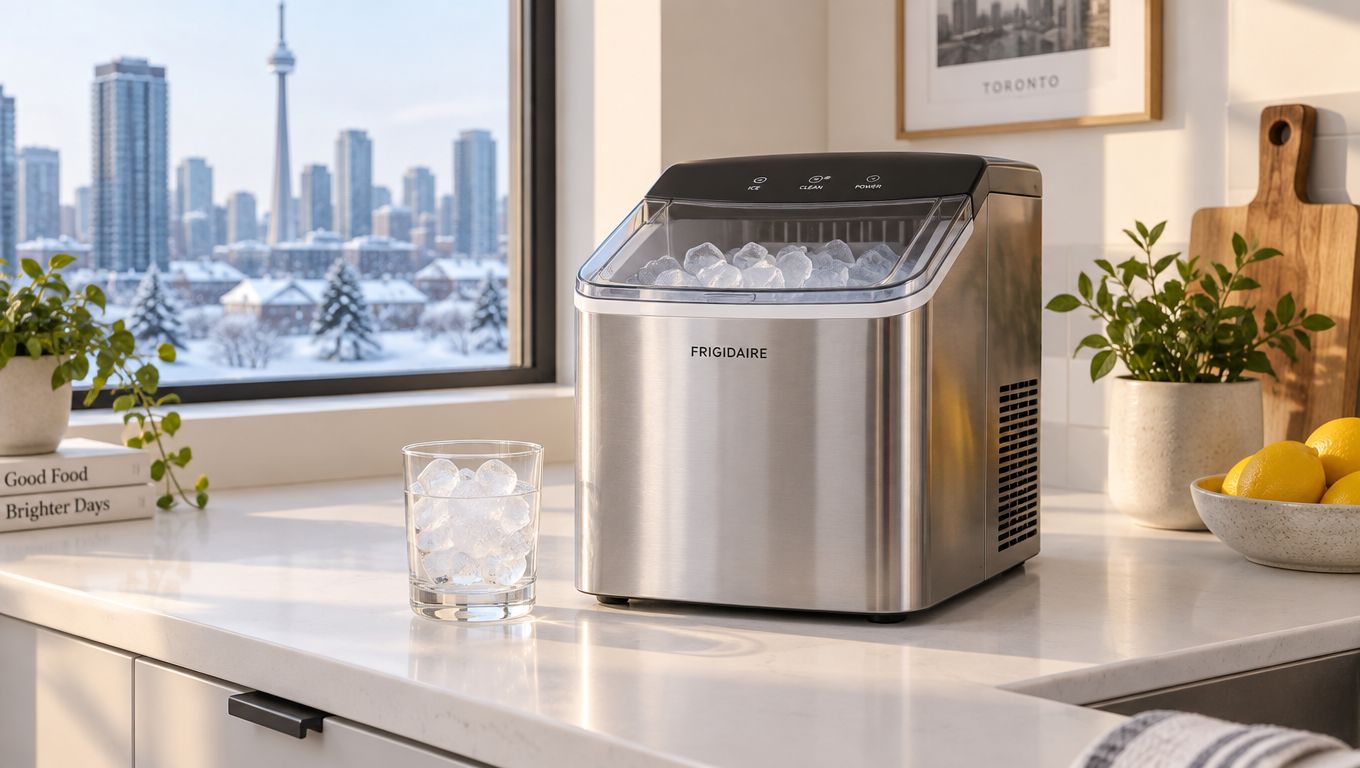
The condo test
Consider two households. The first uses ice for a couple of drinks after work. A compact machine that makes a batch quickly is convenient, even if the owner empties the basket into a freezer container. The second household uses ice during a summer gathering, while the machine sits beside a kettle, toaster, and coffee maker. That buyer needs a repeatable workflow, not just an impressive production rating.
Counter space also changes the calculation. A freestanding appliance may fit physically but still block a cabinet door, sit too close to a wall, or make the work surface uncomfortable to use. Best Buy Canada describes these appliances as compact, freestanding machines suited to kitchens, offices, recreational vehicles, and cottages, but “compact” still needs to be measured against the actual counter and ventilation space.
Practical rule: Judge an ice maker by usable ice per hour, not by its headline output over a full day.
Noise and heat matter just as much. A machine in an open-plan kitchen operates beside the living room, so fan noise and compressor cycling become part of daily comfort. In a small room during a heat wave, the appliance's warmth may be more annoying than the sound. This guide therefore weighs ice geometry, basket size, footprint, clearance, noise, maintenance, and seasonal use alongside production speed.
How to Compare Countertop Ice Makers That Actually Matters
A spec sheet gives you a production figure. It doesn't tell you whether you'll spend the evening transferring ice, wiping condensation, or moving the machine away from the wall. Compare each model as a complete workflow.
Start with the ice and the storage path
Mainstream portable units generally make bullet-shaped ice, often with two size settings. That shape works well for everyday drinks and is easy to produce, but it doesn't automatically mean the ice will remain available in the basket for hours. A machine with a small storage area may produce ice continuously while giving you only a modest supply at any one time.
Capacity has two separate meanings:
- Daily production tells you what the machine might produce under ongoing operation.
- Basket capacity tells you how much ice is ready before you must transfer it.
- Water-reservoir size determines how often you'll refill the machine.
- Ice shape affects how well pieces suit glasses, coolers, and slow-drinking beverages.
A larger daily rating is useful for cooler-filling or family entertaining, but it's wasted capability if you only make a few drinks and don't want the machine running for long periods.
Treat footprint and clearance as operating requirements
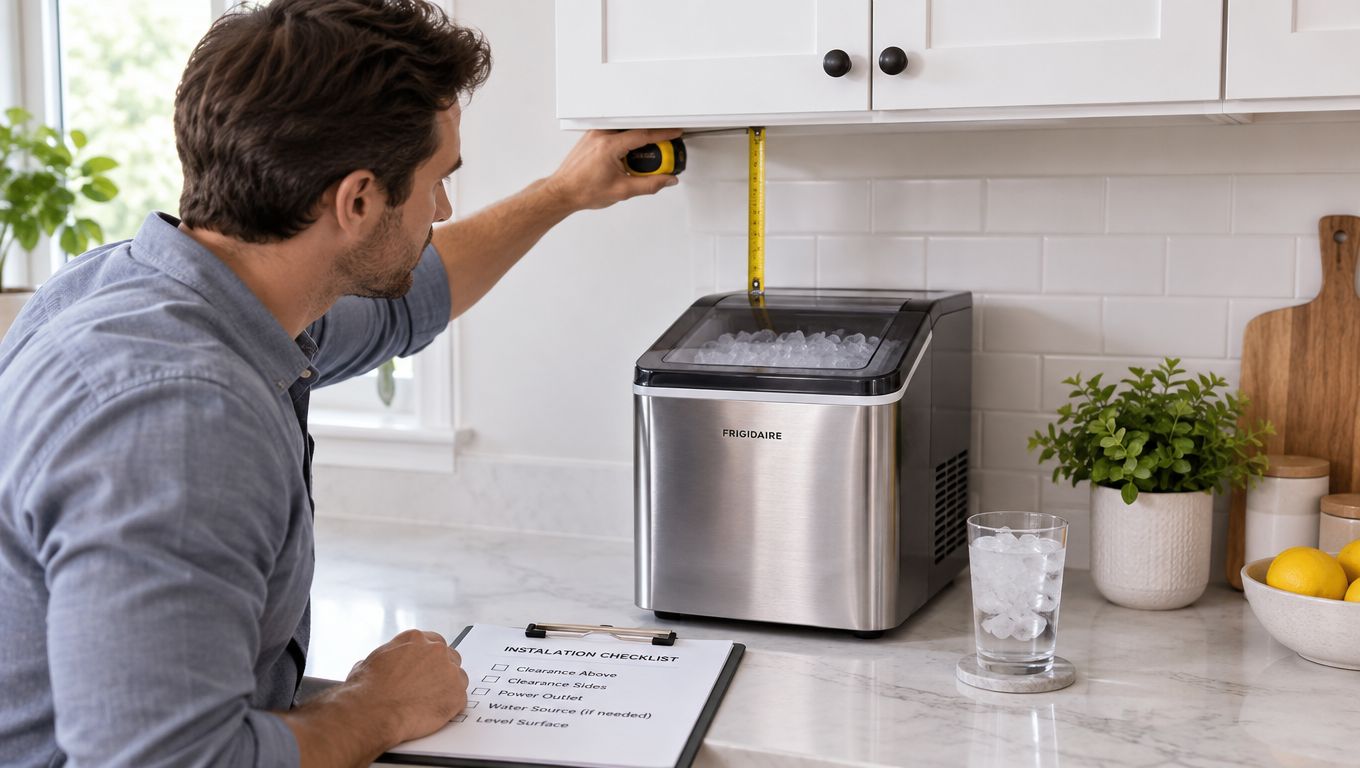
Measure width, depth, height, and the space needed to lift the lid or remove the basket. Home Depot Canada highlights a Frigidaire countertop model designed to fit under standard cabinets, a useful reminder that cabinet clearance can decide whether a unit works in a real kitchen. Don't push the rear vents against a wall or place the machine where warm air blows directly toward a seating area.
Noise deserves the same attention as size. Canadian listings and buying coverage show reported noise figures ranging from under 40 dB to about 46 dB, so the quietest and loudest options can feel different in an open-plan home. Canadian countertop ice-maker coverage from Top Products Canada is useful for identifying the range, but treat manufacturer noise claims as a comparison point rather than a promise of silence.
| Criterion | Why It Drives Satisfaction | Red Flag to Watch |
|---|---|---|
| Ice and basket capacity | Determines whether ice is ready when guests need it | High daily output paired with a tiny basket |
| Footprint and clearance | Prevents blocked cabinets, trapped heat, and awkward access | Dimensions listed without operating clearance |
| Noise | Matters in condos, offices, and open-plan rooms | A rating without context about fans or compressor cycling |
| Cleaning design | Reduces stale water, residue, and neglected maintenance | “Self-cleaning” presented as a substitute for manual cleaning |
| Controls and alerts | Makes refilling and emptying easier during real use | No low-water, full-basket, or cleaning indication |
Self-cleaning is helpful, but it doesn't eliminate responsibility. You'll still need to drain old water, clean accessible surfaces, and follow the manufacturer's instructions for the water path. A removable reservoir or basket usually makes that work less awkward than a sealed design with difficult corners.
Best Countertop Ice Makers for Common Canadian Use Cases
The best countertop ice maker is rarely the fastest one. A machine can produce ice quickly yet waste it as the basket warms, while adding heat and noise to a compact kitchen. Choose for usable ice per hour, storage habits, and the seasonal cost of making ice compared with buying bags.
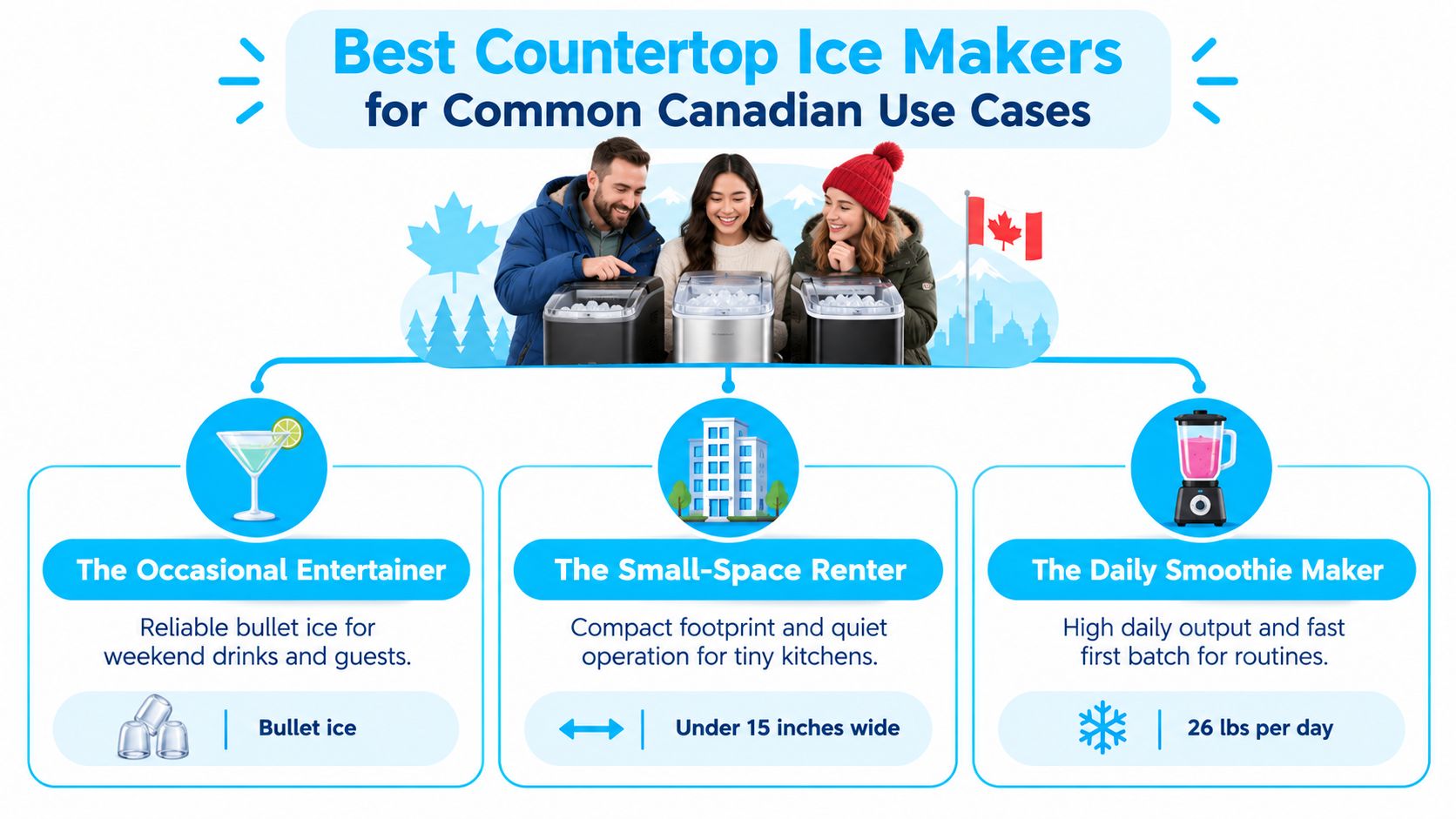
The occasional entertainer
Choose a basic bullet-ice countertop machine for drinks at home, small gatherings, or occasional guests. It offers quick first batches, simple controls, and portable operation without a water line or permanent installation.
Move finished ice into a freezer-safe container instead of leaving it in the basket. The basket is for short-term holding, not long-term storage, so transferring the ice keeps the machine ready for another cycle and reduces melt. A smaller unit can be the better buy when your routine involves only a few drinks at a time. Compare its operating cost with bagged ice across the season before paying for output you will not use.
The small-kitchen resident
Renters and condo owners should prioritise width, cabinet clearance, ventilation, and noise. A narrow unit that stays in one workable position beats a larger model that must be moved whenever the counter is needed.
“Countertop” does not guarantee under-cabinet clearance. Check the listed dimensions, lid movement, air gaps, and access to the drain before ordering. A machine that vents heat into a tight corner can make a small kitchen less comfortable and may reduce practical output during long runs. For a wider shortlist of countertop appliances suited to Canadian kitchens, see Celmin's guide to the best kitchen appliances.
The cottage or high-use household
Choose a higher-capacity portable unit when the machine will supply repeated drinks, fill coolers, or serve several people through the day. Canada-facing comparisons place many portable models near 26 lb per day, while higher-capacity options can reach about 44 lb per day. CTV News' Canadian countertop ice-maker comparison distinguishes daily output from cycle speed, which matters more for entertaining and cooler-filling.
Capacity still creates work. Larger units take more counter space, release more heat, and need a plan for moving finished ice into a freezer or insulated cooler. If melted ice remains in the basket, the advertised daily output will not equal the amount available when drinks are served.
What Canadian Shoppers Should Expect on Price and Availability
Canadian buyers can find countertop ice makers through national appliance retailers and major online marketplaces. The category isn't restricted to specialist restaurant equipment, which makes local purchasing, returns, and warranty checks easier than relying on an imported model with uncertain support.
Entry-level listings at Home Depot Canada currently place compact countertop units around C$98 to C$230, including Danby and Frigidaire models. Home Depot Canada's Canadian listings provide a useful local pricing reference, although prices, stock, and promotions can change.
Buy for the season you'll actually use
Demand tends to become more practical during warm weather, entertaining season, and cottage trips. That's when a machine moves from “nice to have” to a solution for a specific inconvenience, and it's also when popular compact models may be harder to find in the preferred colour or configuration.
A sensible Canadian purchase check includes:
- Retailer location: Confirm the seller ships within Canada and shows the final price in Canadian dollars.
- Return terms: Check whether the retailer accepts opened small appliances if the machine doesn't suit your counter.
- Warranty support: Look for a Canadian warranty path, not only an overseas seller's message system.
- Dimensions: Compare the listed size with your actual cabinet, wall, and lid-opening space.
- Drainage and transport: Decide where the water goes when the unit needs cleaning or seasonal storage.
Feature-rich machines may command more money, but extra controls don't necessarily improve an occasional user's routine. A simpler unit with reliable local support can be the smarter purchase if it makes the required ice without occupying permanent premium counter space.
If you're comparing other compact appliances at the same time, Celmin's guide to the best compact coffee makers uses the same Canada-first approach to footprint, availability, and everyday handling.
The Hidden Trade-Offs Most Guides Skip
The biggest flaw in many countertop ice-maker comparisons is that they treat the basket as storage. It isn't a freezer. Ice sitting in the bin can melt back into the reservoir, which means the machine may keep producing ice while your usable supply rises and falls.
That creates a frustrating cycle in a small kitchen. You run the machine before guests arrive, discover the basket is full, move the ice to the freezer, and return later to find the next batch partly melted. Product listings and reviewer commentary repeatedly flag this limitation, while coverage often spends more time on daily output and noise than on the transfer routine.
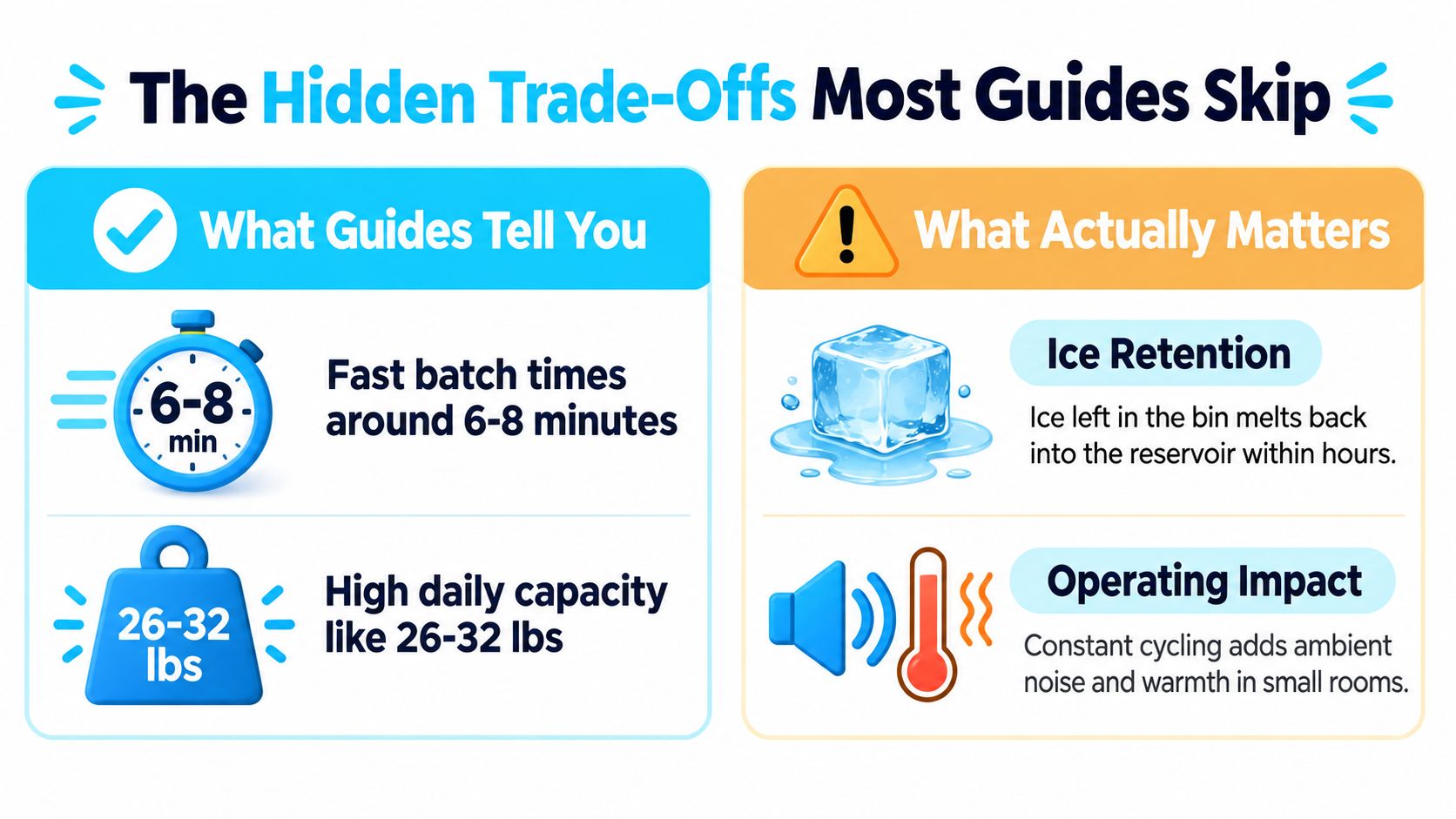
The usable-ice calculation
Think of the machine as a small production station, not a freezer. Its useful output depends on:
- How quickly the first batch arrives.
- How much the basket holds before transfer.
- Whether you have freezer space for finished ice.
- How often you're willing to refill water and empty the basket.
- Whether the machine runs long enough to warm the room.
A countertop ice maker can be worthwhile for repeated use, especially when buying bags of ice is inconvenient. For occasional drinks, freezer trays may be cheaper and quieter if you already have enough freezer capacity. Bagged ice remains practical for a single gathering because it shifts production, storage, and appliance heat away from your kitchen, even if it's less convenient for spontaneous use.
Heat and electricity change the summer decision
Quiet operation doesn't mean no operating impact. Canadian specifications report models from under 40 dB to about 46 dB, while some models advertise very low hourly energy use. Top Products Canada's ice-maker guide illustrates why those claims need context. A low sound rating won't solve a machine that adds warmth beside a dining table, and a low hourly-use claim doesn't tell you how much electricity the appliance consumes across repeated summer sessions.
The right comparison isn't “fast machine versus slow machine.” It's “repeated appliance use versus freezer trays or a bag of ice.”
For a condo kitchen, the decisive cost may be comfort rather than the electricity line on the bill. If you use the appliance only during occasional heat waves, buying ice or using trays can be more rational. If you make drinks daily, the convenience may justify the counter space, provided you accept the transfer and cleaning routine.
How to Choose the Right Countertop Ice Maker for Your Kitchen
Choose the machine around frequency, space, and storage behaviour. Don't start with the most exciting feature. Start with the task you'll repeat.
A compact bullet-ice unit is the sensible choice for drinks, short entertaining sessions, and renters who need a portable solution. A higher-output model earns its larger footprint when several people need ice throughout the day or when you're filling coolers. A feature-heavy unit is harder to justify if you won't use its controls, alternative ice settings, or automated cleaning prompts.
Match the reservoir to your patience
Canadian countertop models commonly use compact water reservoirs of roughly 1.2 L to 1.7 L, with ice baskets holding about 1.5 lb to 1.7 lb. The Frigidaire product listing on Amazon Canada shows why these figures matter. A small reservoir and basket can work well for personal use, but they require more frequent refilling and transferring during extended entertaining.
Use this quick selection matrix before you compare finishes or control panels:
| Priority | Recommended Profile | Skip If |
|---|---|---|
| Minimal counter use | Narrow bullet-ice unit with verified cabinet clearance | You need a large supply without transferring ice |
| Quiet open-plan living | Compact model with a lower reported noise figure | The listing gives no noise information at all |
| Frequent family use | Higher-capacity portable model with freezer storage available | You have no place to store finished ice |
| Seasonal cottage use | Simple portable machine with easy drainage | You expect permanent, built-in installation |
| Lowest purchase complexity | Basic model from a Canadian retailer | Warranty and returns depend on an unknown marketplace seller |
The best choice for a small kitchen is often the model you can leave in one safe position and clean without dismantling half the appliance. Browse other space-conscious options in Celmin's kitchen-appliance guide for small spaces if the ice maker must share a crowded work surface.
My verdict is simple. Buy a compact unit for regular personal use, step up to higher output only when your household needs sustained production, and choose bagged ice or freezer trays when your demand is too occasional to justify another appliance.
Verify Before You Buy
A few minutes of checking can prevent the most common countertop ice-maker regrets.
Measure the working space
Measure the counter, then measure the appliance's full operating footprint. Include the lid-opening area, basket removal path, rear and side ventilation, and the clearance above the machine. A unit that technically fits under a cabinet may still be impractical if you can't remove the basket or pour in water without twisting it sideways.
Validate the claims in context
Check the manufacturer's noise rating, but also look for owner feedback about fan sound, compressor cycling, and the clink of ice dropping into the basket. Confirm the Canadian retailer, return window, warranty contact, and included accessories before placing the order.
Use this final maintenance checklist:
- Use fresh water: Empty old water rather than letting it sit between uses.
- Clean the water path: Follow the manual's cleaning instructions, even when a self-cleaning cycle is included.
- Transfer finished ice: Move ice to the freezer when you need it to remain available.
- Keep vents clear: Don't crowd the rear or sides with appliances, walls, or stored items.
- Plan seasonal storage: Drain and dry the machine before putting it away at a cottage or during a long period of disuse.
The best countertop ice maker is the one that fits your kitchen and your habits without forcing you to manage more appliance than ice. Confirm the dimensions, storage workflow, heat impact, and Canadian support before you buy.
Celmin publishes Canada-focused buying guides and practical reviews for kitchen appliances, including comparisons that account for condo space, local availability, and everyday trade-offs. Visit Celmin to make your next appliance decision with the same practical focus.
Sign up or sign in to join the conversation.