
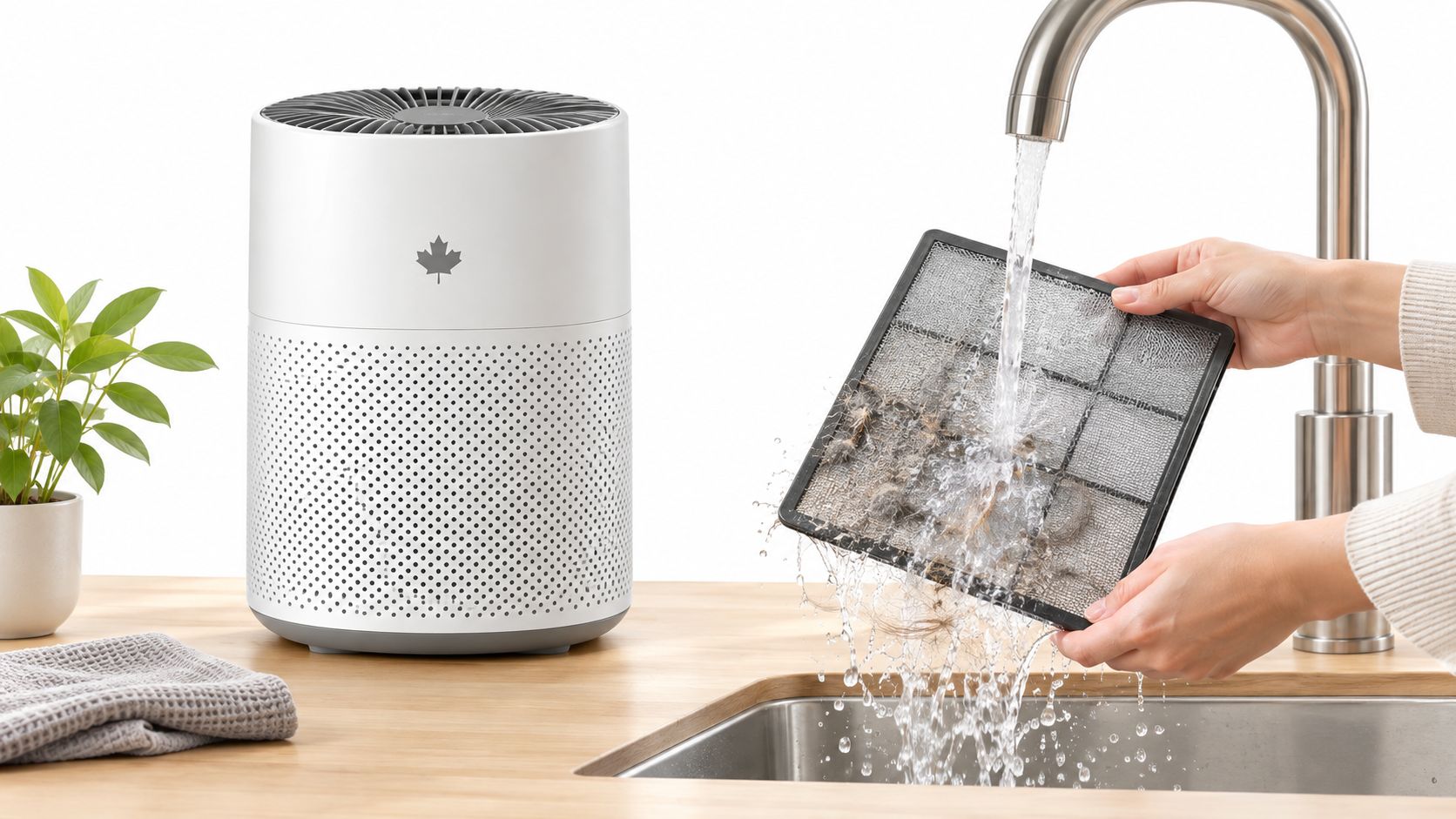
The popular advice is simple: buy an air purifier with a washable filter and forget about replacement costs. That advice is incomplete, and during a Canadian wildfire-smoke event it can be unsafe if it leads you to assume that a washable screen provides fine-particle protection.
In most designs, “washable” describes only the first layer, a mesh pre-filter that catches hair, lint, and larger dust. The filter that matters most for PM2.5 is usually a separate high-efficiency stage. A washable pre-filter can reduce waste and help preserve airflow, but it doesn't make a purifier maintenance-free, eliminate replacement filters, or guarantee effective smoke filtration.
Table of Contents
- The Washable Filter Marketing Trap
- Understanding the Filter Stack Architecture
- Comparing Maintenance Costs and Waste
- Sizing for Canadian Rooms and Wildfire Smoke
- Managing Seasonal Air Quality Constraints
- The Correct Pre-Filter Cleaning Routine
- Final Verdict and Buying Recommendations
The Washable Filter Marketing Trap
The washable label often applies to the least demanding part of the filter stack. In many purifiers, it identifies an outer pre-filter that catches larger debris and protects the deeper media. Its presence says little about whether the unit has a sealed HEPA stage for fine particles.
That distinction becomes important during Canadian wildfire-smoke events. Dust, pet fur, and lint are relatively large contaminants, while smoke contains much finer particles. High-efficiency HEPA filtration is recommended for trapping the very small particles associated with smoke. The British Columbia Centre for Disease Control reports that portable air cleaners reduced small-particle concentrations by approximately 40–80% in most reviewed studies, with high-efficiency HEPA filtration recommended for wildfire smoke in its portable-air-cleaner evidence summary.
What the washable layer actually does
The pre-filter has a useful, limited role:
- Captures larger debris: Hair, fur, lint, and visible dust are stopped before reaching the main filter.
- Protects airflow: Keeping the screen clean can slow loading of the deeper filter.
- Reduces disposable waste: The screen can be cleaned rather than discarded during each maintenance cycle.
- Adds another chore: Inspection, vacuuming, permitted rinsing, and thorough drying still take time.
The marketing trap is treating this maintenance component as the purifier's full filtration system. Health Canada describes indoor-air cleaning as one part of a broader strategy that includes source control, ventilation, and filtration. Its guidance identifies portable HEPA-based cleaners as an option when additional particulate control is needed in Canadian indoor-environment guidance.
Practical rule: Buy the washable feature for easier pre-filter maintenance, not as proof of smoke performance.
A washable pre-filter suits a condo with shedding pets or heavy household dust. For wildfire preparation, assess the rest of the machine: the manufacturer should publish meaningful CADR data, identify the main particle-filter media, and explain how the layers are sealed. The label earns attention only after you know which layer is washable and which one handles fine particles.
Understanding the Filter Stack Architecture
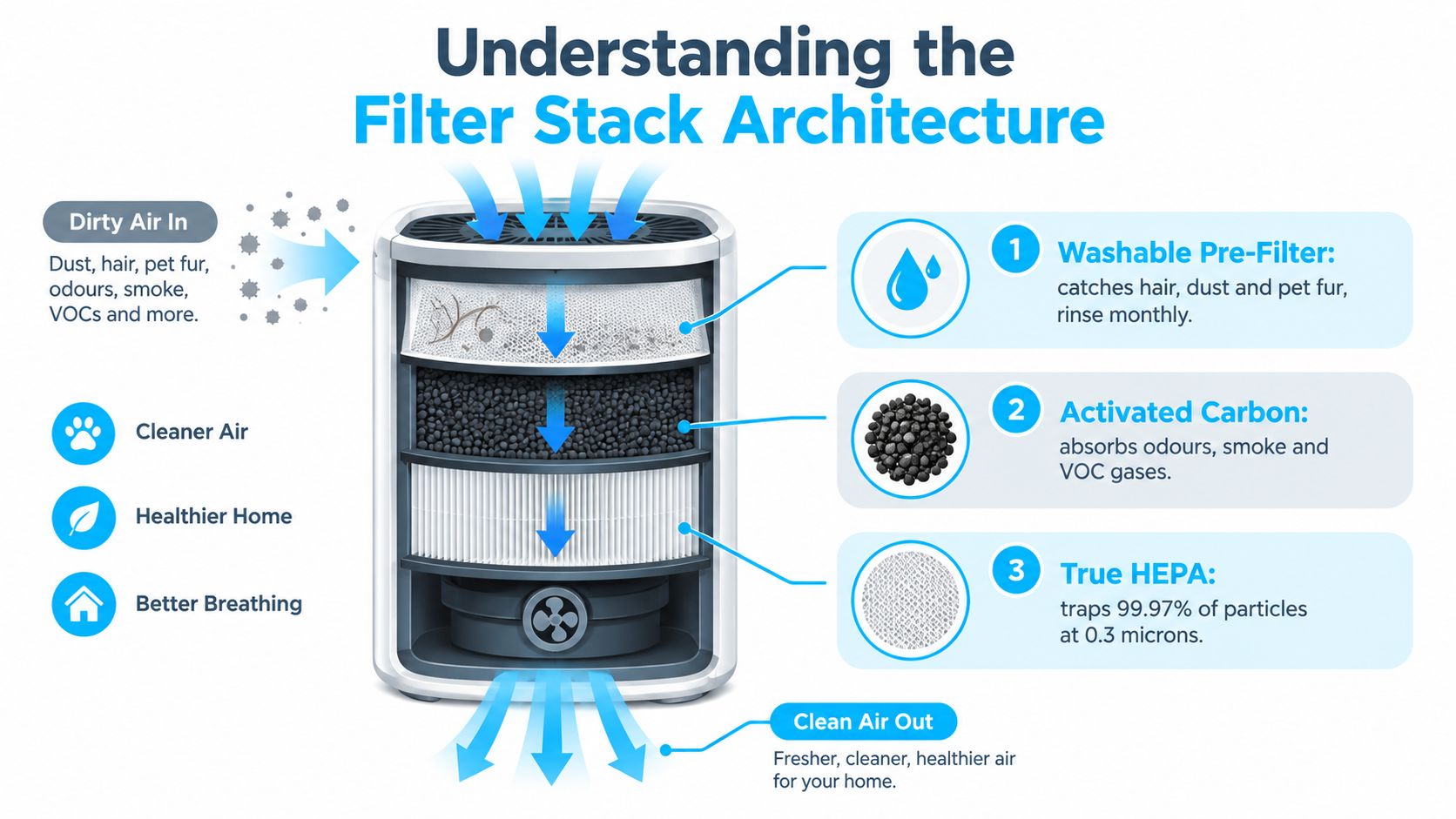
Look inside the machine before judging its value. A conventional multi-stage purifier moves room air through increasingly selective layers, and each layer has a different responsibility. The washable component generally starts the process, while the main particle filter determines how effectively the unit handles fine airborne material.
The three layers to identify
The washable pre-filter is usually a mesh or coarse screen. It catches hair, larger dust, and lint. Its value is protective and practical, because less debris reaches the deeper stages. It doesn't establish HEPA-level removal of fine particles.
Activated carbon handles gases and odours through adsorption. A thin carbon sheet may offer limited capacity, while a thicker bed can provide more useful contact with odorous compounds. The presence of the word “carbon” alone doesn't tell you how well a product will handle cooking smells, smoke odours, or renovation-related gases.
The main particle filter is the critical stage for small particles. A sealed HEPA-based filter, suitable airflow, and effective gaskets matter together. Health Canada notes that portable-air-cleaner performance depends on both filter efficiency and airflow, not on filter terminology alone in its guidance on improving indoor air.
Washing the wrong layer can damage the purifier. Water can disrupt the structure of disposable particle media, and it can reduce the adsorption function of carbon unless the manufacturer specifically says that the carbon stage is washable. A pre-filter that looks similar to the main cartridge isn't necessarily interchangeable with it.
Read the product specification, not the headline
Before purchasing, find the filter diagram, replacement part number, and care instructions. Look for language that clearly distinguishes a washable pre-filter from a replaceable HEPA or high-efficiency particle filter. If the product page says only “washable filter” without showing the stack, treat the claim as incomplete.
A practical inspection checklist includes:
- Layer identity: Is the washable part labelled pre-filter, mesh, or screen?
- Fine-particle stage: Does the unit name a separate HEPA or high-efficiency filter?
- Sealing: Does the cartridge sit tightly against a gasket or enclosed frame?
- Performance data: Is tobacco-smoke CADR published and tested?
- Replacement instructions: Does the manufacturer explain when non-washable layers must be changed?
For readers comparing particle capture in dusty rooms, this guide to air purifier dust removal is useful, but the same principle applies here. A washable first layer is a maintenance aid. It isn't the complete filtration architecture.
Comparing Maintenance Costs and Waste
A washable pre-filter reduces recurring waste, but replacement cartridges still carry a cost. The purifier also needs regular cleaning to preserve airflow. The useful comparison is between washable pre-filtration plus replaceable deep filtration and a system that uses a fully disposable cartridge.
A disposable cartridge offers simple maintenance. Remove the old filter, install the new one, and discard the used media. That suits owners who do not want to rinse, dry, or inspect a screen. It also creates more recurring material waste, and the expense rises when the purifier operates continuously or replacement is postponed.
A washable pre-filter shifts part of the work to the owner. Vacuuming removes loose debris, while rinsing may restore the screen when the manufacturer permits it. Its financial value depends on how much dust and pet debris it keeps away from the main filter, plus whether the owner cleans it before restricted airflow becomes noticeable.
Use a real Canadian cost comparison
A five-year comparison needs the model's current Canadian price, replacement-part price, and stated service interval. Those figures vary by retailer and product, so record them from the listing and manufacturer instructions rather than treating a generic table as a quote.
| Model Type | Initial Cost (CAD) | Replacement Filters (5 Yrs) | Total 5-Year Cost |
|---|---|---|---|
| Washable pre-filter with replaceable main filter | Use the current Canadian listing | Count replacements using the manufacturer's Canadian schedule | Initial price plus replacement-filter cost |
| Fully disposable filter cartridge system | Use the current Canadian listing | Count replacements using the manufacturer's Canadian schedule | Initial price plus replacement-filter cost |
Include shipping, taxes, and any separately sold carbon or HEPA stages if the listing excludes them. A Canadian air purifier replacement-filter guide can help identify the correct parts and check whether they are available locally. A lower upfront price does not settle the comparison if replacement media is difficult to source.
Where the washable design earns its keep
The strongest case is a dusty home where the outer screen loads quickly. Pet fur and larger debris may cover a coarse pre-filter long before the deeper filter reaches the end of its useful life. Cleaning that screen avoids discarding a multi-layer cartridge just because its outside surface is dirty.
The trade-off is hands-on care. A clogged screen restricts airflow, reducing the amount of filtered air reaching the room. Reinstalling it while damp may also introduce moisture into the appliance. The feature saves money and waste only when the screen is cleaned, dried, and fitted correctly.
A washable pre-filter lowers waste and may extend the useful life of the main cartridge, while requiring regular attention.
Before buying, confirm that the replacement HEPA stage is sold in Canada, that its price is identifiable, and that the purifier provides a clear filter-life indicator. Compare the complete filter stack, expected replacement frequency, room dust load, and local parts availability. That is the basis for judging total ownership cost, not the washable label alone.
Sizing for Canadian Rooms and Wildfire Smoke
A purifier with an excellent filter can still disappoint if its airflow is too low for the room. The most useful specification is the tobacco-smoke Clean Air Delivery Rate, or CADR, because Health Canada identifies it as the CADR category representing removal of the smallest particle group among standard ratings.
For ordinary room sizing, Health Canada gives a practical rule of at least two-thirds of the room area in square feet as tobacco-smoke CADR in its portable-purifier guidance. A 200-square-foot bedroom therefore needs at least about 133 cfm of tobacco-smoke CADR under that rule. The calculation is simple:
- Measure the room area in square feet.
- Multiply that area by two-thirds.
- Compare the result with the purifier's tobacco-smoke CADR.
- Choose a stronger unit if the room is open to another space, has high ceilings, or has a substantial pollution source.
Daily operation and smoke-event operation differ
A bedroom with a closed door is easier to size than an open-concept condo. In a combined living, dining, and kitchen area, the purifier must treat a larger effective volume, and doors opening to hallways or adjacent rooms add leakage. A unit sized exactly to the minimum may work adequately in normal conditions but struggle when smoke enters continuously through small gaps.
Wildfire smoke changes the operating target. Health Canada recommends substantially higher filtered airflow during smoke events, with smoke CADR sized for roughly two to three room air volumes per hour in its portable-purifier guidance. That is why a quiet bedroom unit may not be sufficient for an open living area during a severe smoke episode.
Keep windows closed when outdoor air quality is poor, reduce infiltration where practical, and run the purifier in the occupied room. Doors should remain closed when possible, especially if you're trying to create a cleaner sleeping space. A washable pre-filter helps only if it remains clear enough to let the fan deliver its rated airflow.
What to verify before buying
Don't compare models by fan-speed count or marketing words such as “powerful.” Look for tested tobacco-smoke CADR, room-size assumptions, and the conditions under which the rating was measured. If a Canadian model publishes only a vague recommended room size, you have less information for smoke planning.
A larger unit may be the better CAD value when it lets you use a lower speed for routine operation while retaining headroom for smoke. That doesn't mean every oversized machine is efficient or quiet, so check replacement-filter access, noise information, and physical dimensions alongside CADR.
Managing Seasonal Air Quality Constraints
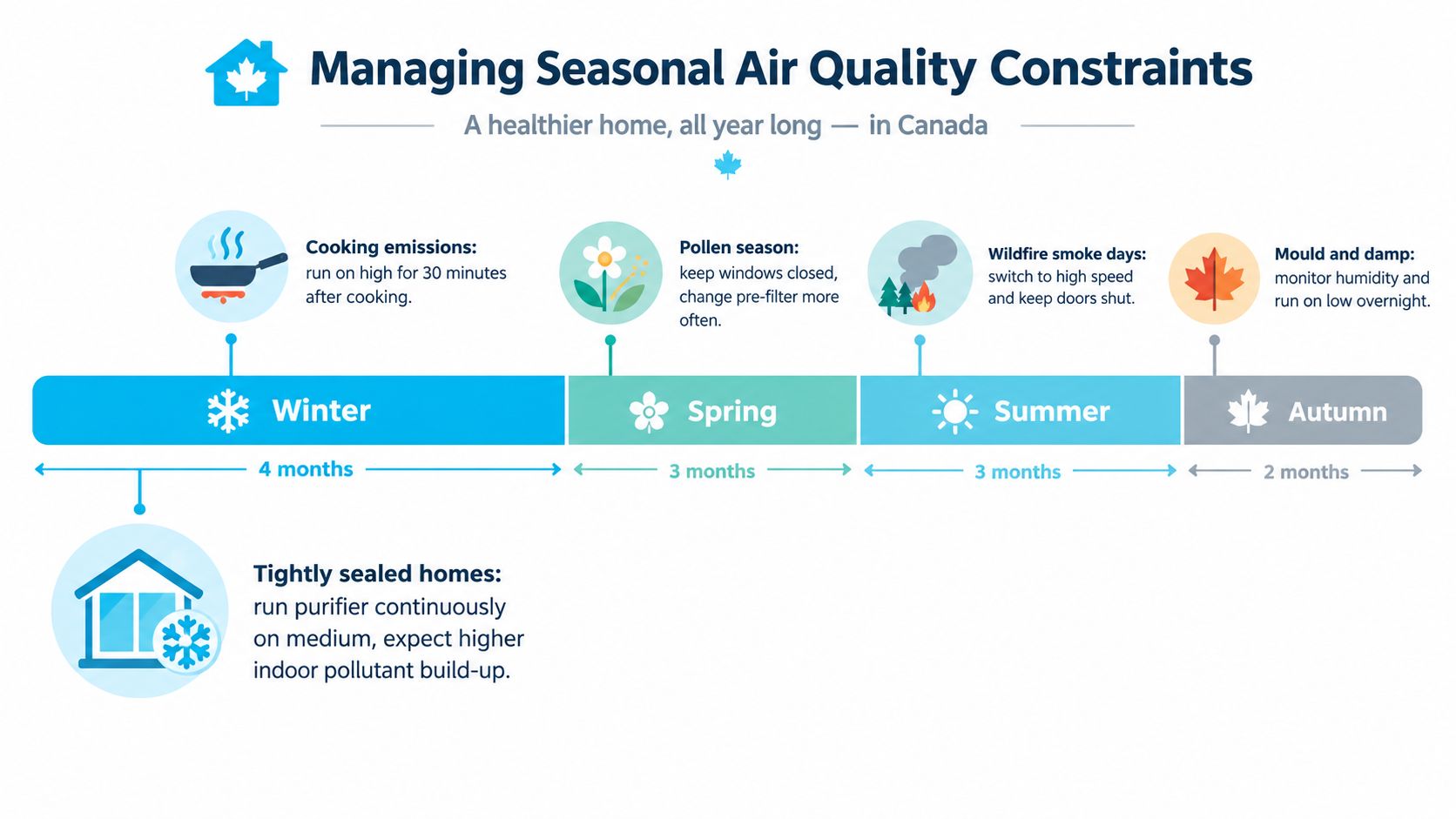
A purifier's job changes with the season. During winter, closed windows limit natural air exchange while cooking and household activity continue adding indoor pollutants. During wildfire smoke events, opening windows may bring polluted outdoor air inside. Filtration helps with airborne particles in both situations, while mechanical ventilation and source control handle problems a recirculating purifier cannot.
Health Canada places filtration within a broader indoor-air strategy for airtight homes. Mechanical ventilation supplies fresh air, while a portable purifier recirculates and cleans room air. That distinction matters in a condo or newer house, where cleaner particle levels do not necessarily mean lower carbon dioxide, less moisture, or fewer gaseous pollutants.
How to ventilate during winter months
A washable screen handles larger debris. It does not address stale air, volatile organic compounds, or excess humidity, and most air cleaners do not remove gases. Use the home's mechanical ventilation as designed when outdoor conditions permit. Run the kitchen exhaust during cooking, and remove pollutants at the source before relying on filtration for particles that remain suspended.
Activated carbon may reduce some odours, but its performance depends on the amount and design of carbon. A small carbon label on the filter is not enough evidence that the unit will control a broad range of gases.
What to change during wildfire smoke
Smoke events change the priority from routine air exchange to particle containment. Keep windows and doors closed as practical, run a properly sized purifier in the occupied room, and raise the fan speed when indoor particle levels rise. Check the washable pre-filter before and during a prolonged event. Hair and dust can restrict airflow when the purifier is working hardest.
Carbon requires the same caution. A carbon stage may reduce some odours, but it does not guarantee removal of every smoke-related gas. Washing carbon can damage its adsorption function unless the manufacturer explicitly approves it. Treat the carbon layer separately from the washable mesh.
Operating choices should follow outdoor conditions:
- Cleaner outdoor conditions: Use mechanical ventilation and source control, then run filtration for remaining particles.
- Cooking periods: Use kitchen exhaust first, with purifier support for airborne residue.
- Smoke episodes: Close windows, use a high-efficiency particle filter, and prioritise adequate CADR.
- Stale winter air: Improve mechanical ventilation rather than expecting recirculating filtration to supply outdoor air.
The practical trade-off is coordination. A tightly closed Canadian home may need filtration and ventilation at the same time, but they perform different jobs. The washable pre-filter protects airflow through the purifier. It does not convert that appliance into a ventilation system.
The Correct Pre-Filter Cleaning Routine
The washable screen works only when it stays open enough for air to pass through. Pet hair can form a visible mat, while fine household dust can coat the mesh without looking dramatic. Both conditions increase resistance and make the fan work harder.
A routine that protects airflow
Start with the manufacturer's instructions. Some screens are designed for vacuuming only, while others can be rinsed. Never assume that a filter is water-safe because the product listing uses the word “washable.”
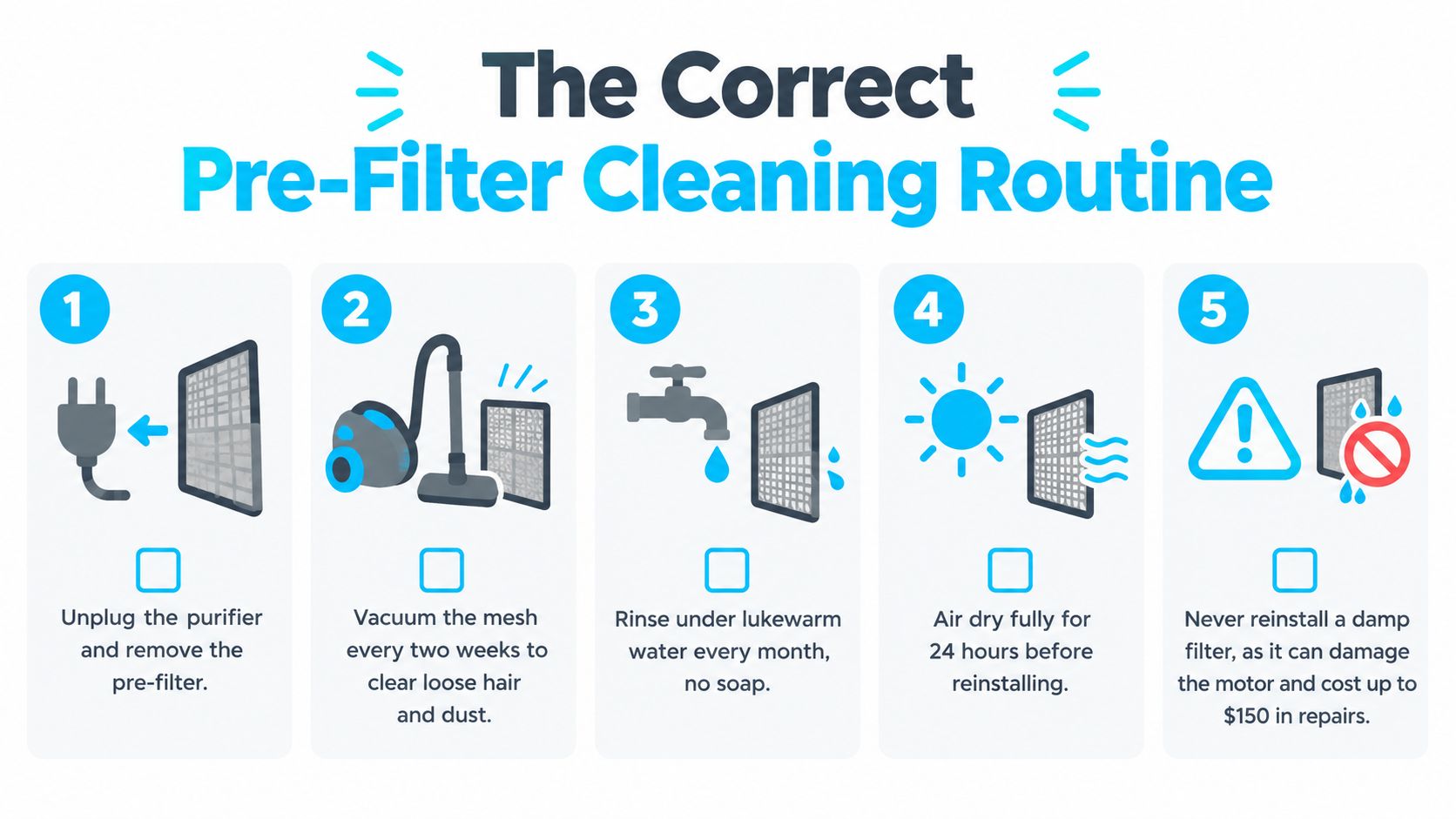
- Unplug the purifier. Remove the pre-filter carefully so loose dust doesn't fall into the housing.
- Vacuum loose debris. Use a soft brush or low-suction attachment to clear hair, fur, and surface dust without deforming the mesh.
- Rinse only when approved. Use lukewarm water and avoid soap unless the manufacturer specifically permits a cleaning product.
- Dry it completely. Leave the screen in a clean, ventilated place until no moisture remains in the mesh or frame.
- Inspect before refitting. Check for tears, warped edges, brittle plastic, or gaps that could let debris bypass the screen.
The supplied cleaning graphic recommends vacuuming every two weeks, rinsing every month, and air-drying for 24 hours. Treat those intervals as a starting routine rather than a universal rule, because a home with multiple pets may load the screen faster than a lightly occupied room.
The damp-filter mistake
Reinstalling a damp pre-filter is one of the easiest ways to create a new indoor-air problem. Moisture can encourage mould growth, damage nearby components, and alter airflow through the filter. It also defeats the point of cleaning because the purifier immediately draws air through a wet surface.
Keep a spare, compatible pre-filter if the manufacturer sells one and the purifier is essential to daily operation. Replace the screen when the mesh has stretched, split, developed permanent blockage, or no longer seats tightly against the frame. “Washable” describes how the part can be cleaned. It doesn't mean the part lasts forever.
Final Verdict and Buying Recommendations
An air purifier with a washable filter earns its place when that feature means reusable pre-filtration. In a condo with pets, visible dust, or frequent daily use, a clean outer screen can reduce the load on the deeper filter and limit disposable waste. It remains a maintenance aid, not the main smoke-control feature.
For wildfire preparation, assess tobacco-smoke CADR, the stated high-efficiency particle filter, housing seals, and Canadian access to replacement media. The washable feature supports long-term maintenance but does not determine smoke-filtration performance.
Match the design to the household
For a dusty condo or pet household, choose an accessible washable pre-filter, clear cleaning instructions, and a separately identified main filter. The convenience pays off only when the screen is cleaned before dust restricts airflow.
For a bedroom, use tobacco-smoke CADR rather than the largest room claim on the box. A closed room is easier to manage, but the purifier still needs adequate airflow and a sealed filter path.
For British Columbia, Alberta, and other smoke-prone areas, prioritise tested CADR and high-efficiency filtration. Confirm replacement-filter availability before buying. A washable label is not evidence of emergency-smoke performance.
For winter airtight homes, pair filtration with mechanical ventilation and source control. A purifier reduces airborne particles, while ventilation supplies outdoor air and addresses contaminants a particle filter may not capture.
As noted earlier, the BCCDC evidence summary found reductions in small-particle concentrations across the reviewed studies and recommends high-efficiency HEPA filtration for the very small particles in wildfire smoke. For Canadian model comparisons, consult Celmin's air-purifier guide alongside the manufacturer's CADR and filter documentation.
The buying rule is simple: buy the filter stack, not the washable promise. A washable pre-filter is useful when it sits ahead of a capable, sealed, properly sized particle-filtration system. Check the full replacement plan before choosing a model, including filter access, Canadian availability, cleaning instructions, and the expected smoke-season workload.
Celmin offers Canadian-focused appliance reviews and buying guides covering CADR, filter design, maintenance, and local availability. Visit Celmin for comparisons that account for Canadian winter air and wildfire-smoke seasons.
Sign up or sign in to join the conversation.