
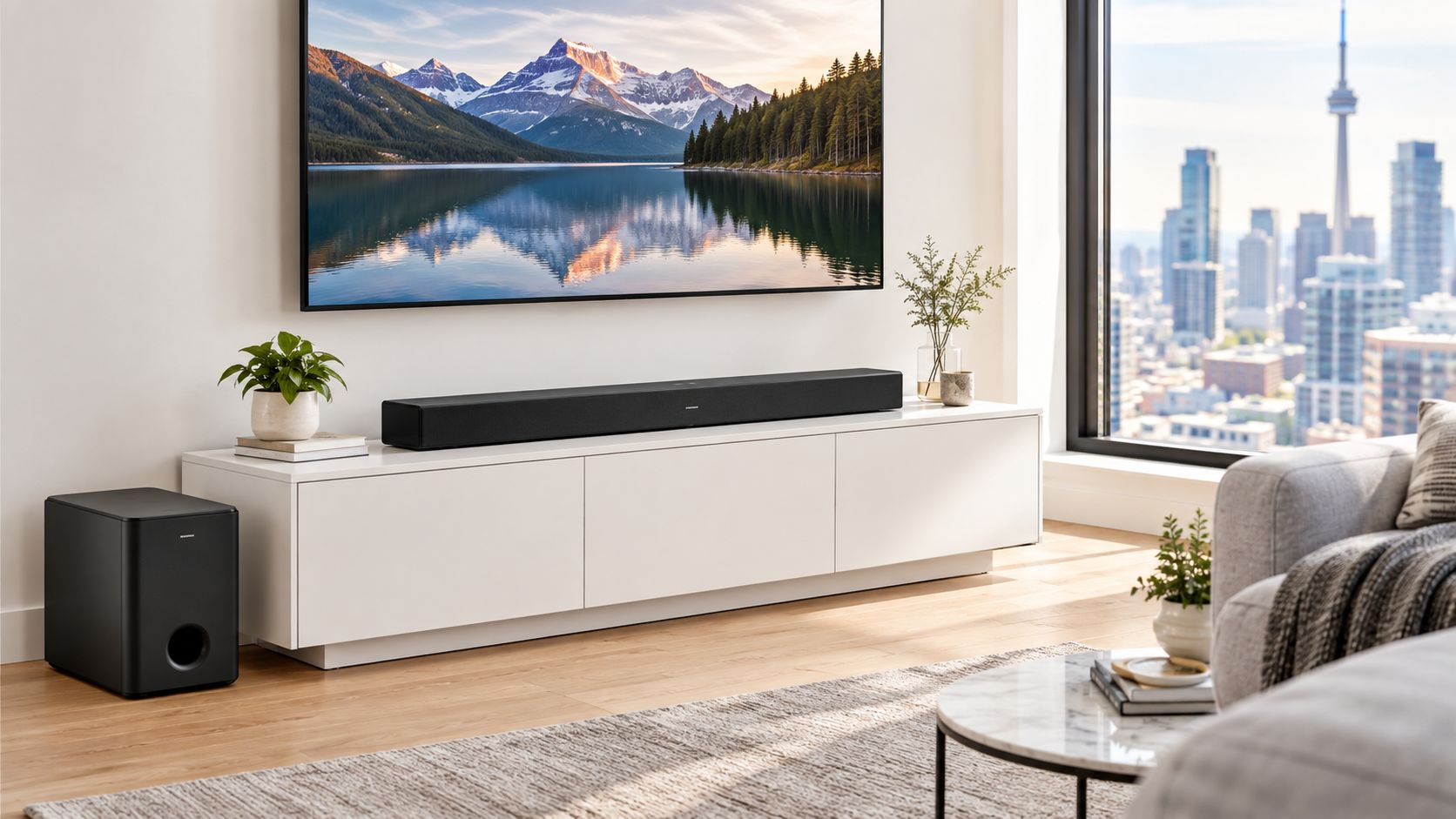
For a typical Canadian living room or condo, a quality soundbar with subwoofer costs $300-500 for reliable entry-level performance and $700-1200 for mid-range, with 2.1-channel configurations representing approximately 40-45% of Canadian unit sales in 2026. That makes this format a practical starting point for better television sound without committing to a full surround system.
You've probably noticed the problem after moving into a North Vancouver condo, renovating a Toronto townhouse, or just replacing an older television. The screen is sharper, streaming audio is more ambitious, but the built-in speakers still sound thin, narrow, and strangely disconnected from the action. Dialogue disappears under music, while explosions either sound flat or force you to reach for the remote.
A soundbar with subwoofer addresses both weaknesses in a compact package. The soundbar handles speech and most of the front soundstage, while the separate subwoofer adds low-frequency impact. The compromise is that bass travels through floors and walls more easily than midrange dialogue, so the right system for a Canadian home isn't necessarily the loudest one.
Table of Contents
- Why Soundbars with Subwoofers Fit Canadian Homes
- The Canadian 2.1-Channel Market Shift
- How to Set Up Your Soundbar and Subwoofer Correctly
- Wattage Versus Real Bass Performance
- Three Soundbar with Subwoofer Tiers for Canadian Buyers
- Making the Final Decision as a Canadian Buyer
Why Soundbars with Subwoofers Fit Canadian Homes
A soundbar-plus-subwoofer system works particularly well when the room has a television, a sofa, and very little appetite for speaker stands. The bar sits below or beside the screen, and the subwoofer can usually be placed on the floor without running speaker cable across the room. Compared with a receiver, centre speaker, left and right speakers, and rear channels, the installation is easier to organise and far less intrusive in a rental or condo.
The 2.1-channel layout is the useful middle ground. A soundbar alone improves speech direction and television volume, but it often lacks physical depth in music and film effects. Adding one subwoofer supplies dedicated bass without requiring the front of the room to accommodate a pair of large speakers. Canadian market estimates identify 2.1 systems as the largest soundbar configuration, with approximately 40–45% of Canadian unit sales in 2026 attributed to the format, according to IndexBox's Canadian soundbar market analysis.

What the subwoofer changes
In a small living room, a subwoofer can make a soundtrack feel more complete at moderate listening levels. You hear the weight of a film score, the body of a bass guitar, and the low rumble of an engine without asking the soundbar's small drivers to reproduce every frequency. That doesn't mean the system becomes a cinema installation. It means the television no longer sounds as though all audio is coming from a narrow slot.
The physical room still sets limits. A ported subwoofer placed against a wall may sound fuller, while a corner can make certain notes boom. In a wood-framed building, the same low-end energy may be more noticeable in the neighbouring unit than it is from your sofa. The best setup creates controlled bass at the listening position, not maximum vibration throughout the building.
Practical rule: Choose a system that gives you a separate subwoofer level, night mode, and dialogue enhancement. Those controls matter more in shared housing than an impressive maximum-volume claim.
Wireless pairing adds another Canadian condo concern. Routers, mesh nodes, Bluetooth devices, and nearby networks can crowd the licence-exempt radio bands used by some subwoofer links. Keep the subwoofer away from a router and metal cabinet, and don't assume a correctly connected soundbar means the bass module will remain trouble-free.
The Canadian 2.1-Channel Market Shift
A full Home-Theater-in-a-Box setup can demand a receiver, several speakers, long cable runs, and furniture arranged around the system. That layout rarely suits a Canadian condo, rental, or compact family room. A soundbar with subwoofer changes the entry point: the bar handles centre-channel and front-speaker duties in one narrow enclosure, while the subwoofer supplies dedicated low-frequency output without requiring a full component installation.
That convenience has moved soundbars into the mainstream home-theatre category. Soundbar-based systems are estimated to represent approximately 58–68% of Canadian home-theatre-system unit shipments, according to IndexBox's Canadian home-theatre market assessment. The figure includes standalone soundbars with wireless subwoofers and related satellite kits, so it does not describe basic 2.1 models alone. It does show how strongly the narrow-bar format has replaced older packages.
Why buyers changed direction
Smaller furniture footprints explain only part of the shift. Streaming services provide easy access to better soundtracks, while formats such as Dolby Atmos give television owners a reason to upgrade. A soundbar can improve film and sports audio without asking a renter to drill into walls or a condo owner to give up valuable floor space.
Shared-wall living also changes what buyers should value. Bass impact matters, yet excessive low-frequency energy can travel through floors and walls. A system with adjustable bass, clear dialogue, and a practical night mode often suits a Canadian condo better than one designed mainly to produce maximum rumble. Dialogue clarity deserves special attention for listeners who have hearing loss or struggle to follow speech over music and effects. A dedicated centre-focused mode or dialogue control can improve access to spoken content, although processing that is set too aggressively may make voices thin or unnatural.
Replacement behaviour has changed as well. Older home-theatre equipment often remained in service for roughly 8–10 years, while soundbar-based systems are estimated to be replaced on a 4–7-year cycle. New television connections, wireless functions, streaming habits, and immersive formats create reasons to replace a working system. The same assessment projects approximately 1–3% annual unit-demand growth from 2026 to 2035, with future purchases driven more by replacements and secondary rooms than by first-time adopters.
A mature category gives buyers many incremental features. Some upgrades improve daily use, while others add processing modes that make little audible difference in a small room.
What 2.1 does and does not provide
A 2.1 system creates a front-focused presentation with stronger bass. Genuine rear effects require additional speakers, and virtual surround performance depends heavily on room shape and seating position. Dolby Atmos can add height cues with suitable content, though it does not replicate a complete multi-speaker installation.
For many Canadian homes, that limitation is a sensible trade. A reliable bar, controllable bass, and intelligible dialogue can provide a better daily experience than an ambitious system that overwhelms a shared building or never fits the room.
How to Set Up Your Soundbar and Subwoofer Correctly
Most disappointing installations fail because of placement or connection choices, not because the hardware is incapable. Set up the television signal first, then deal with the subwoofer as a separate room and wireless problem.
Start with the television connection
Use HDMI ARC or eARC when both the TV and soundbar support it. HDMI allows the television remote to control volume and can carry compatible surround formats more conveniently than older connections. eARC offers greater bandwidth for supported high-resolution audio formats, but the actual benefit depends on the TV, streaming device, and soundbar.
Optical remains useful when ARC behaves badly or when an older television lacks HDMI audio return. A suitable digital optical cable guide can help you check the connector type and avoid buying a cable for the wrong input. Bluetooth is convenient for music, but it shouldn't be your first choice for television because lip-sync behaviour can vary.
After connecting the cable, open the TV audio menu and select the external audio system. Turn off the TV's internal speakers if they continue playing at the same time. If voices sound doubled or delayed, test the TV's digital audio output settings, then use the soundbar's lip-sync control rather than immediately blaming the HDMI cable.
Place the subwoofer for even bass
Start beside the television, but don't treat that position as permanent. Play a familiar music track or film scene at a moderate level and move the subwoofer to a few practical locations. Listen from the main sofa, not while standing beside the unit.
- Avoid shared walls: Keep the subwoofer away from a wall that directly borders a neighbour's bedroom or living room where possible.
- Test a nearby wall position: A wall can reinforce bass, but it may also make one-note effects more obvious.
- Use isolation: Isolation feet or a firm platform can reduce mechanical vibration passing into a floor, especially in an upstairs unit.
- Leave ventilation space: Don't wedge the cabinet into a sealed shelf or behind a stack of storage boxes.
Protect the wireless link
ISED identifies extensive residential use of the 2.4 GHz and 5 GHz bands in Canada, while its licence-exempt spectrum guidance covers 5 GHz digital-transmission devices and indoor restrictions for the 5150–5250 MHz range. A wireless subwoofer can therefore operate in an electrically busy environment, particularly in a dense condominium.
Keep the bar and subwoofer within the manufacturer's recommended range. Don't place either beside a Wi-Fi router, mesh node, Bluetooth hub, or metal cabinet. Pair the subwoofer again after moving it, and check whether the indicator remains stable during a long viewing session.
A clean setup separates problems: HDMI ARC or eARC carries the TV audio, while the subwoofer maintains its own wireless connection. If bass drops out but dialogue continues, investigate the subwoofer link rather than replacing the HDMI cable.
Wattage Versus Real Bass Performance
A large wattage figure looks persuasive on a retail page, but it isn't a reliable ranking of loudness, bass depth, or sound quality. Manufacturers may present maximum output under conditions that don't match sustained listening, and the number rarely tells you how much distortion the system produces when pushed.
IEC 60268 is the relevant measurement framework identified for at least some Canadian-market products. For example, Philips Canada's TAB4500 specification lists 140 W maximum and 70 W RMS, with system output based on IEC 60268. RMS is the more useful figure for comparing sustained output, but even RMS doesn't reveal maximum sound-pressure level, distortion, bass extension, or how the room will reinforce particular frequencies.
Read the frequency information carefully
The subwoofer's frequency specification is more useful than a peak-watt number when you're trying to understand bass capability. Canadian-market examples range from approximately 45 Hz on a compact 2.1 system to 55 Hz on the Creative Stage V2, while premium products may claim substantially deeper bass. Those figures still aren't a substitute for an independently measured frequency-response graph, because manufacturers may use different tolerances and test conditions.
A ported subwoofer also behaves differently depending on its location. Near a wall, low frequencies may receive useful reinforcement. In a corner, the room may exaggerate certain notes while leaving others weak, producing bass that sounds loud but not accurate. Move the cabinet before increasing the level.
| Metric | What It Measures | Why It Matters |
|---|---|---|
| Maximum watts | A peak output figure under specified conditions | Useful for identifying broad system class, but poor for ranking real-world bass |
| RMS watts | Sustained output under a stated measurement method | More meaningful for continuous listening than peak power |
| Frequency range | The frequencies a product claims to reproduce | Helps indicate bass extension, but needs context about tolerance and distortion |
| Independent response | Measured output across the frequency range | Shows whether bass is deep, uneven, or heavily coloured |
| Distortion | Unwanted changes added as the system plays | Separates clean bass from loud but blurred or rattling bass |
For music, integration matters more than impact alone. A useful subwoofer should support the kick drum and bass line without sounding detached from the bar. If the bass seems to come from a separate box, reduce the subwoofer level, adjust its position, and check whether the soundbar offers a crossover or bass-management control. Celmin's guide to choosing a subwoofer for music is useful for thinking about extension, placement, and blend rather than wattage alone.
The practical test: Compare independently measured response and distortion whenever those measurements are available. Use manufacturer power figures to identify a product class, not to declare a performance winner.
Three Soundbar with Subwoofer Tiers for Canadian Buyers
Price should follow the room and listening problem, not the number printed on the box. A compact condo bedroom doesn't need the same package as an open-plan living room, and a premium system can create more neighbour-management work if its bass can't be used comfortably.
Entry-level systems
The $300–500 range is the sensible starting point for a basic 2.1 system in a bedroom, small condo, or rental where simple installation matters. Look for a physical subwoofer level, dialogue mode, night mode, HDMI ARC, and a stable optical fallback before prioritising extra virtual channels.
At this level, expect a clear improvement over built-in TV speakers and more convincing music weight. You may get less consistent bass at the edges of a larger open room, fewer calibration controls, and modest connectivity. A compact system can still be the better choice if you need to reduce the subwoofer level regularly.
Mid-range systems
The $700–1,200 range suits a main living room or an open-plan unit where the television needs a wider front presentation and the system will be used for films, streaming, and music. Here, dialogue processing, room calibration, HDMI eARC, independent bass control, and better handling of quieter listening become important.
Check the physical dimensions before ordering. A wide bar may block an infrared sensor or sit too high in front of a low television. Also verify whether the subwoofer is wireless only, whether the system includes Wi-Fi or Bluetooth, and whether the manufacturer provides useful firmware support in Canada.
Premium systems
Premium packages add more advanced calibration, higher-end drivers, immersive formats, and sometimes rear speakers. They make sense for a dedicated room or for buyers who value a larger soundstage and are prepared to spend time positioning and tuning the components.
They don't automatically make sense in a shared-wall apartment. If you watch mostly dialogue-heavy programmes at moderate volume, a premium package's extra bass and surround processing may offer less daily value than a mid-range bar with stronger speech controls. A Dolby Atmos soundbar comparison can help distinguish immersive-format support from a noticeably more complete multi-speaker layout.
Retail availability varies by model and season. Compare Canadian listings through Amazon.ca and local electronics shops, and confirm that the advertised price is in CAD, the warranty is Canadian, and replacement accessories are available. A discount isn't useful if the system lacks the inputs or controls your room requires.
Making the Final Decision as a Canadian Buyer
The best purchase answers two questions at once: Can everyone understand the dialogue, and can the household use the bass without upsetting neighbours? Most soundbar comparisons answer only the second question, and often reduce it to maximum volume or Dolby Atmos support.
Accessibility deserves a deliberate test. Canadian data reports that 81% of people with a hearing disability experienced accessibility barriers, while 24.0% of people with disabilities or long-term conditions reported barriers when watching or listening to online content, and 25.1% reported television-related barriers, according to the Canadian accessibility survey report. These figures don't tell you which soundbar to buy, but they show why dialogue intelligibility should be treated as a core performance requirement rather than a bonus feature.
Test speech before effects
Use a dialogue-heavy programme with captions off, then repeat the test with captions on. Try both English and French content if those are part of your household's viewing, and compare a quiet conversation with a scene containing music or background effects.
Prioritise:
- Centre-channel clarity: Speech should remain anchored and intelligible without forcing excessive volume.
- Dialogue enhancement: Check whether the mode improves consonants or merely makes voices sharper and thinner.
- Night mode: Compression should reduce sudden peaks while preserving enough detail for speech.
- Subwoofer control: You should be able to lower bass independently instead of reducing the entire system's volume.
- Caption compatibility: Captions help accessibility, but they shouldn't be the only way to follow ordinary dialogue.
A soundbar that sounds spectacular during an action scene can still be a poor household fit if one listener needs captions and another finds the effects too aggressive. Ask whether the system maintains comfortable speech at a lower overall level. That is a more useful test than asking whether it can fill the room.
Manage bass for the building
Canadian housing conditions make this a practical purchasing issue, not a minor installation detail. In 2025, housing completions included 44% intended for the rental market and 25% classified as condominiums, according to Statistics Canada's accessibility and housing topic information. Many buyers will use audio equipment in buildings with shared floors, walls, or ceilings.
Start with the subwoofer gain lower than the factory default. Raise it until bass effects are audible and connected to the soundtrack, then stop before the floor or furniture begins to vibrate. In a wood-framed building or upstairs unit, isolation feet or a platform may reduce mechanical transfer, while moving the cabinet away from a shared wall can reduce the amount of energy reaching the neighbouring room.
Neighbour-conscious setup: Reduce subwoofer gain before reducing the main volume. If dialogue becomes too quiet after lowering the bass, activate dialogue enhancement or night mode instead of turning the entire system back up.
Before keeping the system, test the connections that matter in your home. Watch television through HDMI ARC or eARC, stream music over Bluetooth, and leave the system playing long enough to reveal a possible wireless-subwoofer dropout. Check lip-sync with live television and streaming apps, because a setup that works with one source may still need adjustment with another.
A useful final filter
Choose the entry tier when the room is small, the television is the main source, and you need controlled improvement over built-in speakers. Choose the mid-range tier when speech clarity, moderate bass, and reliable connectivity matter across a larger living space. Consider premium equipment only when you have the room, the budget, and the freedom to use its additional bass and surround hardware.
Before ordering, write down the wall shared with neighbours, the distance between the TV and sofa, the available HDMI ports, and the listening needs of everyone in the home. A soundbar with subwoofer is successful when it improves ordinary evenings, not just the occasional film night.
Celmin offers Canadian reviews, buying guides, comparisons, and setup advice for home technology, including audio equipment and subwoofer placement. Visit Celmin to compare practical recommendations for your room, budget, and living situation before you buy.
Sign up or sign in to join the conversation.