
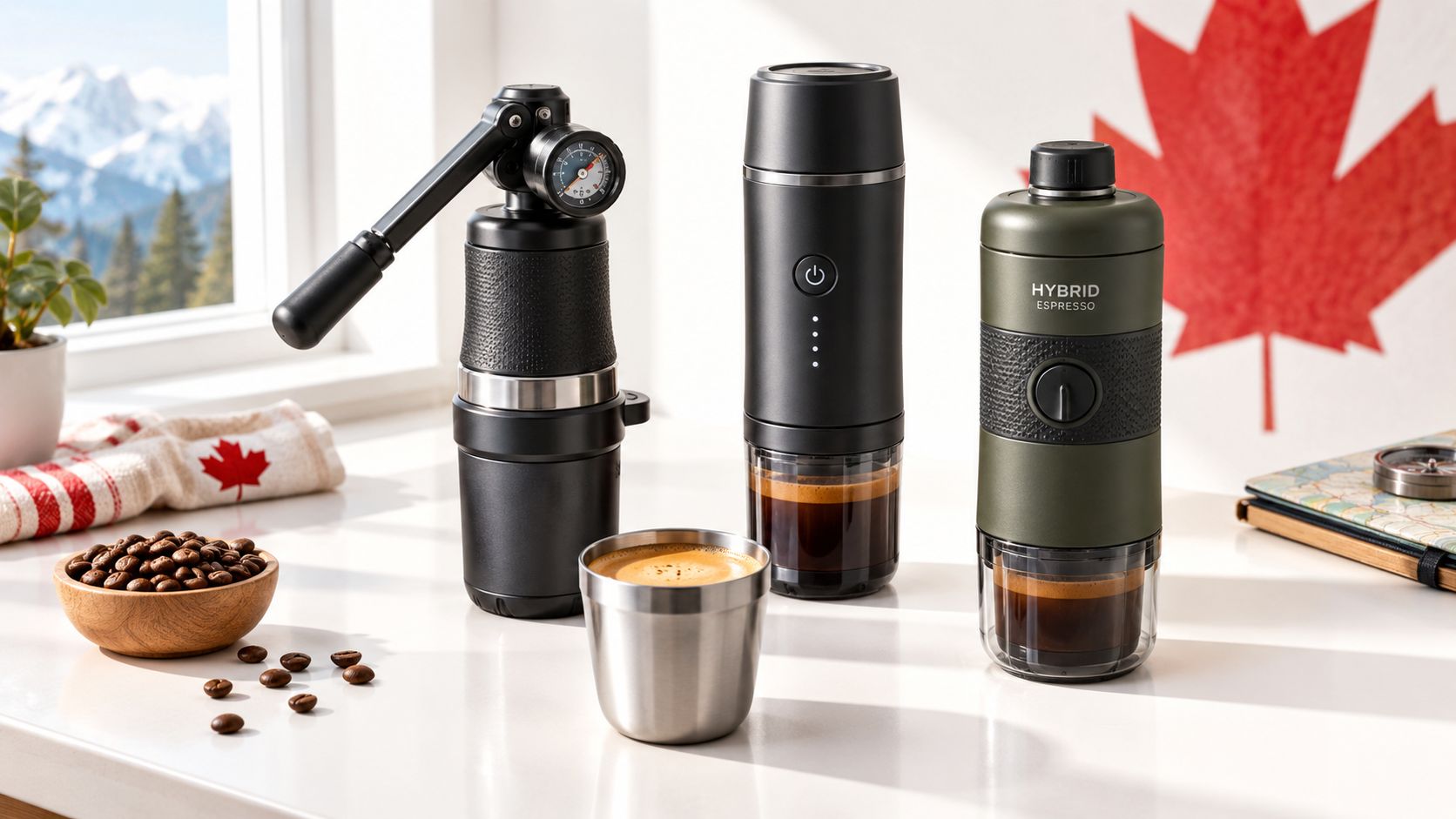
At 6:15 on a February morning, your Toronto condo is quiet except for the kettle, the grinder, and the faint smell of burnt coffee drifting in from a neighbour's stovetop moka pot. A few weekends later, you're at an Algonquin campsite before sunrise, staring at a lake in the dark with instant coffee as the only realistic option. In both situations, the problem isn't a lack of coffee gear. It's friction.
A portable espresso maker can remove that friction without taking over a small kitchen. It can travel to a cottage, fit in a work bag, and brew where counter space, power, or a full-size grinder isn't available. Canada's home coffee shift gives the category a strong foundation. NPD reported that more than 3.5 million coffee and espresso preparation appliances were sold at retail in Canada during the last 12 months, with total sales exceeding 6.7 million units since March 2020. The Canadian portable espresso maker market sits inside that wider move toward in-home coffee preparation.
This guide takes a practical position. Manual brewers are the smarter purchase, while electric units earn their premium only when heating water and one-button convenience solve a genuine daily problem.
Table of Contents
- Why a Portable Espresso Maker Matters in Canada Right Now
- The Main Fork Before You Pick a Model
- Comparing the WACACO Models Sold in Canada
- What the Specs Actually Mean in the Cup
- Cleaning and Daily Maintenance Differences
- Price Tiers in CAD and Total Cost of Ownership
- Matching a Model to a Canadian Buyer Profile
- The Final Verdict for Canadian Shoppers
Why a Portable Espresso Maker Matters in Canada Right Now
A compact espresso maker earns its place when Canadian routines make a full machine impractical. A condo resident may have a narrow galley kitchen, a commuter may leave before cafés open, and a cottage owner may have limited electrical access. At a campground, durable packing and simple rinsing matter more than countertop appearance.
The same brewer can serve different trips. In Montréal's Mile End, café culture makes good espresso easy to find, but daily purchases add up. In Whistler or Banff, a workation rental may provide a kettle without an espresso machine. A portable unit also suits road trips, hotel rooms, and workspaces where a full setup is excessive.
Canadian shoppers have a broad local selection. Amazon.ca lists manual piston machines, electric brewers, capsule-compatible models, and camping-oriented options in its Canadian category. That variety matters because the lowest shelf price does not show the full cost. Electric units may require a charger, cable, power bank, or compatible battery setup. Manual models usually shift the burden to a kettle or another way to heat water.
The practical problems these brewers solve
- Cost per cup: Use your own beans instead of buying café drinks each morning.
- Counter space: Store a handheld unit in a drawer instead of giving it permanent kitchen space.
- Electrical access: Manual models operate without an outlet, charger, or power bank.
- Travel flexibility: Carry one brewer from a hotel room to a campsite.
- Small households: Make one careful shot without buying a full-size machine.
The trade-off is straightforward. Every portable brewer still needs coffee, a suitable grind, and usually hot water. An electric model can reduce separate steps, but its accessories increase the all-in cost and create more charging logistics. A manual model is slower to set up, yet it remains useful across condos, cottages, vehicles, and campsites because it depends on fewer components.
For packing and outdoor brewing considerations, use this guide to portable coffee makers for camping.
Practical rule: Buy portability to remove a specific inconvenience, not because a tiny espresso machine looks clever in a product photo.
The Main Fork Before You Pick a Model
A hotel room without a kettle, a vehicle at a trailhead, and a cold campground expose the same choice: manual versus electric. Pick the power source before comparing model names.
A manual piston brewer requires hand pressure and usually water heated separately. That extra step pays off in Canadian travel. A manual unit works on flights, canoe trips, cabin stays, and winter road trips without a battery, heating element, or cable. It also takes less room in a pack and leaves fewer parts to damage or forget.
An electric brewer heats water internally, runs its pump, and shortens the route from packed gear to espresso. That convenience suits hotel rooms without kettles, offices, vehicles, and cottages where setting up a kettle is a nuisance. The trade-off is practical: more weight, charging, and components that can become troublesome in cold weather. The hidden cost is not just the brewer. You may also need the right cable, charger, or power source.
Choose based on the part of your routine you want to remove.
Choose manual when the trip matters more than speed
Manual suits anyone already carrying a kettle or camp stove, or anyone with reliable access to boiling water. It is also the better fit for flyers watching pack weight, cottage owners without dependable power, and espresso drinkers who want direct control over grind, dose, and pressure.
The WACACO Picopresso is the clearest example. It weighs 350 g, holds 80 ml of water, accepts up to 18 g of grounds, and lists maximum pressure of 18 bar, according to its Canadian retailer specification page. Those specifications describe a compact brewer for one concentrated drink, not a replacement for a café station serving several people.
Choose electric when water heating is the real obstacle
Electric earns its place when heating or carrying water is the step you repeatedly avoid. The WACACO Pixapresso weighs 755 g, has a 120 ml water capacity, supports 8 g to 16 g of grounds, and uses a 3000 mAh battery with up to five espressos per charge, based on the Canadian product listing.
That added weight buys internal heating, capsule compatibility, and temperature control. It does not guarantee better coffee. It gives you a simpler routine, provided the battery is charged and the accessories are packed.
For a broader comparison of battery-powered, vehicle-powered, and mains-powered options, see this Canadian guide to electric portable espresso makers.
Comparing the WACACO Models Sold in Canada
WACACO's names are easy to confuse, but the models serve distinct buyers. Picopresso is the enthusiast's manual choice, Nanopresso is the approachable travel pump, and Pipamoka is the low-fuss press-style option.
| Model | Brewing Method | Max Pressure | Basket / Dose | Weight | Power Source | Best For |
|---|---|---|---|---|---|---|
| Picopresso | Manual piston, espresso-focused | 18 bar | Up to 18 g | 350 g | Hand pressure | Dialled-in espresso and serious travel |
| Nanopresso | Manual semi-automatic piston | Not stated in the verified Canadian data | Model and accessory dependent | Not stated in the verified Canadian data | Hand pressure | General travel and simple espresso-style brewing |
| Pipamoka | Manual pressure and travel press hybrid | Not stated in the verified Canadian data | Model and accessory dependent | Not stated in the verified Canadian data | Hand pressure | Easy cleanup and forgiving campsite coffee |
Picopresso for the cup-focused buyer
Picopresso has the most demanding workflow. It expects better grinding, careful dosing, and attention to preparation. Its small water capacity and grounds capacity make it a single double-shot brewer, so it works best when you want one concentrated drink rather than a round of coffees.
The reward is a more espresso-like process and greater control. The naked-style brewing design also makes mistakes obvious. A poor grind or uneven distribution won't hide behind convenience, which is frustrating at first but useful once you learn the unit.
Nanopresso for the first-time portable buyer
Nanopresso is easier to recommend to someone who wants a compact espresso ritual without turning the trip into a technical project. Its integrated manual pumping approach gives it a more familiar travel workflow than the Picopresso, and its shape suits cases and luggage.
It's the sensible middle ground. You still heat water separately, but the device asks less of you than the more enthusiast-oriented Picopresso. If you're unsure whether portable espresso will become a regular habit, Nanopresso carries less commitment.
Pipamoka for simple, low-mess brewing
Pipamoka is the outlier. It's closer to a pressure-balanced travel press than a conventional espresso machine, so you shouldn't buy it expecting the same crema or concentrated texture as Picopresso. Its strength is speed, simplicity, and cleanup.
That makes it attractive for cottages, road trips, and work bags where a strong coffee matters more than reproducing a café shot. It's also the model I'd choose for someone who dislikes tamping, fine grind adjustments, and a multi-part espresso routine.
The WACACO lineup shows why a single “best portable espresso maker Canada” answer is misleading. The best model depends on whether your priority is espresso quality, ease of use, or cleanup.
What the Specs Actually Mean in the Cup
Portable espresso specifications matter only when they improve the drink or reduce work during a trip. Pressure, water capacity, temperature control, and battery performance set the brewer's limits. They do not guarantee café-quality results.
Pressure supports extraction, but does not create quality
The Picopresso lists a maximum of 18 bar, while the Pixapresso lists 20 bar. That higher figure does not make the Pixapresso the better-tasting brewer. Grind size, coffee dose, puck preparation, water temperature, and flow control have a greater effect on the cup.
A manual brewer can produce a rich, concentrated shot with the right grind and steady pumping. A stronger pump can still produce thin or bitter coffee when the basket is poorly filled or the water is too cool. Treat pressure as a capability, not a quality score.
Temperature has a direct effect on flavour
Electric models can heat water internally, which matters in a condo kitchen, hotel room, or campsite without a kettle. The Pixapresso offers three brew temperatures, 88°C, 92°C, and 96°C, according to Eight Ounce Coffee's Canadian product information. That range gives you useful control across lighter and darker roasts.
Manual brewers can perform well with a kettle, but preheating takes planning. A cold brewer carried through a Banff winter parking lot pulls heat from the water quickly. Warm the cup and brewing parts before extraction instead of chasing a larger pressure rating.
Basket capacity affects body and serving size
The Picopresso's 18 g grounds capacity supports a fuller, double-shot style than smaller travel baskets. The Pixapresso accepts 8 g to 16 g, giving you more dosing flexibility while keeping servings compact. A smaller dose can taste clean and intense, but it will not behave like a large home-machine basket.
| Spec | Why It Matters | Real-Cup Outcome |
|---|---|---|
| Pressure | Moves water through fine coffee | Helps only with the right grind and puck preparation |
| Temperature | Controls extraction and roast balance | Higher settings may suit lighter roasts, while darker coffee may prefer less heat |
| Basket size | Sets the coffee dose for one shot | Larger doses can provide more body and intensity |
| Water capacity | Limits serving size and repeat brewing | Small tanks favour one concentrated drink rather than several cups |
For Canadian buyers, the practical choice is clear. Electric heating costs more and brings battery and charging requirements, but it removes the separate-kettle step. Manual brewing costs less to operate and packs easily, provided you already have hot water. Specs describe the brewer's boundaries, not the quality of every cup.
Cleaning and Daily Maintenance Differences
At a campground wash station or in a hotel bathroom, cleanup determines whether a portable espresso maker remains practical. Manual units are easier to manage because they have fewer electronic parts and no heating chamber that needs flushing after brewing. For Canadian travel, that simpler routine often matters more than a faster start.
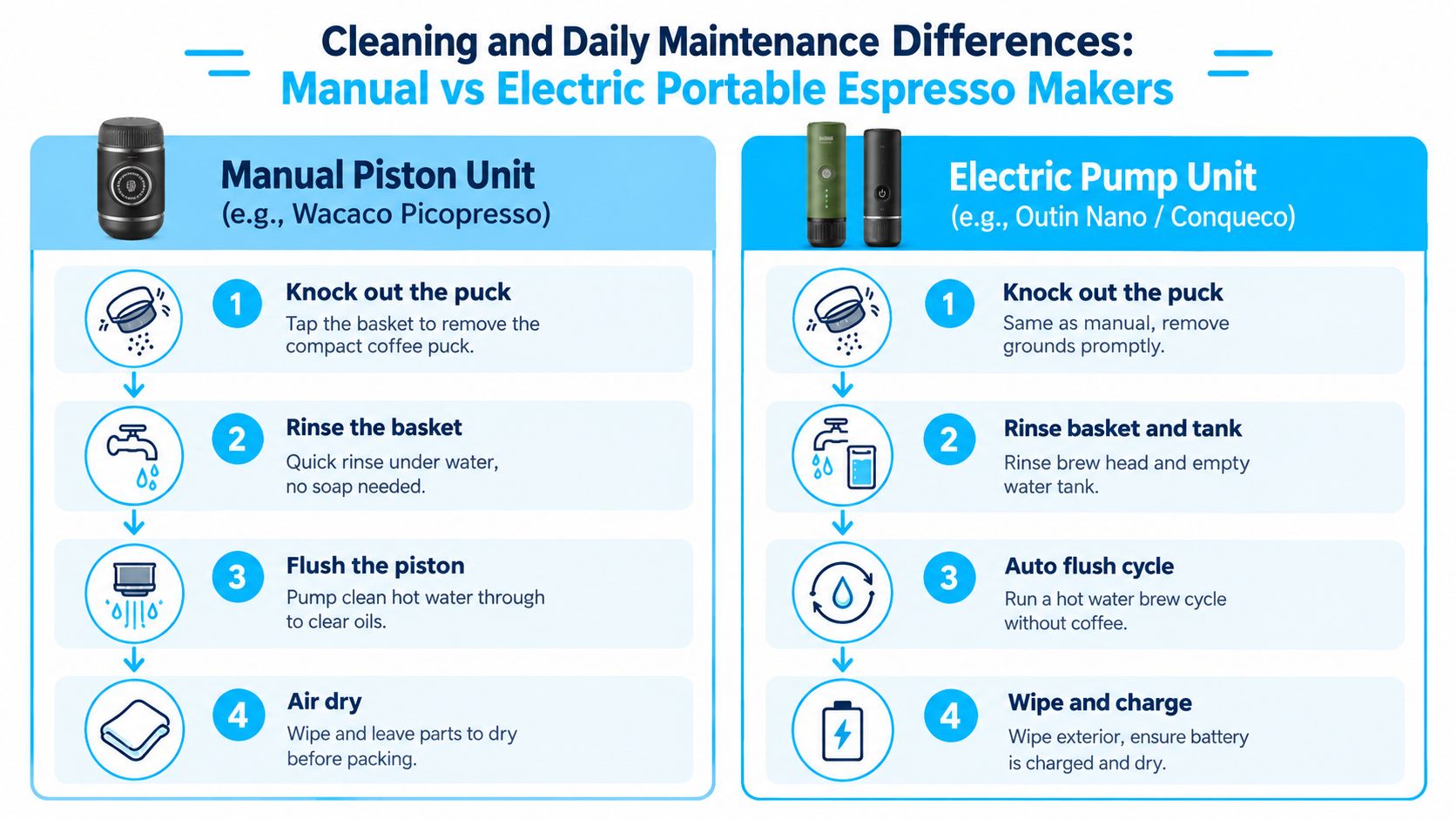
A Picopresso-style cleanup starts with removing the puck, rinsing the basket, flushing clean water through the filter screen, and drying the piston seal and removable parts before packing. Coffee oils still need attention. Put a wet, dirty brewer into its case and odours and residue will build up.
Electric models require closer attention. Empty the spent water, rinse the basket and tank, run a clean-water cycle when the design allows it, and wipe around the charging port and heating area. Their push-button convenience does not remove maintenance. Residue and mineral deposits can affect the brew path if you leave them unattended.
Manual cleanup suits campsites
- Remove grounds promptly: A fresh puck releases more easily than one left to dry.
- Rinse without overcomplicating it: Water is usually enough for the immediate post-brew rinse.
- Flush the piston: Running clean water through the brew path clears residue from areas you cannot wipe.
- Dry before storage: Separate the parts briefly so trapped moisture does not remain in the travel case.
Manual cleanup is the better fit for extended off-grid trips because it does not depend on recharging. Electric units can be close to rinse-and-go after one drink, but they become less convenient when you cannot recharge or rinse the internal path properly.
Hard water makes descaling more important. Watch for mineral deposits on the brewer, kettle, and taps, particularly in places where that buildup is already visible.
The following video shows portable espresso operation and handling:
Price Tiers in CAD and Total Cost of Ownership
A portable espresso maker can look affordable until you price the complete setup. For Canadian buyers, the total may include a grinder, hot-water solution, carrying protection, replacement parts, and accessories added after the base model proves limiting.
Canadian pricing spans a wide range. MEC lists the WACACO Minipresso GR2 at about CAD $85 to $95, while the WACACO Pixapresso is listed at CAD $219.95, according to Canadian retailer pricing information. The same pricing information points to an OutIn Nano trade-off: a unit priced around CAD $170 to $200 may need a larger basket costing about CAD $40, bringing the practical machine total to approximately CAD $210 to $240 before a grinder.
| Tier | MSRP (CAD) | Required Accessories | First-Year Total |
|---|---|---|---|
| Entry | About CAD $85 to $95 | Existing kettle and suitable coffee | Base price if you already own the rest |
| Mid-range | About CAD $170 to $240 in the cited examples | Possible basket upgrade, grinder, and case | Base price plus accessories you actually need |
| Premium | Varies by model and Canadian retailer | Grinder, protection, and a reliable water setup | Often much higher than the machine headline |
Battery convenience can create new costs
A manual brewer stays inexpensive when you already have a kettle and grinder. Without them, the coffee setup becomes several separate purchases. An electric model can remove the kettle from your packing list, while adding charging equipment, a larger basket, a case, and replacement parts.
The OutIn example shows why accessory fit matters. A larger basket is not decoration if the stock basket does not suit your preferred dose. Its practical cost can move into another buying tier before you purchase coffee.
Spend according to your routine
An occasional cottage visitor has little reason to pay for self-heating electronics used only a few times. A daily commuter has a stronger case for electric convenience, especially when the brewer replaces regular café purchases and gets packed each morning.
Manual models also suit Canadian condos and campsites when storage, charging, or kettle access is limited. Electric units make more sense where heating water is inconvenient and recharging is reliable. The premium is justified by that specific routine, not by the word “premium” on the box.
Value test: Add the machine, grinder, water solution, case, and replacement parts before comparing the setup with your café habit. The base price hides the real decision.
Matching a Model to a Canadian Buyer Profile
The most useful recommendation starts with the buyer's routine, not the product's marketing category. A condo resident, a frequent flyer, and a cottage owner may all search for a portable espresso maker, but they're solving different problems.
| Buyer Profile | Best Pick | Why It Wins | Approx. CAD |
|---|---|---|---|
| Urban condo dweller | Picopresso or Nanopresso | Small footprint and no permanent counter installation | Picopresso pricing varies by Canadian retailer |
| Frequent flyer | Nanopresso | Manual operation and travel-friendly format | Canadian retailer dependent |
| Weekend camper | Picopresso or Pipamoka | No charging requirement and straightforward field use | Canadian retailer dependent |
| Off-grid cottage owner | Pixapresso or another self-heating model | Electric heating reduces dependence on a kettle | Pixapresso listed at CAD $219.95 |
| Office coffee experimenter | Pipamoka | Low learning curve and simple cleanup | Canadian retailer dependent |
Condo living favours compact manual gear
If your kitchen is short on storage, the Picopresso makes more sense than a countertop machine that stays unused between drinks. Nanopresso is better for a person who values a simpler pump routine and doesn't want to spend as much time adjusting technique.
Montreal and Toronto renters also tend to have a practical constraint that coffee hobbyists overlook: the grinder. Fresh espresso requires a suitable grind, but not every renter wants another appliance on the counter. A compact manual grinder is usually a better companion than a cheap electric grinder that produces inconsistent particles.
Travel and camping reward independence
Frequent flyers should prioritise weight, durability, and the absence of charging equipment. A manual brewer can go into a bag without turning the coffee ritual into a battery-management task. Campers should ask whether their trip already includes a kettle or stove. If it does, electric heating is solving a problem they don't have.
For compact alternatives beyond espresso-focused devices, compare the options in this compact coffee maker guide.
Electric is convenience, not a magic quality upgrade
A premium electric brewer can be worthwhile for a person who repeatedly lacks hot water. It's harder to justify for someone who already owns a kettle and has a few minutes to pump manually. In that situation, the money is usually better spent on fresh beans and a capable hand grinder, which influence the cup more directly than a larger pressure rating.
Celmin also publishes Canadian buying guides for coffee equipment and compact kitchen tech, including local availability and household-focused comparisons.
The Final Verdict for Canadian Shoppers
For most Canadian buyers, the WACACO Picopresso is the right portable espresso maker. It is compact, manual, and independent of charging, so it suits travellers, condo dwellers, and campers who care more about the shot than one-button convenience. Its 350 g weight, 80 ml water capacity, and 18 g grounds capacity keep it focused on single servings, as detailed in the Canadian Picopresso listing.
Choose the electric tier only when heating water is a genuine problem. The WACACO Pixapresso makes sense for travellers, office users, and cottage owners who need internal heating, capsule compatibility, and temperature selection. It costs more, weighs more, and adds battery charging to the kit. That premium is hard to justify if you already carry a kettle.
A simple immersion brewer is the better choice when time, rather than portability, is your main constraint. Portable espresso still requires grinding, dosing, pumping or heating, and rinsing. It delivers a more involved coffee routine, not automatically a faster one.
Buy based on the complete CAD setup cost, including accessories and charging needs. Manual pumping is the better trade-off for trips with a kettle or stove. Electric heating earns its space where hot water is unreliable. Choose the simplest brewer that solves your actual inconvenience.
Celmin publishes Canadian buying guides and reviews for portable espresso makers, compact kitchen appliances, and everyday consumer tech, with CAD pricing and local-use considerations. Visit Celmin before your next condo morning, flight, or camping trip.
Discussion
Sign up or sign in to join the conversation.