
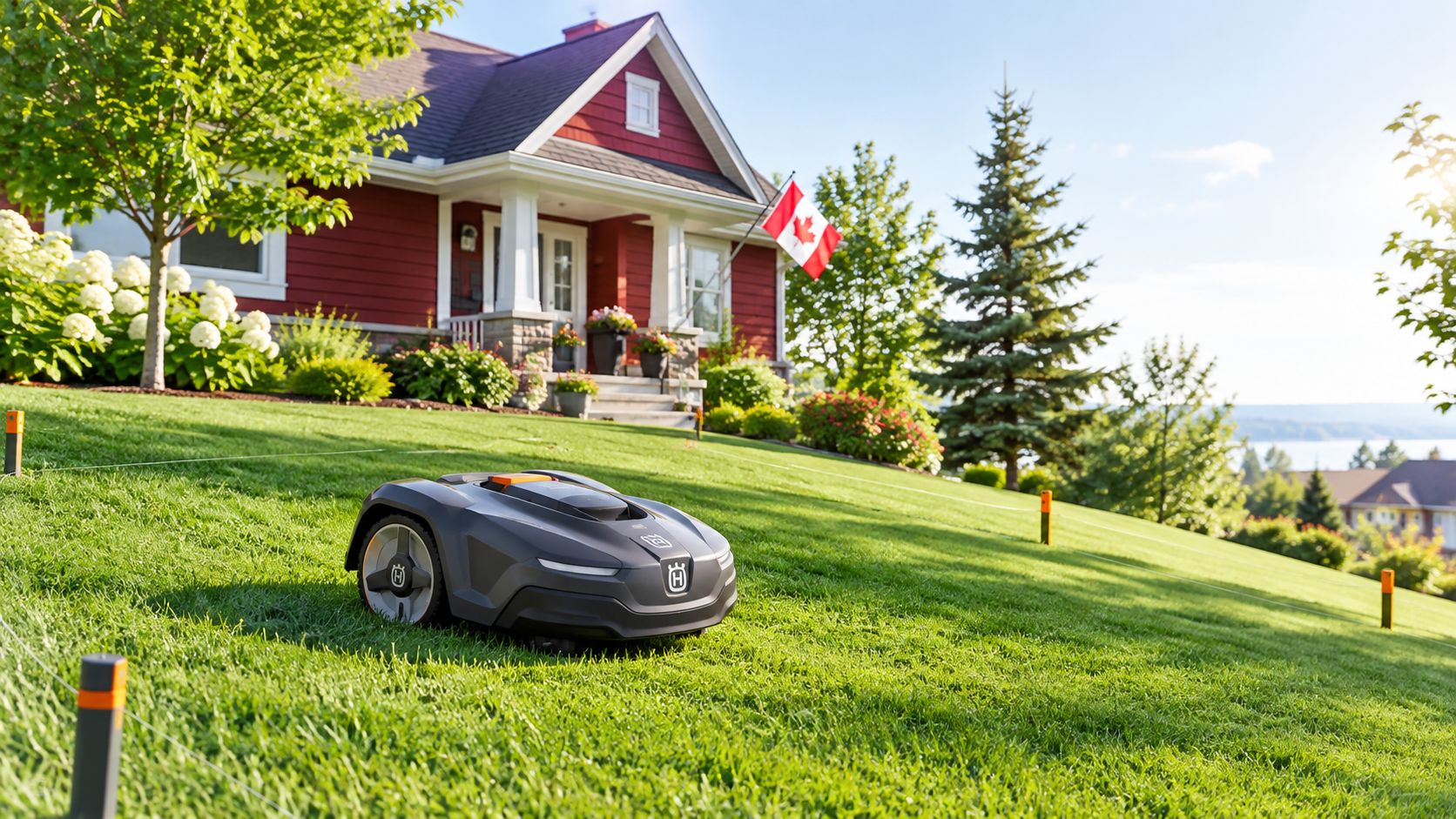
A Canadian spring lawn rarely waits for a convenient weekend. The grass grows in uneven patches, the ground stays soft, and the first warm stretch disappears before you've found time to pull out the mower. By summer, a sloped suburban yard, narrow side passage, or separate front and back lawn can turn an apparently simple robot-mower purchase into an expensive experiment.
The best lawn mower robot in Canada isn't automatically the model with the largest advertised coverage area. It's the one that can handle your actual slope, return to charge before the battery becomes a limitation, work with your boundary system reliably, and survive the long period when snow keeps it indoors. This guide focuses on those practical details, with Canadian availability, local safety considerations, CAD buying context, and winter storage treated as part of the ownership decision rather than footnotes.
The recommendations below are situational. A compact mower may be the right answer for a flat urban lot, while a wire-free model with strong slope handling makes more sense on a hilly suburban property. I'm also direct about compromises, because a mower that looks impressive on a product page can still struggle at a drainage dip, fail to dock consistently, or demand more winter storage space than a condo owner has available.
Table of Contents
- Introduction Why Choosing the Right Robot Mower Matters in Canada
- How Robot Lawn Mowers Evolved and Why the Canadian Market Is Expanding
- What to Compare Before You Buy for Canadian Yards
- Detailed Comparison of the Best Lawn Mower Robots Sold in Canada
- Boundary Systems and Installation Choices for Real Canadian Lots
- Winter Storage and Off Season Maintenance Most Guides Ignore
- Our Recommendations by Yard Size Slope and Budget
Introduction Why Choosing the Right Robot Mower Matters in Canada
A robot mower earns its place when it keeps grass under control while you are working, travelling, or waiting for spring weather to settle. It leaves the charging station, cuts on its schedule, and returns for power. That convenience depends on the property. A flat, open lawn is forgiving. Slopes, garden islands, gates, and narrow links between lawn sections expose weak navigation quickly.
Canadian ownership has a second test: the mower works for only part of the year, then spends roughly four to six months in storage. Cleaning, battery storage, charging-station placement, and spring reactivation all affect the buying decision. A unit that cuts well in July but sits in freezing conditions is not a complete solution.
Choose for the property, not the acreage headline
Manufacturers usually lead with maximum coverage. Treat that figure as a starting point, not a guarantee. A mower can have enough advertised capacity and still waste time on steep ground, divided zones, or a route that places the charger too far from the hardest section.
Assess these factors together:
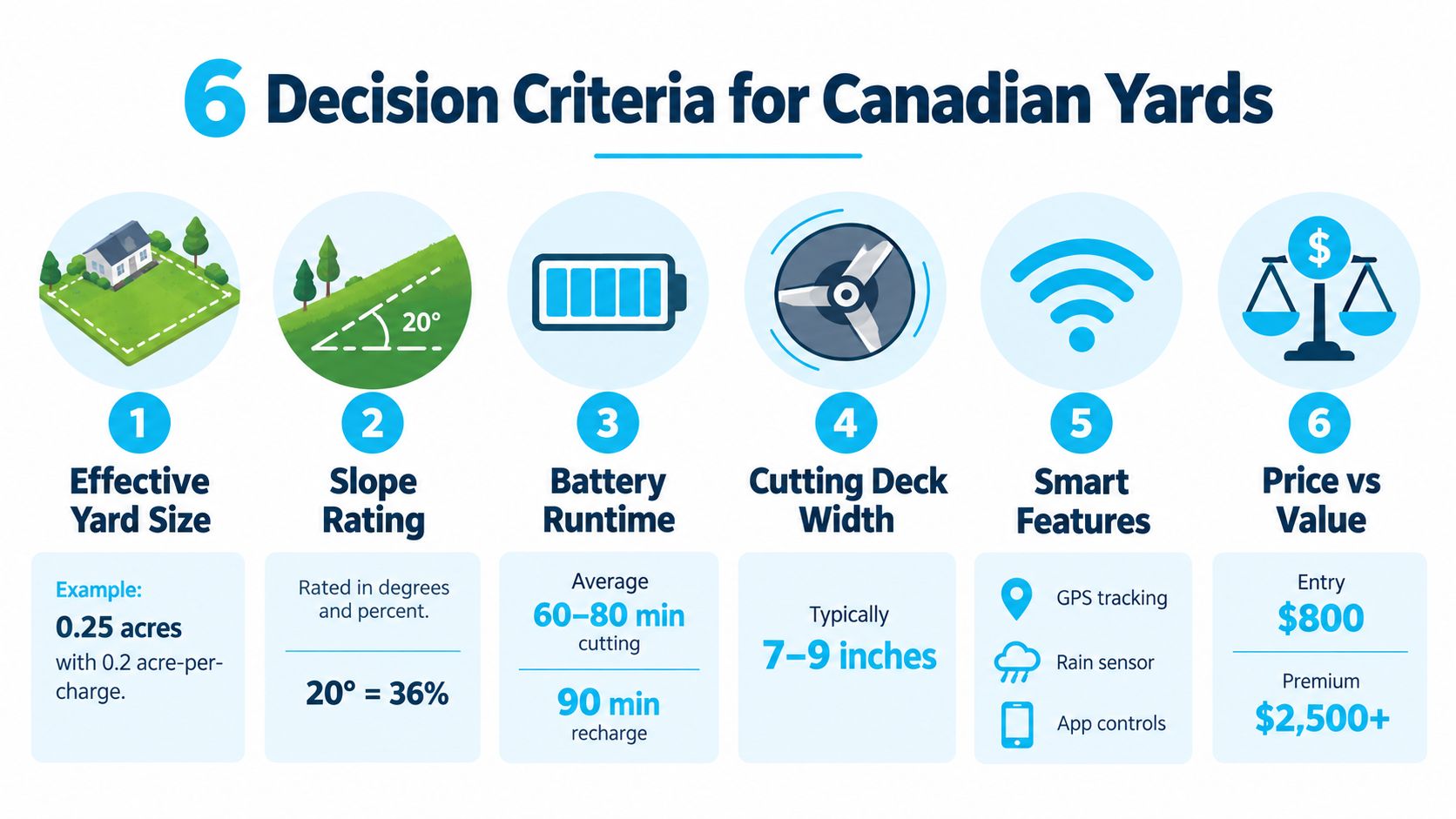
- Effective yard size: Compare the advertised area with the lawn it can cut before recharging.
- Slope performance: Measure the steepest section in degrees or percentage, then leave room for wet grass and uneven traction.
- Boundary technology: Choose perimeter wire for a defined installation, or wire-free guidance when trenching and boundary layout are poor fits.
- Runtime and recharge: Judge the full mowing cycle, including travel back to the station, rather than battery capacity alone.
- Winter care: Confirm how the battery, mower, and charging station should be cleaned and stored.
For Canadian yards, the useful comparison is slope-per-charge, not acreage alone. A mower that covers a large area on paper may deliver less practical coverage on a steep lot, while a smaller unit can be the better choice for a compact, flat property. The published Canadian-market mower specifications show why models differ across coverage, operating time, recharge needs, cutting width, noise, and slope handling.
Boundary choice also changes ownership effort. Perimeter wire requires planning and installation, but it gives the mower a defined operating area. Wire-free systems reduce that physical setup, yet they still need reliable positioning and careful mapping around gardens, driveways, and separate lawn zones.
I will not name one universal winner. Match the mower to the steepest route, its expected work between charges, the boundary setup you can maintain, and the storage space available through winter. That produces a more dependable recommendation than the largest acreage claim.
How Robot Lawn Mowers Evolved and Why the Canadian Market Is Expanding
A mower that works on a flat suburban lawn may struggle on a Canadian lot with wet grass, slopes, tight passages, and several months of storage. The category evolved by solving those practical problems, not by adding stronger blades.
Husqvarna's innovation timeline places the launch of the world's first fully automatic lawn mower in 1995, followed by the first-generation Automower in 1998. The company later introduced the third-generation Automower 305 for lawns up to 600 m², then added GPS-assisted navigation on the 330X and a 2020 model for smaller, complex gardens, narrow passages, and slopes up to 40%, as documented in Husqvarna's Canadian robotic mower collection.
Those milestones show how the buyer's priorities changed. Early automation focused on keeping grass short. Current machines must locate the lawn, follow its boundaries, maintain traction, avoid obstacles, return to the charger, and resume work after recharging. For Canadian properties, slope control and reliable positioning matter more than blade power alone.
Why expansion matters to shoppers
Canada remains a fast-growing niche rather than a mature appliance segment. One 2026 estimate places the market at USD 52.0 million in 2026 and projects USD 165.7 million by 2033, implying an 18.5% CAGR, according to the Canada robotic lawn mower market estimate.
That projection is not a promise about any retailer or model. It does point to more choice, broader Canadian availability, and faster development of products suited to local yards. Shoppers are likely to see more compact machines for urban properties and more capable systems for steep or divided lawns.
A separate Canada-focused forecast estimates USD 639.12 million in 2025, rising to USD 1,217.69 million by 2034, with a 7.53% CAGR from 2026 to 2034. The forecasts differ sharply in market size, so neither should serve as a precise sales count. Their shared direction still matters: expanding demand should support more boundary options, better terrain handling, and easier access to Canadian-compatible products.
For owners, growth only helps if the mower fits the lot. Compare slope-per-charge, boundary setup, service access, and the space available for four to six months of winter storage before treating a larger coverage rating as an advantage.
What to Compare Before You Buy for Canadian Yards
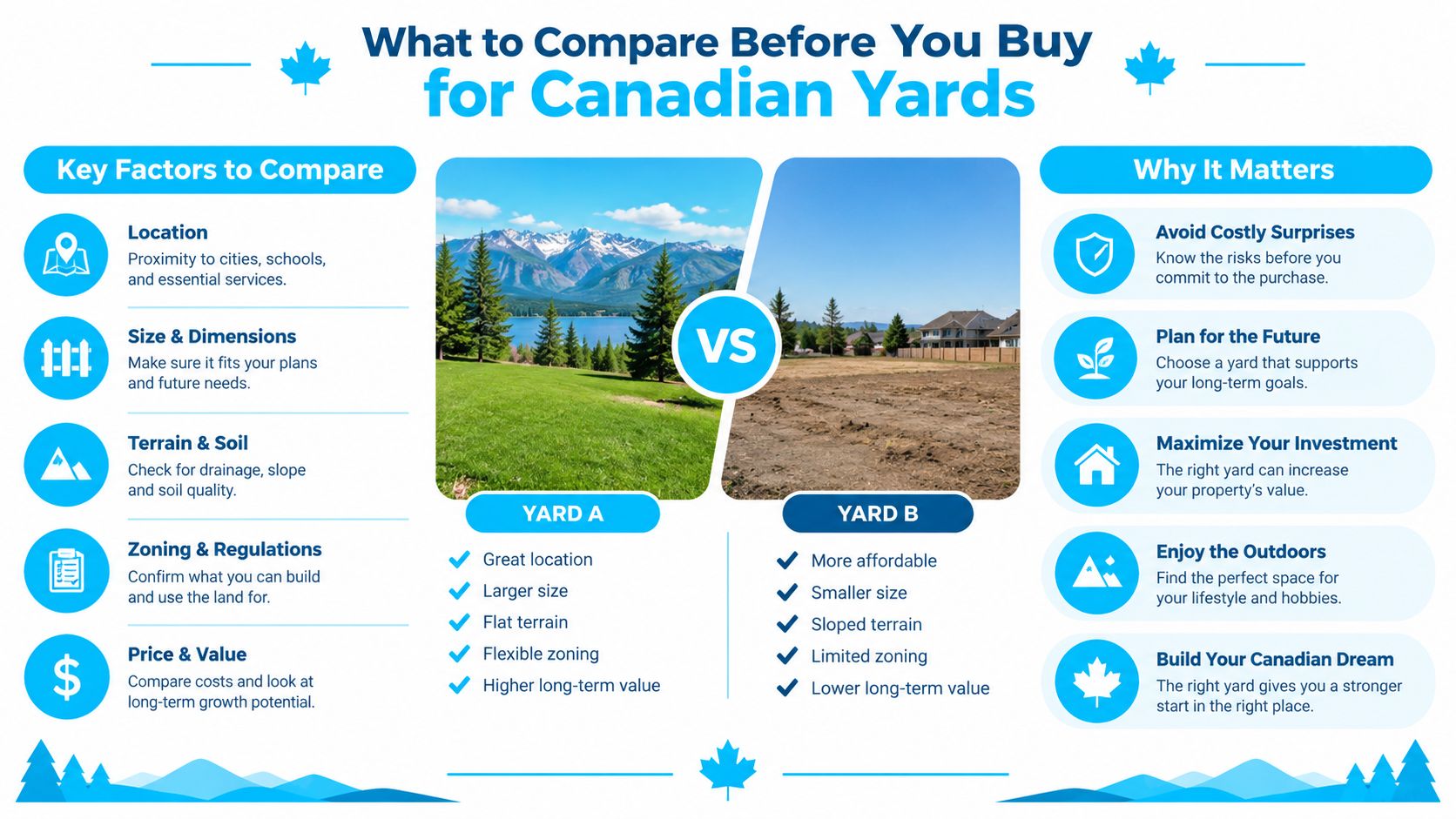
A small Toronto lawn, a sloped suburban lot, and a property with separate front and back grass areas need different mower designs. Measure usable turf, locate the steepest section, and check every route between buildings, garden beds, fences, and lawn zones. Those details reveal whether the mower can complete a cut efficiently or will spend the day charging and correcting its route.
Six specifications that deserve priority
Effective capacity is more useful than the biggest acreage figure on the box. Slopes, narrow passages, and divided zones reduce productive mowing time, so compare the claimed coverage with the grass area the robot can reach.
Slope rating should appear in degrees and percentage whenever possible. An 18-degree limit and an 80% capability describe very different machines. On a steep Canadian lot, traction and consistent climbing matter more than a generous headline coverage rating.
Runtime, recharge time, and slope-per-charge performance determine whether the mower finishes its schedule. A robot that handles a flat lawn well may lose considerable ground on inclines. For broad properties or several zones, long charging pauses can leave some grass untouched.
Cutting width and noise affect both finish quality and neighbour comfort. A wider deck covers more turf per pass, while a quieter compact mower suits dense neighbourhoods. Width does not replace traction, especially on wet or uneven ground.
Boundary technology sets the installation workload and daily accuracy. Physical-wire systems take more initial work but create a clearly defined perimeter. Wire-free systems reduce installation, yet their reliability depends on navigation method, satellite or positioning conditions, and the property layout. Choose the boundary system before comparing acreage.
Safety compliance belongs on the shortlist. Canadian guidance covers CSA C22.2 No. 60335-2-107 / IEC 60335-2-107 for battery-powered robotic lawnmowers with battery voltage not more than 75 V d.c., including the charging station, as outlined in the Standards Council of Canada safety notice.
| Yard Profile | Prioritize This Spec | Why It Matters in Canada |
|---|---|---|
| Flat urban lawn | Compact capacity, quiet operation, simple boundary setup | Small properties do not need oversized hardware or a complex installation |
| Hilly suburban lot | Slope rating, traction, slope-per-charge performance | Steep ground can reduce effective coverage and send a poorly matched mower back to charge |
| Separate front and back lawns | Multi-zone navigation and reliable boundary control | Each zone needs dependable access or a practical manual transfer plan |
| Narrow side passages | Navigation accuracy and passage handling | Tight routes expose weak mapping and docking behaviour |
| Condo or rental property | Low-installation boundary system and indoor storage size | Permanent wire installation may be impractical, while winter storage space may be limited |
Canadian ownership also includes a four-to-six-month winter storage period in many yards. Check where the mower, battery, and charging equipment will stay, and confirm that the machine can be cleaned, powered down, and stored indoors without occupying more room than you have available.
Canadian buying rule: Choose by slope-per-charge performance and boundary reliability, then use acreage as a confirmation rather than the starting point.
For irrigation coordination and outdoor automation, Celmin's guide to choosing a smart sprinkler controller applies the same property-mapping approach. Define the zones first, then buy hardware that can handle them.
Detailed Comparison of the Best Lawn Mower Robots Sold in Canada
Canadian buyers need to compare more than cutting width and acreage. A mower can look capable on paper yet struggle with a steep lot, lose efficiency while returning to charge, or require a boundary setup that does not suit the property. Local stock, Canadian warranty support, charging compatibility, and winter storage also affect the ownership experience.
The market is expanding, but product availability changes. A model featured in a US buying guide may not be sold through Canadian channels or supported locally. Confirm current Canadian availability before you compare features or commit to an installation approach.
The options below are best treated as use-case choices, not a universal ranking. Earlier specifications provide the detailed baseline. This comparison focuses on how each product type fits Canadian yards, especially slopes, boundary planning, and seasonal storage.
Wire-free 2026 model line
The wire-free 2026 line suits owners who want to avoid installing a physical perimeter wire and have a property where virtual mapping can remain reliable. Earlier specifications show its larger coverage class, extended operating time, broad cutting path, and high slope rating. Those figures establish useful capacity, but they do not guarantee the same performance on every Canadian lot.
Its main advantage is the combination of wire-free installation and terrain headroom. That makes it a strong candidate for a larger suburban yard with slopes, particularly where trenching around garden beds, retaining walls, or narrow routes would be disruptive.
Best use: A larger Canadian yard with demanding slopes where the owner values wire-free installation.
The trade-off is environmental. Dense tree cover, buildings, difficult sightlines, and complex property edges can make virtual boundaries less dependable. Check the actual yard before buying, and judge the mower by usable slope coverage between charges rather than its maximum slope rating alone.
Smaller 800 m² model
The compact option is intended for lawns up to 800 m², or 0.2 acre, with 56 dB noise, 90 to 110 minute charging, and an 18-degree maximum slope. Its smaller capacity is appropriate for a modest, relatively flat urban property close to neighbours.
Quiet operation and manageable size matter in tight Canadian lots. This class also makes sense when the mower will be stored indoors through winter and available space is limited.
The limitation is terrain margin. An 18-degree rating leaves less room for uneven ground than the wire-free line. A small lawn can still contain a demanding bank, so measure the steepest section and consider how often the mower must return to charge before choosing this class.
Established Automower-style designs
Husqvarna's Automower line has a long history in the category. Its timeline records the first fully automatic mower in 1995, the first-generation Automower in 1998, and a third-generation 305 model rated for lawns up to 600 m², as noted in the Canadian Automower collection.
These models appeal to buyers who prefer an established product family and conventional autonomy through Canadian retail channels. The right choice still depends on the specific model's boundary method, terrain rating, installation requirements, and current CAD pricing. Brand familiarity should not replace a property check.
A smaller established mower can perform well on a tidy lawn while falling short on a sloped yard. Compare expected coverage per charge, not just the maximum lawn area, and plan indoor storage for the mower, battery, and charging equipment during the four-to-six-month winter period many Canadian yards require.
My head-to-head verdict
For a steep, larger suburban lot, choose the high-slope wire-free line when the property supports dependable virtual mapping. For a small, flat urban lawn, the compact 800 m² class is the more practical direction. For buyers who prioritise a mature product family and Canadian retailer access, Automower-style options remain credible, but the exact terrain, boundary, and service details should make the final decision.
Boundary Systems and Installation Choices for Real Canadian Lots
Boundary setup determines how much work a robot mower creates after installation. The main choices are perimeter wire, RTK or GPS mapping, and vision-based wire-free navigation. Pick the system that matches the lot, not the one with the shortest setup video.
A wired mower follows a physical perimeter secured to the surface or installed into the lawn. Installation takes more time around garden beds, narrow passages, and separate mowing zones, but the boundary remains dependable without satellite visibility or camera interpretation. For many small, orderly Canadian lawns, wire is still the predictable choice.
RTK or GPS systems create virtual boundaries through positioning technology. They reduce digging and pinning, which suits larger open properties and owners who expect to change zones. Trees, buildings, and other obstructions can weaken positioning, so place the charging station and reference equipment where they have a clear working area.
Vision-based models use cameras and onboard processing to identify grass and edges. They reduce physical installation, but the yard must provide clear visual separation. Long grass, changing light, fallen leaves, garden clutter, and similar-looking surfaces can make recognition less reliable.
Match the system to the property
- Small urban lawn: Choose a simple wired system when the perimeter is straightforward.
- Rental or condo: Use a low-disruption option if buried wire is prohibited or impractical.
- Large open yard: RTK or GPS mapping can reduce installation work and support virtual zones.
- Tree-heavy property: Test satellite performance before committing to a positioning-dependent mower.
- Narrow passages: Confirm that the mower can enter, turn, and return without relying on optimistic map lines.
Before installation, walk the route at mower level. Mark hard edges, low spots, loose mulch, raised pavers, and traps. Measure the tightest turns, then check the mower's actual clearance and slope performance. A large advertised coverage figure means little if steep sections drain the battery before the mower reaches its dock. Compare slope-per-charge performance and plan zones accordingly.
Set the charging station on stable ground with a clean approach. Keep it accessible for cleaning, troubleshooting, and removal before winter. A well-placed station also makes power routing easier. The same zone-planning approach used when setting up a smart irrigation system can help organise mowing areas, cable routes, and seasonal access.
Canadian electrical safety belongs in the installation decision. Use equipment designed for the applicable mower and charging-station safety requirements, as noted earlier, and follow the manufacturer's instructions for outdoor power, connections, and placement.
Winter Storage and Off Season Maintenance Most Guides Ignore
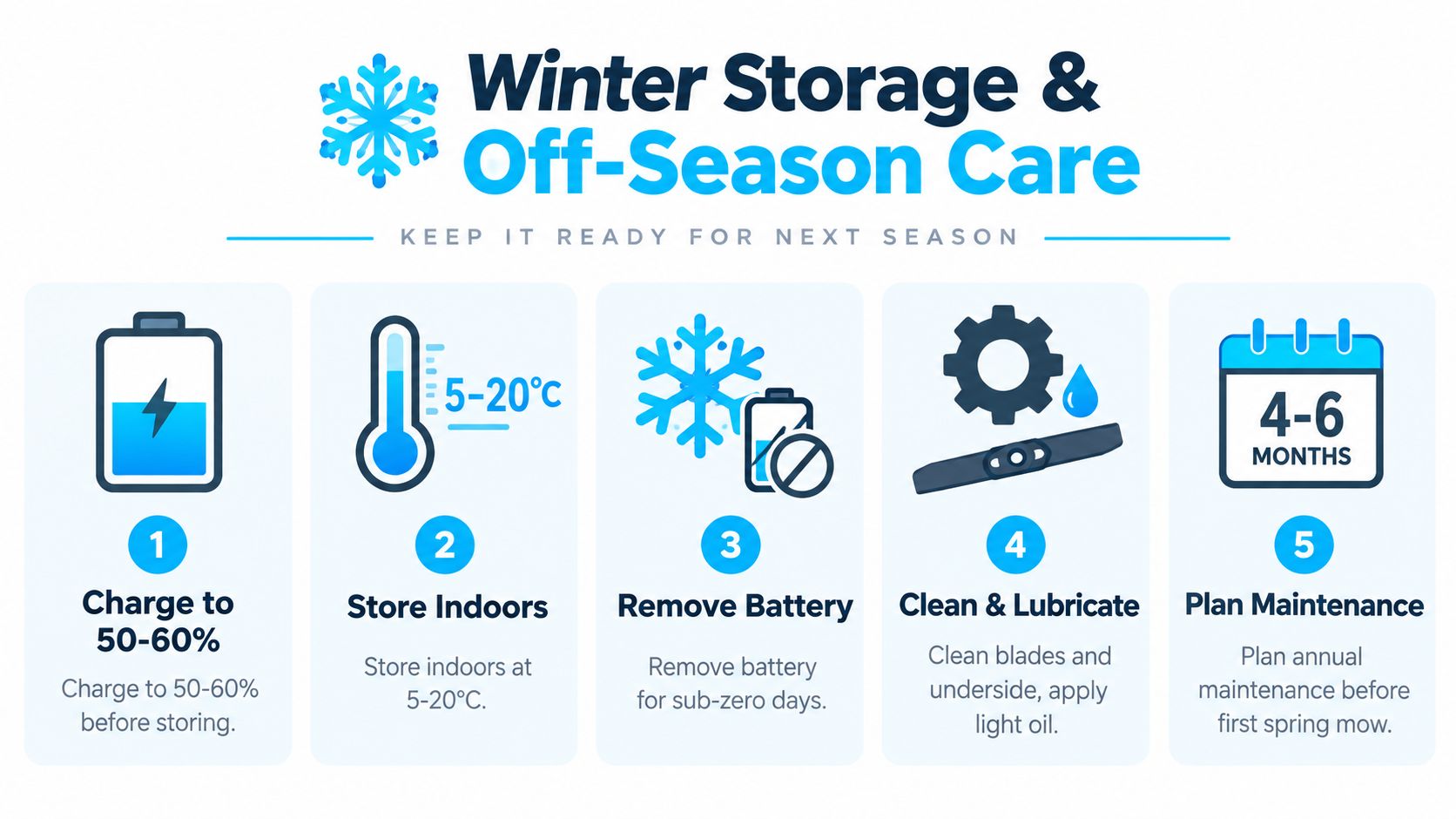
A robot mower can spend four to six months inactive in Canadian conditions, which makes winter preparation part of the purchase decision. Canada-focused winter-maintenance guidance identifies battery state of charge, indoor temperature, cleaning, and spring reactivation as practical ownership needs that many buying lists overlook.
The best routine is simple, but you need to follow the mower's manual for model-specific instructions. Don't improvise around battery removal, charging, or warranty requirements.
Fall shutdown checklist
- Finish the season with a controlled battery level. The supplied winter-care guidance recommends storing the battery at 50% to 60% charge. Avoid leaving the mower fully depleted.
- Clean before storage. Switch the mower off, remove grass and soil from the underside, and clear the charging contacts. Moisture and packed debris can create problems while the machine sits unused.
- Inspect the cutting system. Replace damaged blades according to the manufacturer's instructions and check for wrapped grass around the blade disc.
- Bring the equipment indoors. Store the mower, and any removable battery, in an indoor space held at 5 to 20°C, based on the supplied winter-maintenance guidance.
- Protect the charging station. Remove it if the manufacturer requires indoor storage, or cover and disconnect it as directed. Keep cables dry and organised.
Spring restart
Bring the mower back to room temperature before charging or starting it. Inspect the body, wheels, blades, charging contacts, boundary equipment, and cable connections before sending it onto the lawn.
Check the stored map and schedule, then run a supervised first cycle. Spring lawns can be uneven and soft, so watch for wheel slip, poor docking, and debris that wasn't present at the end of autumn. A short inspection now is much easier than discovering a fault during the first busy mowing weekend.
If you live in a condo or have a small garage, measure the shelf or cabinet where the mower will spend winter before purchase. Storage isn't an afterthought. The machine needs a clean, dry, temperature-controlled place, and the charging station may need separate space.

Our Recommendations by Yard Size Slope and Budget
Start with the property, not the mower's headline acreage. The right choice depends on your steepest bank, boundary setup, expected mowing area per charge, and where the machine will spend the long Canadian winter.
- For a small, flat condo or urban yard: Choose the compact 800 m² class. It suits tidy properties where quiet operation and straightforward upkeep matter more than aggressive traction. Confirm current CAD pricing, retailer support, and stock before ordering.
- For a larger hilly suburban lot: Skip the compact class if your steepest bank exceeds 18 degrees. Choose the high-slope wire-free line noted earlier, then confirm that its per-charge coverage fits your actual mowing area. On a sloped property, usable coverage matters more than the advertised maximum.
- For a buyer who refuses perimeter wire: Select a wire-free system only after checking trees, structures, narrow passages, and virtual-boundary requirements. It saves installation work, but mapping and signal reliability determine whether the mower works every day.
- For a buyer focused on value: Match capacity to the lawn you own. Put the budget toward reliable boundary handling, accessible replacement parts, simple blade changes, and Canadian service rather than unused acreage capability.
- For an established platform preference: Compare Automower-family models through Canadian retailers by yard fit, slope handling, boundary method, installation requirements, and winter support. Brand familiarity helps, but property compatibility decides the purchase.
Use Amazon.ca and local Canadian retailers to check availability and CAD pricing before buying. Seasonal stock changes, so arrange installation early enough to test the boundary system before heavy growth begins.
If the charging area needs protected outdoor power, Celmin's guide to a weatherproof outdoor smart plug is a useful companion resource. Keep the setup practical, with safe cable routing and a location that remains accessible for winter removal.
A strong Canadian shortlist answers four questions: how much lawn the mower can cover per charge, whether it can handle the steepest slope, which boundary system suits the lot, and where it will be stored for four to six months. Confirm availability, safety information, installation requirements, and the return policy before placing the order.
Celmin publishes Canadian buyer guides and comparisons for smart-home devices and everyday technology, with attention to local availability and seasonal ownership. Visit Celmin to compare practical home-tech options for a smarter Canadian home.
Discussion
Sign up or sign in to join the conversation.