
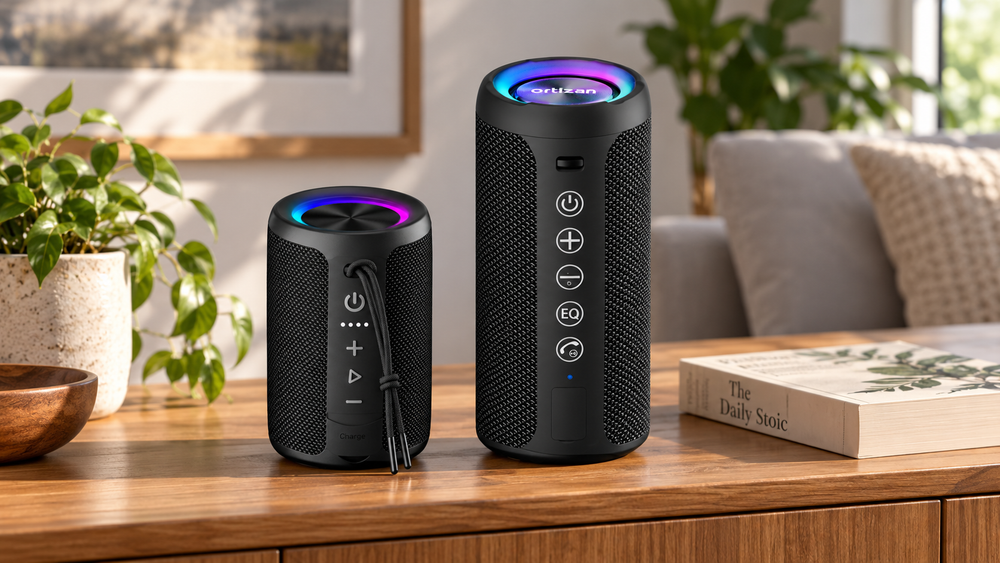
DUDGSIS X2 or Ortizan X10? Compare compact placement, wired and memory-card playback, calls and battery conditions for the way you listen.
The DUDGSIS X2 takes up less space. The Ortizan X10 offers more ways to play audio. That is a more useful starting point than comparing their advertised wattage.
Both are portable Bluetooth speakers with lighting and IPX7 water-resistance claims. Size, connections and your normal listening volume are more useful tie-breakers than wattage alone.
| Detail | DUDGSIS X2 | Ortizan X10 |
|---|---|---|
| Listed size | 7.6 × 7.6 × 10.8 cm | About 7.9 × 7.9 × 17 cm |
| Bluetooth | 5.3 | 5.3 |
| Advertised battery life | Up to 15 hours, 30% volume, lights off | Up to 30 hours, approximately 65 dB playback |
| Extra playback options | Confirm any non-Bluetooth inputs | AUX and TF memory-card playback |
| Calls | Not established here | Built-in microphone advertised |
Maximum runtime is not an all-settings guarantee
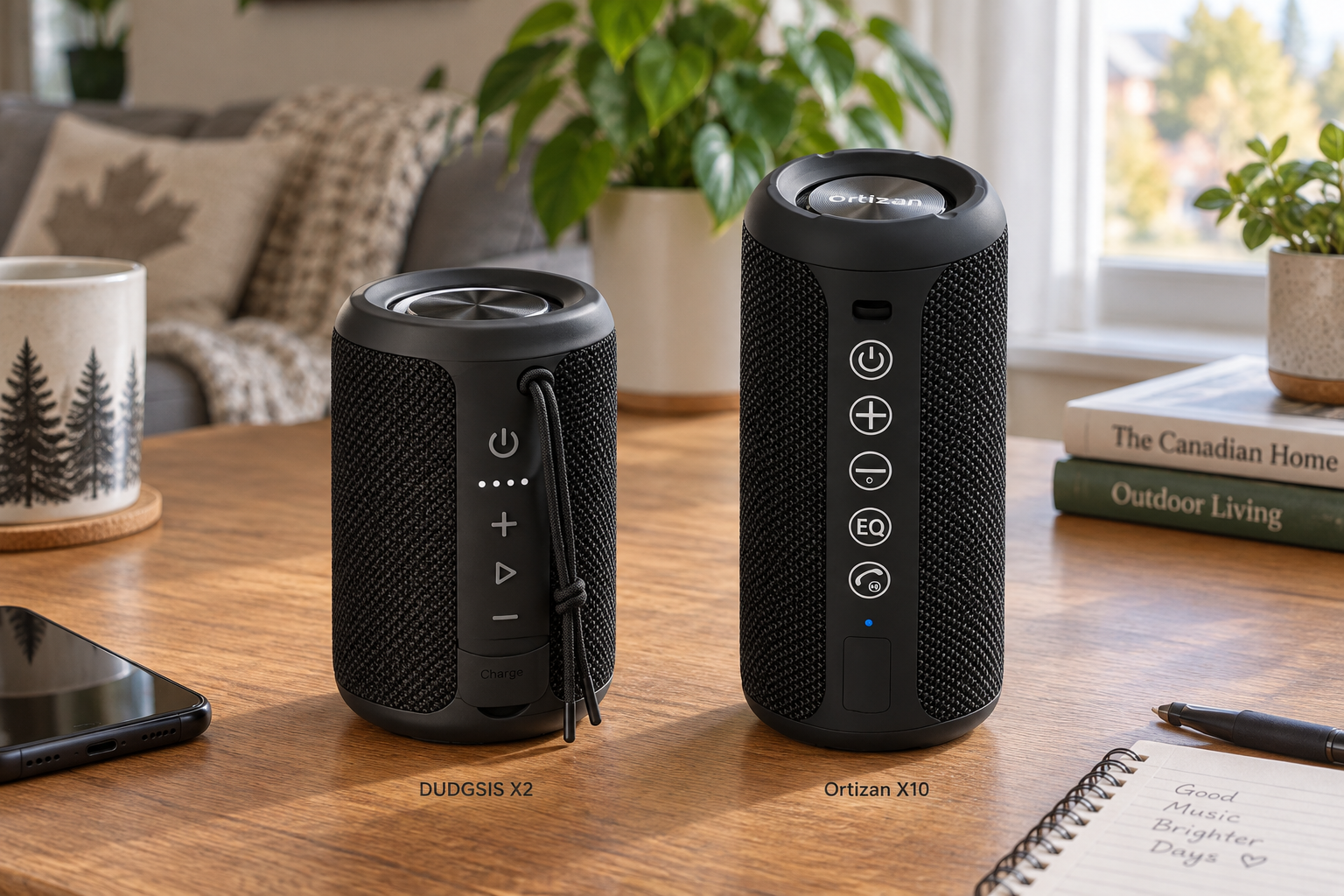
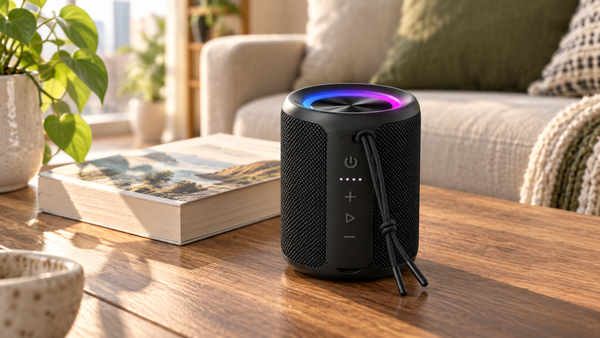
DUDGSIS X2 speaker
 Shop at Amazon.ca
Ortizan X10 speaker
Shop at Amazon.caStart with the device that supplies your audio
If all your listening comes from a phone over Bluetooth, both speakers address the basic connection. In that case, the decision shifts toward physical fit, controls, battery routine and the sound you prefer at normal volume. Extra inputs may have little practical value.
If you sometimes use a source with a headphone output, Ortizan's AUX connection gives you another route. Check whether the source needs its own adapter and whether the cable is included. A wired-input feature is useful only when the complete connection works with the equipment you own.
The X10's memory-card playback creates another possible routine: listening without keeping a phone connected. Confirm supported file formats, card capacity and navigation controls before treating it as a convenient standalone music library. Having a slot does not tell you how easy it is to find a particular track.
Do not transfer those features to the X2 because the two speakers look broadly similar. For DUDGSIS, confirm any function beyond its established Bluetooth playback and compatible-speaker pairing if that function is a requirement.
Which fits a desk, bedside table or bag?
The X2's shorter body can be useful when vertical space is limited or you want a small object beside a keyboard. Measure the actual spot, including any charging lead, rather than judging size from product photographs with different camera angles.
The X10 is taller, so consider shelf clearance, stability and how it fits into the pocket or bag you intend to use. Portability includes the cable and other items you carry, not just the speaker. A slightly larger body may be acceptable if you regularly use its additional inputs.
At a bedside, light controls and low-volume adjustment deserve special attention on either model. Check whether your preferred lighting mode is easy to select and whether indicators or prompts are distracting. Neither model should be assumed to provide an alarm, sleep timer or smart-home function merely because it sits comfortably on a nightstand.
What you gain with the taller speaker
The X10’s AUX input matters if you want to connect a device by cable. Memory-card playback may be useful when you do not want to keep a phone connected. Check supported formats and card limits in the manual before buying a card for it.
Ortizan also advertises a microphone for calls. That confirms the feature, not its call quality in a noisy room. The manufacturer’s product page is the place to check the current controls and connections for this model.
If you will always stream from a phone, those extras may do little for you. The X2’s shorter body could be easier to fit on a crowded bedside table or into a small bag. Measure the actual space; neither photograph is a reliable scale drawing.
Compare listening routines rather than maximum hours
A quiet desk session and a noisy outdoor gathering are different workloads. Decide which describes most of your use, then leave a battery margin for louder playback and lighting. The two advertised test conditions are not equivalent, so they cannot be converted into an exact relative runtime for your day.
Think about charging access as well. A unit that returns to the same desk each evening can follow a straightforward charging routine. A speaker carried on longer outings needs more planning, including an appropriate power source and the manufacturer's rules for charging after exposure to moisture.
Check the battery warning and charging indication during the first few uses. Do not assume that a particular number of hours remains when a light changes. Follow the manual, and avoid scheduling an important event around the last portion of an untested maximum-runtime claim.
Calls, video and music need different checks
The X10 advertises a microphone for calls, which makes it the more relevant of this pair if hands-free calling is a requirement. That does not establish how well it will pick up a distant voice or reject noise. Try a normal call from the position where you expect to use it before depending on the feature.
For video, check synchronisation with the actual phone, computer or television and app you use. A Bluetooth version number alone does not promise a particular delay. A wired connection on the X10 may be useful for some sources, but it still needs a compatible output and appropriate cable.
For music, focus on the balance you enjoy at your usual volume. Neither wattage figure answers whether vocals will sound natural, whether bass will suit your room or whether a louder setting remains pleasant. Those are reasons to keep a listening check in the return window, not to invent a sound-quality winner from the specification table.
Why the battery numbers do not settle it
The X2’s 15-hour claim specifies 30% volume with lighting off. Ortizan’s up-to-30-hour figure uses approximately 65 dB playback. Those are different conditions, not evidence that the X10 will run exactly twice as long during the same outing.
Higher volume and lighting can shorten working time. If the speaker must last a whole outing, leave a charging margin instead of treating the maximum figure as guaranteed.
A fair side-by-side listening routine
Use familiar recordings and place each speaker in a sensible, unobstructed position. Compare at a similar perceived listening level; a louder demonstration can seem more impressive even when it is simply louder. Avoid drawing a conclusion from one speaker next to a wall and the other buried behind desk items.
Include a spoken recording as well as music. Listen for words that become hard to follow, furniture rattles and changes you dislike as volume rises. Then try a quiet setting, because background listening is often where a personal speaker spends most of its time.
Assess practical controls in the same session. Can you change volume without picking the unit up? Is reconnecting straightforward? Can you disable the lights when you want a calmer room? These details can produce a clearer personal choice than a small difference between promotional power numbers.
Buying a pair changes the decision
TWS is a compatible-speaker feature, not a common standard that guarantees the X2 and X10 can pair with each other. Confirm the exact models and revisions supported before ordering a second unit. Do not assume an existing speaker from another brand can become the other half.
Two speakers also need two storage positions and two charged batteries. If you only listen close to one desk, the extra setup may add little. If wider placement is useful, check the pairing instructions and how the two units behave when switched off and reconnected.
Nor do 20 W and 24 W
DUDGSIS describes 20 W peak output. Ortizan describes two 12 W drivers. The figures do not establish a shared measurement method, and neither describes the balance of bass, voices and treble.
Use familiar recordings during the return window. Try speech as well as music, at quiet and normal listening levels. Check whether the buttons are easy to find and whether the connection behaves reliably with your own phone.
For paired playback, confirm the compatible speaker model. TWS is not a universal promise that the X2 and X10 can form a stereo pair with each other.
A practical decision in four questions
Do you need AUX, memory-card playback or calls? If yes, the X10 has clearly relevant extra features to investigate. If no, the X2's smaller size deserves more weight in the decision.
Where will the speaker spend most of its time? Measure that spot and check light behaviour for that environment. A travel-oriented purchase and a quiet bedside purchase need not lead to the same choice.
Can you return an opened speaker if you dislike the sound or controls? Confirm the seller's conditions, particularly for the exact colour or bundle selected. Preference is an important part of this purchase and cannot be settled by a specification sheet alone.
Finally, are your expectations realistic for compact portable audio? Both offer convenient listening with water-resistance claims that need proper care. Neither should be chosen on an assumption of universal dust protection, guaranteed party coverage or maximum battery life at every setting.
Which fits the way you listen?
Choose the X2 for its smaller footprint if Bluetooth is all you need. Give the X10 more attention if wired playback, a memory card or calls would be useful regularly.
Treat both IPX7 claims as limited water protection, not permission to ignore drying and charging instructions. Neither claim establishes dust protection. Keep the ports dry and follow the model’s care instructions after exposure.
The remaining decision is whether you like the sound. That is a good reason to check return terms, not a gap that a confident-sounding specification comparison can fill.
DUDGSIS X2 speaker
Shop at Amazon.caOrtizan X10 speaker
Shop at Amazon.caImages are AI-generated illustrations based on product references.
Sign up or sign in to join the conversation.