
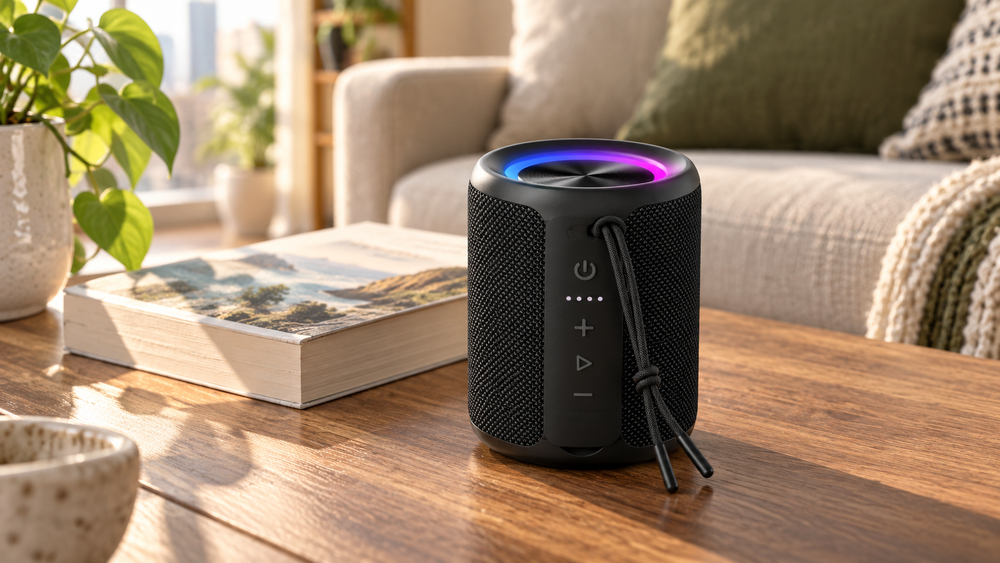
DUDGSIS X2 for desks and bedside use: compact size, Bluetooth pairing, optional lighting, battery conditions and charging considerations.
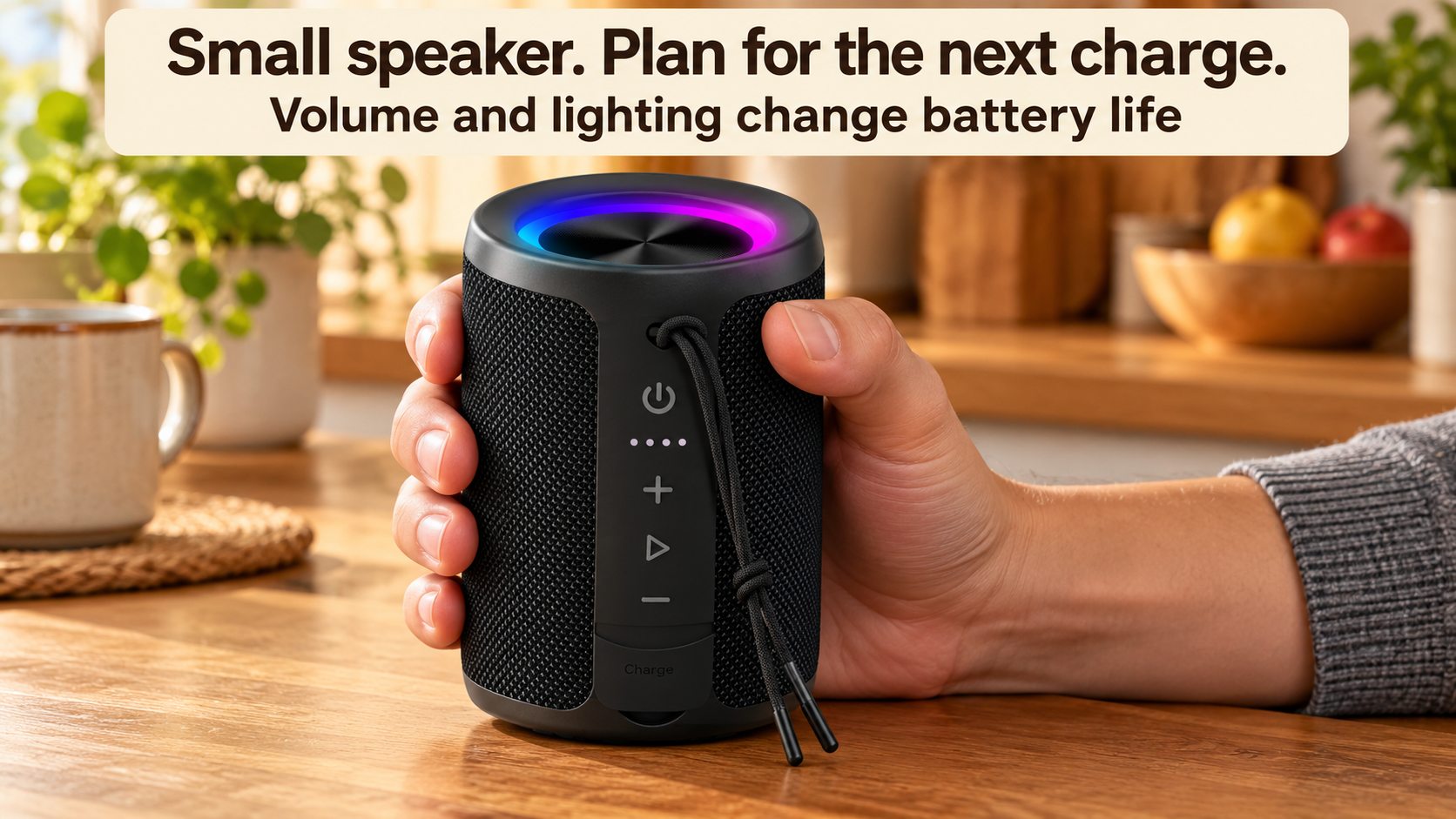
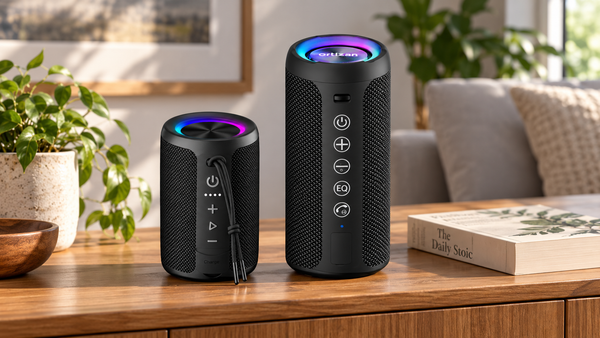
At a listed 7.6 × 7.6 × 10.8 cm, the DUDGSIS X2 is small enough to consider for a desk, bedside table or bag. Its coloured light ring is the most obvious extra. The more useful questions are how it sounds at your normal volume and how often you will need to charge it.
For desk and bedside use, the compact footprint and optional lighting are concrete attractions. Sound, controls and return terms still need to suit the way you listen.
Maximum runtime is not an all-settings guarantee
DUDGSIS X2 speaker
 Shop at Amazon.ca
Where this small speaker makes the most sense
The X2 is easiest to understand as a personal-space speaker: something you can move between a desk, a bedside table and another dry, stable spot at home. Its short body leaves more room around a keyboard or lamp than a taller portable unit. That footprint is a concrete benefit even before sound quality enters the decision.
For spoken audio, focus on whether voices remain easy to follow at a comfortable level. For background music, consider whether quiet playback is adjustable enough for the room. A speaker that only feels useful once turned up substantially may be a poor match for a shared office or late-evening listening.
Outdoor use asks more of a small speaker. Background noise and the absence of room reflections can change the experience, and a compact body should not be purchased on the assumption that it will cover a large gathering. Treat portability as its own advantage rather than a promise of room-sized sound everywhere.
If the light ring is a major attraction, consider where it will face. Lighting that feels cheerful on a desk may be distracting beside a bed or reflected in a screen. Confirm that you can select a comfortable mode or turn it off for the situations where sound is the only feature you want.
Placement is a free adjustment worth trying
Put the speaker on a stable surface with its sound-producing openings unobstructed. Avoid burying it behind books or placing loose objects against it. A shelf, desk and hollow bedside cabinet can each affect how the same speaker sounds in the room.
If a familiar voice sounds boomy or the furniture seems to buzz, try another permitted position before increasing volume or deciding the speaker is faulty. Keep the unit away from an edge where vibration or a tugged charging cable could make it fall.
Small changes in distance also matter for personal listening. A nearby speaker may let you use a lower setting than one across the room. That can be more considerate in a shared space and is a better starting point than treating loudness as the only measure of usefulness.
What “20 watts” leaves out
The seller describes 20 W peak output. That is not a measurement of continuous output, bass depth or how clearly the speaker handles a busy recording. It also cannot tell you whether voices will sound natural.
Think about where you will listen. Quiet background music at a desk asks something different from music outdoors, where room reflections are absent and surrounding noise competes with the speaker.
If you order it, try familiar music and spoken audio at the volume you actually use. Listen for words becoming harder to follow or the sound changing as you turn it up. There is no benefit in a loud setting you do not enjoy listening to.
A simple first-day listening check
Choose a few recordings you already know: a clear speaking voice, a song with a steady bass line and a busier track with several instruments. Use them at the levels you actually expect to listen. There is little value in judging only a brief maximum-volume demonstration.
Check whether speech remains intelligible when the volume is low and whether louder settings make the sound less enjoyable. Listen from your usual seat, then from elsewhere in the small area you want to cover. This is a practical acceptance check, not a claim that one song can measure the speaker's performance.
Test the controls without staring at them. Can you find the volume and playback functions easily? Does the light mode suit the room? Check the manual for button combinations so an accidental long press does not get mistaken for a connection fault.
Try the phone you will normally use, including reconnecting after switching the X2 off. A Bluetooth version number does not establish every aspect of real-world behaviour. Walls, nearby devices and the source phone can affect the connection, so your intended location matters more than a maximum-range claim.
The battery claim has conditions
DUDGSIS advertises up to 15 hours at 30% volume with the lights off. That is useful context, but it is not a promise of 15 hours with bright lighting and louder music.
For everyday use, check how the battery warning works and whether the supplied charging cable fits your available charger. Follow the charging instructions rather than assuming every USB power source is suitable.
The light ring can be part of the appeal or an annoyance beside a bed. Confirm the light controls and whether your preferred setting survives switching the speaker off and on.
Charging should fit the way you carry it
Think about a realistic charging routine before treating the advertised runtime as a whole-week solution. A speaker used quietly for an hour at a desk has a different pattern from one used loudly with lights during an outing. Leave a margin for the latter instead of planning to drain the battery exactly to the published maximum.
Check the charging input and required power supply in the instructions. An included USB cable does not necessarily mean a wall adapter is included. Make sure you have the appropriate source, and avoid stretching a cable across the listening area while the speaker sits near an edge.
Pack the unit so the controls are not continually pressed and the ports are protected from debris. Keep it away from excessive heat and follow the battery care instructions. Water resistance does not remove the need for dry charging connections or appropriate storage.
Features you should not assume
Bluetooth music playback does not establish a microphone for calls, an AUX input, memory-card support or a low-latency gaming mode. If one of those is central to the purchase, obtain a clear specification for the exact X2 version before ordering.
For watching video, check synchronisation with your source device and app during the return period. Do not infer a guaranteed lip-sync result from Bluetooth 5.3. Likewise, compatible-speaker pairing is a separate capability from connecting the speaker to a phone.
Buying two units also changes the practical setup. You need two charged batteries, suitable placement and the correct pairing procedure. Wider placement may be useful, but it is not automatically worthwhile for a single listener at a small desk. Start with the listening area you need to cover.
Pairing one speaker—and buying a second
The X2 lists Bluetooth 5.3 and TWS pairing. The latter is intended for pairing compatible speakers; it is not a promise that any two Bluetooth speakers will work together.
Before buying a second X2, confirm the compatible version and pairing procedure. Two speakers also mean two batteries to charge and two units to carry. If you only want music beside your keyboard, start by deciding whether one does the job.
Do not assume microphone, wired-input or memory-card features that are not clearly included in the selected offer. Bluetooth playback alone does not establish speakerphone support.
Questions to settle before checkout
Is this a good bedside speaker?
Its dimensions make it a plausible fit, but check quiet-volume control, indicator brightness, light settings and startup behaviour. Those everyday details can matter more at night than peak output. Do not assume alarm-clock or sleep-timer functions unless they are specifically supported.
Can it be the audio system for a party?
Consider the size of the gathering, background noise and required coverage. The small body and peak-power claim do not establish how it will perform across a large or open space. Buy for a realistic listening area and assess normal-volume sound before relying on it for an event.
Does IPX7 mean it is dustproof?
The X does not establish a dust-protection rating. Keep grit away from the ports and follow the model's care instructions. Do not turn a water-resistance claim into permission for sand, soap, wet charging or every type of outdoor exposure.
What would make it a poor purchase?
It is a poor fit if you need an unconfirmed input, require dependable all-day loud playback from the maximum runtime figure, or expect a very small speaker to cover a large gathering. Its clearer appeal is convenient Bluetooth audio in a compact package, with lighting that you can choose to use.
Water resistance is not a care routine
The advertised IPX7 rating concerns water protection under defined conditions. The X does not establish a dust rating. It is not a reason to leave the speaker in sand, expose it to soap or charge it wet.
Read the supplied instructions for ports, drying and permitted exposure. A dry shelf is still a better storage place than the edge of a sink.
The X2’s compact body and optional lighting are reasons to consider it for Bluetooth playback in a small space. Peak wattage does not describe tonal balance, so usable return terms matter. Assess speech and familiar music at normal listening levels before treating it as a keeper.
DUDGSIS X2 speaker
Shop at Amazon.caImages are AI-generated illustrations based on product references.
Sign up or sign in to join the conversation.