
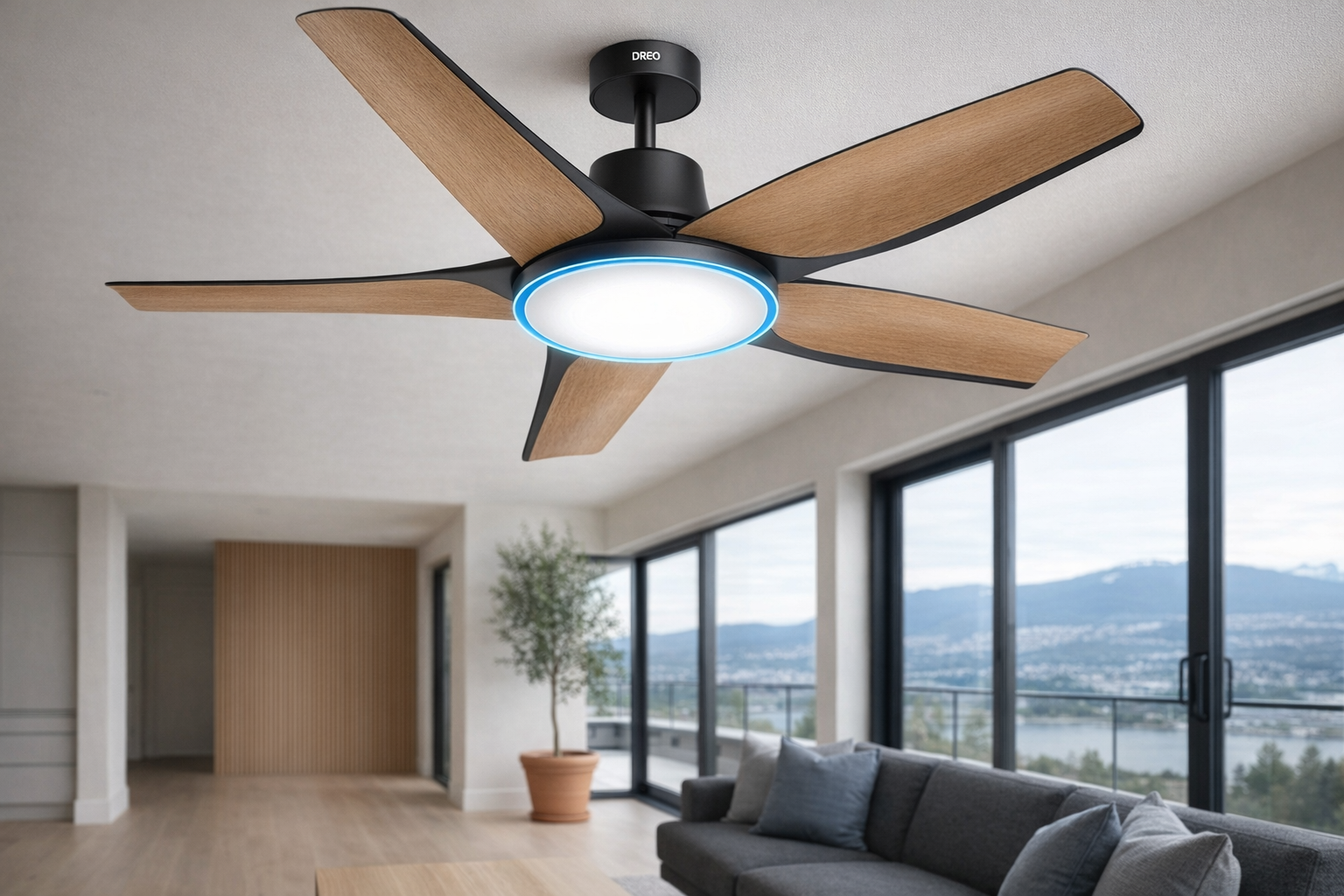
The Dreo Smart Ceiling Fan sits in a more interesting category than it first appears. Ceiling fans used to be one of the dullest purchases in a home: pick a blade colour, hope the wobble is manageable, and forget about it for 10 years. Smart models change that a bit. They combine airflow, lig...
The Dreo Smart Ceiling Fan sits in a more interesting category than it first appears. Ceiling fans used to be one of the dullest purchases in a home: pick a blade colour, hope the wobble is manageable, and forget about it for 10 years. Smart models change that a bit. They combine airflow, lighting, scheduling, app control, and sometimes voice assistant support into a single fixture. That sounds useful, but it also creates a familiar smart-home problem: some features genuinely improve daily life, while others mainly pad out the product page.
This article is not a hands-on review. Nothing here is based on personally installing or living with the fan. Instead, the goal is to explain what the Dreo Smart Ceiling Fan actually is, which kinds of features in this category tend to matter in real homes, and which ones are often just marketing polish. If you are trying to decide whether a roughly $276 CAD smart fan is a practical upgrade or just an expensive light fixture with an app, this is for you.
Quick snapshot
| Question | What the Dreo Smart Ceiling Fan actually is |
|---|---|
| Category | Climate & Comfort |
| Made by | DREO |
| Typical price | ~$276 CAD (listing at the time of writing — verify current pricing) |
| Rating signal | 4.6/5 on the source listing |
| Best for | Bedrooms, home offices, condos, and anyone replacing both a ceiling light and a fan at once |
| Skip if | You want the cheapest possible fan, dislike app-based setup, or already have a perfectly good dumb fan with a wall control |
Pro tip: If you're considering a smart ceiling fan, prioritize the boring stuff first: motor type, light quality, remote/app reliability, and scheduling. Fancy scene names and flashy app screenshots matter a lot less than whether the fan is quiet at 11 p.m.
What the Dreo Smart Ceiling Fan actually is
In plain English, the Dreo Smart Ceiling Fan appears to be a modern ceiling-mounted fan-and-light combo that adds app control and smart-home convenience to a category that has traditionally been very manual. The real appeal is not that it reinvents the fan. It is that it potentially combines several household jobs into one product: air circulation, overhead lighting, remote operation, and routines that can run without somebody remembering to pull a chain or reach for a wall switch.
That empty description block is a little telling in its own way. When the listing does not hand you a crisp, plain-language explanation, you have to read the category carefully instead of the marketing copy. In this category, the features that usually matter are straightforward: a DC motor if one is included, because that often means quieter and more efficient operation; proper dimmable lighting, because this fan will probably replace a main room light; and scheduling or automation, because that is the part that makes a "smart" fan genuinely feel different from a normal one. The features that often matter less are decorative app modes, novelty voice commands, or vague claims about "natural wind" patterns unless the implementation is actually useful.
A useful comparison here is the Hunter Aerodyne Smart Ceiling Fan, one of the better-known smart ceiling fan options. Hunter has longer brand recognition in the fan world, while Dreo is better known in the broader home-comfort space for air movers and purifiers. That makes the Dreo Smart Ceiling Fan interesting: it looks like a company bringing its climate-control sensibility into a permanent fixture category. Whether that is a better fit than a Hunter depends less on branding and more on basics like installation style, control options, and how well the smart features support everyday comfort rather than just looking modern on a listing page.
Key features at a glance
- Smart control through an app and likely voice-assistant integration, depending on current listing support
- Ceiling fan plus built-in light in one fixture
- Dimmable lighting as indicated by the listing title
- Modern replacement for a standard ceiling fixture rather than a separate fan and lamp setup
- Remote-style convenience without relying only on pull chains or a basic wall switch
- Scheduling potential, which is one of the most useful reasons to buy a smart fan in the first place
How the Dreo Smart Ceiling Fan actually works
At a practical level, a smart ceiling fan like this combines three systems into one ceiling-mounted device: the fan motor, the LED light assembly, and the wireless control layer. The fan portion circulates air, the light handles general room illumination, and the smart layer lets you adjust both without physically touching the fixture. That matters most in bedrooms, guest rooms, and home offices, where comfort changes throughout the day and where getting up to change fan speed is mildly annoying every single time.
The smart part is usually less magical than product pages imply. In most cases, you are still dealing with a ceiling fan that needs standard hardwired power and a compatible ceiling box, but the controls are expanded through a remote, an app, and possibly integrations with Alexa or Google Home if supported on the current listing. That means the useful routines are simple ones: fan on low at bedtime, light dimmed to a certain level in the evening, or the fan shutting off automatically overnight. Those are meaningful upgrades. "Talk to your ceiling fan from across the room" is more of a novelty unless mobility or accessibility makes voice control genuinely helpful.
A fan in this class also lives or dies by motor behaviour. If the Dreo Smart Ceiling Fan uses a DC motor, that is one of the features that actually deserves attention. DC motors in ceiling fans are commonly associated with lower power draw, quieter operation, and finer speed control than older AC-style fan setups. That is not exciting copy, but it is the difference between a fan that fades into the background and one that becomes an annoying part of the room. Quiet airflow is worth more than flashy automation.
There is also the lighting side. Because this fixture replaces a ceiling light, the dimmable LED part is not a side perk; it is half the product. A fan light that is too harsh, too dim, or awkward to control will be noticeable every day. Smart dimming and brightness presets are more valuable than cosmetic app themes. Evaluate it like a room fixture first and a smart gadget second.
A realistic "day in the life" with Dreo Smart Ceiling Fan
Because this is an informational explainer, here is what a typical day might look like based on the product category and the listed smart-lighting angle — not a tested account.
- Morning. The bedroom light comes on gradually or at a preset brightness, and the fan stays off because the room is still cool. This is where a combined fan/light fixture is more useful than a regular dumb fan: you are managing comfort and lighting from one control point.
- Midday. In a home office or condo living room, the fan runs at a low or medium speed to keep air moving without blasting the room. This is one of the best use cases for a quiet, controllable ceiling fan — not dramatic cooling, just making a room feel less stale.
- Afternoon. Sun exposure warms the room, so the fan speed gets bumped up through the app or remote without walking over to a wall control. That is the kind of smart feature that actually matters: quick adjustment in response to changing conditions.
- Evening. The light dims for a calmer room, and the fan is scheduled to turn off later at night. Schedules are not glamorous, but they are one of the most practical reasons to pay for a smart model instead of a basic fixture.
Who the Dreo Smart Ceiling Fan is actually for (and who it isn't)
Great fits
- People replacing an old bedroom light fixture and wanting airflow without adding a floor fan.
- Condo owners who want one ceiling-mounted product to handle both lighting and comfort in a compact room.
- Home-office workers who want quieter air circulation overhead instead of a desk fan pointed at their face all day.
- Households already using Alexa or Google Home routines and wanting the ceiling fixture to join those routines.
- Anyone who regularly forgets to turn fans off and would benefit from schedules or timers.
Poor fits
- Renters who cannot replace hardwired fixtures or do not want to deal with installation limits.
- Shoppers looking for the absolute cheapest airflow per dollar; a simple pedestal fan will still win on price.
- Homes with existing high-quality ceiling fans controlled by solid wall switches, where the upgrade benefit may be small.
- People who dislike apps, account setup, or any dependence on wireless control for basic household hardware.
- Anyone expecting a ceiling fan to replace air conditioning during a hot Ontario or B.C. heat wave. It helps with comfort, not actual cooling in the HVAC sense.
Practical trade-offs
Install and compatibility
This is the first real filter. A smart ceiling fan is still a ceiling fan, which means it is not a casual tabletop gadget. You need compatible wiring, enough ceiling clearance, and a room where a fan actually makes sense. If your current setup is just a flush-mount light, replacing it may be straightforward — or it may reveal box, bracket, or switch issues that turn a $275.61 purchase into a bigger install project. That is normal for this category.
It is also worth thinking about control logic before buying. Some smart fixtures want constant wall power so the app and wireless controls stay available. If someone in the house keeps turning the wall switch off, the "smart" part can become annoying fast. That is a more common real-world problem than most listings admit.
Noise and airflow reality
Ceiling fan marketing often blurs the line between comfort and cooling. A fan does not lower the room's actual temperature the way an air conditioner does. What it does is improve perceived comfort by moving air over people and helping reduce stuffiness. That can make a room feel meaningfully better, but it is not magic.
This is why the quality of the motor and speed control matters more than grand claims. A quiet fan with usable low-speed settings is often better than an aggressive fan that only feels effective at louder settings. In bedrooms especially, the difference between "pleasant background airflow" and "constant humming reminder above your head" is everything. That is one reason DC-motor claims, if confirmed on the current listing, are more worth your attention than decorative feature names.
Smart features and long-term value
The useful smart features in a ceiling fan are pretty narrow: timers, schedules, dimming presets, remote access, and possibly voice commands. Those are practical. Beyond that, a lot of app language becomes fluff. If the fan can reliably turn on, dim properly, and run at the speed you want when you want it, it is doing the job.
The long-term question is support. Any connected fixture depends on firmware, app maintenance, and ecosystem compatibility over time. That does not mean smart fans are a bad idea. It just means you should buy one because the core hardware and control options make sense even if the app experience changes later. A smart ceiling fan should still be a decent ceiling fan when the novelty wears off.
Where the Dreo Smart Ceiling Fan fits in a smart home
The Dreo Smart Ceiling Fan fits best as part of a room-comfort setup, not as the centrepiece of a smart home. In a bedroom, it pairs naturally with a smart thermostat, blackout blinds, and a bedside lamp on a schedule. In a living room, it makes sense alongside smart shades and a separate air purifier. In a home office, it works well with a desk lamp, a small humidifier in winter, and a temperature sensor routine.
That matters because ceiling fans solve a narrow but real problem: making occupied rooms feel more comfortable without running bigger equipment all the time. A fan like this can complement an Ecobee Smart Thermostat Premium, a Google Home routine, or Amazon Alexa voice control, but it should not be viewed as a substitute for proper heating or cooling. Think of it as a comfort-layer product. It reduces stuffiness, improves air movement, and combines lighting with automation in a way that can genuinely make a room nicer to live in.
It is also one of the more sensible smart upgrades for condos and smaller homes. Unlike a robot vacuum or a countertop appliance, a ceiling fan does not occupy floor or shelf space. If you need both overhead light and better airflow, combining them into one permanent fixture is a cleaner solution than adding yet another plug-in device.
The buying decision, in plain terms
Before buying the Dreo Smart Ceiling Fan, three yes-or-no questions usually clarify the answer:
- Are you replacing both a ceiling light and a fan problem at the same time? If yes, a combined smart fixture is much easier to justify than if you are only chasing novelty.
- Will you actually use schedules, dimming, or remote control? If yes, the smart features may earn their keep. If not, a simpler fan could do the job for less.
- Are you comfortable with fixture installation and app-dependent setup? If no, the convenience may not feel very convenient once wiring and setup are involved.
If those answers mostly land on yes, the Dreo Smart Ceiling Fan looks like a reasonable modern upgrade; if not, a conventional ceiling fan or even a good standalone fan may be the smarter buy.
Got Questions About the Dreo Smart Ceiling Fan? Let's Clear Things Up.
Is this a hands-on review?
No. This is an informational explainer based on the listing details, the product category, and what the listed features imply in normal home use. It is meant to help you think clearly about the purchase, not to stand in for a physical test or installation report.
What actually matters most in a smart ceiling fan like this?
Usually four things: motor type, noise, lighting quality, and control reliability. If a fan is quiet, dimmable, easy to adjust, and fits your room properly, it is already doing most of what matters. Extra app polish is secondary.
Does a smart ceiling fan replace air conditioning?
No. It improves comfort by moving air, which can make a room feel cooler to the people in it, but it does not lower room temperature the way AC does. In a Canadian summer, that can still be useful, especially in bedrooms and condo units that get stuffy.
Is a DC motor actually important, or just marketing?
If the current listing confirms a DC motor, that is one of the more meaningful features in the category. DC motors are commonly associated with quieter operation, better efficiency, and finer speed control. That is a more honest value point than vague lifestyle claims.
Where can I verify the current listing details or buy it?
The most direct place to confirm current pricing, compatibility notes, and listing details is the retailer page here: Dreo Smart Ceiling Fan on Amazon. That is also where you should check whether the listed smart platform support, dimensions, and included controls have changed.
What does it cost in Canada?
At the time of writing, the listing price is roughly ~$276 CAD. Imported smart-home pricing can move around more than people expect, so it is worth verifying the live price before buying, especially if shipping, exchange rates, or seller changes are involved.
Is this better for a bedroom or a living room?
For most buyers, a bedroom or home office is the most compelling fit because quiet airflow and dimmable light matter more there. In a large living room, it can still make sense, but room size and ceiling height become more important. A smaller, quieter room often lets the benefits show up more clearly.
Where is the Celmin Directory listing for this product?
For a catalog-style view of the same product — structured specs, pros and cons, similar picks, and FAQ — see Dreo Smart Ceiling Fan on Celmin Directory.
If you're building a smarter home in Canada and want honest explainers on gadgets worth considering — plus the ones worth skipping — Celmin covers the full catalog without the marketing theater. More reviews, comparisons, and buyer guides at https://celmin.ca.
Sign up or sign in to join the conversation.