
Cheap TV audio is one of those annoyances people put up with for far too long. Modern TVs keep getting thinner, which is great for wall-mounting and less great for sound. The result is usually the same: dialogue that disappears into background music, action scenes that get loud without sounding f...
Cheap TV audio is one of those annoyances people put up with for far too long. Modern TVs keep getting thinner, which is great for wall-mounting and less great for sound. The result is usually the same: dialogue that disappears into background music, action scenes that get loud without sounding full, and a general sense that your screen is doing more than the speakers can keep up with. The Assistrust Sound Bar for Smart TV 2-in-1 Detachable sits squarely in the budget-fix category — a low-cost soundbar that promises clearer, louder, more flexible sound without pushing you into full surround-sound money.
This is not a hands-on review. Nothing here is based on personally using the soundbar. Instead, this is a plain-English explainer built from the listed features, pricing, and the broader realities of budget soundbars. The goal is simple: explain what this model actually offers, where the detachable design matters, and whether a roughly $69 CAD soundbar is a smart upgrade or just another box under the TV.
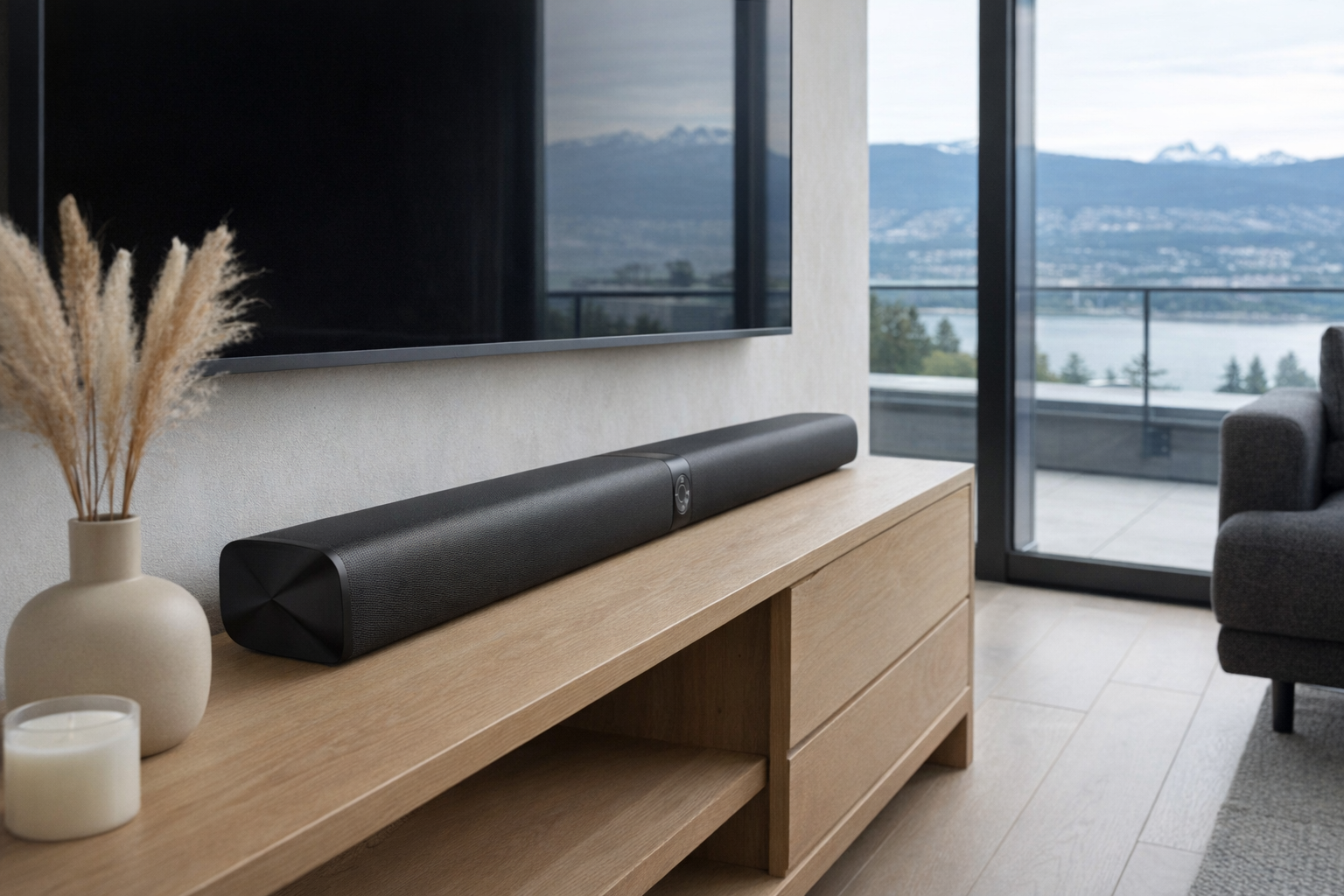
📺 Watch: Assistrust Sound Bar for Smart TV 2-in-1 Detachable in context
Quick snapshot
| Question | What the Assistrust Sound Bar for Smart TV 2-in-1 Detachable actually is |
|---|---|
| Category | Electronics |
| Made by | Assistrust |
| Typical price | ~$69 CAD (listing at the time of writing — verify current pricing) |
| Rating signal | 4.2/5 on the source listing |
| Best for | People frustrated with weak TV speakers, bedroom TV setups, renters, and budget-focused shoppers |
| Skip if | You want deep sub-bass, true surround sound, HDMI eARC extras, or a premium brand ecosystem |
Pro tip: If you buy this for speech clarity, start with News mode and use ARC if your TV supports it. On budget soundbars, connection choice often matters almost as much as the speaker itself.
What the Assistrust Sound Bar for Smart TV 2-in-1 Detachable actually is
The Assistrust Sound Bar for Smart TV 2-in-1 Detachable is a compact, low-cost TV speaker designed to solve the most common audio complaint in modern living rooms: thin, unclear sound from flat-panel TVs. Its main pitch is not luxury audio. It is convenience and improvement. You get 80W of claimed output, 4 high-performance drivers, a few useful connection options, and a detachable body that can work either as one horizontal bar or as split vertical speakers depending on your setup.
80W 2-in-1 detachable soundbar with Bluetooth 5.0, ARC, Optical, and AUX connectivity. Features auto volume boost, 3 EQ modes (movie, music, news), and 4 high-performance drivers for immersive stereo sound.
In plain terms, this is a “make the TV sound better without overthinking it” product. The detachable design is the unusual part. Most budget soundbars are one fixed bar that sits under the TV and stays there. This one is meant to give you placement options: keep it joined for a standard soundbar look, or separate the halves if your furniture or wall space makes that more practical. That puts it in a more flexible category than something like the Roku Streambar, which bundles streaming features into a more locked-in single-box design. The Assistrust model appears simpler and cheaper, which is good if all you want is better sound and not another streaming platform.
Key features at a glance
- 80W claimed output with 4 high-performance drivers
- 2-in-1 detachable design for horizontal or split placement
- Bluetooth 5.0, ARC, Optical, and AUX connectivity
- 3 EQ modes: movie, music, and news
- Auto volume boost for quieter sounds and dialogue moments
- 18-month warranty with 24/7 support
How the Assistrust Sound Bar for Smart TV 2-in-1 Detachable actually works
At a basic level, this soundbar does what every TV audio upgrade should do: it moves sound from tiny, downward- or rear-firing TV speakers into a larger speaker enclosure with more room for actual drivers. The listing says there are 4 drivers inside, which suggests the bar is trying to produce more stereo spread and more usable midrange than your TV can manage on its own. That does not automatically mean cinematic sound, but it should mean more presence and clearer voices than the average thin TV panel.
The connection options matter more than the wattage number. ARC is usually the easiest route for a TV setup because it lets the television send audio back through HDMI and often allows volume control with the TV remote. Optical is the reliable fallback if ARC is not available or behaves badly. AUX is the old-school wired option for older TVs, PCs, or even some projectors. Bluetooth 5.0 is there for casual music streaming from a phone or tablet, which makes the unit a bit more useful than a TV-only speaker.
The detachable design likely works by allowing the central body to split into two speaker sections. In joined mode, you get the standard soundbar footprint under a TV. In separated mode, the speakers can sit on either side of the screen for a different stereo presentation or simply to fit awkward furniture. That is genuinely practical in small condos, bedrooms, or dorm-like setups where one long bar may not fit cleanly. It is also a more honest kind of feature than a lot of budget-audio marketing; placement flexibility is something people actually notice.
Then there are the processing features. The listed 3 EQ modes — movie, music, and news — are preset sound profiles. News mode is likely tuned to bring dialogue forward. Movie mode probably pushes a broader, more dramatic balance. Music mode usually aims for a flatter or fuller sound for songs. The auto volume boost feature is especially interesting on a cheap soundbar because it targets a real problem: whispered dialogue and inconsistent volume between scenes. If it works well, it can make late-night viewing less annoying. If it is too aggressive, it can flatten dynamics. That is the trade-off with any speech-enhancement style processing.
A realistic "day in the life" with Assistrust Sound Bar for Smart TV 2-in-1 Detachable
Based on the listed features and how products like this usually fit into daily use, here is what ownership likely looks like.
- Morning. You turn on a bedroom or kitchen TV for news, and instead of riding the volume every few minutes, you switch to News mode. Voices should come through more clearly than they do on the TV’s built-in speakers, which is exactly the kind of boring improvement that makes a soundbar worth keeping.
- Midday. A phone connects over Bluetooth 5.0 for music or a podcast while you clean, work, or move around the room. This will not replace a serious speaker system, but it gives the bar a second job beyond television duty.
- Afternoon. You rearrange the media console or shift the TV to a tighter room. The 2-in-1 detachable design becomes the selling point: instead of struggling to fit one long bar, you split the speaker sections to suit the furniture layout.
- Evening. Movie time exposes the reason most people start shopping for one of these in the first place. You connect through ARC or Optical, switch to Movie mode, and get a wider, louder presentation than thin TV speakers can usually produce. The improvement may not be theater-grade, but what the listed features imply is a much more listenable setup.
Who the Assistrust Sound Bar for Smart TV 2-in-1 Detachable is actually for (and who it isn't)
Great fits
- People with a budget TV in a bedroom whose biggest complaint is muffled dialogue.
- Renters who want a simple audio upgrade without wiring rear speakers around the room.
- Parents or older viewers who are tired of turning the volume up for speech and back down for everything else.
- Students or condo dwellers who need one speaker system to handle both TV and occasional Bluetooth audio.
- Shoppers replacing TV sound on a secondary screen, not building a full home-theatre system.
Poor fits
- Anyone expecting chest-thumping bass from a bar with no dedicated subwoofer listed.
- Buyers who want Dolby Atmos, advanced app control, voice assistants, or premium HDMI features.
- Home-theatre hobbyists comparing this to established midrange bars from Samsung, Sonos, or JBL.
- People who want one-cable simplicity but have a TV with unreliable ARC and no patience for setup menus.
- Shoppers who mainly want a music-first speaker rather than a TV-first audio fix.
Practical trade-offs
Bass and overall sound expectations
This is the big one. An 80W number on a budget soundbar can sound impressive on a product page, but watt figures alone do not tell you how full, clean, or room-filling the audio will actually be. There is no separate subwoofer listed, and that matters. Expect clearer and bigger sound than the TV, not the kind of low-end weight you get from a bar-and-sub package.
That is not a flaw so much as a category limit. Evaluate this like a practical TV upgrade, not like a compact home cinema. If your main pain point is hearing dialogue and getting more body in everyday viewing, this makes sense. If your pain point is explosions that do not shake the couch, this is the wrong tool.
Setup and connection realities
The good news is that the inputs are sensible: ARC, Optical, AUX, and Bluetooth 5.0 cover most normal households. The less good news is that budget soundbars still depend heavily on your TV behaving properly. ARC is convenient when it works well; when it does not, troubleshooting can involve TV audio settings, HDMI-CEC quirks, and the occasional “why is there no sound” loop.
That does not mean this bar is unusually difficult. It means soundbars are often sold as plug-and-play when they are really plug-and-possibly-adjust-settings. Optical is often the calmer backup. It gives up some convenience, but it is usually stable.
Placement, durability, and long-term support
The detachable design is useful, but it also introduces one more physical variable compared with a fixed bar. If you plan to separate the speakers, think about cable routing, furniture spacing, and whether the setup will still look tidy. In small spaces, this could be a genuine advantage. In others, it may turn into extra clutter.
The 18-month warranty is a nice practical detail at this price, and 24/7 support sounds reassuring on paper. Still, budget audio brands live and die by retailer support, replacement responsiveness, and whether parts or help remain available later. That is why products in this range are best treated as value buys, not heirloom electronics.
Where the Assistrust Sound Bar for Smart TV 2-in-1 Detachable fits in a smart home
This soundbar is best understood as the audio cleanup layer for a modest TV setup, not as the centre of a larger ecosystem. It pairs naturally with a Fire TV, Roku TV, Google TV, Apple TV 4K, or a basic smart television where the picture is fine but the speakers are weak. In that kind of system, the soundbar’s job is simple: make speech easier to hear and movies less flat.
It also makes sense in rooms that are not your main theatre space. A basement workout TV, condo bedroom setup, guest room screen, or cottage TV can all benefit from a cheap, uncomplicated soundbar more than they benefit from a premium audio system. The detachable format is especially relevant if your media console is narrow or your TV sits on furniture with legs or decor blocking a traditional bar.
What it does not appear to be is an ecosystem product. There is no listed tie-in to Sonos multi-room audio, Alexa voice control, or HDMI eARC-heavy premium setups. That is perfectly fine. In fact, for many people it is a relief. Keep your streaming box handling apps, keep your smart plugs handling automation, and let this bar do one job well enough: improve TV sound for not much money.
The buying decision, in plain terms
Three questions usually make this decision clearer.
- Is your real problem weak TV audio rather than a desire for home-theatre bass? If yes, this is pointed in the right direction. If you want room-rattling sound, skip straight to a bar with a dedicated subwoofer.
- Will the detachable layout genuinely help your room? If your stand is tight, your TV sits awkwardly, or you like the idea of splitting the speakers, this feature is more than marketing. If the bar will just sit under the TV as one piece forever, it is a smaller advantage.
- Are you comfortable buying a budget audio product from a lesser-known brand? At ~$69 CAD, the appeal is obvious. But part of that low price is accepting fewer brand assurances than you get from Bose, Sony, Samsung, or Sonos.
If your goal is simply to make a TV easier and nicer to listen to without spending much, this looks like a sensible budget pick. If you are chasing premium sound, keep shopping.
Got Questions About the Assistrust Sound Bar for Smart TV 2-in-1 Detachable? Let's Clear Things Up.
Is this a hands-on review?
No. This is an informational explainer based on the product listing, stated features, and what those features typically mean in the budget soundbar category. It is meant to help you decide whether this model deserves a closer look.
Does the detachable design actually matter?
For some rooms, yes. A split design can be useful if your TV stand is narrow, your screen sits on furniture that blocks a normal bar, or you simply want more flexible speaker placement. If your setup is straightforward and you plan to keep it as one bar, it is still fine — just less distinctive.
Can it connect to older TVs as well as newer ones?
According to the listing, yes. ARC, Optical, and AUX cover most TV generations, while Bluetooth 5.0 adds wireless playback from phones and tablets. For the smoothest TV control, ARC is usually best, but Optical is a very common fallback.
Is the auto volume boost the same as true dialogue enhancement?
Not exactly, at least not by name. The listing describes auto volume boost for faint sounds, which suggests a form of loudness balancing or speech-forward processing. In real use, that usually helps with quiet voices and uneven scene volume, but it is not the same as a guaranteed premium dialogue-processing system.
Is this better than just using the TV speakers?
What the listed features imply is yes, especially for entry-level and midrange TVs with weak built-in speakers. A separate bar with 4 drivers and 80W claimed output should produce fuller, more direct sound than the tiny speakers inside most flat TVs. The real question is not whether it beats the TV — it is whether it beats the TV enough for your expectations.
Where can you verify the listing or buy it?
The most direct place to verify the current price, warranty details, and connection claims is the retailer listing. You can check it here: Amazon product page. That is also where you should confirm availability, since budget electronics listings can change quickly.
What does it cost in Canada?
At the time of writing, the listed price is ~$69 CAD. That is low enough to treat this as an affordable upgrade for a secondary TV or a frustration-fixer for a main screen. As always, verify the current price before buying because marketplace listings move around.
Where is the Celmin Directory listing for this product?
For a catalog-style view of the same product — structured specs, pros and cons, similar picks, and FAQ — see Assistrust Sound Bar for Smart TV 2-in-1 Detachable on Celmin Directory.
If you're building a smarter home in Canada and want honest explainers on gadgets worth considering — plus the ones worth skipping — Celmin covers the full catalog without the marketing theater. More reviews, comparisons, and buyer guides at https://celmin.ca.
Discussion
Sign up or sign in to join the conversation.