
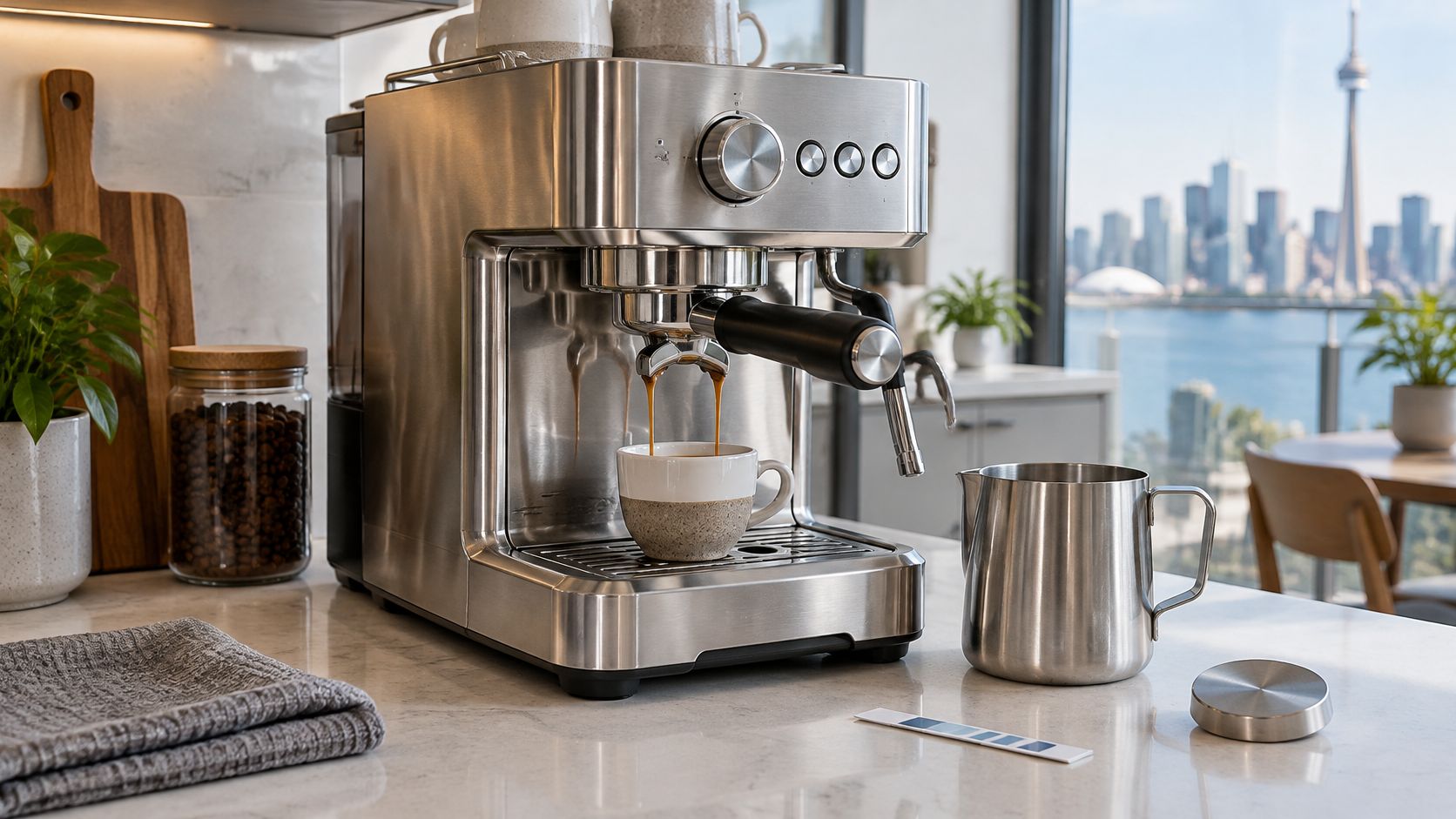
The usual advice is to buy a stainless-steel espresso maker because it's durable, easy to clean and better at holding heat. That puts the finish ahead of the engineering. A stainless exterior tells you surprisingly little about the parts that heat your water, control brewing temperature or keep the appliance electrically safe.
For a Canadian condo, the better starting points are your tap water, the machine's certification and the space you'll need to operate it. When you compare an espresso maker, stainless steel should be a useful construction detail, not the reason you overlook awkward cleaning, an undocumented water path or an overseas model with no Canadian service support.
Table of Contents
- What Stainless Steel Means on an Espresso Maker
- Heat Retention and a Simple Cleaning Rhythm
- Canadian Water Hardness and Descaling
- Counter Space and Certified Power in Canada
- CAD Prices and Where to Buy in 2026
- Features and the Buying Decision
What Stainless Steel Means on an Espresso Maker
The door skin isn't the brew path. Think of the shell as clothing and the internal plumbing as the body. A brushed-metal front can surround an aluminium heater, plastic tubing, brass valves and rubber seals without telling you anything about their quality.
A listing might describe a stainless finish, stainless panels, a stainless boiler or stainless water-contact components. Those are different claims. Before comparing appearances, ask the seller which components the description covers.
Even genuine stainless panels aren't interchangeable. Austenitic stainless generally offers stronger corrosion resistance than lower-cost ferritic sheet, but finish, fabrication and cleaning also matter. Polished steel can show fingerprints clearly, while a brushed finish can disguise some marks and retain grime along its grain.
Espresso maker body materials compared
This comparison separates exterior materials from heater construction. They can coexist in the same appliance, so don't treat the rows as mutually exclusive machine categories.
| Build | Heat behaviour | Corrosion and wear | Cleaning | Main compromise |
|---|---|---|---|---|
| Austenitic stainless panels | Substantial panels store some heat, but don't establish brew stability | Good corrosion resistance with appropriate care; still scratches | Soft cloth, mild cleaner, wipe with the grain | Higher-quality cladding doesn't prove higher-quality internals |
| Ferritic stainless wrap | Thin sheet contributes little useful thermal storage | Can develop surface staining around wet seams | Remove deposits gently and dry thoroughly | Lower-cost metal finish needs careful seam care |
| Lined aluminium boiler | Conducts heat readily and keeps weight down | Surface treatment must remain compatible with water and cleaner | Use the specified descaler and procedure | Internal surface quality matters more than the case |
| ABS or other plastic | Insulates the hand rather than acting as useful thermal mass | Can retain oily film, scratch or crack | Hand-wash removable parts when permitted | Light construction can feel less steady |
| Chrome-look plastic | Little useful stored heat | Coating can chip and expose the moulding underneath | Soft cloth; don't scrub the coating | Metallic appearance without a solid-metal surface |
Don't assume every aluminium boiler is lined, either. Ask how its internal surface is treated and which cleaning products the manufacturer permits.
Ask about the parts your water touches
A useful manufacturer response names the boiler or heater, tubing, group, valves and fittings, not just the removable basket. Ask for water-contact material specifications, any brass-alloy declaration and applicable migration or leaching test documentation.
Canadian consumer-product restrictions are material-specific. For example, the Glazed Ceramics and Glassware Regulations concern glazed ceramic and glass products, not blanket approval of an espresso machine's hidden metal components. A general statement about compliance therefore needs a clearly identified standard and scope.
Nickel sensitivity is a legitimate reason to request more documentation. It isn't evidence that every stainless machine is unsafe, and a shiny exterior can't establish someone's exposure. If you have a diagnosed sensitivity, take the manufacturer's material information to your clinician rather than relying on a marketplace claim.
The same distinction matters when choosing an electric kettle without plastic: inspect the water-contact construction, not merely the visible body.
In-store check: A magnet can help distinguish some panel materials, but it can't certify an alloy. Attraction doesn't prove poor quality, and neither result tells you what the boiler or valves contain.
Heat Retention and a Simple Cleaning Rhythm
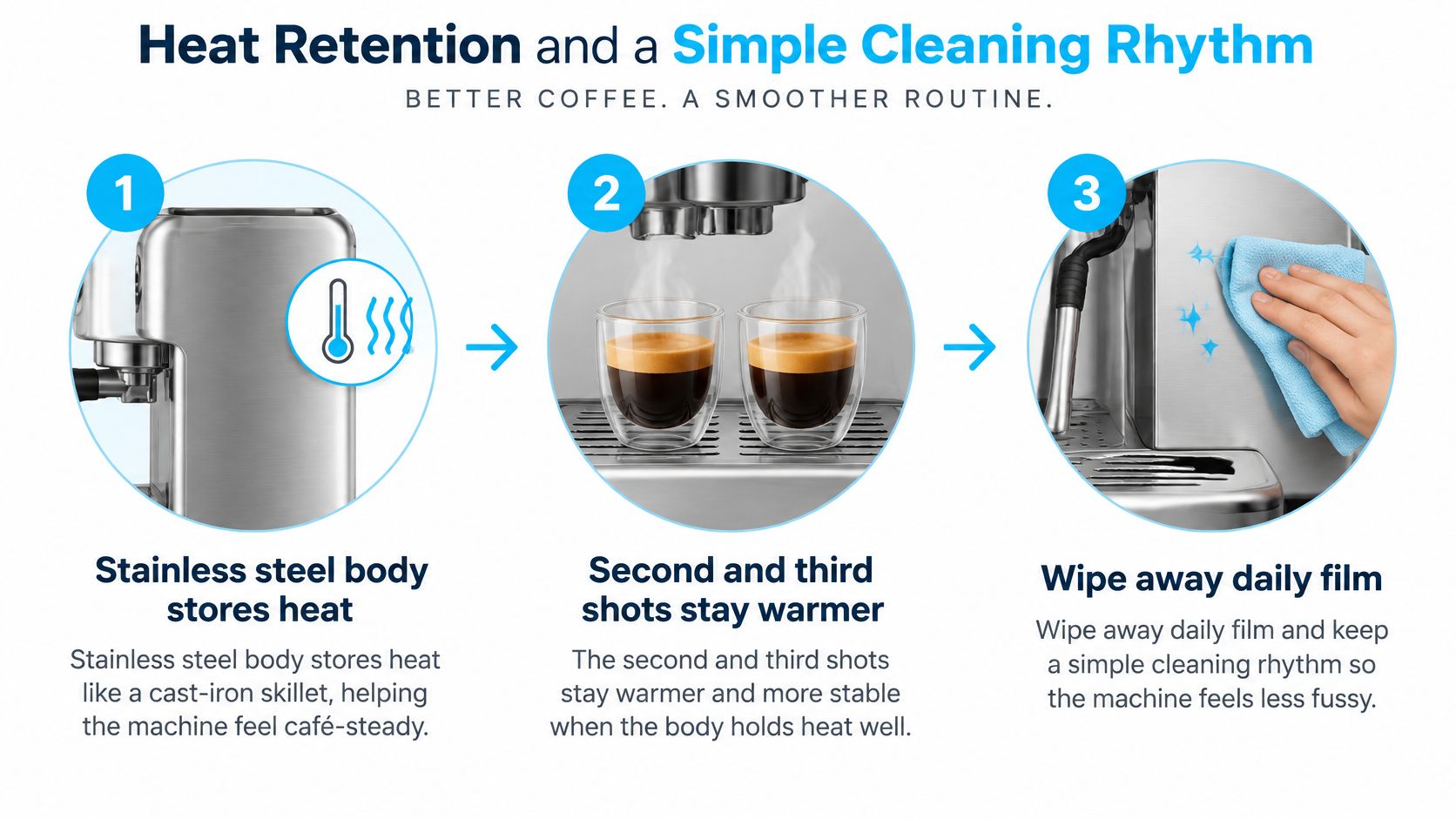
A heavy boiler or group behaves a little like a cast-iron skillet: once warmed, its thermal mass can resist sudden temperature changes. A stainless outer shell is different. Unless it's meaningfully connected to the brewing assembly, its warmth tells you little about the temperature reaching the coffee.
That distinction matters on a cold morning. A ready light may indicate that the heater is prepared while the portafilter and cup remain cool, so follow the machine's preheating instructions rather than touching the case to judge readiness.
The illustration below pairs thermal-mass concepts with everyday care. Apply the heat-retention idea to the heated brewing components, not automatically to the exterior panels.
Match the heating system to your routine
A boiler stores heated water; a thermoblock heats water through a heated passage. Either design requires appropriate temperature control, and neither guarantees good espresso because the housing is metal.
For weekday use, check the complete cold-start routine, including cup warming and preparation for steaming. For back-to-back drinks, look at recovery and the transition between brewing and milk, not just the advertised initial heat-up.
Cleaning has a similar distinction: coffee-oil removal isn't descaling. Detergent tackles brewing residue, while descaler addresses mineral deposits. Substituting one for the other leaves the original problem unresolved and may damage components.
Build a repeatable care habit
- Clear the brewing area after use. Remove the puck, rinse the basket and flush the group if the manual directs it. Loose grounds are easier to remove before they dry onto the gasket.
- Wipe and purge the steam wand promptly. Use a dedicated damp cloth, keeping your fingers away from the hot tip. Milk residue becomes harder to remove once it dries.
- Empty the drip tray before leaving the kitchen. Wash away coffee sludge and dry accessible seams. A tray full of rinse water shouldn't become permanent storage.
- Inspect removable brewing parts regularly. Soak compatible baskets and screens in the specified espresso detergent when oily residue develops. Keep handles, coatings and seals out unless their instructions allow immersion.
- Protect the finish. Skip steel wool, bleach and abrasive cream. Use a soft cloth and wipe brushed steel with its grain.
- Backflush only approved machines. A supplied blank basket and an explicit procedure are useful checks. Don't improvise a blocked-flow cleaning cycle.
Never put a panel or tray in the dishwasher merely because it looks metallic. Before buying, find the manual's instructions for a removable tray, accessible shower screen and stated descaling procedure. If routine care requires awkward dismantling, the machine may be a poor fit for a busy kitchen.
Canadian Water Hardness and Descaling
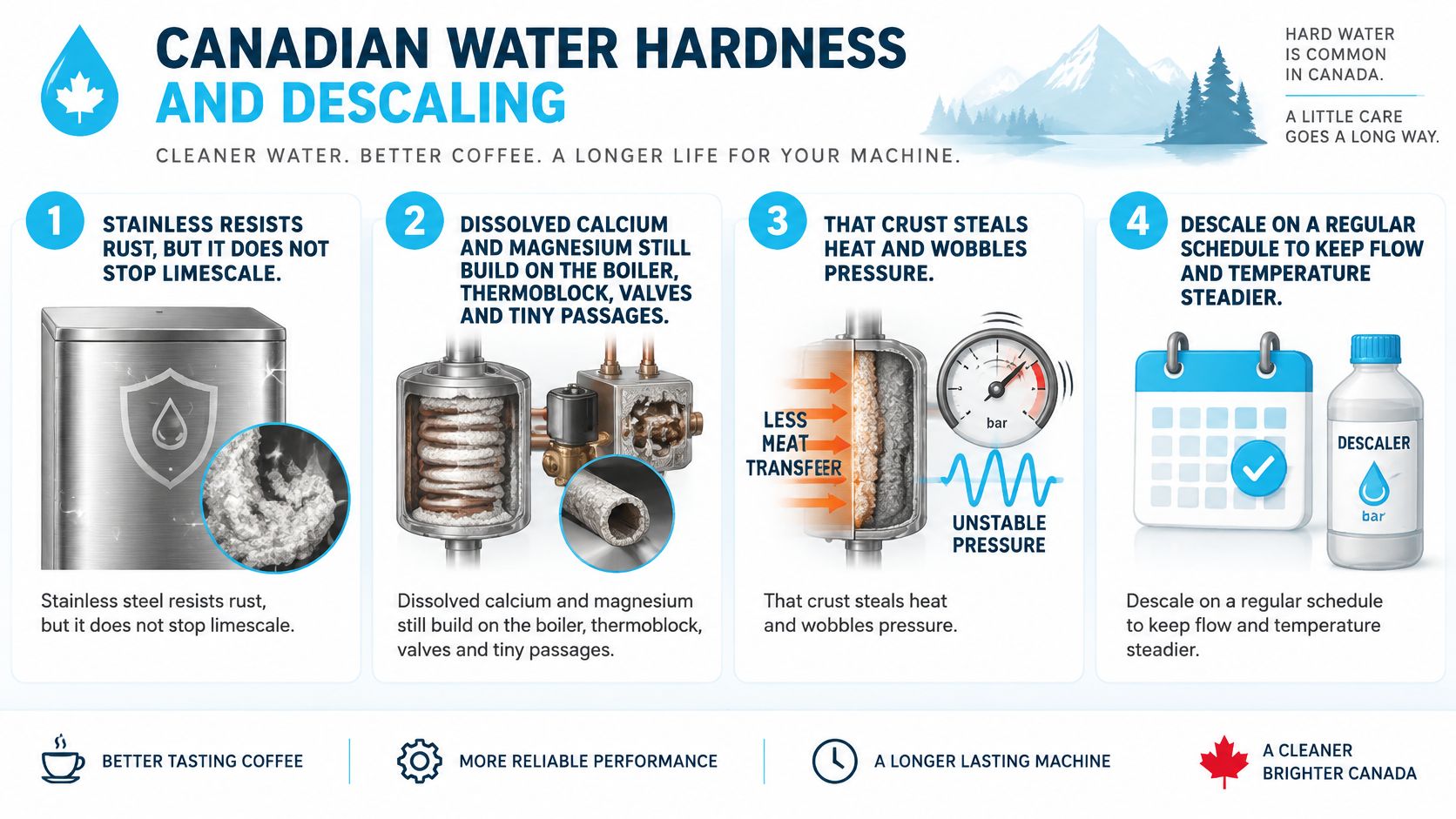
Stainless resists corrosion. It doesn't stop limescale. Dissolved calcium and magnesium can form deposits inside the heater, valves and narrow water passages, regardless of the exterior finish. Those deposits can restrict flow and interfere with heat transfer.
Health Canada's drinking-water operational guidance describes hardness above 200 mg/L as poor for domestic use and identifies 80–100 mg/L as calcium carbonate as a practical balance between corrosion and incrustation. Its Canadian context also places about half of municipalities below 80 mg/L, notes that levels above 180 mg/L occur more frequently in the Prairie provinces and Ontario, and reports Ontario groundwater as high as 1,300 mg/L.
Those figures describe water conditions, not universal espresso-machine settings. Use the manufacturer's water specification to decide whether your supply is suitable.
Canadian hardness bands and what to do
The bands below overlap because they describe different reference points, not a complete classification system. All hardness figures are expressed as calcium carbonate.
| Hardness | Where it shows up | What to do |
|---|---|---|
| Under 80 mg/L | About half of Canadian municipalities | Expect less scale than with harder water; retain the maker's maintenance schedule and monitor taste |
| 80–100 mg/L | Health Canada's practical balance | Use the standard maintenance setting if it matches the appliance's specification |
| Above 180 mg/L | More frequently in the Prairies and Ontario | Select the maker's hard-water setting and an approved hardness-treatment cartridge |
| Above 200 mg/L | Described as poor for domestic use | Check treatment needs before filling the tank; use water meeting the appliance's specification |
| Up to 1,300 mg/L | Reported Ontario groundwater | Arrange suitable treatment or an approved alternative supply |
| Sodium-softened tap | Ion-exchange systems | Confirm appliance compatibility; retain an unsoftened drinking and culinary supply |
The distinction between a rust-resistant surface and mineral deposits is worth keeping visible near your maintenance supplies.
Check the kitchen tap before choosing a filter
- Read the municipal report. Look for hardness and confirm whether the published figure covers your supply zone. Well water needs its own assessment.
- Test at the tap. Use a hardness strip according to its instructions, especially if your building has treatment equipment.
- Choose treatment for the actual problem. A taste-and-odour carbon filter doesn't necessarily reduce hardness. Bottled water isn't automatically suitable either; check its mineral information.
- Set maintenance from the manual. Enter the measured hardness where the machine offers that setting, and record cartridge changes and descaling.
Very soft water isn't a free pass. Hardness, alkalinity, chloride and total dissolved solids describe different properties, so a low hardness reading alone doesn't establish compatibility.
For renters, a tank-compatible cartridge or separately prepared water can be more practical than altering the plumbing. Don't automatically fill from a sodium-softened tap: ion exchange can increase sodium, and the appliance maker may impose additional restrictions.
Counter Space and Certified Power in Canada
A shiny case doesn't validate grounding, insulation or overheating protection. Electrical certification is a purchase gate, particularly for an appliance that combines electricity, hot water, steam and conductive surfaces.
Health Canada's electrical-product guidance says products connected to an outlet should carry a certification mark from an accredited body, with CSA, cUL and cETL among its examples. Check the mark on the actual machine, not only in a seller's description.
Check the model before measuring the nook
Ask for a readable photograph of the rating label when buying online. Match its model designation to the listing and confirm that the certification applies to the Canadian-market version you'll receive.
A plug adapter changes the connection shape; it doesn't establish electrical compatibility or Canadian certification. Reject an unmarked import rather than trying to solve uncertainty with an accessory, especially when a seller advertises broad voltage compatibility without documentation.
Also check how the manufacturer expects the machine to connect. Use the specified grounded connection and avoid routing the cord across the sink, behind a hot surface or through a pinching cupboard door.
Buy the documented Canadian model, not an overseas lookalike that happens to accept a local plug.
A powerful heater sharing a circuit with another heating appliance can overload that circuit. Don't assume separate receptacles mean separate circuits, and don't keep resetting a breaker without addressing the load or having a fault investigated.
Measure the working space, not just the footprint
Use painter's tape to outline the machine on the counter, then rehearse making a drink. Leave the ventilation clearances stated in the manual rather than choosing an arbitrary gap.
Check these operating movements before committing:
- Reservoir removal. Can you lift the tank clear beneath the cupboard, or will you have to drag the appliance forward?
- Portafilter movement. Allow space to insert and rotate the handle without hitting a wall.
- Milk preparation. Swing the wand through its working position and leave room for the pitcher.
- Tray access. Make sure you can remove a full drip tray without tilting it across the counter.
- Bean access. Open the hopper lid and consider how you'll pour beans without spilling them behind the machine.
A refillable tank is generally the simpler choice where plumbing changes need landlord or condo approval. A compact machine can still be awkward if its service access is at the rear.
Compare operating layouts in this compact coffee maker guide, then finish with physical checks: the chassis mark, the specified Canadian connection and a taped outline that leaves useful preparation space.
CAD Prices and Where to Buy in 2026
Best Buy Canada listed the Breville Barista Express stainless-steel espresso maker at CAD 749.98 in 2026. Treat that listing as a price benchmark for a grinder-included semi-automatic, not a guaranteed checkout price or a ceiling for the category.
Popularity offers a different signal. An Amazon.ca listing showed the stainless-steel Ninja Luxe Café Premier with more than 400 purchases in the previous month in 2026, but that doesn't establish reliability, owner satisfaction or suitability for your counter.
Canadian buying lanes for stainless espresso makers
Only the Breville price above is established here. Other prices remain unverified, and the shopping channels below are places to investigate rather than promises of stock.
| Lane | Retailer signal | Best fit |
|---|---|---|
| Breville Barista Express stainless | Best Buy Canada listing; price benchmark stated above | Semi-automatic workflow with a built-in grinder |
| Ninja Luxe Café Premier stainless | Amazon.ca purchase activity stated above; CAD price unverified | All-in-one café drinks at home |
| Manual lever, Europiccola class | Check specialty importers; CAD price unverified | Enthusiast willing to manage a hands-on routine |
| Capsule machine in a stainless finish | Check brand boutiques and big-box retailers; CAD price unverified | Fast preparation in a condo |
| Dedicated travel espresso maker | Check Amazon.ca and outfitters; CAD price unverified | Packing and travel rather than permanent counter duty |
The useful distinction is workflow. A semi-automatic asks you to manage grinding, dosing and preparation; an assisted all-in-one may guide some of that work. A manual lever adds direct involvement in extraction, while a capsule system exchanges flexibility for simpler preparation.
A travel maker solves another problem entirely. Its capacity, cleaning access and power arrangement need to suit where you'll use it, not merely look like a smaller domestic machine.
Compare the whole purchase
Open the exact model's product page and manual together. Confirm what's included before comparing totals: a grinder, milk pitcher, water-treatment cartridge, detergent and compatible accessories can change what you need to buy.
Then examine the seller, not just the retailer's logo. A marketplace offer may come from a third party with different return arrangements and warranty handling. Ask who pays return shipping, whether opening and using the machine affects eligibility, and where warranty repairs take place.
Best Buy, Amazon.ca, London Drugs, Canadian Tire and a local coffee-equipment specialist are reasonable places to check for Canadian-market options. Don't assume each carries every lane, and ask a local roaster whether it sells equipment or can direct you to a repairable option.
A lower sticker price isn't a saving if you can't obtain the correct seal, basket or replacement tank. Before paying, locate the support contact and ask how ordinary replacement parts are ordered. A clear answer is more useful than a vague promise of premium construction.
Features and the Buying Decision
Rank features by the interruptions they remove from your actual morning. In a small condo, easy tank access and a manageable cleaning routine can matter more than another drink preset or a larger sheet of brushed steel.
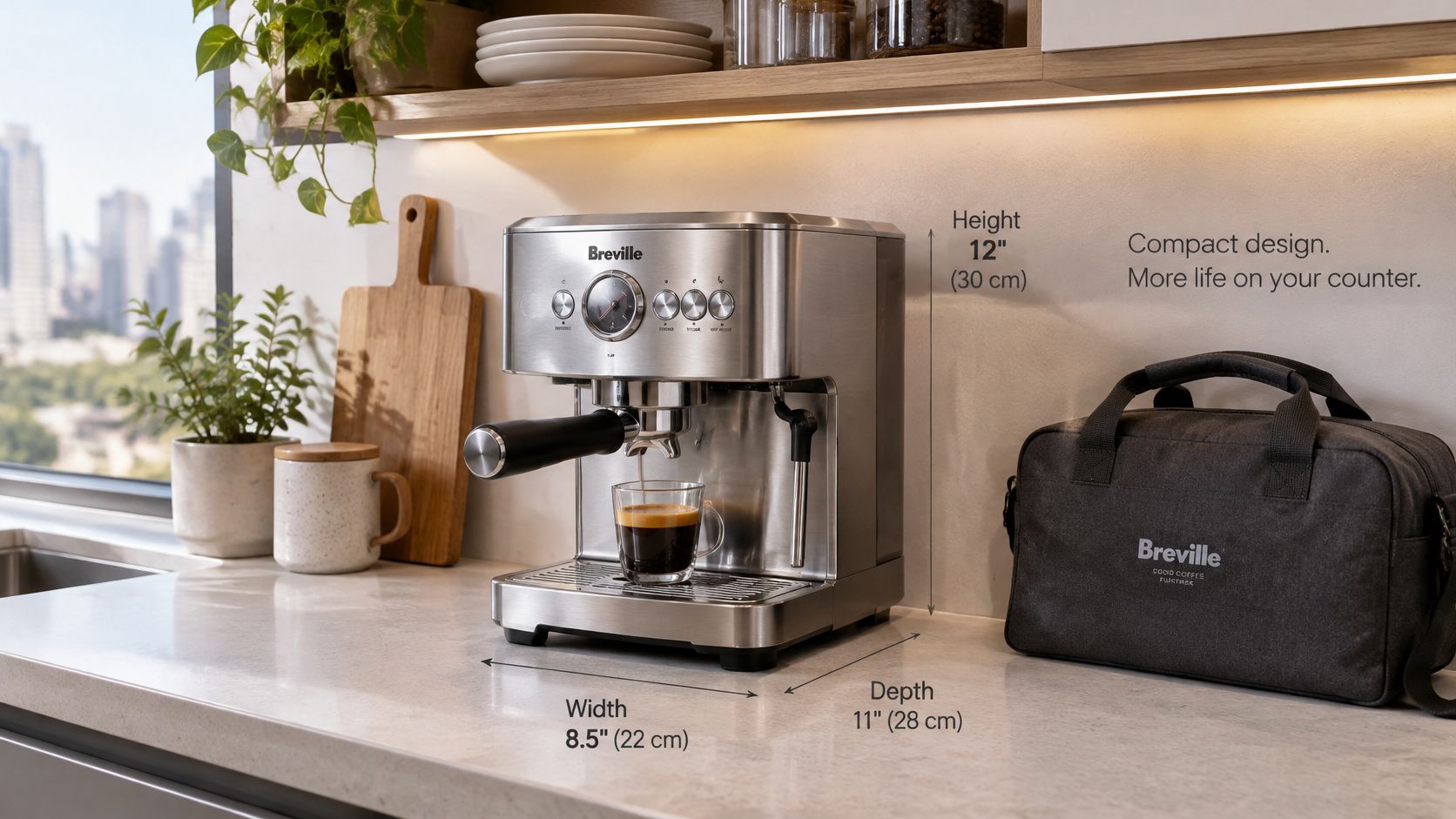
The counter setup below illustrates the distinction between a domestic appliance and something you might carry. A bag beside a machine doesn't make its size, weight or power requirements suitable for travel.
Choose for the drink you make most
For straight espresso, prioritise repeatable preparation, useful grind adjustment and temperature control. A large maximum-pressure badge doesn't tell you how the machine controls pressure while brewing. A gauge helps only when you know what it measures and how the manual says to interpret it.
For milk drinks, rehearse the whole sequence: grind, brew, steam, wipe and reset. A manual wand gives you control and a visible cleaning surface, but you must learn the technique. Automatic milk systems can simplify preparation while adding removable parts, internal passages or dedicated cleaning cycles.
For Americanos, check that the exact Canadian model provides the hot-water function you expect. Don't infer features from a similarly named overseas version, and include any separate kettle in your space and electrical planning.
Tank capacity should cover preparation, rinsing and purging, not just the liquid in your cup. Rather than choosing by the largest reservoir, check whether you can comfortably remove, wash and refill it. Water left sitting in an oversized tank isn't a convenience.
Treat noise and service as everyday features
A combined grinder saves the need to position a separate appliance, but it also couples your grinder choice to the machine. Separate components offer more freedom to upgrade or repair independently, at the cost of additional counter and storage space.
Listen to demonstrations with care. Grinding, pumping and steaming make different sounds, and a quiet-looking video isn't a measured noise test. If your kitchen borders a bedroom, ask whether you can hear the machine operating at a retailer or specialist showroom.
Use the demonstration below to observe preparation movements and handling. Confirm the model-specific operating and safety instructions in the manual before copying a technique.
Travel deserves a separate shortlist. Distinguish a hand-powered brewer that needs externally heated water from an electric model with a heater, charger or mains connection. Check every powered component's compatibility, and consider how you'll empty and dry the brewer before packing it.
A portable electric espresso maker guide can help separate those arrangements. Choose a cup and carry system you'll pack rather than assuming a compact countertop machine belongs in a suitcase.
Make the final shortlist pass or fail
Use these purchase checks rather than awarding points for appearance:
- Construction disclosure. The manufacturer identifies what stainless steel covers and answers reasonable water-path questions.
- Documented electrical suitability. The exact unit has the appropriate Canadian certification and connection.
- Water compatibility. You have a workable supply and maintenance plan, including obtainable treatment consumables.
- Usable dimensions. The machine fits with its tank, hopper, wand and tray in their operating positions.
- Canadian support. You know the warranty contact, return conditions and route to replacement parts.
- Acceptable daily work. You're willing to perform the actual preparation and cleaning routine.
Shortlist rule: Choose the appliance you can operate, maintain and obtain service for. Let the finish break a tie, not decide the purchase.
If a seller can't resolve a failed check, wait. A machine that suits your water, kitchen and maintenance habits is a more useful purchase than an undocumented stainless lookalike.
Celmin offers Canadian appliance reviews and practical buying guides that compare counter-space demands, maintenance and CAD buying context. Visit Celmin to cross-check compact coffee and portable espresso options, then take your measurements and water report to the retailer before ordering.
Sign up or sign in to join the conversation.