
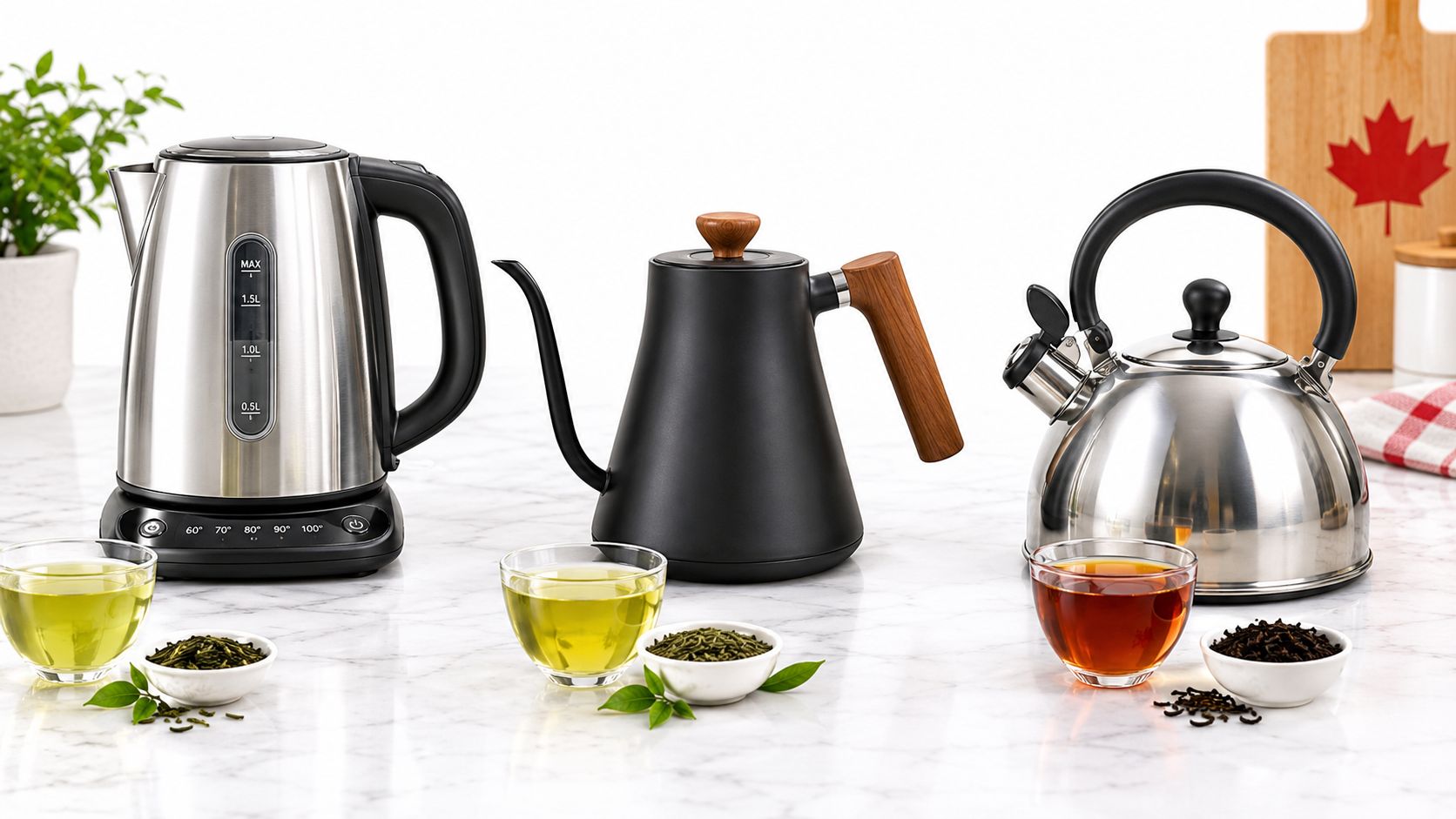
Canada had enough tea available in 2022 to provide approximately 95 litres per person, just over a cup a day, marking the fourth consecutive annual increase, according to Statistics Canada's tea availability report. That makes a kettle a daily appliance, not an occasional gadget. The best kettle for tea should suit your leaves, fit your counter and remain straightforward to clean, with Canadian electrical certification and clear water-contact material disclosures treated as purchase requirements.
Table of Contents
- Quick-Pick Kettles for Tea in Canada
- How Water Temperature Changes Your Cup
- Boil Speed and Capacity Fit for Your Kitchen
- Certification and Boil-Water Readiness Before You Buy
- Materials and Water-Contact Parts to Check
- How to Descale a Tea Kettle Without Damaging It
- Choose Your Kettle by Tea Routine and Household
Quick-Pick Kettles for Tea in Canada
Start with the kettle type, not the brand. A narrow spout, a digital display and a large chamber solve different problems, and paying for all of them doesn't necessarily improve your morning tea.
These are category recommendations, not a ranking based on personal long-term testing. Model-specific boil results appear below; current prices, certification and construction details still need checking against the exact unit you're buying.
| Kettle type | Best fit | Main trade-off | CAD price |
|---|---|---|---|
| Variable-temperature electric kettle | A household brewing different tea styles | More controls to learn, but useful when a full boil isn't always wanted | Unconfirmed |
| Variable-temperature gooseneck | Someone who values deliberate pouring for tea and pour-over coffee | The projecting spout takes counter space and may feel unnecessary for filling a teapot | Unconfirmed |
| Boil-only electric kettle | A black-tea or herbal-infusion routine | Simple operation, without a lower-temperature setting | Unconfirmed |
| Compact electric kettle | A solo drinker or crowded condo counter | Less spare capacity, and compact size doesn't guarantee temperature control | Unconfirmed |
| Stainless stovetop kettle | A cottage or household with a suitable non-electric heat source | No built-in temperature selection, and outage usefulness depends on the available stove | Unconfirmed |
Choose the compromise you can live with
For a mixed tea cupboard, I'd shortlist a conventional variable-temperature kettle before a gooseneck. Pouring precision is worth paying for when you use it, but it shouldn't displace easy filling, readable controls or comfortable handling.
A compact kettle makes sense when it can stay on the counter without obstructing food preparation. Don't assume a smaller chamber means a smaller overall footprint: the handle, base and spout count too.
Practical rule: Buy for the tea you actually prepare, not the brewing routine you hope a new appliance will create.
Check Amazon.ca and local retailers for current CAD prices on the day you buy. Compare the exact model, seller, warranty and included base rather than matching a product photograph.
Narrow the field to a couple of candidates, then compare temperature options, measured speed, minimum fill, certification, materials and cleaning access. A shortlist that fails any hard purchase requirement isn't ready for a price comparison.
How Water Temperature Changes Your Cup
A mixed household rarely shares a single brewing preference. Historical Canadian market research cited in a Statistics Canada study put black and flavoured black tea at 57% of tea consumed, compared with 25% for green and flavoured green tea; those are historical findings, not a current market-share estimate (Statistics Canada's study of beverage consumption).
The practical distinction is straightforward: green and white teas generally benefit from lower heat, while black tea and herbal infusions typically use near-boiling water. Exact brewing instructions should come from the tea producer, rather than a universal temperature chart.
| Tea type | Water temperature | Kettle setting | Why it matters |
|---|---|---|---|
| Green tea | Lower than boiling, following the packet | An appropriate lower-temperature preset | Avoid treating a delicate tea as a full-boil default |
| White tea | Lower than boiling, following the packet | A lower-temperature preset matched to the tea | Gives you control over a delicate brew |
| Oolong | Follow the particular tea's instructions | The closest available setting | Don't assume every oolong needs the same treatment |
| Black tea | Generally near boiling | Full-boil setting when directed | A boil-only kettle can suit this routine |
| Herbal tea such as rooibos | Generally near boiling, following the packet | Full-boil setting when directed | Check the infusion's preparation instructions |
Presets need to match your cupboard
The useful questions aren't how impressive the display looks or how many tea names appear beside the buttons. Ask:
- Lowest selectable setting: Does it reach the temperature your usual green or white tea calls for?
- Preset spacing: Can you select a suitable setting without making a substantial compromise?
- Temperature hold: Does the kettle maintain your chosen temperature, or does the water start cooling immediately after heating?
- Control clarity: Can another person in the household select the right programme without consulting the manual?
A hold function is useful if you return for another infusion. It's less compelling if you heat water, pour immediately and unplug the kettle.
Temperature selection also doesn't answer questions about the water going into the appliance. If filtration is part of your routine, weigh its ongoing cost separately using this pitcher-filter economics guide. A kettle and a filter address different buying decisions.
For a black-tea-only household, a dependable boil-only kettle remains a sensible choice. Variable temperature earns its place when you regularly use lower settings, not because the feature sounds more refined.
Boil Speed and Capacity Fit for Your Kitchen
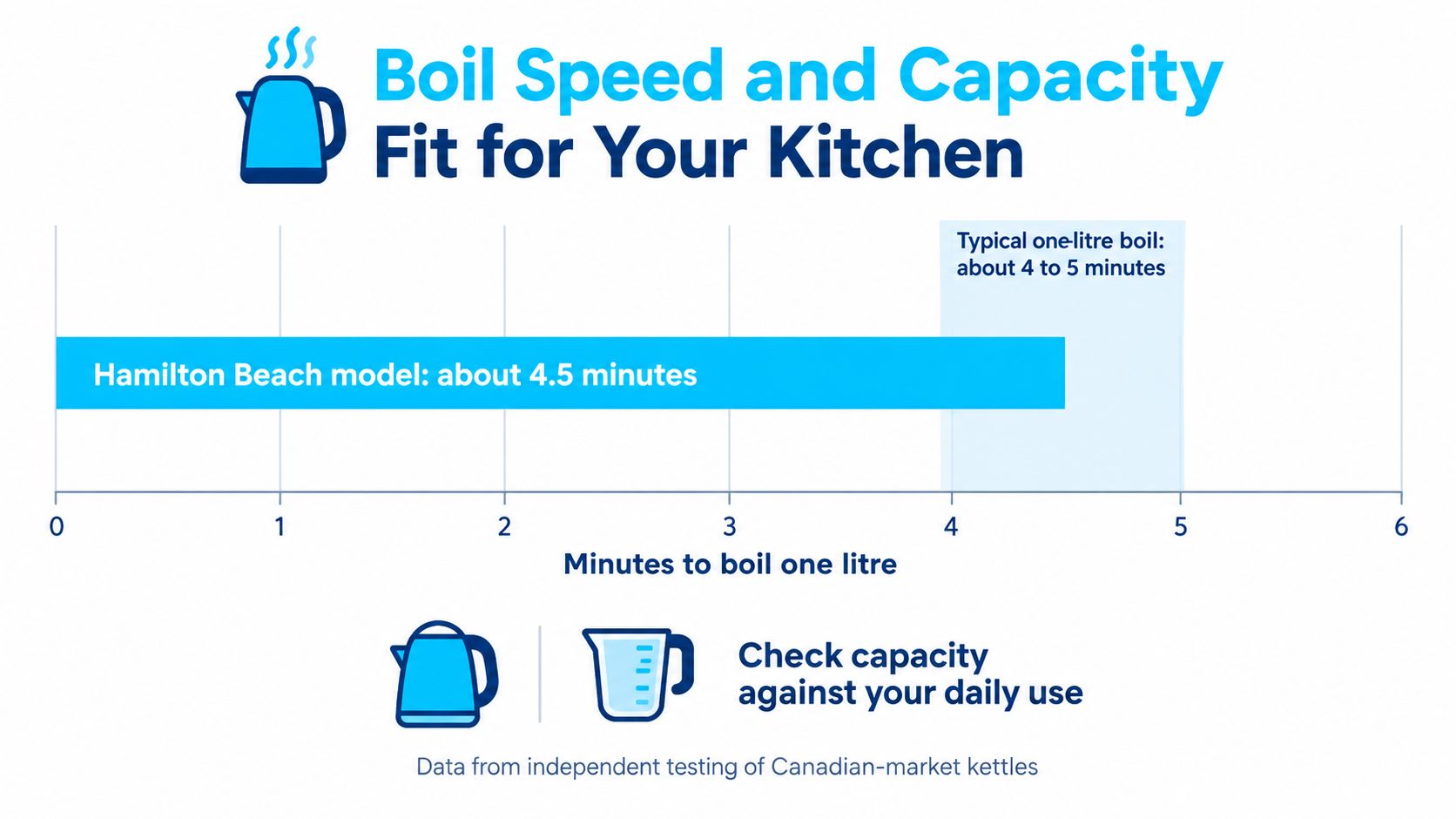
A litre of water takes roughly four to five minutes to boil in the comparison of Canadian-market kettles. The comparison reports about 4.5 minutes for a Hamilton Beach kettle and slightly over four minutes for an OXO gooseneck (Reviewed's Canadian electric-kettle comparison). It does not establish that the same test quantity was used for each named kettle, or provide the Hamilton Beach model identity. Treat these times as reported comparisons, not a controlled, model-by-model test.
| Kettle | Reported boil time | What the comparison establishes |
|---|---|---|
| Hamilton Beach kettle | About 4.5 minutes | The model identity and test quantity for this result are not specified |
| OXO gooseneck | Slightly over 4 minutes | The test quantity for this result is not specified |
The comparison also discusses 1.7-litre Ninja and Cuisinart models with seven presets, spanning roughly 70°C to 100°C. Those details can help identify the range of capacity and temperature controls available, but they do not show how quickly those models boil a litre. Nor do the reported times establish a universal winner or support ranking every kettle currently sold in Canada.
Compare reported boil times, not advertised wattage alone. A result for an unidentified Hamilton Beach kettle should not be treated as a promise about every model from that brand.
Capacity should match the ordinary fill
Choose a capacity suited to the amount of water you usually need for your teapot or mugs, with extra room for guests if that matters. A large maximum capacity helps only if the kettle can also safely heat your usual smaller amount.
Check the minimum-fill line as well as the maximum. If your normal drink needs less water than the manufacturer's stated minimum, that kettle may not suit your routine. Clear markings make it easier to fill accurately; look for a scale you can read at the sink, rather than one hidden behind the handle or visible only with the lid open.
Measure the whole appliance
On a shallow counter, a gooseneck's projecting spout can affect where the kettle fits and how easily you can pour. Check that there is room to lift, fill and pour without catching the spout on a cabinet edge.
- Base footprint: Measure the counter space the kettle uses when parked.
- Working height: Check clearance for lifting the kettle and opening its lid.
- Cord routing: Make sure the cord reaches an outlet without crossing a preparation area.
- Storage: Decide whether the kettle will stay on the counter or be put away after use.
Apply the same measuring approach when choosing kitchen appliances for small spaces. Measure the usable counter area, not just the open space shown in a product photograph.
Before choosing a model, check counter depth and cabinet clearance with the handle and spout included.
Certification and Boil-Water Readiness Before You Buy
The most precise kettle isn't automatically the most useful one. A lower-temperature programme can suit tea preparation while doing nothing to establish emergency water-treatment capability.
Canadian electrical certification comes first. Health Canada advises buying plug-in electrical products bearing a mark such as CSA, cUL or cETL, indicating assessment against applicable Canadian safety standards, and advises unplugging heat-producing appliances such as kettles when they're not in use (Health Canada's electrical-product safety guidance).
Use this checklist when checking a retailer listing and again when the product arrives.
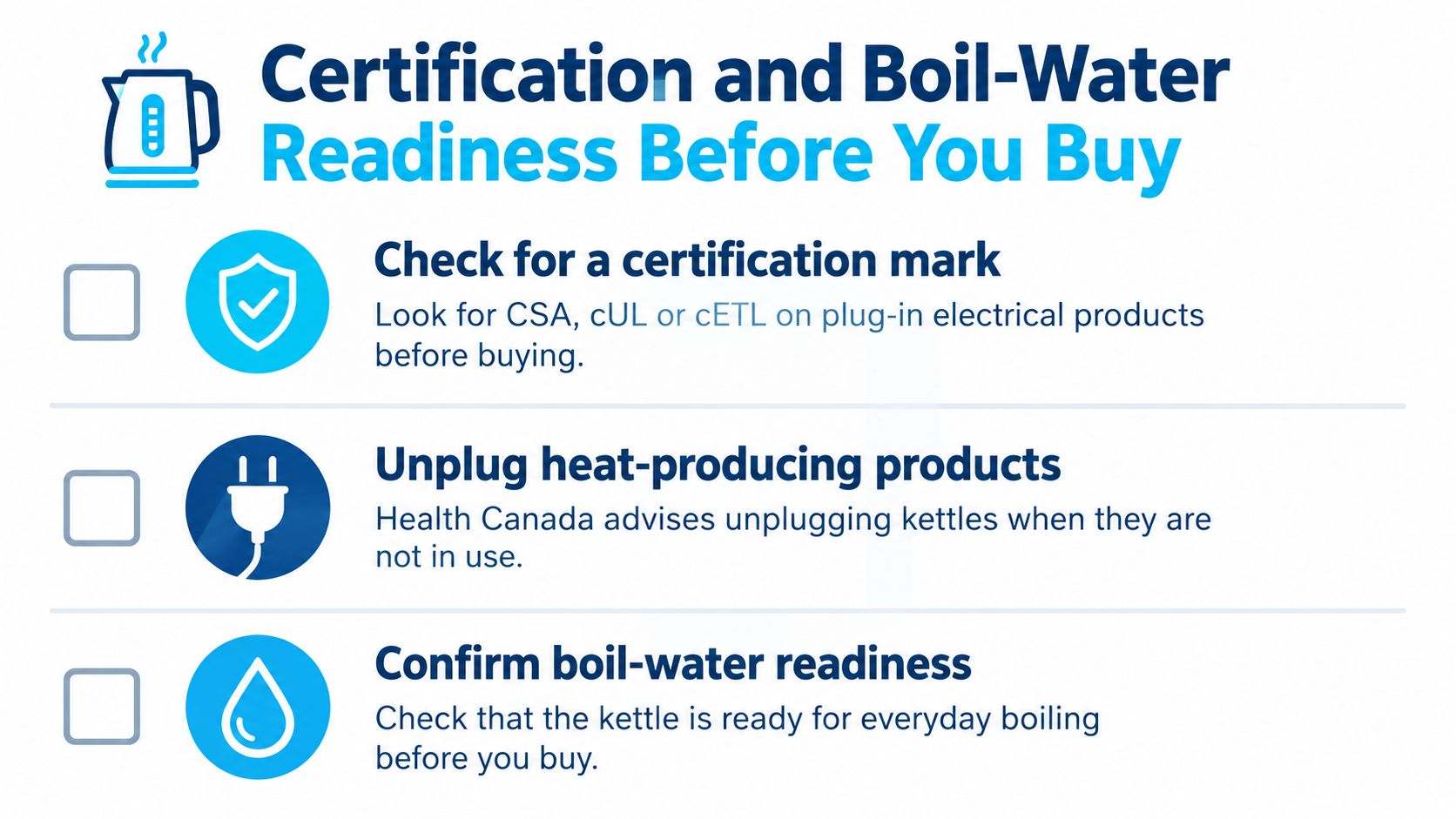
- Physical certification mark: Check the kettle or packaging, not just a marketplace photograph.
- Exact Canadian variant: Match the model identifier, plug and documentation to the unit being shipped.
- Protective functions: Confirm automatic shut-off and boil-dry protection in the manual.
- Secure handling: Inspect the lid closure and handle before using hot water.
A full-boil button isn't an advisory guarantee
During a boil-water advisory, Health Canada says water for hot beverages must reach a rolling boil maintained for one minute; boiling inactivates disease-causing microorganisms but doesn't remove chemical or radiological contaminants (Health Canada's boil-water advisory guidance).
That distinction matters with automatic kettles. Reaching a boil and immediately switching off isn't the same as maintaining the required boil.
Emergency limit: Never hold down a switch or defeat automatic shut-off to make a kettle meet an advisory requirement.
If the appliance can't perform the prescribed process safely, use a suitable alternative and follow local public-health instructions. Don't assume repeated short heating cycles are equivalent.
During ordinary use, observe whether the kettle reaches a visible rolling boil, whether it shuts off before doing so, and whether its permitted minimum fill fits your needs. Keep your face and hands away from escaping steam; never open a hot lid to inspect the water.
Plan for cooling and covered storage using the advisory's instructions. A stovetop kettle can provide another option during an outage only if you have a suitable, safely usable heat source that still works; an electric hob won't provide that backup.
Materials and Water-Contact Parts to Check
Which parts touch the hot water? That's the question a stainless-steel exterior photograph can't answer.
Health Canada states that food-contact materials must not transfer harmful chemicals to food and directs consumers with PFAS questions to manufacturers. Its treatment-based drinking-water objective is 30 ng/L for the combined concentration of 25 PFAS, a water-supply objective, not a kettle certification or material rating (Canada's PFAS risk-management approach).
Use the following as an inspection and disclosure checklist. The material descriptions are possibilities to verify, not confirmed construction details for every kettle.
| Component | Common material or description to verify | Ask the maker | Wear sign to investigate |
|---|---|---|---|
| Interior water chamber | Stainless steel | Food-contact declaration and grade | Pitting, rust-like spots or metallic taste |
| Interior coating | Ceramic or nonstick finish, if present | Composition and PFAS statement | Chipping, peeling or persistent odour |
| Lid, spout and handle plastics | Plastic, sometimes labelled BPA-free | Which parts contact water or steam, material identity and replacement options | Cracks, cloudiness or odour |
| Seals and gaskets | Silicone or rubber, where fitted | Material specification and Canadian replacement availability | Hardening, mould or leaks |
| Filter basket | Metal mesh or plastic | Whether it's removable and replaceable | Buildup or damage |
| Heating base | Metal heating surface | Which seams and materials contact water | Persistent deposits or deterioration around seams |
Disclosure matters more than a slogan
Stainless steel describes a material, not the entire appliance. It doesn't establish what the lid underside, gasket, filter or joining materials contain.
Likewise, a BPA-free label doesn't answer every question about plastics or coatings. Request information about all water-contact parts rather than treating a single marketing phrase as a complete declaration.
The presence of a material doesn't, by itself, establish unsafe exposure. Equally, an unanswered construction question shouldn't be converted into an assurance that everything is fine.
Prefer documented construction over an unsupported claim that a kettle is non-toxic.
Before buying, ask for food-contact documentation, coating composition where relevant, and confirmation that replacement seals and filters are sold in Canada. If the maker can't identify the parts, that's a reason to choose a more transparent alternative, not proof that the product is hazardous.
How to Descale a Tea Kettle Without Damaging It
Limescale can slow heating and leave flakes in your cup, but an overly harsh cleaner can damage a kettle's interior. For ordinary mineral deposits, diluted white vinegar or citric acid are common descaling options. Use them only if the kettle's materials and manufacturer's instructions allow it.
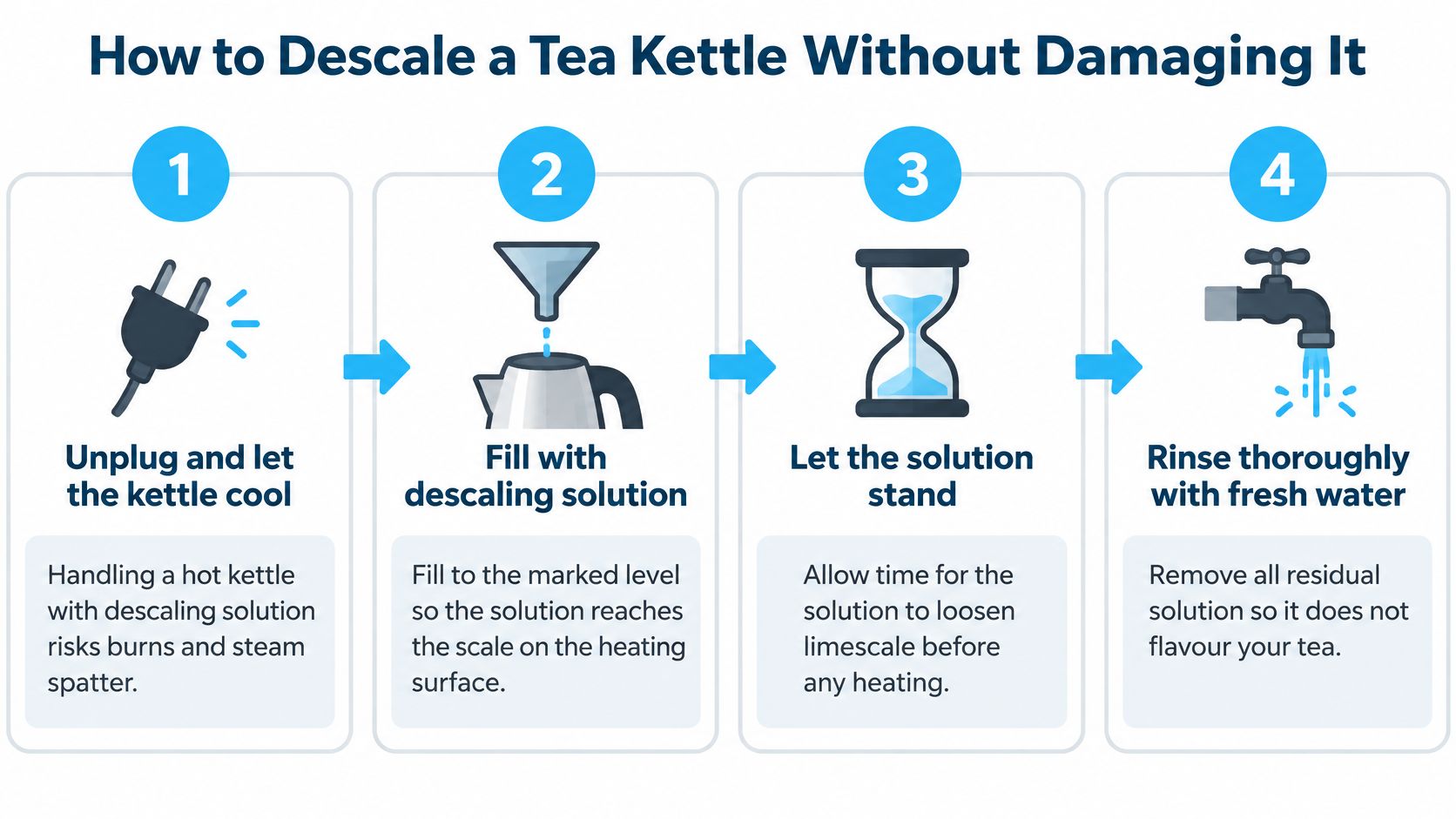
A safe descaling routine
- Unplug and cool the kettle. Keep the electrical base dry and away from the cleaning solution.
- Inspect the inside and removable parts. Check for mineral deposits, damaged coating or deteriorating components. Avoid vinegar and other acidic cleaners on coated interiors unless the maker specifically approves them.
- Choose a suitable descaler. For an uncoated interior, use diluted white vinegar or citric acid, following the product directions and the kettle's permitted fill level. Don't mix cleaning agents.
- Let the solution work. Follow the kettle maker's directions for contact time. Don't boil the solution unless the instructions specifically call for heating it.
- Empty and rinse thoroughly. Rinse the chamber, filter and lid area, then run fresh water through the kettle as directed. Repeat rinsing until no cleaner smell or taste remains.
- Clean and reassemble. Follow the maker's guidance for removable filters, seals and other parts. Check that each piece is seated correctly before use.
Set a practical cleaning interval
There's no single schedule that suits every household. Check for visible scale and descale when deposits begin to collect or affect pouring, rather than waiting for flakes to appear in a drink. If the kettle maker specifies an interval, follow it.
A wide opening and removable filter make deposits easier to inspect and clean. Avoid abrasive pads, sharp tools and scraping, especially around coatings and seams.
If scale remains after a suitable treatment, or the kettle has a persistent odour, leak or damaged surface, stop using stronger cleaners and contact the manufacturer.
Choose Your Kettle by Tea Routine and Household
For a mixed tea cupboard, my default recommendation is a conventional variable-temperature electric kettle. Choose a gooseneck when controlled pouring is part of your routine, and a boil-only model when lower-temperature programmes would go unused.
The right choice should be obvious from ordinary use, not from a long list of features.
| Situation | Recommended kettle type | Specs to confirm |
|---|---|---|
| Solo condo resident drinking green and white tea | Compact variable-temperature electric kettle | A suitable low preset, certification, minimum fill and actual footprint |
| Couple or family making black and herbal tea | Family-capacity boil-only or variable-temperature kettle | Dependable full-boil operation, shut-off and readable volume markings |
| Pour-over or precise green-tea drinker | Variable-temperature gooseneck | Measured speed, preset spacing, temperature hold and pouring comfort |
| Renter preparing for possible boil-water advisories | Full-boil electric kettle, with a separately assessed backup | Advisory-compatible boiling method, suitable heat source and covered storage |
| Camper or cottager with unreliable power | Stainless stovetop kettle | Heat-source compatibility, capacity, handle safety and lid design |
Decide between close candidates
If both kettles meet your brewing needs, favour the one you can inspect, clean and obtain parts for. A slightly less elaborate control panel is a reasonable compromise for clearer documentation and accessible replacement components.
Think about how you drink after brewing, too. If the actual problem is tea cooling while you work, compare a suitable insulated drinking vessel or an electric mug warmer available in Canada rather than buying a kettle with a hold function you won't use.
Before checkout, make a final pass through the practical details:
- Documentation: Obtain the manual, certification details and water-contact disclosures for the exact model.
- Daily fit: Confirm minimum fill, lid access, usable capacity and counter clearance.
- Performance evidence: Look for a named model and a defined test quantity, rather than transferring another kettle's result to your shortlist.
- Canadian support: Check warranty terms, return conditions and availability of filters, seals or other service parts.
- Current cost: Compare the delivered CAD price on Amazon.ca with local retailers, including any shipping or cross-border complications.
Use the return window sensibly
After delivery, verify that the markings and model match what you ordered. Observe normal heating and pouring behaviour without bypassing safety features, and return a kettle that leaks, behaves unexpectedly or doesn't fit your permitted daily fill.
There's no need to buy the most elaborate appliance in the comparison. The best kettle for tea is the one that meets your brewing needs without compromising certification, disclosure or everyday usability.
Celmin publishes Canadian appliance reviews, practical buying guides and a weekly email brief covering new and updated articles. Visit its kettle coverage to compare trade-offs and check current CAD pricing and local availability before settling on your shortlist.
Sign up or sign in to join the conversation.