
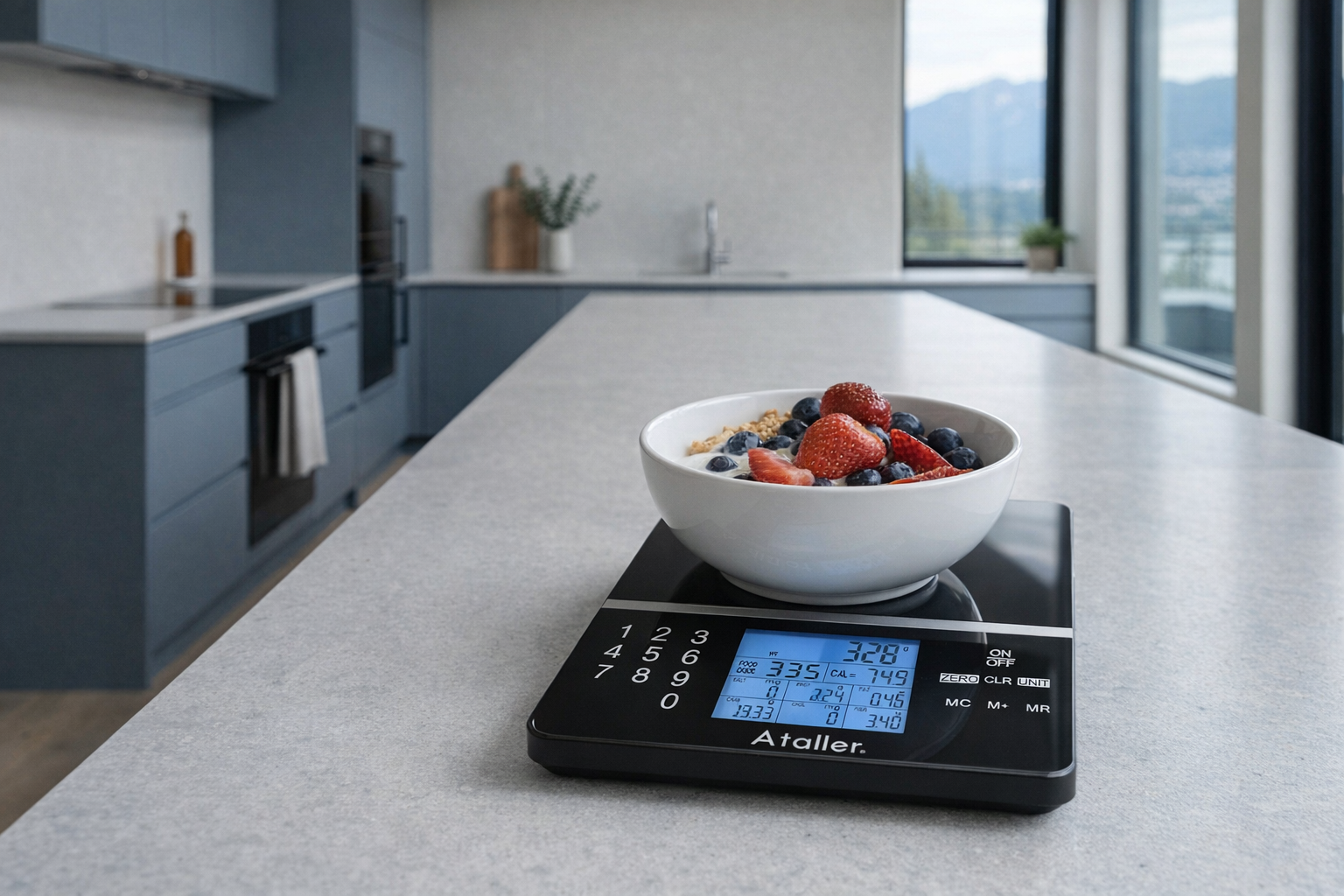
The Ataller Food Scale with Nutritional Calculator sits in a very practical corner of the smart-kitchen world: the low-cost digital scale that promises to do more than just tell you how many grams of oats are in your bowl. Products like this are aimed at people tracking calories, macros, port...
The Ataller Food Scale with Nutritional Calculator sits in a very practical corner of the smart-kitchen world: the low-cost digital scale that promises to do more than just tell you how many grams of oats are in your bowl. Products like this are aimed at people tracking calories, macros, portion sizes, or ingredient weights closely enough that a basic kitchen scale starts to feel a little too basic. It is not a flashy category. It is a discipline tool.
This article is not a hands-on review. Nothing here is based on personally using the scale. Instead, the goal is to explain what the Ataller Food Scale with Nutritional Calculator appears to be from its listing, what the “nutritional calculator” angle likely means in real life, and who it genuinely makes sense for. If you are deciding between a plain $15 scale and something with app-style ambitions for about $32.58 CAD, this is the calmer breakdown.
📺 Watch: Product demo video available on the retailer page.
Quick snapshot
| Question | What the Ataller Food Scale with Nutritional Calculator actually is |
|---|---|
| Category | Smart Kitchen |
| Made by | Ataller |
| Typical price | Pricing varies — check current Canadian listings |
| Rating signal | 4.3/5 on the source listing |
| Best for | Calorie trackers, macro-focused meal preppers, people replacing guesswork with measured portions |
| Skip if | You only bake occasionally, hate app-style setup, or just need a simple grams-and-ounces scale |
Pro tip: Buy this kind of scale for consistency, not for motivation. If you are not already the sort of person who weighs rice, chicken, coffee, or baking ingredients a few times a week, the nutritional-calculator feature will not magically make you start.
What the Ataller Food Scale with Nutritional Calculator actually is
In plain English, this is a digital kitchen scale aimed at people who want food weight plus an extra layer of dietary tracking. A normal scale answers one question: “How much does this weigh?” A nutritional scale tries to answer the follow-up: “And what does that mean for calories or nutrition?” That can be useful if you are logging meals, building repeatable portions, or trying to stop underestimating how much peanut butter, cereal, pasta, or cooking oil you are actually using.
That empty product description is worth noting. When a listing leans on a product name like “Food Scale with Nutritional Calculator” but offers little formal description text, you are relying more heavily on the title, retailer images, and whatever support materials exist on the page. That does not make it bad, but it does mean expectations should stay modest. Treat this as a budget smart scale, not as a clinically detailed nutrition system.
The most obvious real-world comparison is the Greater Goods Nutrition Food Scale, which is one of the better-known products in this niche. The Greater Goods model is built around nutrition lookup and portion tracking too, but it generally carries a stronger brand profile in this category. The Ataller alternative looks more like a value pick: lower price, similar promise, and likely best for buyers who want the concept without spending much. That is a fair lane to occupy, and for $32.58 CAD, it is a more accessible experiment than many branded nutrition scales.
Key features at a glance
- Digital kitchen scale format for weighing food portions and ingredients
- Nutritional-calculator positioning aimed at calorie or macro-conscious users
- Budget-friendly pricing compared with more established nutrition-scale brands
- Useful for meal prep, dieting, and portion control where exact weight matters
- Likely better than eyeballing servings for foods that are easy to underestimate
- Compact countertop tool that fits a kitchen, pantry shelf, or meal-prep station
How the Ataller Food Scale with Nutritional Calculator actually works
At the simplest level, a product like this uses a load sensor to measure the weight of whatever you place on its platform. That is the same basic principle as an ordinary digital kitchen scale. Where the Ataller Food Scale with Nutritional Calculator tries to distinguish itself is in the nutrition side: the idea that once the scale knows how much food is present, it can help translate that into something more meaningful than just a raw number in grams.
There are two common ways products in this category handle that. The first is an onboard nutrition database or food-code system, where you select a food item and the scale uses the measured weight to estimate calories, protein, carbs, fat, sodium, or similar values. The second is a looser “calculator” interpretation, where the scale gives you accurate weight and you pair that with manual tracking habits. Because the supplied listing data does not include detailed feature text, it is safest to say the product is marketed around nutritional calculation without assuming how deep that database goes. Check the current retailer page carefully before buying if that specific function is the whole reason you want it.
In practical use, the workflow is usually straightforward:
- Place a bowl, plate, or container on the scale.
- Tare or zero it out so the container weight does not count.
- Add the food until you hit the portion or recipe amount you want.
- Use the nutritional-calculator function if available for that item, or log the measured weight in your preferred app.
That last step is where reality matters. Even with nutrition-aware scales, the output is only as helpful as the food matching. Packaged foods with exact label data are easier. Homemade chili, mixed salads, marinated meats, and restaurant leftovers are much messier. That is not a flaw unique to Ataller; it is just the honest limitation of the category.
A realistic "day in the life" with Ataller Food Scale with Nutritional Calculator
Because this is an informational piece, here is what a typical day might look like based on the product category and listing signals, not on direct testing.
- Morning. You set a bowl on the scale, tare it to zero, and portion cereal or oatmeal by weight instead of by guesswork. That matters because “one serving” is usually smaller than people assume, and breakfast is where small errors can add up fast.
- Midday. While meal prepping lunch, you weigh cooked rice, grilled chicken, or salad toppings so each container is roughly the same. This is probably the scale’s most realistic strength: repeatable portions, not nutrition wizardry.
- Afternoon. You make a smoothie or a high-protein snack and weigh ingredients like yogurt, berries, or nut butter. For foods like peanut butter, a scale is far more honest than a spoon, which is exactly why people who count calories end up buying one.
- Evening. You use it for dinner prep or basic baking, measuring flour, vegetables, pasta, or meat portions. Even if you barely touch any nutrition function, accurate weight alone can make recipes more consistent and portions more predictable.
Who the Ataller Food Scale with Nutritional Calculator is actually for (and who it isn't)
Great fits
- People actively counting calories or macros in an app like MyFitnessPal, Cronometer, or Lose It, where exact food weight matters more than visual guesses.
- Meal preppers who make four or five lunches at once and want each container to be reasonably uniform.
- Beginners starting a weight-loss or fitness routine who have realized that “a tablespoon” and “a handful” are not reliable measurement systems.
- Home cooks who also bake occasionally and would benefit from a digital scale even if the nutrition angle ends up being secondary.
- Anyone replacing a cheap, inconsistent scale with something that at least aims to add nutritional context.
Poor fits
- People who cook intuitively and do not want to measure anything. This will feel like friction, not help.
- Occasional bakers who only need grams for flour once a month; a simpler basic scale would probably do.
- Buyers expecting medical-grade dietary precision for diabetes management, clinical meal planning, or tightly regulated nutrition programs.
- Anyone who dislikes setup, buttons, or food-database lookup. If you will not use the extra function, do not pay extra for it.
- Households mainly wanting a premium countertop appliance. This is a utility gadget, not a design object.
Practical trade-offs
Nutrition data is only as good as the food matching
This is the biggest honest caveat with any nutritional scale. Weight is objective; nutrition lookup is not always objective. If you are weighing plain oats, chicken breast, or rice, things are relatively straightforward. If you are weighing homemade lasagna or a leftover stir-fry, the scale cannot magically know the exact oil, sauce, or ingredient proportions. Evaluate the nutritional-calculator feature like a helpful shortcut, not like a lab instrument.
It may be more effort than a normal kitchen scale
A plain scale is simple: set it down, weigh, done. A nutrition-oriented scale can add button presses, codes, or food-selection steps depending on how it is designed. For some people, that structure is useful because it builds better habits. For others, it is enough annoyance that the scale ends up in a drawer after two weeks. That is a more honest risk than many listings admit.
Long-term usefulness depends on your habits, not the hardware
At around $32.58 CAD, the financial risk is not huge, but even cheap gadgets can become clutter fast. The hardware itself may be perfectly adequate, yet still go unused if you are not someone who benefits from measuring portions regularly. The best use case is not “I want a smarter kitchen.” It is “I already care about portion accuracy enough that this solves a recurring problem.”
Where the Ataller Food Scale with Nutritional Calculator fits in a modern kitchen
This scale makes the most sense as part of a meal-planning and nutrition-tracking setup, not as a standalone smart-kitchen centrepiece. In a practical kitchen, it would sit alongside:
- A calorie or macro app such as MyFitnessPal or Cronometer
- Glass meal-prep containers for repeatable lunch portions
- A basic air fryer, rice cooker, or Instant Pot for batch cooking proteins and grains
- A regular measuring cup and spoon set for quick cooking tasks where precision matters less
That is the right context for it. It does not replace your oven, blender, or countertop ecosystem. It supports a very specific workflow: weigh, portion, log, repeat. If you already use Apple Health, Google Fit, or a smartwatch for broader health tracking, a food scale like this can be one small input into that routine. Just do not expect deep ecosystem integration from a budget kitchen scale unless the listing clearly says so.
In other words, this is closer to a fitness accessory that lives in the kitchen than to a “smart home” device in the usual sense. That distinction matters. It is not trying to automate cooking. It is trying to reduce self-deception.
The buying decision, in plain terms
Before buying the Ataller Food Scale with Nutritional Calculator, three yes-or-no questions usually get you to the right answer:
- Do you already weigh food, or genuinely plan to start? If yes, this could be useful. If no, the extra nutrition branding probably will not change your habits.
- Do you want exact portions more than you want convenience? A scale helps when precision matters, but it always adds one more step to cooking and eating.
- Would a basic digital scale be enough? If all you need is grams for baking or coffee, a simpler model may be the smarter buy.
If you answer yes to the first two and no to the third, the Ataller Food Scale with Nutritional Calculator looks like a sensible low-cost buy. If not, keep your money and get a plain scale instead.
Got Questions About the Ataller Food Scale with Nutritional Calculator? Let's Clear Things Up.
Is this a hands-on review?
No. This is an informational explainer based on the product listing, pricing, and the broader nutrition-scale category. It is meant to help you decide whether the product type fits your routine, not to substitute for direct testing.
What does the “nutritional calculator” part likely mean?
It usually means the scale is marketed to help translate food weight into calorie or nutrition information, either through an onboard function or a structured tracking workflow. Because the supplied listing data does not spell out the exact method, you should verify on the retailer page whether it uses food codes, a database, or a simpler calculator-style approach.
Is this better than a regular kitchen scale?
Only if you will actually use the nutrition side. For baking, coffee, and general cooking, a regular digital scale often does the job just fine. The Ataller model makes more sense for portion control, calorie tracking, and repeatable meal prep than for casual kitchen use.
Is it useful for weight loss or fitness goals?
Potentially, yes. A food scale is one of the simplest ways to make calorie tracking more honest, especially for calorie-dense foods like nuts, oils, cereal, pasta, and spreads. The key is consistency: the scale helps most when it becomes part of a routine rather than a short burst of motivation.
What should buyers verify before ordering?
Check whether the nutritional-calculator function is fully onboard, requires manual food selection, or is limited in some way. Also look for current photos, operating instructions, and any mention of units, database support, or battery details on the retailer page. With lightly documented products, those details matter more than the headline name.
Where can I verify the listing or buy it?
The most direct place to verify current pricing, availability, images, and listing details is the Amazon product page here. That is also where you should confirm whether the nutritional features shown today match what you expect, since listings can change over time.
What does it cost in Canada?
At the time of writing, the listed price provided for this article is $32.58 CAD. In the snapshot above, the pricing cell is intentionally broader — Pricing varies — check current Canadian listings — because marketplace pricing can move around quickly.
Where is the Celmin Directory listing for this product?
For a catalog-style view of the same product — structured specs, pros and cons, similar picks, and FAQ — see Ataller Food Scale with Nutritional Calculator on Celmin Directory.
If you're building a smarter home in Canada and want honest explainers on gadgets worth considering — plus the ones worth skipping — Celmin covers the full catalog without the marketing theater. More reviews, comparisons, and buyer guides at https://celmin.ca.
Discussion
Sign up or sign in to join the conversation.