
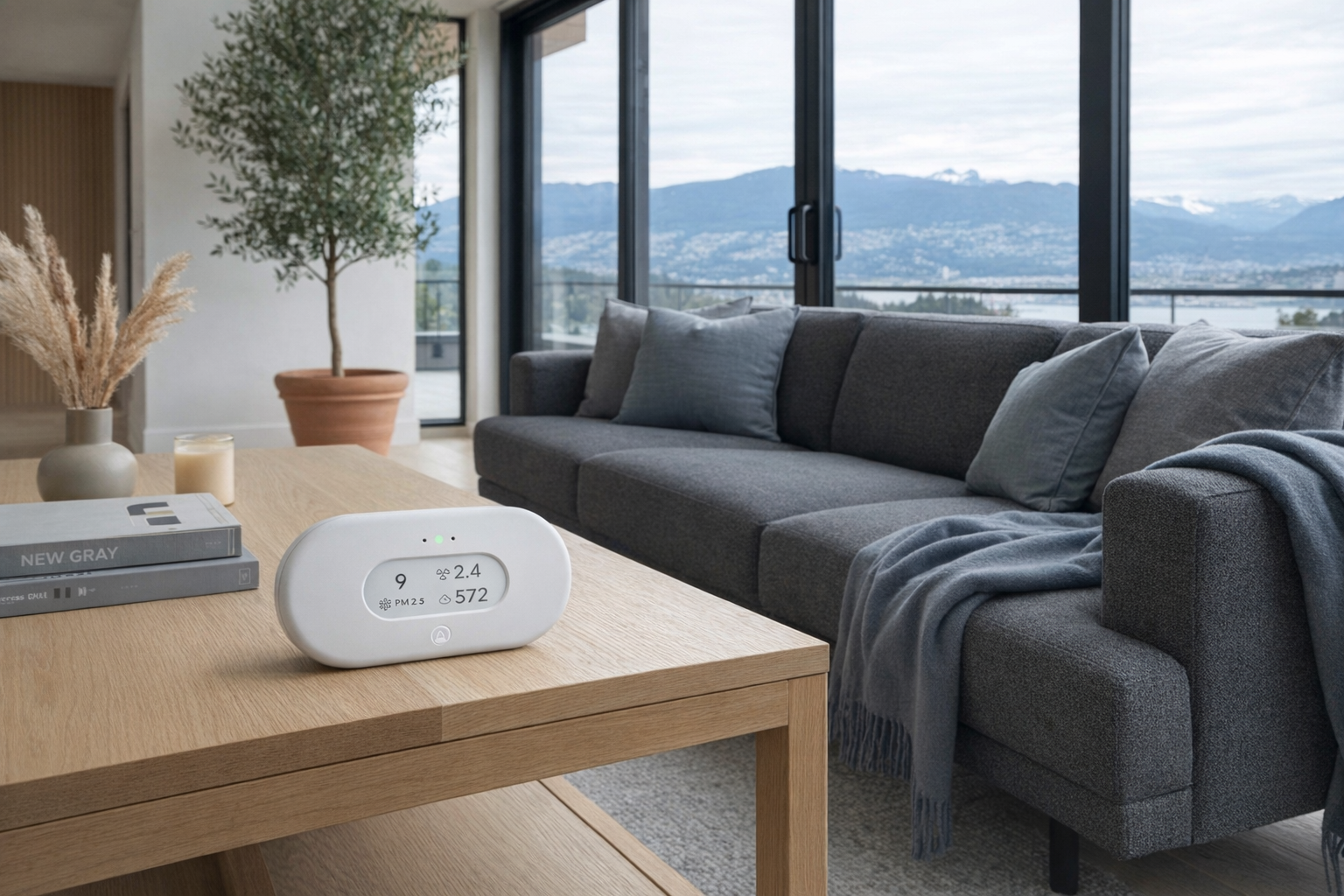
The AirThings View Plus Air Quality Monitor sits in a more serious corner of the smart-home world than most people expect. This is not an air purifier, not a thermostat, and not a decorative little sensor you buy just to populate an app dashboard. It is a wall-mountable indoor air monitor aim...
The AirThings View Plus Air Quality Monitor sits in a more serious corner of the smart-home world than most people expect. This is not an air purifier, not a thermostat, and not a decorative little sensor you buy just to populate an app dashboard. It is a wall-mountable indoor air monitor aimed at the stuff that is easy to ignore because you cannot see it: radon, carbon dioxide (CO2), and volatile organic compounds (VOCs), along with the usual temperature and humidity context. For a lot of homes, especially tighter newer builds and long-heating-season houses, that makes it more useful than many flashier gadgets.
This article is not a hands-on review. Nothing here is based on personally testing the device. Instead, the goal is to explain what the AirThings View Plus Air Quality Monitor actually is, what these air-quality measurements mean in plain English, and who it makes sense for — using the product listing as the lens, plus what is broadly known about indoor air quality. If you are trying to decide whether a roughly $390 CAD monitor is overkill or quietly sensible, this is the calmer breakdown.
Quick snapshot
| Question | What the AirThings View Plus Air Quality Monitor actually is |
|---|---|
| Category | Climate & Comfort |
| Made by | Airthings |
| Typical price | ~$390 CAD (listing at the time of writing — verify current pricing) |
| Rating signal | 4.1/5 on the source listing |
| Best for | Homeowners concerned about radon, families in airtight homes, basement monitoring, data-minded indoor air tracking |
| Skip if | You only want a basic temperature/humidity sensor, or you are not going to act on the readings |
Pro tip: If you buy the AirThings View Plus Air Quality Monitor, put it where people actually spend time breathing for long stretches — not beside a window, not over a vent, and not only in a hallway. For many homes, that means a basement family room, bedroom, or main living area, depending on what concern you are trying to track.
What the AirThings View Plus Air Quality Monitor actually is
In plain English, the AirThings View Plus Air Quality Monitor is a connected indoor air monitor built to answer a more uncomfortable question than most smart-home gear does: what is the air in your home actually like over time? It is meant to sit there continuously, collect data, and show you trends rather than quick one-off readings. That matters because the biggest headline feature here is radon, and radon is not something you judge from a ten-minute spot check. It is a long-term exposure issue.
"""
"""
The empty listing description is a bit telling in itself. This is one of those products where the headline matters more than the marketing poetry: if you are looking at View Plus, you are almost certainly here because you care about radon, indoor ventilation, or a room that always feels stuffy. Compared with a simpler sibling like the Airthings Wave Mini, the View Plus is the more complete health-focused option. The Wave Mini is a cheaper way to keep an eye on basic indoor air concerns, but it is not the same thing if radon is the real reason you are shopping. That makes View Plus the more relevant model for homeowners, especially in basements and lower floors.
Key features at a glance
- Radon monitoring for long-term indoor exposure awareness
- CO2 tracking to reveal stuffy, under-ventilated rooms
- VOC monitoring to flag emissions from paints, cleaners, furniture, and everyday household products
- Temperature and humidity tracking for comfort and mould-risk context
- Connected monitoring and trend viewing rather than a one-time test
- Designed for indoor placement where air-quality patterns actually develop over days and weeks
How the AirThings View Plus Air Quality Monitor actually works
The basic idea is straightforward: the AirThings View Plus Air Quality Monitor stays in one place and samples indoor air over time, then surfaces those results through the device itself and its app ecosystem. That "over time" part is the real point. Air quality is messy. Open a window, cook dinner, run a shower, paint a shelf, host four guests in a small room, and the readings can all move for different reasons. A monitor like this is meant to help sort those causes out.
There are three measurements here that matter most for real households:
- Radon. Radon is a naturally occurring radioactive gas that can enter homes from the ground, especially through foundations, slab cracks, sump pits, and other openings. You cannot smell or see it. In colder climates where windows stay shut for much of the year, radon can become a bigger concern simply because the house is closed up for longer periods. This is one reason the product makes sense as more than a niche gadget.
- CO2. Carbon dioxide indoors is not usually the Hollywood-style danger people imagine, but it is a very useful proxy for ventilation. When CO2 rises in a bedroom overnight or a home office during the workday, it usually means the room is not getting enough fresh air relative to the number of people in it.
- VOCs. Volatile organic compounds come from all sorts of normal household sources: cleaning sprays, fresh paint, new furniture, flooring adhesives, candles, cooking fumes, and more. VOC readings are best understood as a clue that something in the room is off-gassing or that ventilation is poor.
This also explains why the View Plus is better evaluated like a smoke alarm crossed with a weather station, not like a flashy smart display. The usefulness is not in staring at the numbers all day. The usefulness is in patterns. If radon trends high in the basement, that is actionable. If CO2 spikes every night in a closed bedroom, that is actionable. If VOCs jump every time a certain cleaner comes out, that is actionable too. That's a more honest use case than many smart-home products promise.
And because this is a connected monitor, it fits into a broader habit of checking the app periodically rather than waiting for a dramatic alert. Indoor air is rarely one big event; it is a long series of small exposures and room conditions that add up.
A realistic "day in the life" with AirThings View Plus Air Quality Monitor
Here is what a typical day might look like based on the listed category and the known purpose of this kind of monitor — not a tested account.
- Morning. You check the bedroom or basement reading after the house has been closed up overnight. If CO2 has climbed, that points to stale air and weak ventilation. If humidity is elevated too, the room may simply need better airflow as much as any new gadget.
- Midday. Someone is working from home in a small office with the door shut. The AirThings View Plus Air Quality Monitor helps show whether the room gets progressively stuffier as the day goes on, which is exactly the kind of issue people often blame on "feeling tired" without realizing ventilation is part of it.
- Afternoon. A cleaning session, a DIY project, or unpacking new furniture can push VOC readings up. That does not automatically mean disaster, but it can confirm that the room needs open windows or more active air exchange.
- Evening. Over the long run, the most important check is not the evening reading itself but the rolling trend line for radon. If the basement or ground floor stays elevated day after day, the device has done its real job: it has shown you there is a problem worth addressing properly.
Who the AirThings View Plus Air Quality Monitor is actually for (and who it isn't)
Great fits
- Homeowners with a basement they actually use, especially as a family room, office, or bedroom. Radon risk matters more when the lower level is occupied regularly.
- People in newer, tighter homes where energy efficiency is good but fresh-air exchange can be weaker than expected.
- Parents of kids with allergies or sensitivity to stuffy rooms, who want more than guesswork before buying more fans or purifiers.
- Data-minded homeowners who like seeing trends and making practical changes based on evidence rather than vibes.
- Anyone buying or renovating a house and wanting a clearer picture of whether air quality and ventilation need attention.
Poor fits
- Renters who cannot act on the findings. If a high radon reading would leave you with no real path to mitigation, the value gets murkier.
- People who only want a comfort gadget. If all you need is temperature and humidity, there are much cheaper monitors than a roughly $389.75 unit.
- Shoppers expecting it to clean the air itself. This is a measurement device, not a purifier, HRV, or dehumidifier.
- Anyone who will obsess over every small fluctuation. Air quality moves around; the product is most useful to people who can think in trends, not panic at every bump.
- Households wanting a totally app-free setup. A connected monitor makes the most sense when you are willing to check history and alerts digitally.
Practical trade-offs
Radon is the headline, but radon is slow
The most important practical trade-off is psychological: radon monitoring is not instantly satisfying. If your expectation is immediate "good" or "bad" certainty, this category can feel frustrating. Radon decisions are better made from longer-term patterns, not a single glance after setup. That makes the View Plus more useful than a one-time disposable test in some households, but it also demands patience.
This is worth emphasizing because radon is one of the few indoor air issues that genuinely changes the value equation. Temperature and humidity are convenience metrics. Radon is a health metric. If that is your real concern, the AirThings View Plus Air Quality Monitor makes more sense than a generic indoor sensor.
Placement matters more than people think
Indoor air monitors are only as useful as their placement. Put one beside a drafty window, directly above a vent, next to a bathroom door, or in a room nobody uses, and the numbers can be technically real but practically misleading. A basement utility corner may not tell you much about the basement rec room where people spend 2 to 4 hours at a stretch.
For this product, placement is especially important because radon can vary meaningfully between floors. A reading on an upper level does not always tell you what is happening near the foundation. If you care about the lowest occupied level of the home, monitor there first. That is the more honest approach.
Monitoring is only half the job
This is the classic trade-off with all environmental sensors: reading a problem is not the same as solving it. If CO2 is high, you may need better ventilation habits, an HRV/ERV strategy, or changes to how a room is used. If VOCs are persistently elevated, you may need to identify the source. If radon is high, proper mitigation can mean calling a specialist, not shopping for another smart device.
So evaluate the View Plus like a diagnostic tool, not a fix. That is not a criticism. It is exactly what a good monitor should be. But it does mean the product is best for people prepared to take the next step when the data points in an inconvenient direction.
Where the AirThings View Plus Air Quality Monitor fits in a smart home
This is not the centre of a smart home. It is the quiet environmental truth-teller sitting off to the side while other systems do the active work.
A realistic setup looks something like this:
- AirThings View Plus Air Quality Monitor tracks radon, CO2, VOCs, temperature, and humidity.
- An air purifier from a brand like Blueair, Coway, or Levoit handles particulates in occupied rooms.
- A dehumidifier helps keep damp basements under control when humidity is the bigger problem.
- An HRV or ERV improves fresh-air exchange in tighter homes where CO2 trends high.
- A smart thermostat such as Ecobee or Nest manages comfort, but does not replace actual air-quality insight.
- A radon mitigation system, if needed, solves the serious part that no app can solve for you.
That is where the View Plus makes sense: not as a gadget you buy instead of fixing your house, but as the monitor that tells you which fix may actually be worth doing. In that role, it is more practical than many smart-home toys because it points to building-health decisions rather than screen time.
The buying decision, in plain terms
Before buying, three simple questions usually surface the right answer.
- Are you specifically concerned about radon, basement air, or poor ventilation? If yes, the AirThings View Plus Air Quality Monitor is much easier to justify. If no, a cheaper temperature/humidity sensor may cover what you actually need.
- Will you act on the data? If a high reading would push you to ventilate differently, move a monitor, add a dehumidifier, or investigate mitigation, then the device has a job. If you only want reassurance, the price may feel steep.
- Do you want trends, not one-off checks? This product makes the most sense for ongoing monitoring. If you just want a single snapshot, a simpler test approach may be enough.
If those answers are mostly yes, this is a sensible buy for the right home — especially one with a basement and long closed-window seasons.
Got Questions About the AirThings View Plus Air Quality Monitor? Let's Clear Things Up.
Is this a hands-on review?
No. This is an informational explainer based on the product listing, the known purpose of the device category, and broader indoor-air-quality context. It is meant to help you decide whether this type of monitor fits your home, not to stand in for a lab test or long-term product trial.
What exactly does the AirThings View Plus Air Quality Monitor measure?
The key draw is that it is positioned as an indoor air monitor for radon, CO2, and VOC awareness, with temperature and humidity context also part of the overall picture. In practice, that means it is aimed at both health concerns and comfort clues, rather than just acting as a room thermometer.
Why is radon such a big deal in homes?
Radon is a naturally occurring gas that can enter homes from the ground and build up indoors over time, particularly in lower levels. You cannot smell or see it, which is exactly why monitoring matters. In homes that stay closed up for long stretches during colder months, it is sensible to pay attention rather than assume everything is fine.
Does this replace an air purifier or dehumidifier?
No. The AirThings View Plus Air Quality Monitor tells you what the air is doing; it does not clean, dry, or ventilate the air itself. Think of it as the diagnostic layer that helps you decide whether a purifier, dehumidifier, ventilation change, or professional radon mitigation might actually be necessary.
Where should you put it?
In the room that matches your concern. If radon is the main issue, the lowest occupied level of the home is usually the most relevant place to start. If CO2 and stuffiness are your concern, a bedroom or home office may be more informative than a hallway.
Where can you verify the current listing or buy it?
The most direct place to verify the current product page, pricing, and buyer feedback is the retailer listing here: AirThings View Plus Air Quality Monitor on Amazon. Because connected-product listings can change, it is worth checking the latest details before buying.
What does it cost in Canada?
At the time of writing, the listing price is about ~$390 CAD. More specifically, the supplied listing price is $389.75 CAD, but it is always worth confirming the current total on the retailer page, especially for imported smart-home devices where pricing can drift.
Where is the Celmin Directory listing for this product?
For a catalog-style view of the same product — structured specs, pros and cons, similar picks, and FAQ — see AirThings View Plus Air Quality Monitor on Celmin Directory.
If you're building a smarter home in Canada and want honest explainers on gadgets worth considering — plus the ones worth skipping — Celmin covers the full catalog without the marketing theater. More reviews, comparisons, and buyer guides at https://celmin.ca.
Discussion
Sign up or sign in to join the conversation.