
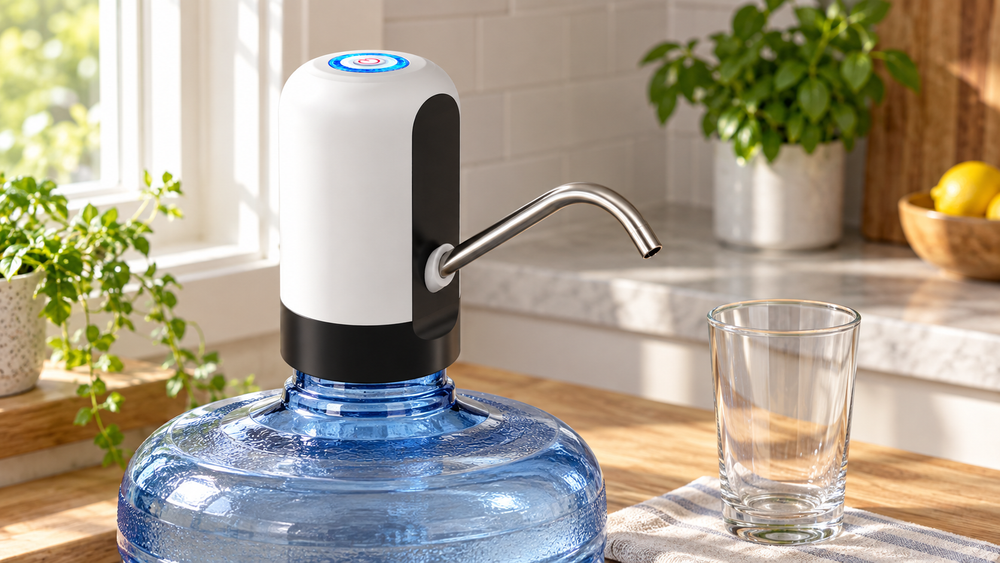
Check the Swardroof 012SB-1’s jug fit, USB-C charging, folding spout and timed versus continuous dispensing before buying.
The Swardroof 012SB-1 sits on an upright water jug and pumps water through a folding spout. It saves tilting a heavy jug to pour a glass. It does not remove the need to move the next full jug into place.
USB-C charging and a foldable outlet are useful conveniences. Two less obvious details deserve attention first: whether it fits your bottle, and the difference between a short and long button press.
A simpler pour, with a few setup decisions
The Swardroof is designed around an upright bottle. That can make filling a glass easier than repeatedly lifting and tipping a heavy jug. The benefit is most obvious when the bottle has a stable everyday location and the outlet is at a comfortable height.
It does not remove every physical task. Someone still needs to bring a full bottle into place, prepare it for the pump and handle the tubing during changes. If heavy bottle changes are the main difficulty, think through that part of the routine before expecting the pump alone to solve it.
Choose a position that lets you see the water level in the vessel. A low floor position may mean bending for every pour; a raised position needs a surface appropriate for the full bottle's weight and a secure arrangement. Do not use an unstable stand simply to bring the spout closer.
Keep the outlet away from electrical items and give yourself room to hold the usual glass, mug or reusable bottle. A convenient button is only part of an easy pour. Cup clearance and a view of the rising water matter just as much.
Bottle fit is a complete assembly
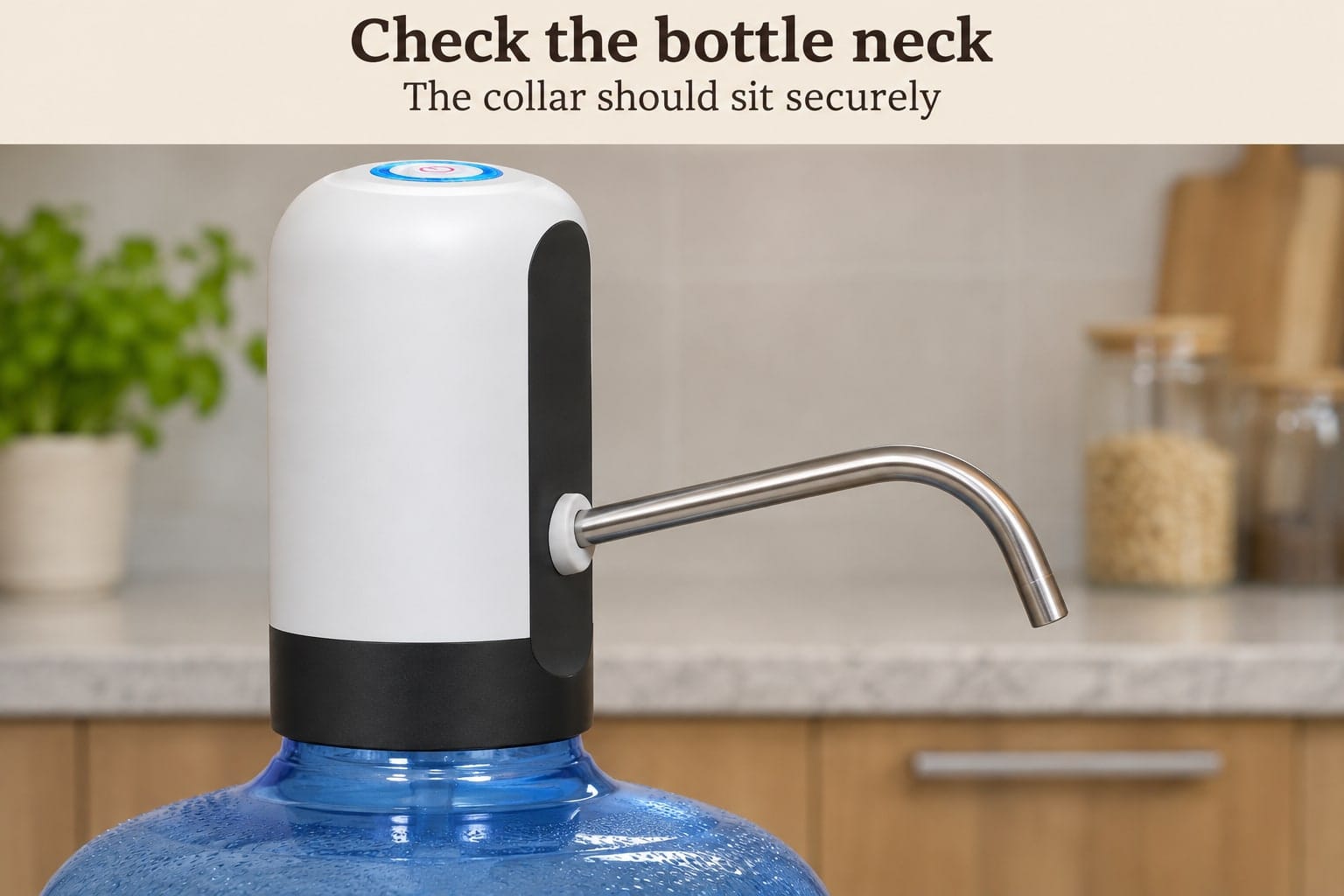
The pump, neck or cap arrangement and intake tube need to work together. Ask the seller about the exact bottle you use, including its opening and cap style. A broad gallon-size claim cannot establish how securely the pump will sit on every container of that volume.
Find out whether installation uses an existing cap opening, an adapter or another specified fitting. Do not cut or modify parts unless the product instructions explicitly call for it. A loose pump that happens to move water is not a satisfactory fit.
Check the intake tube's intended length and placement. It needs to reach as instructed without an improvised connection. Avoid assuming that a generic replacement tube is suitable for drinking-water contact or compatible with the pump merely because its outside diameter looks similar.
If the fit cannot be explained clearly before purchase, wait for that answer. USB-C charging and a folding spout are secondary advantages when the basic bottle connection is uncertain.
Jug capacity does not establish fit
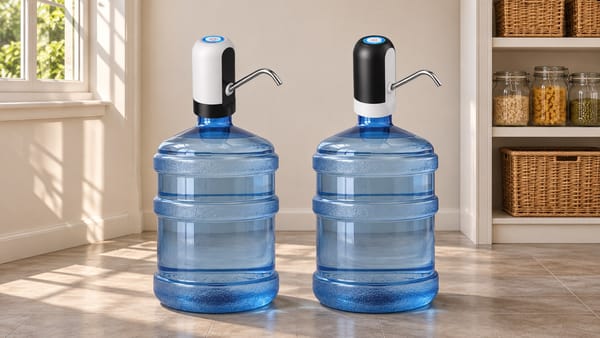
The seller advertises compatibility with common 3-, 3.5- and 5-gallon bottles. The part the pump actually grips is the neck. Two containers with similar volume can have different openings or caps.
Measure your jug’s opening and ask how the pump attaches to that neck. Confirm whether part of the cap stays in place, whether an adapter is needed and whether one is included. The intake tube must also fit and reach as instructed.
Do not improvise a loose installation just because the tube reaches the water. Put the jug somewhere stable, where you can hold a glass below the outlet and see it filling.
Swardroof 012SB-1 water pump
 Shop at Amazon.ca
Set up the first pour deliberately
Read the assembly and cleaning instructions before use, then install the clean components as directed. Put the bottle in its intended stable position and keep charging equipment away from the dispensing area. Inspect the connections and confirm that the spout is in its operating position.
Use a suitable container and stay beside the pump while learning the controls. Practise starting and stopping a normal pour before relying on the automatic time limit. The relevant skill is stopping at the desired fill level, not waiting to see how much a timed cycle produces.
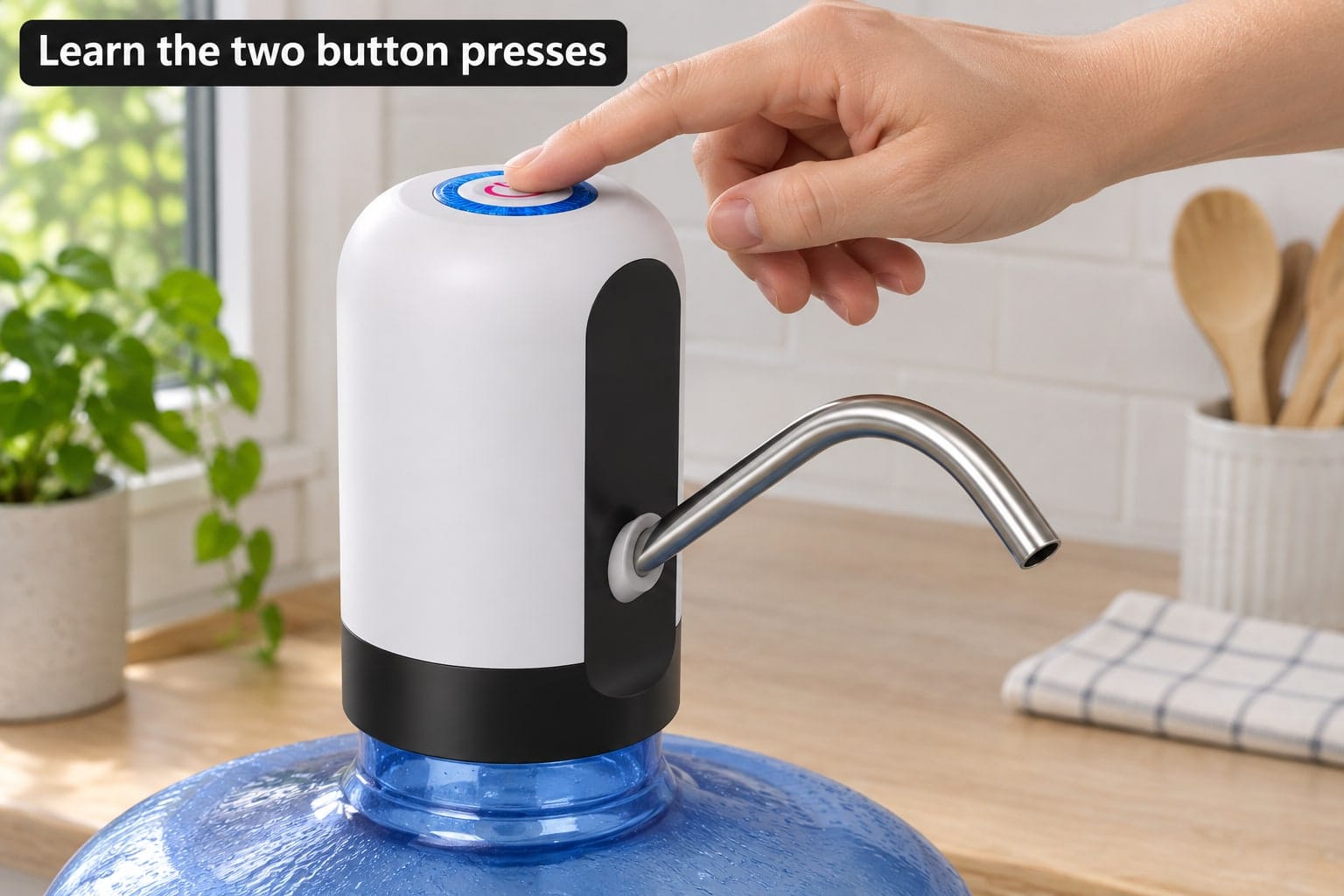
Show other users the difference between a short press and the longer press that selects continuous operation. In a shared kitchen or office, do not assume the next person understands that distinction. A simple demonstration can prevent a mode-selection mistake.
Keep the receiving vessel clear of the outlet. You should be able to fill it without pressing its rim against the spout or obscuring the water level. If that is awkward with your favourite bottle, reconsider the placement rather than balancing it in an unstable position.
A useful routine for shared use
Keep the dispensing area clear enough that a person can approach, hold a container and reach the stop control easily. Do not leave a filling vessel unattended because the pump has a timer. Smaller glasses can overflow before the time limit is reached, and continuous mode removes that limit altogether.
Make one person responsible for the bottle-change and cleaning routine in a shared space, or agree clearly on how it is handled. A small dispenser still has water-contact components that need care. Convenience can make it easy to forget the tube and outlet between bottle changes.
For children or anyone unfamiliar with the control, provide appropriate supervision and instruction. One-button operation does not mean the pump can detect a full glass, sense a spill or choose a safe stopping point on its own.
The timer does not know when the glass is full
In normal operation, a short press starts dispensing and the pump is advertised to stop within about a minute. You can press again to stop sooner. A small glass may fill long before the timer ends.
A hold of more than three seconds selects continuous operation without that automatic stop. That is worth demonstrating to everyone who will use it. Someone expecting a timed pour should not accidentally choose the mode that keeps running.
Stay with the container and stop at the desired level. This is not a calibrated measured-dose dispenser.
Bottle changes are part of the hygiene routine
Prepare a clean place for the components before removing the pump. Keep the intake end from touching the floor, bin or other dirty surfaces while changing bottles. Follow the manufacturer's cleaning method for the tube, outlet and connections rather than improvising a recipe intended for a large cooler tank.
Ask which components can be removed, washed or replaced and how they should be dried. Keep water away from the electronics according to the instructions. A folding spout can be convenient for storage, but folding it does not remove residue or clean the joint.
Use suitable drinking water from a safe source. The Swardroof does not change the water's quality through filtration or disinfection, and it does not make an unsafe supply drinkable. A clean-looking outlet is not evidence that the water or the entire contact path is safe.
If the water develops an unusual smell, taste or appearance, do not assume running more through the pump will solve it. Stop using the affected setup and investigate the water source and components using appropriate guidance.
Folding the spout does not clean it
The folding outlet may make storage or packing easier, but water-contact parts still need proper cleaning. Get the model’s instructions for the tube, outlet and connections before use.
During a bottle change, keep the intake end off the floor and other dirty surfaces. Avoid touching a drinking vessel to the outlet. Health Canada’s bottled-water guidance discusses handling and dispenser hygiene, but use Swardroof’s own directions for cleaning its components.
The pump does not filter, chill or disinfect water. Start with suitable drinking water and keep the path through the dispenser clean.
Charging and taking it away from home
USB-C can simplify the cable collection if you already use that connector, but check the required input rather than assuming every charger is suitable. Charge in a dry location and keep the port protected from splashes. Battery capacity does not provide a dependable litres-per-charge prediction by itself.
For a trip, plan how you will transport clean tubing and keep it separate from dirty equipment. Follow the drying and storage instructions before packing. The folded spout may reduce projection, but it is not proof of a leakproof travel assembly or outdoor weather resistance.
At the destination, the same fit and stability questions apply. A different jug may have a different neck even when its stated capacity is familiar. Confirm the container before depending on the pump as the only convenient way to dispense water.
Is the Swardroof the right fit?
It is most relevant when you want easier pours from a compatible bottle that can remain upright in a suitable location. USB-C charging and the folding outlet are useful conveniences after the fit, care instructions and controls are settled.
It is less relevant if you expect chilled water, filtration, a measured dose or unattended filling. Those are different functions. The pump's value is simpler dispensing, with the user still responsible for the water source, clean components and stopping the pour.
Before ordering, get clear answers about bottle attachment, replacement tubing, charging input and cleaning. Those ordinary details determine whether the Swardroof becomes a convenient part of the kitchen or another accessory that needs a workaround every time the bottle changes.
Charge and store it somewhere dry
The pump has a 1,200 mAh battery and USB-C charging. Capacity alone does not tell you how many jugs it will empty between charges. Follow the input requirements and keep the charging port away from splashes.
For travel, check the permitted storage and operating conditions. A camping photograph is not a waterproofing specification. Protect clean tubing during transport and follow the drying instructions before packing the pump away.
The Swardroof is worth considering if you want easier dispensing from a compatible upright jug. Confirm the neck fit and cleaning instructions first, then make sure the button modes suit the people using it. Those checks matter more than a claim about how many bottles one charge might last.
Swardroof 012SB-1 water pump
Shop at Amazon.caImages are AI-generated illustrations based on product references.


Sign up or sign in to join the conversation.